What the Asian Games represent
The Asian Games are Asia’s leading multi-sport competition and are widely recognised as the world’s second-largest multi-sport event after the Olympic Games. The Olympic Council of Asia itself has used this description. The comparison expresses the Games’ scale and importance, although the precise relationship with the Olympics varies according to the edition and the measure being compared. [3]
The 20th edition took place in Aichi Prefecture and Nagoya, Japan, from 19 September to 4 October 2026. The OCA’s published programme listed 43 sports, 71 disciplines and 469 events, bringing together competitors from across the continent. Such breadth gives the Games a distinct identity, combining internationally prominent sports with disciplines that have particular significance within Asia. [4]
The Games provide athletes with a demanding continental benchmark and give national sporting systems a public test of their effectiveness. For countries, performance can reveal where coaching, facilities and competitive experience are producing results and where development remains uneven. For audiences, the event brings attention to athletes and disciplines that may receive limited recognition between major competitions.
Their meaning also extends beyond medals. Countries with different languages, histories and economic circumstances meet within a common sporting framework. India’s relationship with this platform began at its foundation: New Delhi hosted the inaugural Games in 1951. The 2026 edition therefore marked 75 years of a competition that India helped establish. [5]
India’s trajectory across generations
India’s early record was strong, with second place and 51 medals at New Delhi in 1951, followed by third place at Jakarta in 1962. Later decades were less consistent. The 57-medal performance at the 1982 New Delhi Games was followed by a difficult period, including just one gold and 23 medals at Beijing in 1990. [5]
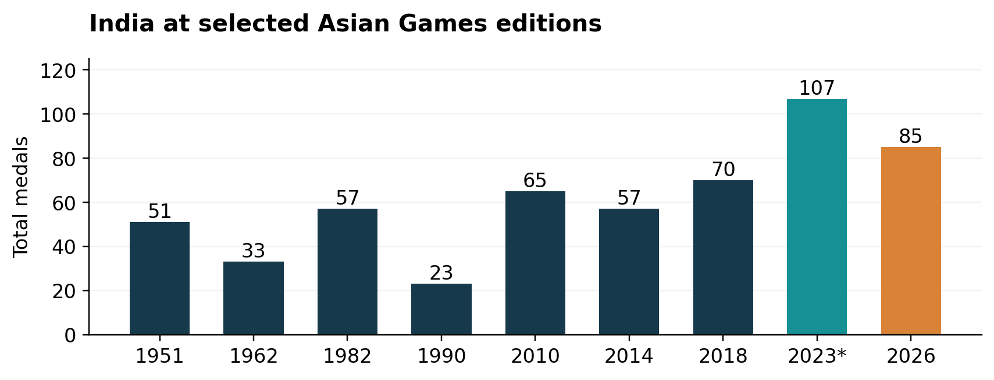
Figure 1. Selected editions show an uneven long-term rise. *The Hangzhou 2022 edition was held in 2023. Sources: historical retrospective [5], Hangzhou official year-end review [2], and 2026 reporting [1]. Event programmes differ across editions.
The modern expansion became clearer with 65 medals at Guangzhou in 2010 and 70 at Jakarta-Palembang in 2018. Hangzhou then established a new benchmark with 107 medals, including 28 golds. Aichi-Nagoya’s 85 medals in 2026 remained above the earlier totals, while showing that progress does not follow a straight line. The changing programme limits direct comparisons. [1, 2, 5]
India’s recent surge and the meaning of sporting strength
Hangzhou’s significance lay in the scale of the breakthrough. India crossed the 100-medal threshold for the first time, with 28 gold, 38 silver and 41 bronze medals, according to the government’s year-end review. The result raised expectations for a country whose international successes had often depended on a comparatively narrow set of disciplines and individual champions. [2]
Aichi-Nagoya showed that India retained substantial medal-winning depth. Athletics contributed 24 medals, shooting 15 and archery nine. Archery was the largest gold contributor with five titles, while boxing and shooting produced three each. Cricket, hockey and kabaddi each delivered two golds through victories by the men’s and women’s teams. [6]
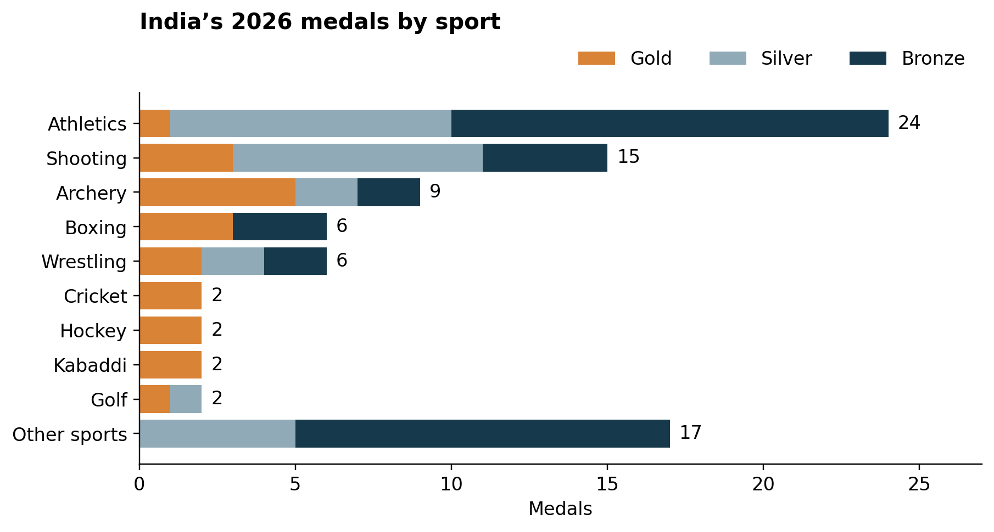
Figure 2. Gold, silver and bronze contributions in 2026. Other sports combine the remaining disciplines: 17 medals. Source: sport-wise results [6]. The chart totals 85 medals.
The campaign also broadened India’s achievements. Kumkum Anil Mohod’s women’s individual recurve archery gold and the women’s recurve team title represented important breakthroughs, while Pranavi Urs won women’s individual golf gold. Such results show why the country’s sporting story increasingly extends beyond its most familiar disciplines. [1]
The term dominance nevertheless needs to be used carefully. In athletics specifically, 24 podium finishes included only one gold. India has considerable competitive depth in track and field, but further work is needed to turn that depth into more event titles. Finishing fourth overall also points to a strong position within Asia rather than leadership of the entire continental field. [6]
The most useful interpretation is that India is developing strengths in several sports while continuing to face uneven performance elsewhere. The next stage will depend on how reliably new athletes enter the system and how effectively established contenders sustain their performance across successive competitions.
Funding the preparation behind performance
India’s preparation for Aichi-Nagoya involved a substantial financial commitment. Reporting based on Sports Ministry figures recorded ₹702.86 crore under the Annual Competition and Training Calendar and ₹97.84 crore through the Target Olympic Podium Scheme, a combined ₹800.70 crore over three years. These amounts relate to athlete preparation rather than the cost of hosting the Games in Japan. [7]
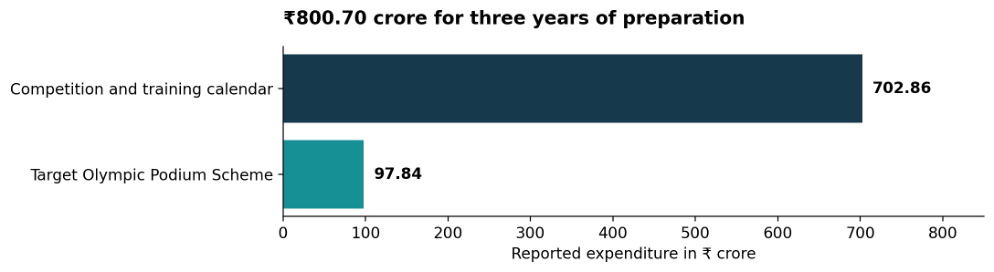
Figure 3. Reported preparation expenditure through two funding channels over three years. Source: Sports Ministry figures reported by Business Standard [7]. This is not a full breakdown of all public and private support for the contingent.
The ministry’s account included ₹251.4 crore for international competition exposure and ₹118.3 crore for domestic training. Both are important because preparation requires more than access to facilities. Athletes also need opportunities to test themselves against strong opponents, adapt to competitive pressure and refine performance through repeated experience. These categories are components of the reported preparation account and should not be added again to the ₹800.70 crore total. [7]
At the wider institutional level, the Union Budget allocated ₹4,479.88 crore to the Ministry of Youth Affairs and Sports for 2026–27, compared with a revised estimate of ₹3,346 crore for 2025–26. The comparison must retain these labels: one is a new budget estimate and the other is a revised estimate for the preceding year. The ministry’s total also includes youth-affairs activities, so it should not be described as expenditure exclusively on elite sport. [8]
Investment can improve the conditions in which athletes train, but the medal table does not isolate its effect. Coaching, prior training, injuries, selection, private support and the strength of competitors all influence results. The appropriate assessment therefore asks how consistently funding reaches athletes, what services it purchases and whether those services improve development over several seasons.
How Khelo India and TOPS strengthen athlete development
Khelo India operates across participation, competitions and talent development. The purpose is to give emerging athletes access to organised opportunities and support before they reach the senior international stage. TOPS complements that wider pathway by offering selected athletes tailored assistance for high-performance preparation. Together, the programmes address different stages of development rather than providing identical support to every athlete.
The Sports Authority of India describes TOPS support as including foreign training, international competition, equipment and coaching camps. Such assistance can help an athlete obtain specialist resources that would otherwise be difficult to access. Although the scheme is designed around Olympic and Paralympic preparation, training gains can also carry into other major events, including the Asian Games. [9]
Structural change and the next stage of sporting development
The expanded Khelo India framework places greater emphasis on connecting talent identification with training institutions, competitions and athlete support. The government reported a combined outlay of ₹36,441 crore for the revamped scheme and enhanced assistance to National Sports Federations for 2026–27 to 2030–31. This is a multi-year combined outlay, not an annual Khelo India allocation or money already spent. [10]
As of July 2026, government figures recorded 1,067 Khelo India Centres, 2,745 supported Khelo India athletes and 349 approved infrastructure projects worth ₹3,176 crore. These measures describe the scale of the programme at that date. They do not establish that every approved project is complete or that every centre delivers the same quality of service. [10]
The Khelo India Mission announced in the 2026–27 Budget identifies integrated training pathways, coach development and sports science as priorities. This approach recognises that sporting performance develops through a chain of connected services. Identifying talent is only useful when athletes can subsequently access suitable coaching, regular competition, medical support and opportunities to continue their education. [8]
Governance is another part of that structure. Rules notified on 12 January 2026 under the National Sports Governance Act prescribe requirements for representation, elections and the functioning of national sports bodies. They require at least four women on executive committees and provide a six-month period for bodies to align their bye-laws, with a mechanism for relaxation. The ordinary six-month period falls before the September Games; however, the notification alone does not demonstrate uniform implementation or an immediate effect on sporting results. [11]
The timing of reform matters. Measures introduced in 2025 and 2026 cannot explain Hangzhou’s achievements in 2023. Nor can new institutional arrangements be assumed to transform athletes whose preparation has already taken many years. Their significance will become clearer through implementation, athlete experience and performance over subsequent competition cycles.
India’s Performance at Asian Games 2026 in Perspective
India’s performance at Aichi-Nagoya presents a mixed picture. Fourth place and 85 medals show that the country remained competitive across several disciplines. However, the fall from Hangzhou’s 107 medals and 28 golds to 85 medals and 21 golds means that the 2026 campaign did not extend the previous edition’s record. The unchanged overall rank reflects India’s relative position in the field, while the lower medal count indicates that results weakened against its own recent benchmark. Both measures matter when assessing the outcome. [1, 2]
The sport-wise results suggest that India’s strengths are substantial but uneven. Athletics produced the largest contribution with 24 medals, although only one was gold. Archery delivered five golds, and victories by the men’s and women’s teams in cricket, hockey and kabaddi demonstrated strength in those sports. These results support a description of broad competitive capacity with specific areas of excellence; they do not establish dominance across Asian sport. [6]
The preparation expenditure and development programmes show a significant commitment to supporting athletes. Nevertheless, expenditure alone cannot establish effectiveness, and a lower medal tally does not by itself prove that a programme failed. Athlete development, injuries, selection, event opportunities and the strength of opponents can influence outcomes. A more reliable evaluation would examine results over several editions alongside athlete progression, training quality and the delivery of support.
The neutral observation is that India has a stronger platform than in many earlier decades, but its progress remains uneven. The 2026 Games offered evidence of depth and new achievements alongside a need for greater consistency and more gold-medal conversion. Sustained improvement will depend on how institutions respond to these patterns rather than on treating the campaign as either an unqualified success or a comprehensive setback.
What India needs to sustain its progress
From a Cosminnox perspective, India’s next sporting gains depend on continuity. A promising school athlete needs a practical route to district, state and national competition. An international contender needs reliable coaching, rehabilitation, equipment and support during setbacks. Institutions need to make these services available throughout the year, including outside the immediate preparation period for major events.
This creates opportunities for collaboration between public institutions, academies, educational organisations and businesses. Affordable equipment, better facility management, accessible rehabilitation and useful performance analysis can address specific gaps in athlete development. Their contribution should be judged by improved access and service quality, alongside participation and competitive outcomes.
Aichi-Nagoya leaves India with both encouraging results and clear areas for improvement. The long-term rise is visible, while the decline from Hangzhou cautions against assuming automatic progress. India’s future as a sporting power will depend on making high-quality support routine enough for successive generations to succeed.
Sources and data notes
Figures were checked on 5 October 2026. The 2026 results use corroborated post-Games reporting because the cited Olympics.com results page could not be retrieved during this review. Hangzhou is shown as 107, following the official 2023 year-end review; some later reports state 106 without establishing a reconciliation. Historical medal figures can change after reallocations. Policy discussion distinguishes stated programme objectives from demonstrated outcomes, and no causal estimate of medals attributable to spending is claimed.
[1] Indian Express. India’s Asian Games 2026 medal winners.
[2] Press Information Bureau. Sports year-end review dated 19 December 2023.
https://www.pib.gov.in/PressReleasePage.aspx?PRID=1988258&lang=2®=48
[3] Olympic Council of Asia. Sporting Asia edition 56.
https://oca.asia/media/newsletters/1/edition-files/Sporting_Asia_56.pdf
[4] Olympic Council of Asia. Aichi-Nagoya event overview dated 19 August 2026.
[5] Business Standard. India’s performance across previous Asian Games editions.
[6] Times of India. India’s 2026 sport-wise medal breakdown.
[7] Business Standard. Government expenditure on Asian Games preparation dated 15 September 2026.
[8] Press Information Bureau. Khelo India Mission and Union Budget announcement dated 1 February 2026.
https://www.pib.gov.in/PressReleasePage.aspx?PRID=2221706&lang=1®=3
[9] Sports Authority of India. Target Olympic Podium Scheme overview.
https://sportsauthorityofindia.gov.in/sai_new/target-olympic-podium
[10] Press Information Bureau. The Making of a Sporting Nation dated 3 August 2026.
https://www.pib.gov.in/PressReleasePage.aspx?PRID=2293849&lang=2®=48
[11] Press Information Bureau. National Sports Governance Rules dated 12 January 2026.
https://www.pib.gov.in/PressReleasePage.aspx?PRID=2213803®=48&lang=2