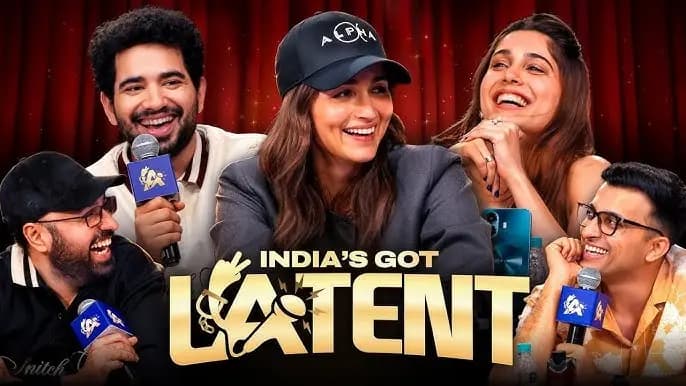
When Samay Raina launched India’s Got Latent, it was a wild, unpredictable celebration of raw human talent—and unfiltered, often boundary-pushing, comedy. But the spectacular trainwreck of Season 1 proved one thing to the entire digital entertainment industry: in modern media, a punchline can quickly turn into a police complaint.
The fallout was historic. Following high-profile controversies—ranging from highly insensitive jokes targeting individuals with Spinal Muscular Atrophy (SMA) to crass remarks about parental intimacy—the show faced nationwide outrage, multiple FIRs, cyber cell investigations, and was entirely pulled from public platforms. Host Samay Raina and fellow panellists even found themselves tendering unconditional apologies in the Supreme Court of India.
When Season 2 finally made its highly-anticipated comeback on Netflix and YouTube with major stars like Alia Bhatt, eagle-eyed fans noticed a massive change. The end credits didn't just thank the production crew; they proudly displayed a massive, 11-member structured legal team.
For any unscripted, edgy reality format, a dedicated legal shield is no longer a luxury—it is a baseline operational necessity. Here is why.
1. The Legal Definition of Obscenity is a Moving Target
In India, the legal framework governing what you can say online is incredibly tight. Digital creators constantly balance on the razor's edge of:
Section 67 of the IT Act: This penalizes the transmission of "obscene material" in electronic form, carrying a threat of heavy fines and up to five years of imprisonment.
Section 292 of the IPC: Criminalizes content deemed lascivious or tending to "deprave and corrupt" the audience.
The problem? Indian law doesn't explicitly define a sharp line between what is "offensive or edgy" and what is "legally obscene." Courts rely on general judicial tests to determine if a joke crosses into depravity. A legal team's primary job is to act as a buffer, ensuring the unscripted banter doesn't inadvertently hand a prosecutor an easy case.
2. Managing the Risk of "Unscripted" Chaos
Unlike a structured fiction show, India’s Got Latent relies heavily on improvisational humor from a shifting panel of guests, alongside completely unpredictable contestants.
The Season 1 Nightmare: A guest or a contestant drops a casual, below-the-belt remark, the live crowd roars, the editors leave it in for the viral traction—and 24 hours later, an FIR is registered for defamation or harming societal sentiments.
The Legal Solution: Entertainment lawyers are now embedded directly into the post-production pipeline. They watch the raw cuts frame-by-frame, assessing the legal liabilities of specific jokes before they ever hit the internet.
3. Protecting the Vulnerable (And Navigating Supreme Court Mandates)
Satire is historically protected under freedom of speech (Article 19(1)(a)), but that protection completely vanishes when comedy targets marginalized groups or individuals with disabilities.
Following the Apex Court’s strong exception to the mockery of severe medical conditions on the show, Chief Justice Surya Kant emphasized that "humour should never come at the cost of dignity." With courts actively discussing tougher legal penalties for mocking disabled individuals, a legal team is vital to enforce a strict boundary: punch up, punch sideways, but never punch down at vulnerable communities.
The Corporate Reality Shift
“Just remember we had to fight a year-long legal battle where we promised to stay in line... He has fought countless battles behind the scenes.”
— Comedian Ashish Chanchlani on the return of Latent
4. Platform Compliance: YouTube vs. OTT Giants
When a show expands from a loose YouTube upload to a simultaneous streaming model with giants like Netflix, the corporate compliance requirements skyrocket. International streaming platforms demand rigorous vetting regarding copyright clearance, talent agreements, and strict adherence to local broadcasting guidelines. An 11-member legal firm like Hirani & Associates ensures the show meets massive corporate standards without losing its identity.
The Verdict: The Cost of Doing Business
The era of digital creators operating in a legal Wild West is officially over. As online comedy scales to match the numbers of mainstream television, it must accept mainstream accountability. Samay Raina’s 11-lawyer credit roll isn't a sign of creative defeat—it's a tactical blueprint for how edgy digital content survives in a highly litigious world.
The Cosminnox • Reporting compiled from digital content regulatory indicators, Supreme Court case monitoring systems, OTT streaming guidelines, and Hirani & Associates media compliance disclosures