

A bank’s doors can remain open while its customers’ information slips out of sight. A website can look perfectly normal while a weakness beneath its surface leaves it exposed. In cybersecurity, the absence of a visible breakdown is not always evidence of safety.
Two developments have brought that uncomfortable reality into focus: critical security flaws in PHP, a programming language used to build websites, and the discovery of SBI customer records on the dark web.
Their appearance in the same news cycle invites a question: could the software vulnerabilities have enabled the banking data exposure? It is a reasonable question. But a research hypothesis must be a bridge built from evidence, not a thread spun from coincidence.
The evidence reviewed does not establish a causal connection. This analysis compares public technical advisories, SBI’s exchange disclosure and regulatory guidance. It does not have access to SBI’s systems, forensic findings or the exposed dataset. Its purpose is to establish what is known, identify what remains uncertain and explain what would prove or weaken a connection.
Understanding the machinery behind the screen
PHP stands for PHP: Hypertext Preprocessor. It is an open-source scripting language particularly suited to web development. It commonly runs on a website’s server, processing instructions before returning content to a visitor’s browser. It can support functions such as handling forms, retrieving database information and generating personalised pages. [1]
If a website is a theatre, the page we see is the stage; PHP can be part of the machinery working behind the curtain. “PHP devs” simply means developers who build or maintain PHP itself, or applications written in it.
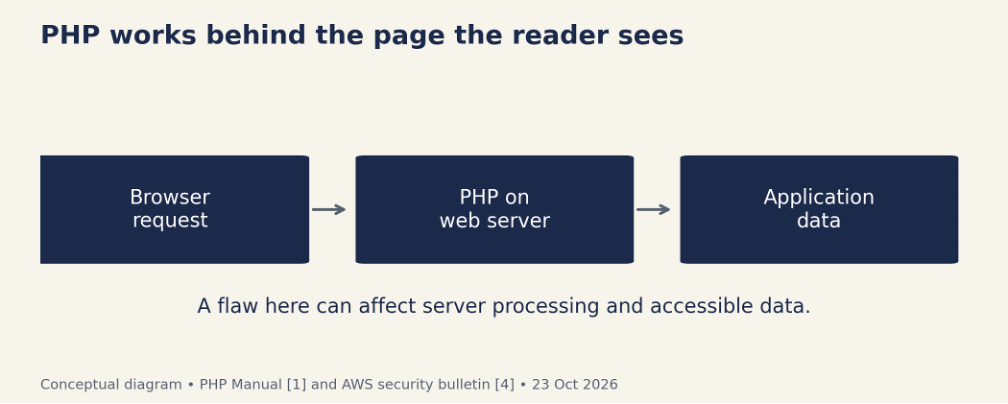
Figure 1. A simplified view of PHP’s role in a website. The diagram is conceptual, not an SBI system map.
PHP does not inherently damage websites. The concern arises when a flaw in the software allows that machinery to behave in unintended ways.
The October vulnerabilities, CVE-2026-109618 and CVE-2026-109619, involve memory handling. One concerns incomplete internal data left during an out-of-memory condition; the other involves leftover internal state referring to memory that has already been freed. Under exploitable conditions, an attacker could run code remotely without logging in. [2]
Successful exploitation could allow unauthorised instructions, access to data available to the affected process, or disruption of service. The eventual damage would depend on the server’s permissions, configuration and connections to other systems. A vulnerable website is therefore a potential entry point; it is not automatic proof that its entire organisation has been compromised. [4]
How the flaws were discovered and fixed
The discovery was a sequence of investigations rather than one dramatic moment. According to the PHP Foundation, early signs of the out-of-memory problem emerged in 2024 while a core developer was addressing findings from a Quarkslab audit. Its practical exploitation was initially unclear. Proposed fixes also carried compatibility and other technical risks. [3]
On 11 August 2026, Calif researcher Ryan A reported remote code execution involving the same underlying problem. OpenAI independently reported that root cause, while Wiz and OpenAI supplied further attack paths. The Foundation acknowledged that resource shortages and its decision-making process had delayed remediation. These researchers investigated and reported weaknesses. Their involvement does not mean they attacked SBI or deliberately introduced the defects. [3]
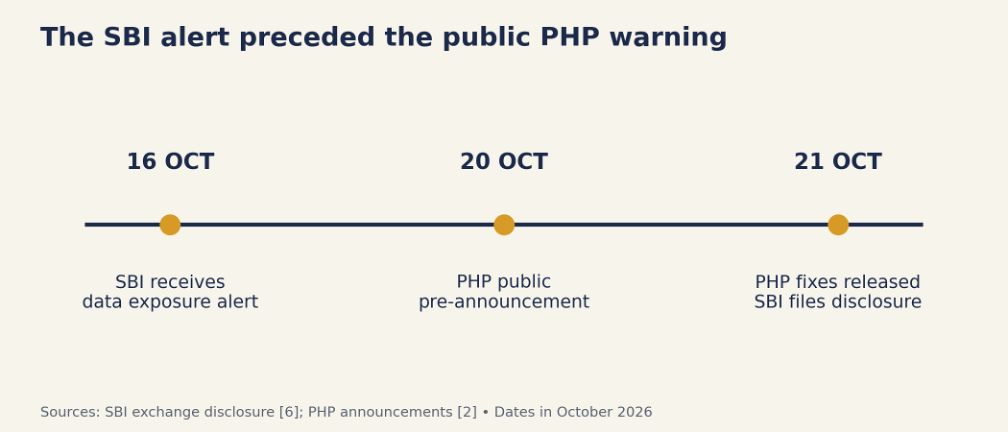
Figure 2. Public chronology. The date an alert is received is not necessarily the date data was stolen.
PHP issued corrected releases on 21 October 2026: 8.5.12, 8.4.27, 8.3.36 and 8.2.35. Its advisory urged immediate updates and warned that partial mitigations did not make an installation safe. Older deployments require particular care, including checking vendor-supported fixes or moving to a supported release. [2]
How quickly can a website recover? There is no universal stopwatch. Installing an available update is one task; checking compatibility, updating every affected server and investigating possible prior intrusion are separate tasks. A patch repairs the lock. It does not establish whether someone entered before the repair.
Who was affected and what happened at SBI
Three categories should remain separate: systems exposed to a vulnerability, services taken offline as a precaution, and organisations whose systems were successfully breached. PHP’s advisory identified installations serving web requests as at risk, with a demonstrated attack against Apache’s mod_php configuration making that deployment particularly concerning. [2]
Reporting documented precautionary disruption to government websites in countries including the United Kingdom, Finland and Japan. Such shutdowns demonstrate operational impact, but do not independently establish data theft. The sources reviewed do not establish a comprehensive list of successfully compromised organisations or a verified worldwide financial-loss total attributable to these two flaws. [5]
Possible costs include interrupted services, emergency technical work and lost business. Those are categories for investigation, not figures that can responsibly be presented as confirmed losses.
A cyberattack is a deliberate attempt to gain unauthorised access to digital systems, steal or alter information, or disrupt services. A data exposure describes an outcome; its precise cause still requires investigation.
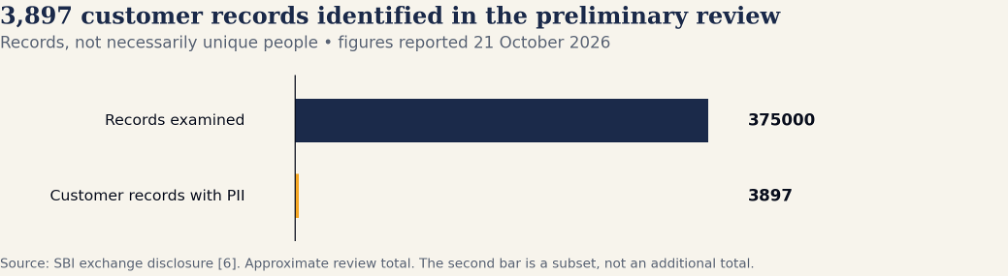
Figure 3. The customer-record count is a subset of the approximate review total. The remaining records are not classified here as safe, unrelated or additional victims.
SBI’s disclosure dated 21 October 2026 said the bank had received alerts on 16 October from its threat-intelligence provider, the Defence Cyber Agency and CERT-In. A preliminary examination of approximately 375,000 records identified 3,897 customer records containing personally identifiable information. [6]
Reported fields included names, mobile numbers, dates of birth, email and residential addresses, branch and customer identifiers, and loan-related metadata. SBI activated its response procedures and appointed an independent CERT-In-empanelled cybersecurity agency. It said core operations continued normally without material impact on financial performance or business continuity. [6]
The cost of exposure extends beyond missing money
The numbers need careful handling: 375,000 records examined do not establish 375,000 affected customers, and 3,897 records do not necessarily represent 3,897 unique individuals. The filing did not identify the attacker or explain how the information escaped. Its authenticity, completeness, source and extent remained subjects of investigation. Claiming that hackers penetrated SBI’s core banking system or exploited PHP to do so would go beyond the disclosure. [6]
The material reviewed does not establish a quantified theft from SBI customer accounts attributable to this incident. Nor does it establish the bank’s final financial loss.
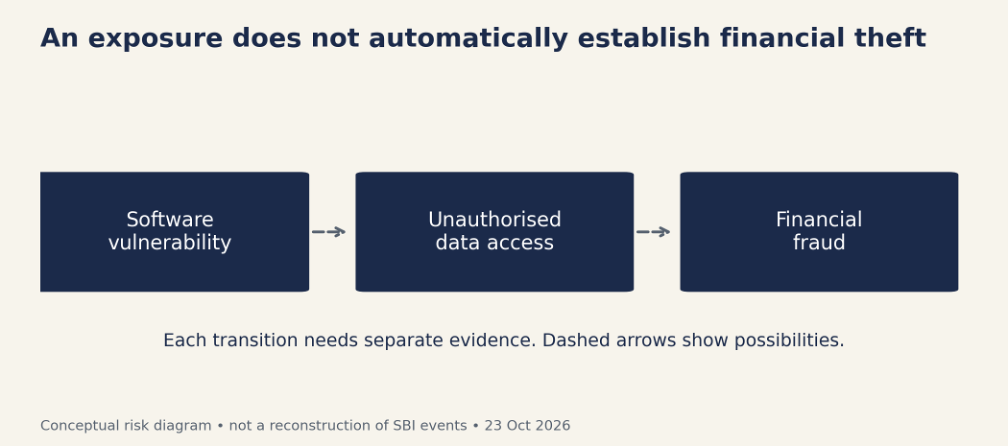
Figure 4. A vulnerability, a data exposure and a financial loss are distinct findings. One does not prove the next.
However, personal information can become raw material for deception. A fraudulent caller who knows someone’s branch, address and loan history may sound more convincing than an unfamiliar voice making a vague claim. This is a plausible downstream risk, not evidence that such fraud has already occurred in these cases.
For customers, the potential burden includes impersonation attempts, anxiety and time spent securing accounts. For the bank, possible costs include investigation, remediation, customer support and any liabilities eventually established.
On 23 October, The Economic Times, citing people familiar with the matter, reported that SBI had informed its insurer and could seek a claim under a ₹1,425-crore cyber-insurance policy. That figure is a reported coverage ceiling not a confirmed loss or approved payout. Any payment would depend on the policy and covered losses; the report said SBI and Oriental Insurance had not responded to its requests for comment. [7]
Government response and customer liability
CERT-In issued a critical PHP vulnerability notice on 21 October. Its technical warning should not be interpreted as a finding that PHP caused SBI’s exposure. The sources reviewed did not establish a separate government announcement identifying SBI’s attack route or promising incident-specific compensation. [8]
If unauthorised electronic transactions occur, RBI’s customer-liability framework becomes relevant. The table summarises key conditions; it is not a finding of liability in the SBI incident. [9]
Circumstance | Treatment under RBI framework |
Bank fraud, negligence or deficiency | Customer can have zero liability. |
Third-party breach where neither bank nor customer is at fault | Zero liability when reported within three working days of receiving the bank’s transaction communication. |
Customer negligence such as sharing credentials | Customer can bear losses before reporting; losses after reporting fall on the bank. |
Reversal and resolution | Shadow reversal within ten working days of notification; resolution within a maximum of ninety days. The bank bears the burden of proving customer liability. |
These rules concern unauthorised transactions. They do not establish an automatic compensation amount merely because personal information appeared in an exposed dataset.
The dark web has no single owner
The dark web refers to online services accessed through specialised networks or software rather than ordinary browsing alone. Tor onion services are a familiar example. They should not be confused with the broader “deep web,” which includes ordinary private pages such as account dashboards. [10, 12]
No single person or organisation is running the entire dark web. Tor uses a distributed network of volunteer-operated servers; individual services have their own operators. The Tor Project develops privacy technology, but does not own every service using it. Privacy networks also serve legitimate purposes, including confidential communication and resistance to censorship. Their existence should not be equated with criminality. [10, 11]
For this investigation, the essential distinction is simple: where data appears does not reveal how it was obtained. A marketplace displaying stolen property does not, by itself, identify the door through which the thief entered.
Testing the PHP and SBI hypothesis
The proposed hypothesis is that an affected PHP deployment within SBI’s systems, or within a service provider handling SBI-related information, enabled access that contributed to the customer-data exposure. This is technically conceivable. It remains unproven.
A competing explanation is that the exposure arose through an unrelated route, for example, compromised credentials, a different software flaw, a misconfigured repository, an insider or a third-party incident. These are alternatives to investigate, not allegations about what happened.
Figure 5. Investigators would need configuration and patch history, exploit traces, access permissions and extraction records. Arrows represent investigative steps, not an established attack route.
Timing offers an additional constraint. SBI received its alert on 16 October, while PHP’s public pre-announcement came on 20 October and fixes followed on 21 October. The SBI exposure therefore cannot simply be explained as an attack triggered by those later public announcements. [2, 6]
That does not exclude earlier exploitation of a then-undisclosed vulnerability. It does mean such an explanation needs positive evidence. The age of a software defect alone cannot connect it to a particular breach.
A connection to investigate
The strongest defensible finding is that public evidence reviewed as of 23 October 2026 does not establish a causal connection between the PHP vulnerabilities and SBI’s data exposure. This is an assessment of the available evidence, not proof that a connection is impossible.
The cases nevertheless raise related questions about digital accountability: how quickly weaknesses are addressed, how clearly institutions explain exposure, and whether customers receive information useful enough to protect themselves. For researchers, the next step is to seek the missing forensic chain. For institutions, it is to combine technical repair with transparent communication.
Trust is built in deposits and can be withdrawn in doubts. Restoring it requires more than reassuring language: it requires evidence that the weakness has been addressed, the damage understood, and the people affected properly informed.
Sources and visual credits
Numbered references support the article and figure captions. The analysis reflects material reviewed on 23 October 2026; subsequent forensic findings may change its conclusions.
[1] PHP Manual. Introduction to PHP. Open source
[2] PHP Project. Security advisory and release announcements, 20–21 October 2026. Open source
[3] PHP Foundation. Today’s PHP Security Release and How We’re Strengthening PHP Security, 21 October 2026. Open source
[4] Amazon Web Services. PHP web runtimes security bulletin 2026-143-AWS. Open source
[5] Associated Press. What to know about the AI-detected security bug impacting wide swaths of the internet. Open source
[6] State Bank of India. Regulation 30 disclosure on data loss, 21 October 2026. Open source
[7] The Economic Times. SBI weighs data leak impact, alerts cyber cover provider, 23 October 2026. Open source
[8] CERT-In. Vulnerability Note CIVN-2026-0510, 21 October 2026. Open source
[9] Reserve Bank of India. Customer protection and liability in unauthorised electronic banking transactions, 6 July 2017. Open source
[10] Tor Project. How Tor works. Open source
[11] Tor Project. About the organisation. Open source
[12] Winter et al.. How Do Tor Users Interact With Onion Services, 2018. Open source
Visual credits: Opening image generated with OpenAI image generation as a conceptual illustration for this article on 23 October 2026; it is not documentary evidence. Figures 1–5 are original editorial graphics prepared for this article. Numerical data in Figure 3 comes from SBI’s exchange disclosure. No fabricated loss estimates or attack-probability scores are plotted.