BRICS BY THE NUMBERS
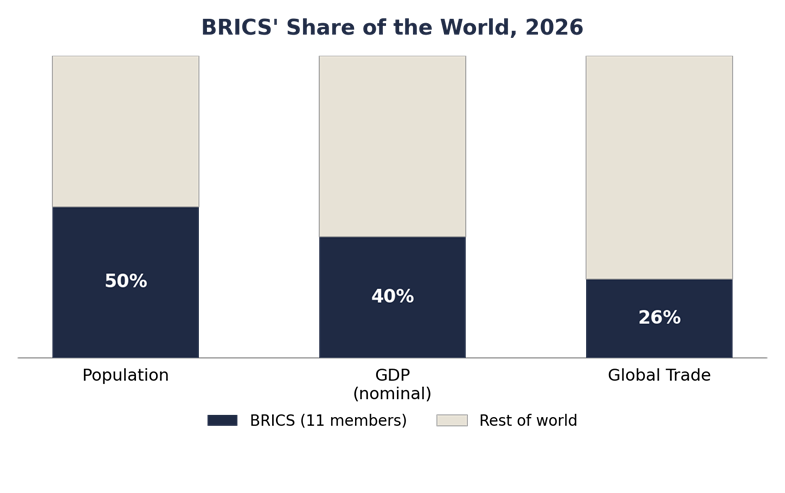
Fig. 1 — BRICS' combined share of world population, nominal GDP, and global trade, as cited around the 2026 summit. [Forbes India, Sept. 2026]
WHAT THE TEXT ACTUALLY COMMITS TO
On the Middle East, the declaration registers “deep concern over the continued escalation of tensions in West Asia” and calls for restraint, protection of civilians, and a return to dialogue. It also flags deliberate attacks on civilian infrastructure and IAEA-safeguarded nuclear facilities, insisting nuclear safety and safeguards be upheld even during armed conflict. On terrorism, the bloc reiterates a strong, unqualified condemnation “in all its forms and manifestations, regardless of its motivation or origin.”
[The Statesman, "BRICS Summit 2026: Here is what the New Delhi Declaration says," Sept. 12, 2026; Sarkaritel, "BRICS New Delhi Declaration 2026: Key Outcomes And Global Impact," Sept. 2026]
None of this names a country. That is not an oversight — it is the mechanism by which Iran and the UAE, or Russia and other members with divergent positions on active conflicts, can both ratify the same paragraph. Forbes India's read of the full text notes explicitly that the bloc's language “stops short of naming any country” across Pahalgam, West Asia, and other flashpoints.
[Forbes India, "BRICS Summit 2026: 11 Key Takeaways From the New Delhi Declaration," Sept. 2026]
On global governance, the declaration is more specific. China and Russia — both permanent UN Security Council members — reiterated their support for the aspirations of Brazil and India to play a greater role in the UN, including its Security Council. The bloc also renewed its push for World Trade Organization reform, calling for restoration of a functioning two-tier WTO dispute settlement mechanism and swift appointment of new Appellate Body members, while registering serious concern over unilateral tariff and non-tariff measures that distort trade. On unilateral coercive measures, the text condemns sanctions “contrary to international law,” including those not authorised by the UN Security Council.
[ANI, "BRICS Delhi Declaration backs UN reform to amplify Global South voice," Sept. 12, 2026]
On the economic track, leaders welcomed progress on the BRICS Economic Partnership 2030 and continued work on cross-border payment interoperability and trade settlement in local currencies, alongside a push for easier MSME finance access and an invoice-discounting mechanism.
[Sarkaritel, Sept. 2026]
WHAT THE FRAMING DOES — AND DOESN'T — ESTABLISH
Prime Minister Modi's own language for the summit's ambition — moving from what he termed a “pyramid of privilege” to a “platform of partnership” — was widely reported around the summit's build-up, though this is Modi's stated framing rather than declaration text, and should be read as such.
The people-to-people pillar drew less contested language: the declaration places emphasis on education, tourism, cultural and youth exchange, and on advancing women-led development initiatives across the now 11-member bloc.
[PIB, press release, Sept. 2026]
BRICS MEMBERSHIP: FIVE TO ELEVEN
Year | Members Added | Bloc Size After |
2006–09 | Brazil, Russia, India, China (BRIC formed 2006; first summit 2009) | 4 |
2010 | South Africa | 5 |
Jan. 2024 | Egypt, Ethiopia, Iran, UAE (Saudi Arabia invited; formal accession status reported inconsistently across sources) | 9–10* |
Jan. 2025 | Indonesia | 10–11* |
*Reports differ on Saudi Arabia's formal membership status. Telangana Today lists it as a full member from January 2024; other summit coverage lists a 10-country expanded bloc excluding it. [Telangana Today, Sept. 2026; ummid.com, Sept. 2026]
THE COUNTER-EVIDENCE: WHAT “UNANIMOUS” DOESN'T MEAN
The headline claim — that New Delhi “bridged” divisions between members like Iran and the UAE — deserves scrutiny against two data points. First, the declaration's own record on its most concrete governance ask is uneven: reporting from 2024, ahead of the bloc's expansion, noted that newer members were not committed “in black and white” to backing India, Brazil, and South Africa's UNSC ambitions, unlike the explicit language in the 2023 Johannesburg Declaration. The 2026 text's UNSC language is a reiteration of a long-standing China-Russia position, not a new commitment extracted from the newer, more Middle East-aligned members.
[Pressreader / Businessline, May 2024]
Second, the summit's own coverage frames the achievement in structural rather than substantive terms: unanimity was reached by keeping the Middle East and conflict-related paragraphs deliberately unnamed and general, while the more specific, harder commitments — UNSC reform, WTO restoration, de-dollarised settlement — track positions the founding five (Brazil, Russia, India, China, South Africa) already held before the 2024 expansion. Where the declaration is concrete, it is concrete on pre-existing consensus items; where it touches genuinely contested ground — the Middle East, sanctions, named conflicts — it is deliberately non-specific.
[Forbes India, Sept. 2026]
CONCRETE VS. DELIBERATELY VAGUE, BY ISSUE
Issue Area | Declaration's Language | Specificity |
UNSC reform | China, Russia reiterate support for India, Brazil having “a greater role” | Concrete — reiterates pre-existing position |
WTO / trade | Calls for restored dispute settlement, new Appellate Body members | Concrete — names the mechanism |
Middle East / West Asia | “Deep concern,” calls for restraint, civilian protection | Vague — no country named |
Unilateral sanctions | Condemns measures “contrary to international law” | Vague — no sanctioning party named |
Terrorism | Condemned “in all its forms and manifestations” | Vague — no incident or actor named |
Classification is this publication's analysis of declaration language as reported; see body text for sourcing per row. [ANI; The Statesman; Forbes India; Sarkaritel — Sept. 2026]
WHAT THE EVIDENCE SUPPORTS
The New Delhi Declaration establishes that all 11 BRICS members were willing to co-sign a shared document — a logistical and diplomatic achievement given the bloc's expanded and more heterogeneous membership, spanning roughly half the world's population and around 40 percent of global GDP. It does not establish that the underlying disagreements between members over the Middle East, sanctions regimes, or specific conflicts were resolved or even substantially narrowed; the text's studied avoidance of naming any country on those questions is itself evidence that consensus was manufactured through vagueness rather than negotiated agreement. On global governance and trade reform, the declaration reiterates rather than advances existing BRICS positions. The more interesting test — whether India's chairship converts this text into institutional follow-through on UNSC reform, WTO dispute-settlement restoration, or local-currency settlement infrastructure — remains open, and is a question for the next reporting cycle, not this one.
[Forbes India, Sept. 2026]
Sources: Prime Minister of India (pmindia.gov.in); ANI; The Statesman; Forbes India; Sarkaritel; PIB; Pressreader/Businessline (2024 background).