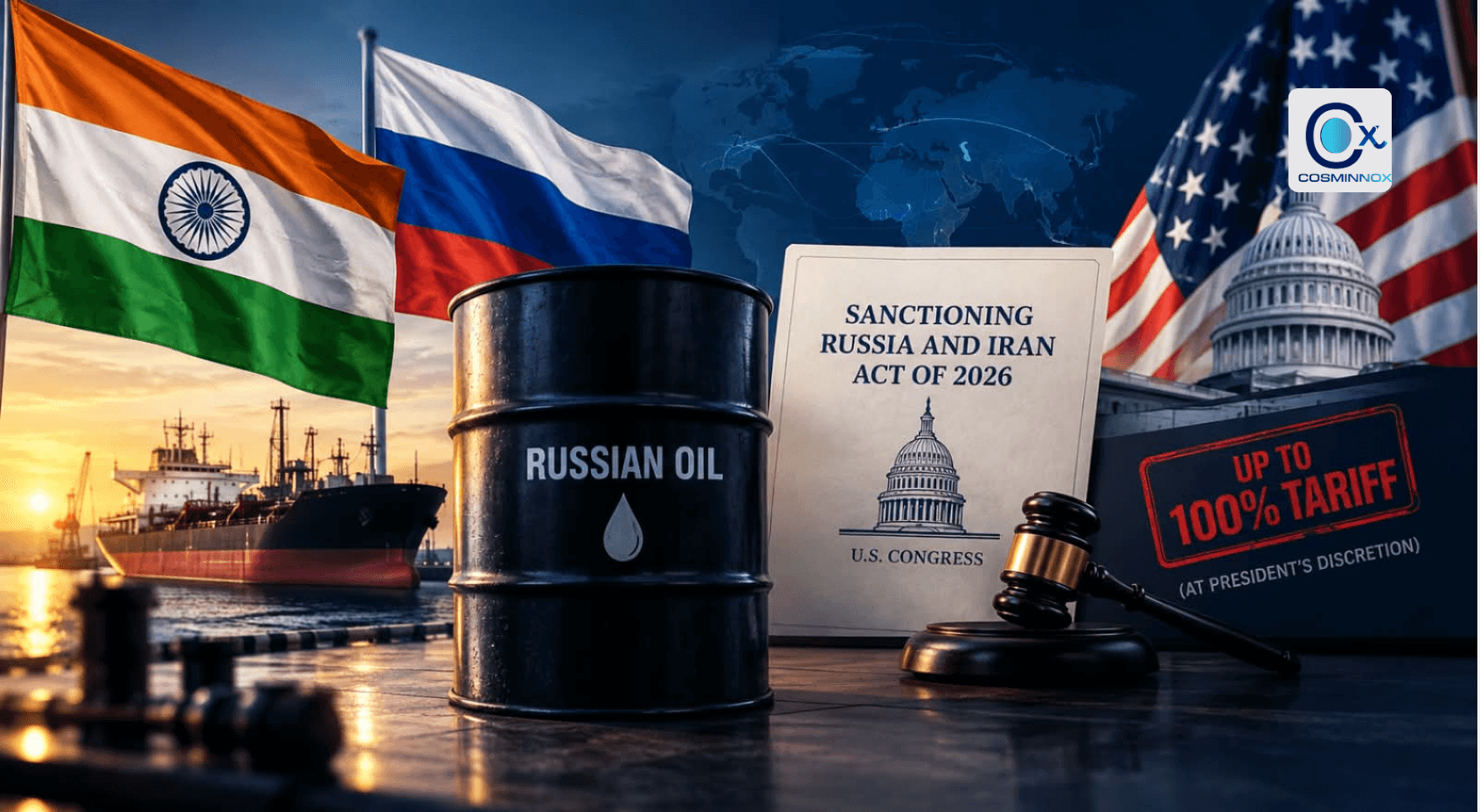
The question: does the Sanctioning Russia and Iran Act of 2026 hand Washington a tool it is likely to use against India's Russian oil trade, or is New Delhi's carefully worded warning more a marker for future leverage than a signal of imminent economic rupture? The available record supports the latter — but the discretion built into the law means the answer depends entirely on choices Donald Trump has not yet made.
Legislative Timeline
Date | Chamber | Vote | Milestone |
Aug. 7, 2026 | Senate | 86–11 | Sanctioning Russia and Iran Act advances |
Sept. 16, 2026 | House | 262–159 | Act passes, heads to president's desk |
Sept. 17, 2026 | — | — | India's MEA issues response statement |
Early Dec. 2026 | — | — | Putin's planned visit to India (annual summit) |
What the Act Actually Authorizes
The US House passed the Lindsey O. Graham Sanctioning Russia and Iran Act of 2026 by a 262–159 vote on September 16, 2026, following an 86–11 Senate vote on August 7, 2026 [U.S. Senate Committee on Foreign Relations, press release, Aug. 7, 2026; KPMG Tax News Flash, Aug. 7, 2026]. The legislation authorizes tariffs of up to 100% on the five largest purchasers of Russian oil and natural gas, and on the five leading facilitators of sanctions evasion, alongside sanctions on Russian officials, banks, and its "shadow fleet" of tankers [KPMG Tax News Flash, Aug. 7, 2026]. The law exempts countries importing less than 15% of Russia's natural gas exports that are demonstrably reducing purchases — a carve-out that shields several European buyers but does not extend to India's crude-oil dependence [Shankar IAS Parliament, "Sanctioning Russia and Iran Act of 2026," Jul. 31, 2026]. Critically, the bill does not impose tariffs automatically; it authorizes the president to do so, at his discretion, once signed into law.
Table 1: Key Provisions of the Sanctioning Russia and Iran Act, 2026
Provision | Detail |
Tariff ceiling | Up to 100% on top 5 buyers of Russian oil/gas |
Evasion facilitators | Tariffs on top 5 sanctions-evasion facilitators |
Other sanctions | Russian officials, banks, "shadow fleet" tankers |
Exemption threshold | <15% of Russian gas exports, if demonstrably reducing |
Trigger mechanism | Presidential discretion — not automatic on signing |
How New Delhi Worded Its Response
India's Ministry of External Affairs (MEA) did not protest the bill's substance. It said the government "has noted the passage of the Sanctioning Russia and Iran Act in the US Congress," and that "its potential implications for not just the bilateral relationship but also the international energy market have been very clearly articulated by the Indian side" [MEA statement, as reported by News24online and ETV Bharat, Sept. 17–18, 2026]. The MEA reiterated that India "remains firmly committed to ensuring energy security for its 1.4 billion people" through "diversified sourcing," and said it would "take all measures necessary to protect its economic interests" [MEA statement, as reported by ThePrint, Sept. 17, 2026]. Notably, the statement stopped short of naming the tariff provision as a grievance against the US specifically — it framed the concern as one shared with global energy markets broadly.
Why the Stakes Are Real
Russia has been India's largest single source of crude oil since 2022, and China and India together account for roughly 85% of Russian crude exports — near 47–50% and 36–38% respectively [Shankar IAS Parliament, Jul. 31, 2026]. An investment banker quoted in regional reporting noted that a US tariff would strip away both the "predictable supply of oil" and the discount India currently secures against market rate, raising landed cost across transportation, insurance, and crude itself [Rishi Sahai, Cogence Advisors, as quoted by ETV Bharat, Sept. 17, 2026]. This arrives atop an already-strained trade relationship: Trump imposed a 25% tariff on Indian goods in July 2026, and Reuters reported Indian officials saying New Delhi would keep buying Russian oil despite earlier threats of a separate penalty tariff [Reuters, as reported by Yahoo News, 2026].
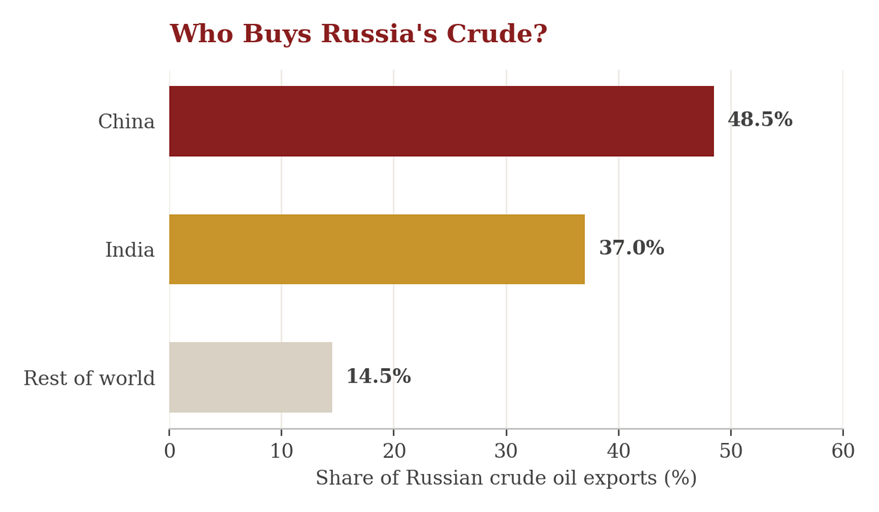
Figure 1: Who Buys Russia's Crude?
Source: Shankar IAS Parliament, Jul. 31, 2026 (approximate, midpoint of reported ranges)
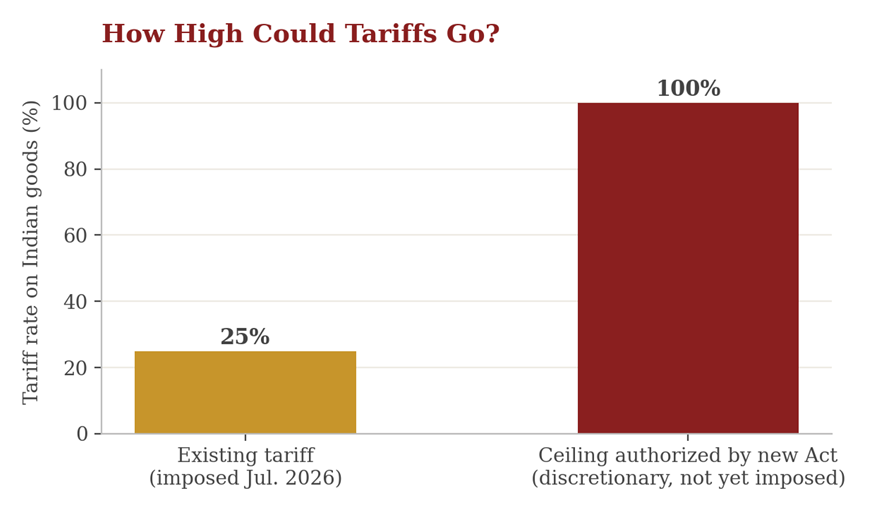
Figure 2: How High Could Tariffs Go?
Source: KPMG Tax News Flash, Aug. 7, 2026; Reuters/Yahoo News, 2026
Counter-Evidence
Set against this is the law's own structure and the diplomatic calendar. The tariff authority is discretionary, not mandatory — KPMG's summary of the bill text states it "would authorize," not require, the tariffs [KPMG Tax News Flash, Aug. 7, 2026]. Democratic Senator Richard Blumenthal's floor remarks urging India and China to "clean up their act" reflect a domestic political message aimed at Congress's own base as much as a forecast of executive action [as reported by ThePrint, Sept. 17, 2026]. Meanwhile, bilateral energy diplomacy has continued on a separate track: President Putin's planned early-December 2026 visit to India for the annual leaders' summit, alongside meetings already under way between External Affairs Minister S. Jaishankar and Foreign Minister Sergey Lavrov, and between NSA Ajit Doval and Nikolai Patrushev, points to India hedging toward continuity with Moscow rather than immediate compliance with Washington [Tribune India, Sept. 2026].
What the Evidence Establishes
The Act gives Trump a legal instrument capable of imposing a 100% tariff on Indian goods over Russian oil purchases; it does not compel him to use it, and India's own statement is calibrated to flag risk without escalating rhetoric. Whether this becomes a genuine rupture in India-US ties turns on a presidential decision not yet made — the evidence supports concern, not prediction.
SOURCES
1. U.S. Senate Committee on Foreign Relations — bipartisan sanctions announcement, Aug. 7, 2026
3. Shankar IAS Parliament — "Sanctioning Russia and Iran Act of 2026," Jul. 31, 2026
4. News24online — "India sounds cautious alarm over Trump's Russia Sanctions Bill," Sept. 2026
8. Tribune India — "Despite US pressure, India-Russia ties look at fresh avenues," Sept. 2026
CORRECTION PROTOCOL
If any figure in this piece is revised post-publish (e.g., final tariff rate set by the administration, updated Russian crude-import shares), a dated correction note will be appended here rather than a silent edit, per COSMINNOX digital protocol.