
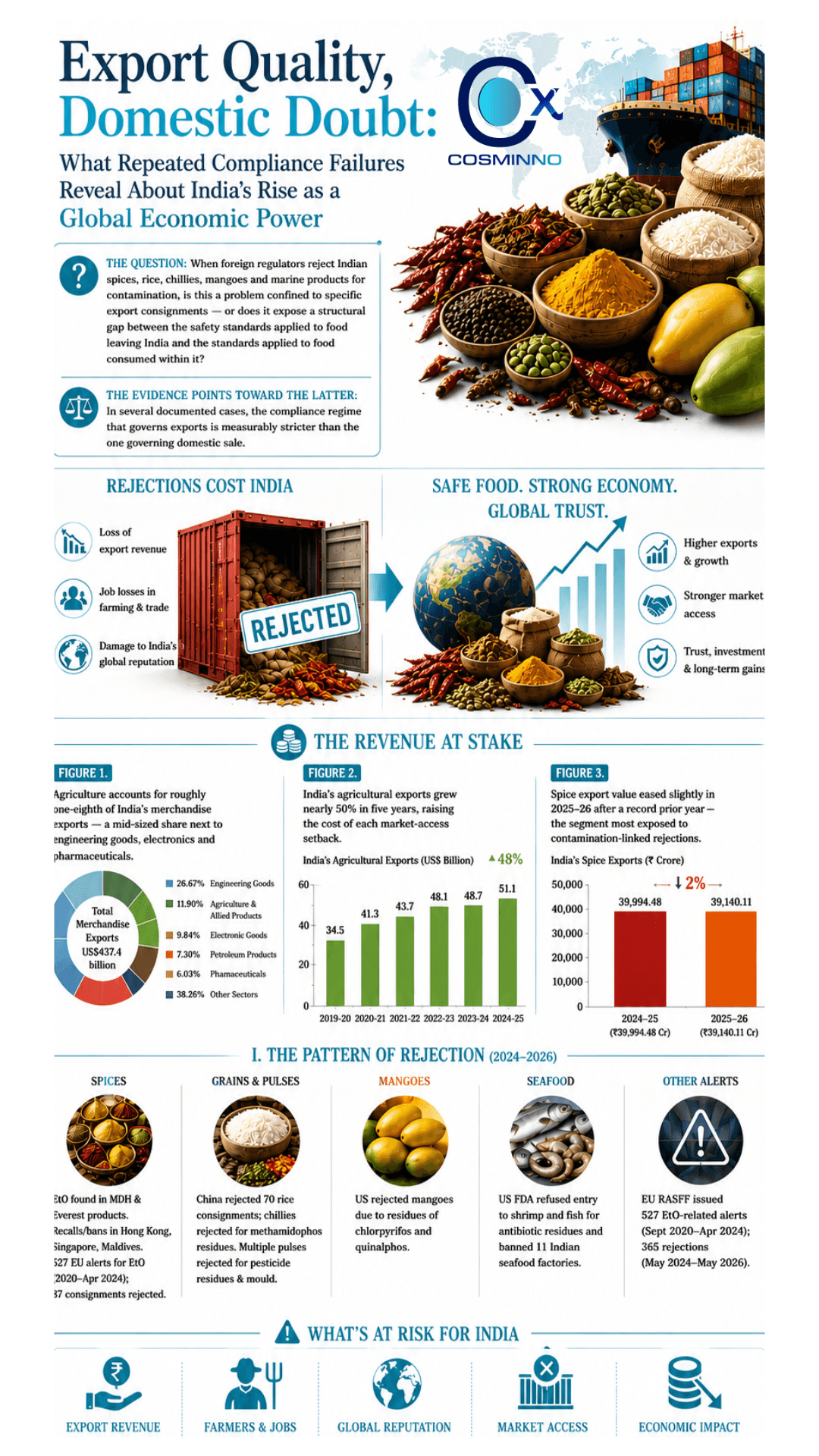
The revenue at stake
India is the world’s largest producer, consumer and exporter of spices, accounting for roughly 43 percent of global spice trade by volume [Spices Board India, 2024, cited in ExportIndiaNews]. Spice exports alone reached a record Rs 39,994.48 crore (US$4,722.65 million) in 2024–25 before easing 2 percent in value to Rs 39,140.11 crore (US$4,430.90 million) in 2025–26 [Spices Board of India, Trade Information and Statistics, 2025–26]. Set against India’s broader agricultural exports, which grew from $34.5 billion in 2019–20 to $51.1 billion in 2024–25, spices represent a small but symbolically outsized share of a sector the government wants to expand well beyond its current level of less than 3 percent of global agricultural trade — despite India holding the world’s second-largest agricultural land area [figures reported in Newslaundry, June 2026]. It is this revenue base, and the ambition to grow it, that the recurring pattern of contamination-linked rejections detailed below puts directly at risk.
Within India’s own trade basket, agriculture is a mid-sized but far from marginal contributor. Agriculture and allied products accounted for US$51.86 billion of India’s US$437.4 billion in merchandise exports in 2024–25 — a share of roughly 11.9 percent, placing it behind engineering goods (26.67 percent of the total) but ahead of pharmaceuticals as one of the four sectors that together made up over half of India’s goods exports that year [Ministry of Commerce and Industry data, reported in IBEF and Indian News Network, May 2025]. Measured against India’s total exports of goods and services combined — a record US$824.9 billion in 2024–25 — agriculture’s share narrows to about 6.3 percent, reflecting how services, led by a record US$387.5 billion in exports, now make up the larger half of India’s overall external trade [Reserve Bank of India data, reported in News on Air, May 2025].
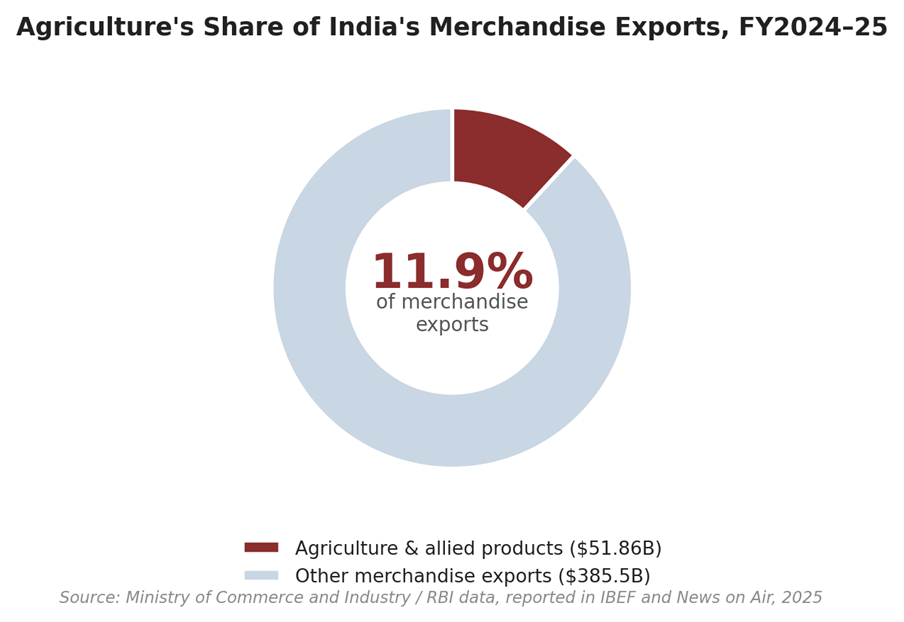
Figure 1. Agriculture accounts for roughly one-eighth of India's merchandise exports — a mid-sized share next to engineering goods, electronics and pharmaceuticals.
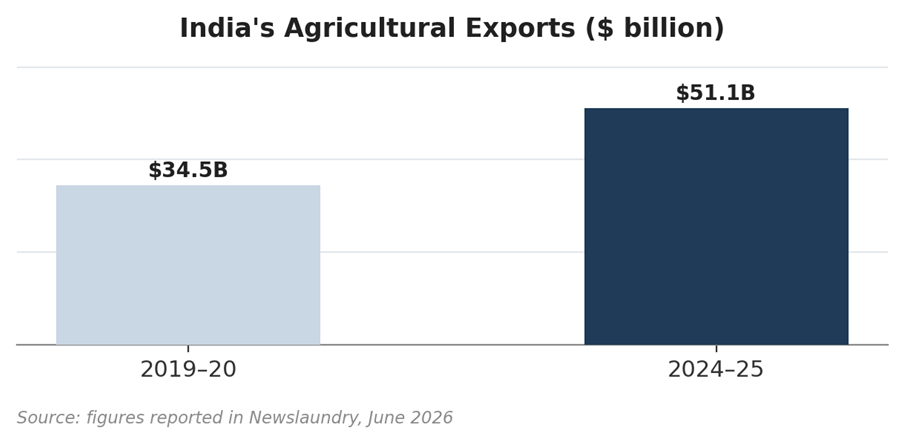
Figure 2. India's agricultural exports grew nearly 50 percent in five years, raising the cost of each market-access setback.
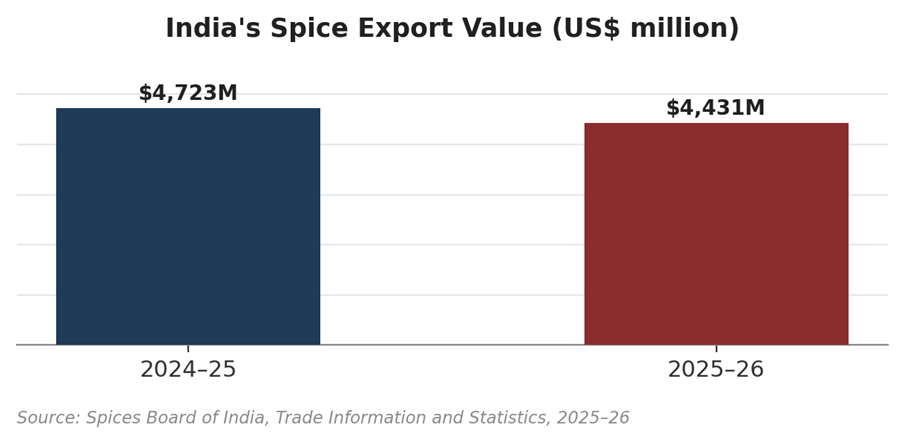
Figure 3. Spice export value eased slightly in 2025–26 after a record prior year — the segment most exposed to contamination-linked rejections.
I. The pattern of rejection
Indian food exports have faced a recurring cycle of contamination-linked rejections across multiple markets and product categories over the past two years.
Spices. In April 2024, Hong Kong’s Centre for Food Safety found the pesticide ethylene oxide (EtO) — classified a Group 1 carcinogen by the WHO’s International Agency for Research on Cancer — in three MDH spice blends and an Everest fish curry masala, and ordered the products off shelves [Centre for Food Safety, Hong Kong, via Business & Human Rights Resource Centre, 20 April 2024]. The Singapore Food Agency followed with a recall of the same Everest product for exceeding permissible EtO limits, and the Maldives banned the products soon after [Singapore Food Agency statement, cited in The News Minute, 27 May 2024]. The US FDA and Australian regulators opened their own information-gathering on the two brands [Deccan Herald, 27 April 2024].
Within that same ethylene oxide problem, the European Union’s Rapid Alert System for Food and Feed (RASFF) recorded 527 India-linked notifications specifically for EtO contamination between September 2020 and April 2024, the majority in nuts and sesame seeds (313) and herbs and spices (60), with 87 consignments rejected at the border [RASFF data, reported in Deccan Herald, 2024]. A subsequent analysis by the Global Food Consumers Forum found the EU rejected 365 Indian food products between May 2024 and May 2026 for excessive pesticide residues and heavy-metal contamination, with more than 450 flagged in total; chlorpyrifos was detected in roughly 135 products, ethylene oxide in around 40, and the rice fungicide tricyclazole in 53 [Global Food Consumers Forum analysis, reported in The Logical Indian, June 2026]. A peer-reviewed review of RASFF pesticide notifications spanning 1981–2020 similarly identified India, alongside Turkey, as the most frequently cited origin for pesticide-residue notifications in herbs, spices, fruits and vegetables [RASFF notification study, published in a peer-reviewed food-science journal, 2022].
Grains and pulses. China rejected 70 consignments of Indian non-basmati rice, and separately rejected Indian chilli shipments for excessive levels of methamidophos, a pesticide linked to nervous-system disorders [Newslaundry, citing Chinese customs authority action, 19 June 2026]. Domestically, changes to permissible residue levels for pesticides used on basmati paddy have been driven by importer requirements in West Asia and the EU rather than by an independent domestic revision [The Tribune, reporting Punjab Agriculture Department officials].
Fruit. Japan banned Indian mangoes for a second time in four decades in 2026 after its inspection team found deficiencies in India’s fumigation and quarantine protocols; a two-decade-long ban imposed in 1986 over fruit-fly infestation had only been lifted in 2006 following the introduction of vapour-heat treatment systems [Newslaundry, June 2026, citing sourcing from The Secretariat]. Sources described both APEDA and the National Plant Protection Organisation — the two bodies formally responsible for monitoring export readiness — as having failed to intervene in time to prevent the ban [The Secretariat, cited in Newslaundry].
The US market. FDA import-refusal data for January 2024–April 2025 recorded approximately 2,687 line-item refusals of Indian-origin food products, spanning spices, grains, pulses, bakery goods, noodles and edible nuts. Salmonella was the single most frequently cited violation, appearing 493 times [FDA import refusal data, analysed in Nuffoods Spectrum, July 2025]. Separate USDA Economic Research Service analysis covering 2002–2019 found India accounted for 22.9 percent of all US pathogen/toxin-related food import refusals — the highest share of any single country — with spices, flavours and salts the second-largest violating category after seafood [USDA Economic Research Service, “Examining Pathogen-Based Import Refusals,” 2002–2019 dataset].
Marine products. Shrimp and fish consignments have repeatedly faced US and EU import alerts for banned veterinary drug residues, unapproved antibiotics, and filth or decomposition violations [Global Agriculture, “Beyond Pesticides,” 2026].
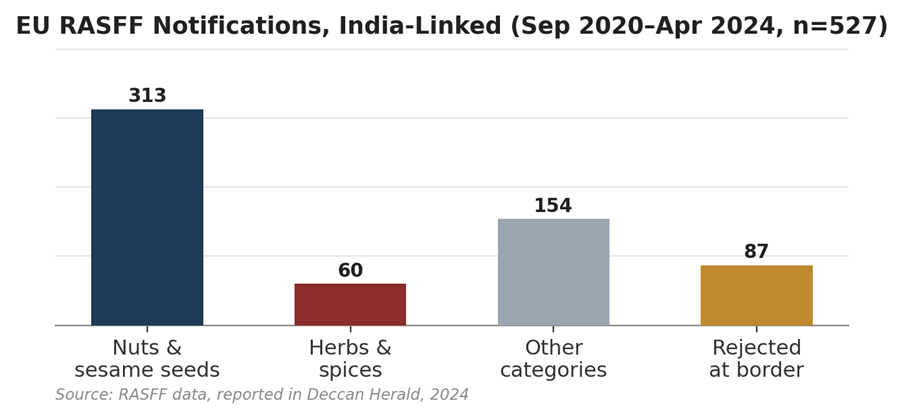
Figure 4. Nuts, sesame seeds, herbs and spices dominate India-linked EU food-safety notifications.
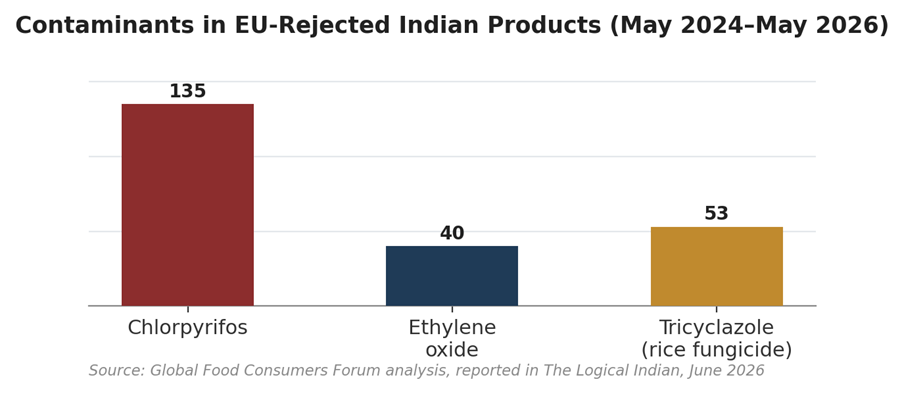
Figure 5. Chlorpyrifos is the most frequently detected contaminant in EU-rejected Indian food products.
Table 1. Documented rejections by market, at a glance
Market | Period | Headline figure |
European Union (RASFF) | Sep 2020–Apr 2024 | 527 EtO notifications; 87 rejected at border |
European Union (GFCF) | May 2024–May 2026 | 365 products rejected; 450+ flagged |
United States (FDA) | Jan 2024–Apr 2025 | 2,687 line-item refusals; Salmonella cited 493× |
United States (USDA) | 2002–2019 | 22.9% of all pathogen/toxin refusals — highest of any country |
China | reported Jun 2026 | 70 non-basmati rice consignments; chilli shipments rejected |
Japan | 2026 | Second mango import ban in four decades |
Hong Kong & Singapore | Apr–May 2024 | MDH/Everest spice blends recalled for ethylene oxide |
Sources: as cited in the text above for each market.
II. Precedent: how India has managed comparable episodes before
The current wave of rejections is not without precedent. Two earlier episodes — one resolved through a standing structural fix, one recurring despite repeated corrective action — offer comparison points for what has and has not worked before.
The 2003 grape crisis and GrapeNet. In 2003, the European Commission issued 17 rapid alert notifications over pesticide residues in Indian table grapes, holding consignments at European ports and causing reported financial losses to exporters [European Commission rapid alert notifications, 2003, cited in Down To Earth]. The Agricultural and Processed Food Products Export Development Authority (APEDA) responded by mandating a Government of India regulation covering every stakeholder in the grape supply chain, then digitising the resulting compliance and monitoring process into GrapeNet, an online traceability platform under which every EU-bound consignment has been tracked since the 2007 season [APEDA, GrapeNet programme documentation]. The system today covers more than 40,000 registered farmers, over 100 pack houses, over 100 exporters, more than 20 laboratories and 32 district-level state government officials, and won the National e-Governance Gold Award in 2007–08 and the eASIA award in 2009 [APEDA, GrapeNet programme documentation]. APEDA subsequently extended comparable residue-monitoring and traceability systems to grape exports bound for Russia, China, the Gulf, Indonesia and Canada, to other fruit and vegetable exports through a parallel HortiNet platform, and to peanuts for aflatoxin control, alongside a domestic zero-residue programme launched in 2017–18 [Bidisha Bhattacharya, “GrapeNet to US tariffs,” ThePrint, opinion analysis, 28 July 2026].
The 2001–02 and 2024–26 shrimp-antibiotic episodes. EU food-safety authorities first detected the banned antibiotics chloramphenicol and nitrofuran in Indian shrimp exports in late 2001 and into 2002, alongside comparable findings in shipments from China, Vietnam, Indonesia and Thailand [Food & Water Europe, “Suspicious Shrimp” report]. India's response centred on the National Residue Control Programme, administered by the Marine Products Export Development Authority (MPEDA), together with post-harvest testing and surveillance protocols [Ministry of Commerce and Industry statements, cited in BusinessToday and The Tribune, May 2026]. The same two antibiotics recurred in Indian shipments in the years that followed, prompting the EU to maintain elevated, consignment-specific testing requirements through the mid-2010s [Global Seafood Alliance, Responsible Seafood Advocate, 2017]. In October 2024, the EU excluded India from its list of countries authorised to export animal-origin products under a revised antimicrobial-resistance regulation, Implementing Regulation (EU) 2024/2598 [European Commission regulation, cited in GKToday, May 2026]. India responded in May 2025 by prohibiting the same 37 antimicrobials the EU restricts in food-producing animals [Ministry of Commerce and Industry, cited in Down To Earth], and was reinstated on the EU's approved list in May 2026 [The Tribune and BusinessToday, May 2026]. Weeks later, in June 2026, India's own drug regulator, the Central Drugs Standard Control Organisation, reported that chloramphenicol and nitrofuran residues were still being detected in shrimp export consignments, accounting for 43 percent of shrimp export rejections by the EU, US and Japan during 2025 and concentrated in Andhra Pradesh (74 percent of implicated farms), followed by Odisha, West Bengal and Gujarat [Business Standard and Medical Dialogues, June 2026, citing MPEDA and CDSCO].
The two precedents differ in one respect the evidence can support: GrapeNet built a standing, government-mandated, farm-to-export traceability system that has operated continuously since 2007 without a documented repeat of an EU-wide grape exclusion, while the shrimp sector's response has taken the form of periodically updated banned-substance lists and testing protocols that the same two antibiotics have continued to breach across two decades. One trade analyst has characterised this as the difference between a durable compliance system and a scandal-triggered one [Bidisha Bhattacharya, ThePrint, opinion, 28 July 2026] — a framing that anticipates the domestic-versus-export testing gap examined in Section III below.
III. What separates the export shipment from the domestic shelf
India’s food-safety regulator, FSSAI, does not dispute that rejections occur; its position, stated after the 2024 spice crisis, is that maximum residue limits (MRLs) differ by commodity because they are set through risk assessment specific to each food category, not because domestic consumers are held to a lower standard [Union Ministry of Health and Family Welfare statement, 5 May 2024, reported in Business Standard and The Tribune]. The ministry stated that India has “one of the most stringent” MRL regimes globally and explicitly denied reports that FSSAI permits ten times more pesticide residue in herbs and spices than international norms [ibid.].
Set against this claim, several documented regulatory facts complicate the picture:
• FSSAI’s own August 2022 order acknowledged that MRLs are not specified for most pesticides in spices and culinary herbs because the underlying field-trial data required to set them does not exist; in its absence, the regulator directs that Codex Alimentarius standards apply where available, and the exporting country’s own standards apply as a fallback [FSSAI order, August 2022, cited in Newslaundry].
• In April 2024 — during the MDH-Everest crisis — FSSAI raised the default MRL for pesticides in spices and culinary herbs tenfold, from 0.01 mg/kg to 0.1 mg/kg, without publicly releasing the data behind the revision. The Centre for Science and Environment and Pesticide Action Network India both raised concerns about the scale and timing of the change [Down To Earth, reporting CSE and PAN India statements, 2024].
• Chlorpyrifos — linked in peer-reviewed literature to neurodevelopmental harm, reduced birth size and elevated cancer risk, and banned in more than 40 countries — remains permitted in India at 0.5 mg/kg on fruit and 0.2 mg/kg on other vegetables. The EU’s effective limit is 0.01 mg/kg, functionally a prohibition. At the Stockholm Convention’s COP-12 in April–May 2025, parties voted to list chlorpyrifos under Annex A for global elimination; India, citing food-security concerns, joined other countries in negotiating the accompanying exemptions list, which expanded from 7 to 22 time-limited, specific-use exemptions [Stockholm Convention COP-12 proceedings, April–May 2025, reported in Newslaundry].
• The May 2024 Spices Board circular requiring exporters to test for ethylene oxide, maintain contamination records and identify EtO as a hazard throughout the supply chain applies only to spices bound for export. No equivalent testing mandate exists for spices sold domestically, and Scroll reported that of 251 samples collected nationwide after the MDH-Everest episode, 104 remained untested at the time of an RTI response, with EtO testing not routinely conducted on the domestic market absent a specific directive [Scroll.in RTI-based reporting, cited in Newslaundry, 19 June 2026].
• Government-monitored pesticide-residue detection rates in Indian food samples rose from 22.6 percent in 2018–19 to 35.9 percent in 2022–23, according to Pesticide Action Network India; the underlying government monitoring reports have not been made public since 2018–19 [PAN India, cited in Newslaundry].
• India’s testing infrastructure for detecting residues in processed spice blends — which requires gas chromatography and mass spectrometry — is concentrated in a limited number of certified laboratories; most state government food labs lack this equipment, pushing testing to private facilities with long turnaround times. When Maharashtra tested spice-powder samples following the 2024 alert, only 150 of 331 collected samples had been tested twelve months later [FSSAI state lab listings and Maharashtra testing data, cited in Newslaundry].
• “Export quality,” a phrase widely used in packaging and trade communication, has no defined legal standing under the Food Safety and Standards Act or FSSAI regulations [FSSAI Food Safety and Standards Act text, cited in Newslaundry].
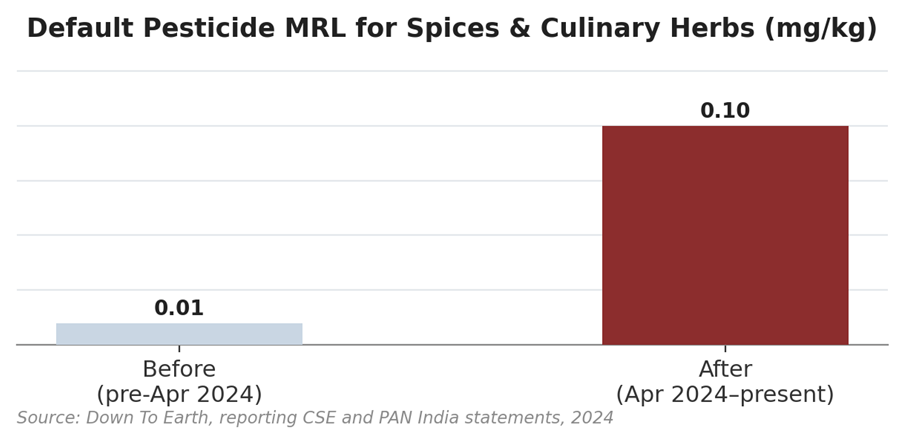
Figure 6. FSSAI raised the default pesticide MRL for spices tenfold in April 2024, without publishing the underlying data.
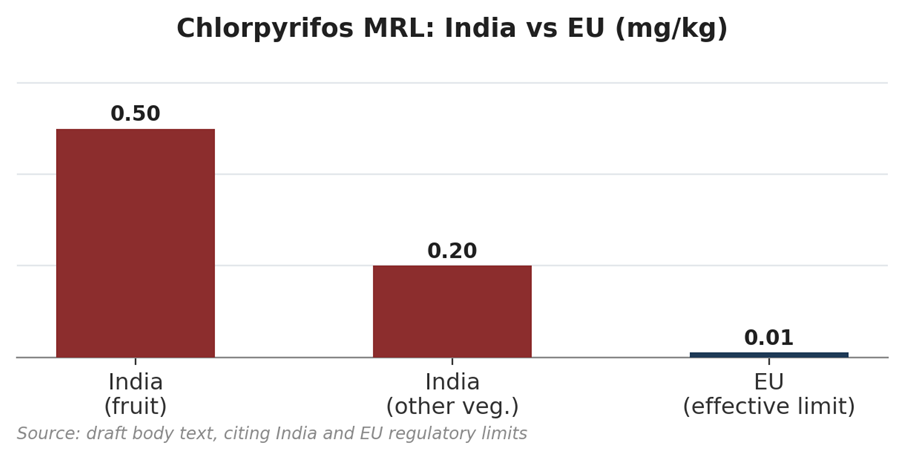
Figure 7. India permits far higher chlorpyrifos residues than the EU's effective limit — note the scale gap.
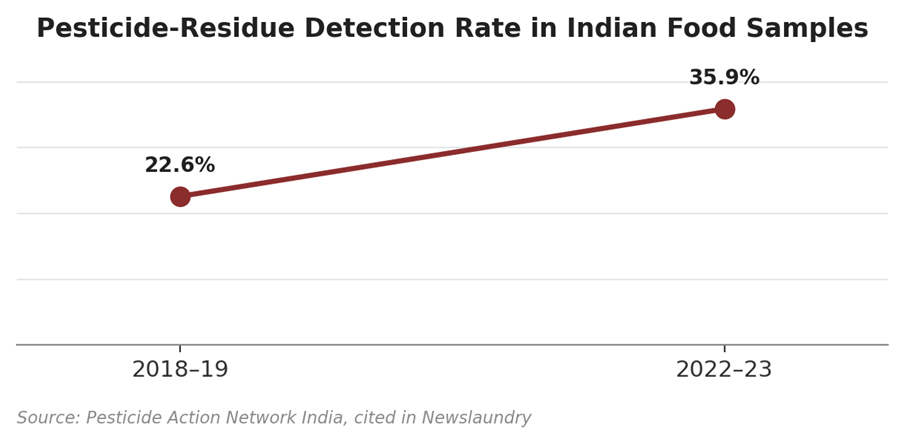
Figure 8. Government-monitored pesticide-residue detection rates rose across four years, per PAN India.
IV. Counter-evidence: the government’s case
The government’s position deserves to be stated on its own terms and is not without support.
Commerce ministry officials noted in May 2024 that the sample failure rate for Indian spice exports stood at 0.1–0.2 percent, compared with a 0.73 percent failure rate for spice imports into India from other countries — meaning, by this metric, Indian export consignments fail inspection less often than shipments India itself receives [Commerce ministry officials, reported in Business Today, 15 May 2024]. Officials also pointed out that some ethylene oxide use is a permitted fumigation practice during transport and storage globally, not an inherently illegal contaminant, and that acceptable EtO thresholds vary legitimately by jurisdiction — from roughly 7 mg/kg in the US and Canada to 0.01–0.02 mg/kg in the EU and Japan [reported in The News Minute, May 2024, and Deccan Herald, May 2024]. FSSAI’s own testing of MDH and Everest products after the 2024 crisis found all 18 MDH samples compliant with the stricter 0.1 mg/kg threshold, with some Everest samples non-compliant and referred for corrective action [government official statement, reported in Deccan Herald, 20 May 2024]. Separately, agriculture ministry officials have historically defended continued domestic use of chemicals banned elsewhere by noting that other agricultural exporters, including Brazil and Australia, also continue to permit some of the same substances [Ministry of Agriculture statement to Parliament, reported in Deccan Herald].
This leaves an unresolved empirical dispute rather than a settled one: whether the commodity-specific, risk-assessment basis FSSAI cites for differing MRLs is scientifically sufficient to explain gaps as large as the chlorpyrifos limits, or whether — as CSE and PAN India argue — some revisions reflect compliance convenience rather than updated risk data. Both sides have made their case publicly; neither has released the complete underlying dataset for outside verification.
V. The economic exposure
India is the world’s largest producer, consumer and exporter of spices, accounting for roughly 43 percent of global spice trade by volume [Spices Board India, 2024, cited in ExportIndiaNews]. Spice exports reached a record Rs 39,994.48 crore (US$4,722.65 million) in 2024–25 before easing 2 percent in value to Rs 39,140.11 crore (US$4,430.90 million) in 2025–26 [Spices Board of India, Trade Information and Statistics, 2025–26]. India’s broader agricultural exports grew from $34.5 billion in 2019–20 to $51.1 billion in 2024–25, against a stated government ambition to expand India’s share of global agricultural trade beyond its current level of less than 3 percent, despite India holding the world’s second-largest agricultural land area [figures reported in Newslaundry, June 2026].
Against this growth trajectory, the Federation of Indian Spice Stakeholders has reported that rejection rates on European-bound spice consignments climbed to around 20 percent, up from roughly 5 percent previously, attributed largely to intensified EtO screening by EU customs [Federation of Indian Spice Stakeholders, cited in Times of India and Newslaundry]. Beyond the direct value of rejected shipments, industry estimates cited in trade publications describe cascading costs from a single contaminated container — shipment value, logistics costs, buyer penalties and the loss of future orders from reputational damage — running into crores per incident, alongside the broader brand-equity damage the MDH-Everest episode caused to India’s spice industry internationally [industry estimates, Sadbhaav Spices trade analysis, February 2026]. The Centre subsequently introduced a Rs 497 crore RELIEF scheme to support exporters with logistics disruption, insurance and compliance costs [IBEF, citing Spices Board initiatives].
The MDH-Everest episode alone illustrates how quickly the exposure can move from a single finding to sector-wide risk. Within weeks of the April 2024 recalls, the Federation of Indian Spice Stakeholders warned that buyers were placing orders on hold and that spice exports could fall by as much as 40 percent, against a sector then worth roughly $4 billion annually [Federation of Indian Spice Stakeholders, cited in Gulf News, May 2024]. Individual rejection events carry their own direct costs: US authorities' rejection of at least 15 mango consignments in May 2025 over irradiation-documentation lapses resulted in the destruction of the perishable shipments, an estimated loss of nearly $500,000 [FDA import data, cited in foodtechnetwork, June 2026].
The marine sector shows the exposure at a larger scale. Each percentage point of US shrimp import market share India holds is worth an estimated Rs 600–700 crore in annual exports; India's share of the US shrimp market fell from 27 percent in 2024 to a projected 21 percent in 2026 amid a combination of tariffs and rejection-driven disruption [Kotak Neo trade analysis, May 2026], even as overall seafood exports reached a record Rs 73,890.46 crore ($8.46 billion) in FY26, with shrimp accounting for close to two-thirds of that value [Business Standard, citing MPEDA data, June 2026].
The burden of compliance is not evenly distributed within the exporting sector. Demonstrating compliance — record-keeping, laboratory testing, audits and a documented supply chain — is largely a fixed cost that changes little with shipment volume; large exporters can spread it across substantial volumes while smaller ones cannot, a dynamic consistent with the broader economic finding that only exporters above a certain productivity threshold can absorb the fixed costs of entering foreign markets [Marc Melitz, Econometrica, 2003, cited in Bidisha Bhattacharya, ThePrint, opinion, 28 July 2026]. This matters for India's export base specifically: MSMEs contributed an estimated 48.58 percent of India's exports in 2025–26, and the number of exporting MSMEs grew from 52,849 in 2020–21 to 173,350 in 2024–25, concentrated in sectors — textiles, leather, gems and jewellery, marine products and processed food — that overlap substantially with the categories facing the rejections detailed above [Economic Survey 2025–26, cited in Bidisha Bhattacharya, ThePrint, opinion, 28 July 2026].
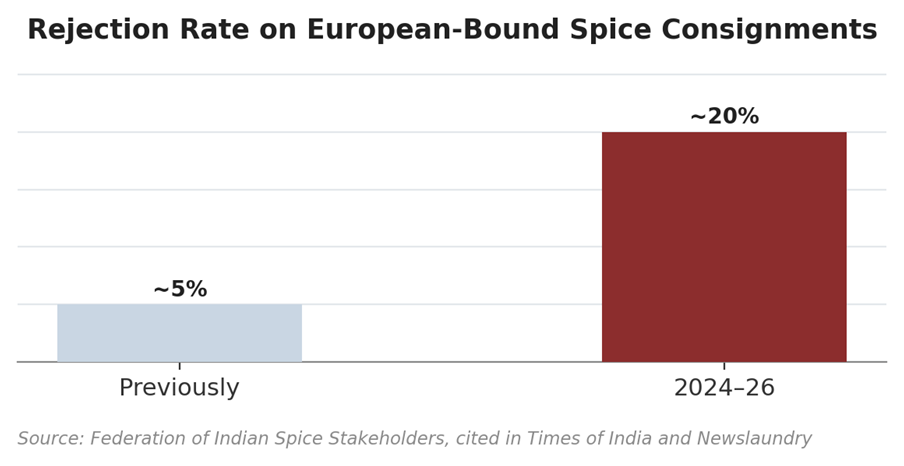
Figure 9. The share of European-bound spice consignments rejected at the border has roughly quadrupled.
VI. What has been proposed: health-wise, and country-wise
Two separate but related bodies of proposals exist in the public record: what health and agricultural researchers say is needed to protect Indian consumers directly, and what comparable regulatory systems abroad already do that India’s domestic market does not.
A. Health-wise: proposals for the domestic market
The scale of domestic exposure is larger than the export debate alone suggests. India produced 12.99 million tonnes of spices in 2024–25, and nearly four-fifths of that volume is consumed within India rather than exported — meaning food-safety gaps in the spice supply chain are, by volume, primarily a domestic public-health question rather than a trade one [ICRIER study, “Streamlining the Indian Spices Market: Issues and Way Forward,” Arpita Mukherjee, Eshana Mukherjee and Samriddhi Dube, cited in The South First, July 2026]. The same study’s authors — describing the risks as “largely preventable” — recommended three specific interventions: stronger batch-level traceability, more consistent testing, and improved farm-level practices among growers, rather than reliance on downstream inspection alone [ibid.]. The study also found a concrete quality gap between packaged and unpackaged spices: in a 2024 Barabanki, Uttar Pradesh sample set, one of five unpackaged turmeric samples and four of five unpackaged coriander samples tested positive for contamination, while none of the tested packaged samples did — pointing the authors toward accelerating the shift from loose to packaged, traceable retail, which still accounted for only 63 percent of the organised market as of 2025 [ibid.].
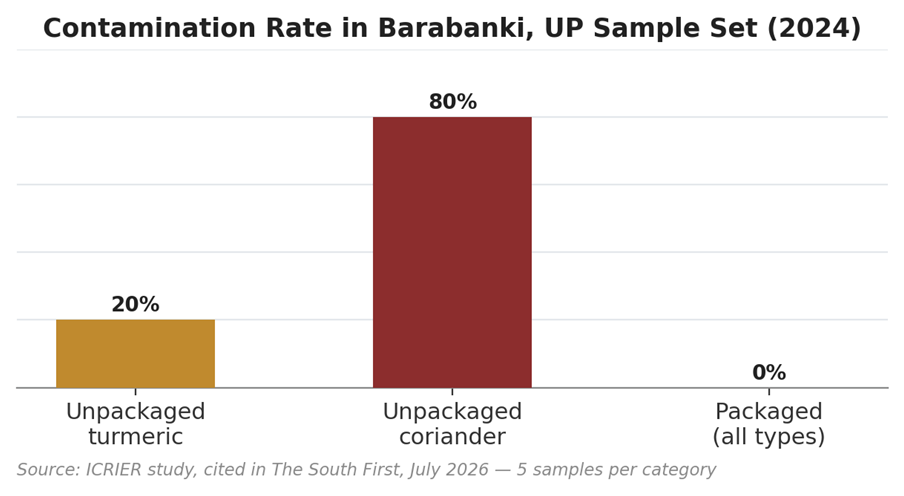
Figure 10. Unpackaged spices showed markedly higher contamination rates than packaged samples in a small 2024 Uttar Pradesh sample set.
On the regulatory side, the Centre for Science and Environment has for over a decade argued that MRLs should be fixed for every registered pesticide-crop combination rather than left unspecified by default, and that the process for updating MRLs needs a transparent, published scientific basis rather than administrative revision — a recommendation it renewed in 2017 submissions to FSSAI’s own draft regulations and repeated after the 2024 spice-MRL increase [Centre for Science and Environment, “Recommendations on the Draft Regulations for Insecticides and Antibiotics,” 2017, and CSE statements cited in Down To Earth, 2024]. Separately, one government official, addressing the domestic-versus-export standards question directly in May 2024, stated that ethylene oxide is used for fumigation to aid storage and that “ideally, products meant for exports should not be directed to the domestic market” — an acknowledgment, from within government, that export- and domestic-bound consignments are not always kept operationally separate even where standards differ [government official, quoted in Business Standard, 5 May 2024].
FSSAI has itself taken some corrective steps since the 2024 crisis: between November 2024 and February 2025 it pulled more than ten thousand spice samples nationally, and in September 2025 it ordered a month-long factory-level enforcement drive under the Food Safety and Standards Act, testing for pesticide residues, aflatoxins and heavy metals at NABL-accredited labs with results uploaded to the FoSCoS compliance portal [FSSAI circular, 17 September 2025, cited in India Law, September 2025]. Agricultural scientists have separately called for harmonising the pesticides State Agricultural Universities recommend for a given crop with what the Central Insecticides Board and Registration Committee has actually registered for that crop — flagging a mismatch between research recommendations and legal registration as a source of on-farm confusion [G V Ramanjaneyulu, Centre for Sustainable Agriculture, cited in Centre for Science and Environment analysis].
B. Country-wise: what comparable systems require, and what it would take to match them
European Union. The EU’s Rapid Alert System for Food and Feed operates alongside graduated, consignment-specific testing frequencies — cumin from India, for instance, has been subject to a 30 percent mandatory testing rate since January 2025 because of a prior pattern of interceptions, a rate that eases only after a sustained compliance record, as happened with Pakistani spice mixes (cut from 50 percent to 30 percent) and Ethiopian spices (moved to a more moderate testing tier in August 2025) [European Commission, cited in CBI Market Information, “What requirements must herbs and spices meet,” 2026]. The EU Deforestation Regulation, applicable from December 2024, additionally requires plot-level geolocation and a filed Due Diligence Statement for certain commodities before entry is permitted [EU Regulation 2023/1115, cited in TraceX EUDR Compliance Guide, 2026]. Trade analysts note that exporters who adopt batch-level digital traceability — proving origin and handling at each stage — have reported 15–30 percent higher export realisation and fewer border rejections [trade analysis, The Traceability Hub, November 2025]. No equivalent batch-traceability requirement exists for spices sold within India.
Japan. Market access for Indian mangoes has twice depended on India building and maintaining a verifiable vapour-heat treatment and quarantine chain inspected by Japanese officials before each season begins — a system that took twenty years to re-establish after the first ban and has now lapsed a second time over inspection-protocol gaps [Newslaundry, June 2026, citing The Secretariat]. The precedent suggests that Japan’s requirement is not a one-time certification but a continuously monitored system, which sources cited by The Secretariat said both APEDA and India’s National Plant Protection Organisation are formally responsible for sustaining.
United States. US market access rests on the Foreign Supplier Verification Program, under which Indian exporters must demonstrate hazard analysis and preventive controls (HARPC) and undergo two-yearly facility registration renewal, with FDA checking documentation of the full treatment and handling chain at the border [USFDA Compliance guidance, cited in USFDA Compliance advisory, October 2025]. This is a documentation-and-verification standard applied at the point of entry into the US, not one that follows the product once inside India.
China, Hong Kong and Singapore. China’s customs rejections of Indian rice and chilli, and Hong Kong and Singapore’s 2024 spice recalls, were each triggered by routine or targeted surveillance testing — Hong Kong’s Centre for Food Safety, for instance, identified the original MDH-Everest contamination through its routine Food Surveillance Programme rather than a complaint-driven investigation [Centre for Food Safety statement, cited in Deccan Herald, April 2024]. The comparable domestic mechanism — routine, unprompted testing of packaged spices for ethylene oxide sold within India — does not currently exist as a standing mandate; testing has so far followed export alerts rather than preceding them [Scroll.in, cited in Newslaundry, June 2026].
Taken together, the common thread across these four regulatory systems is that each treats testing as routine and standing, rather than triggered by a prior scandal — the opposite of the pattern FSSAI’s own domestic response has followed to date.
What the evidence does and doesn’t establish
The evidence supports three bounded conclusions. First, India’s food exports face a documented and recurring pattern of rejection across multiple major markets — the EU, US, China, Japan, Hong Kong and Singapore — for reasons spanning pesticide residues, ethylene oxide, pathogen contamination and quarantine-protocol lapses, and this pattern predates and outlasts any single controversy. Second, in specific, documented instances — the EtO testing mandate applied only to export-bound spices, the tenfold MRL increase introduced without public data, and the order-of-magnitude gap between India’s and the EU’s chlorpyrifos limits — the compliance and testing regime applied to exports is measurably more stringent than what governs domestic sale, and FSSAI has not published data resolving whether this gap is fully justified by commodity-specific risk assessment, as the government maintains, or reflects a systemic focus on external buyers rather than domestic consumers, as CSE and PAN India argue. Third, the economic stakes of this gap are rising in step with India’s export ambitions: a sector generating over $4.4 billion in export revenue and targeting a larger share of a global agricultural trade currently dominated by other exporters faces a widening EU rejection rate and repeated market suspensions in China and Japan, even as the same testing and traceability infrastructure built to satisfy those markets has not been extended, by regulatory mandate, to the food Indian consumers themselves buy.
What the evidence does not establish is a single, quantified estimate of health harm to Indian consumers from this gap, or a definitive ruling on whether FSSAI’s risk-assessment justification is scientifically sound — both would require access to underlying government monitoring data that has not been made public since 2018–19.
On solutions, the evidence supports one further bounded claim: researchers, regulatory-affairs analysts and, in FSSAI’s own recent conduct, the regulator itself have converged on the same broad prescription — routine rather than scandal-triggered testing, batch-level traceability, harmonised pesticide registration and recommendation, and closing the gap between export-only protocols and domestic sale — even though this prescription is not yet reflected in a single, standing domestic mandate equivalent to what EU, Japanese, US, Chinese, Hong Kong or Singaporean regulators already require of Indian consignments bound for their markets. Whether India adopts these proposals at the scale researchers recommend, and on what timeline, remains an open policy question rather than a settled outcome.
Draft for review — sourcing tiers and citation format follow COSMINNOX think-tank protocol. Two open items to flag before print/digital publication: (1) PAN India’s 22.6%→35.9% pesticide-detection figure and the government monitoring reports it references could not be independently verified beyond the secondary citation in this draft — recommend requesting the primary PAN India report or FSSAI monitoring data directly if a harder number is wanted; (2) the ICRIER “Streamlining the Indian Spices Market” study and its Barabanki sample data are cited via The South First’s reporting — recommend sourcing the original ICRIER brief directly for a Tier 1/2 citation if this figure carries a pull-quote or headline claim.