
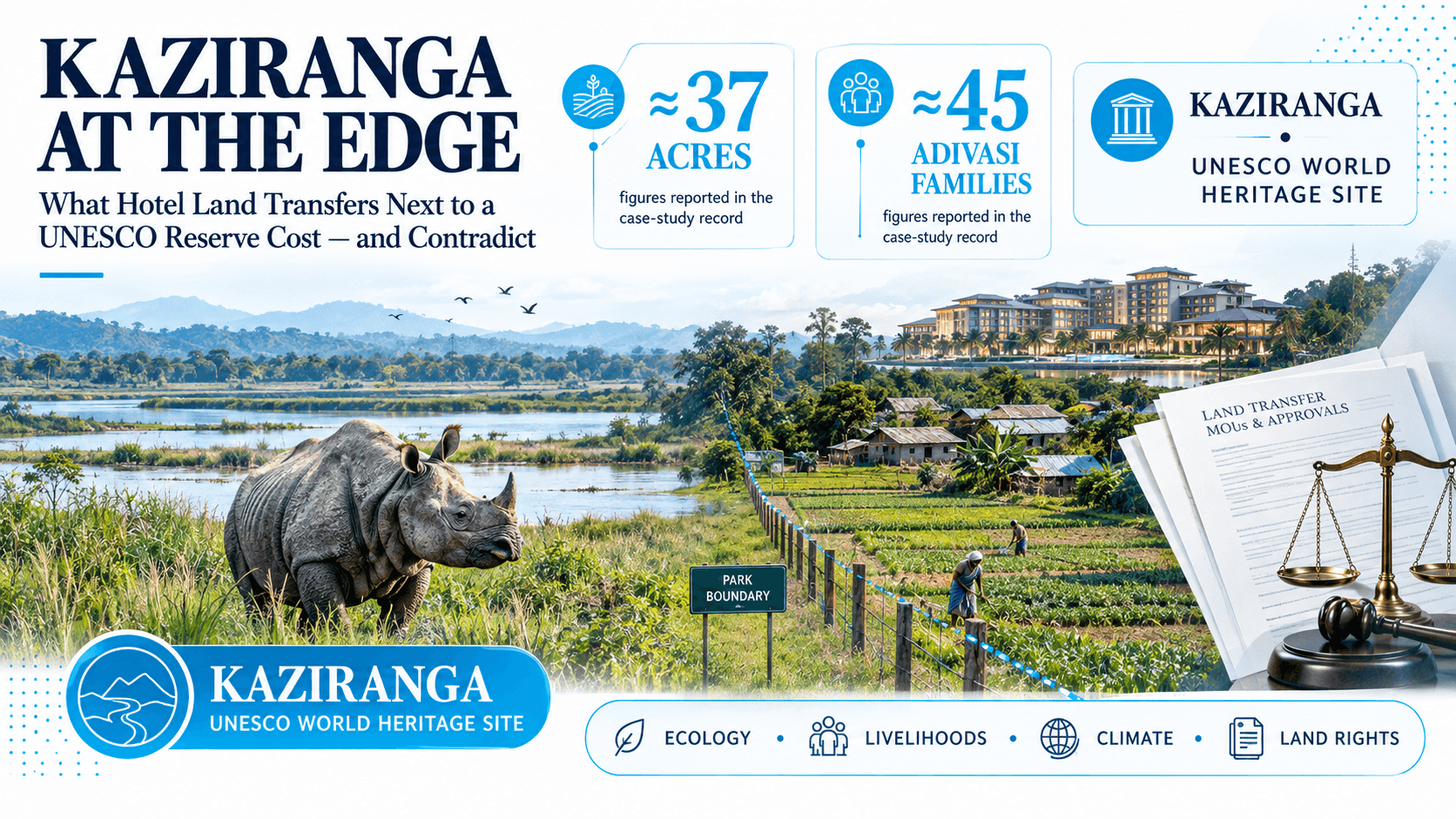
Since 2021, land at Inglay Pathar and adjoining villages bordering Kaziranga National Park and Tiger Reserve (KNPTR) — cultivated for generations by Adivasi and “tea-tribe” families — has been earmarked for two luxury hotel projects: a Hyatt-branded property developed by Juniper Hotels under a 2023 MoU with the Assam Tourism Development Corporation (ATDC), and a Tata Group-linked Taj property under a 2024 MoU. An RTI response from ATDC confirmed the land would go to Juniper Hotels, which operates Hyatt globally, under a memorandum of understanding signed on September 23, 2023. The evidence below indicates the dispute sits at the intersection of five measurable stakes — ecological, climatic, economic, livelihood and demographic — and that the project's trajectory so far runs counter to commitments India has made on forest carbon, biodiversity and inclusive development.
1. Why Kaziranga matters ecologically
Kaziranga hosts roughly two-thirds of the world's greater one-horned rhinoceroses, with the 2022 census recording 2,613 individuals, the highest count on record. It is one of the few protected areas in South Asia where five large mammals — rhinoceros, Asiatic elephant, Bengal tiger, wild water buffalo and eastern swamp deer — share a single floodplain, and the park has achieved notable conservation success relative to other Indian protected areas, sitting on the edge of the Eastern Himalaya biodiversity hotspot with high species diversity. Over 42 reptile species including the endangered gharial, the endangered Ganges river dolphin, and migratory birds such as the lesser adjutant and black-necked stork depend on the park's wetlands. The park is bordered on three sides by human settlement and tea plantations, with the Brahmaputra River providing its only natural buffer to the north — meaning any southern-boundary land conversion removes one of the park's few remaining ecological margins.
2. Carbon sink and climate value
Kaziranga's grassland-forest-wetland mosaic contributes to the forest and tree-cover carbon stock that underwrites India's climate pledge. India's Nationally Determined Contribution under the Paris Agreement commits to creating an additional carbon sink of 2.5 to 3 billion tonnes of CO2 equivalent through additional forest and tree cover by 2030. The Forest Survey of India's State of Forest Report projects the country will add 3.57 billion tonnes CO2 equivalent by 2030, taking total forest carbon stock from 28.14 billion tonnes in 2005 to 31.71 billion tonnes — a target that depends on protecting, not fragmenting, existing high-density natural cover such as Kaziranga's floodplain forest and grassland, which cannot be substituted by plantation elsewhere on a like-for-like basis.
3. Economic and livelihood importance
The immediate dispute concerns roughly 37 acres of agricultural land at Inglay Pathar, traditionally cultivated by about 45 Adivasi families belonging to the “tea tribes” community, with activists alleging the project will impact these families' livelihoods and render hundreds of other locals jobless while disturbing wildlife corridors. Farmer Geeta Gowala left restaurant employment in Kohora to return to working her land — illustrating how agriculture, not hospitality wages, remains the primary livelihood base for many affected households, a distinction the “hotels bring jobs” argument tends to elide.
4. Demographic and indigenous-rights dimension
The Greater Kaziranga Land and Human Rights Protection Committee (GKLHRPC), an umbrella body representing more than 100 fringe villages around Kaziranga, has stood with the Adivasi farmers since the resistance began, arguing the land diversion threatens both livelihoods and the fragile ecological habitat. Farmers state they hold documents evidencing cultivation across generations and that a promised revenue-department survey of the land was never carried out. The affected households are drawn from Assam's Adivasi and “tea-tribe” communities — descendants of tea-garden labour brought to Assam in the colonial period — who already occupy a marginal position in the state's land-tenure and political hierarchy.
5. Chronology: displacement and fragmentation in motion
2021–22 Adivasi farmers allege developers and local land interests began eyeing the Inglay Pathar plot; a proposed piggery project morphed into a heritage museum plan, then a hotel plan, despite most landowners rejecting it.
Sept 2023 ATDC signs MoU with Juniper Hotels (Hyatt) for the Inglay Pathar site.
Aug 2024 Assam government signs a further MoU with Amalgamated Plantations and Indian Hotels Co (Tata Group); the proposed Hyatt project alone seeks 120 rooms with a swimming pool on 8.5 acres, at an investment of Rs 100 crore.
July 2024 GKLHRPC convenor Pranab Doley is arrested amid protests; four other activists are also arrested; Doley is denied bail and sent to judicial custody.
Aug 2024 Activists documenting testimony from 45 displaced families in Rongajan village are surrounded by a mob of over 100 people, detained, and their vehicle damaged; a local woman and her daughter are assaulted.
Aug 2024 The NGT Principal Bench takes suo motu cognisance of the hotel plans, citing a news report, and transfers the case to its Eastern Zone bench.
Feb 2025 The NGT's Eastern Bench dismisses the petition, calling the apprehensions “premature”; legal experts and local activists question the reversal. The state's draft eco-sensitive zone notification for KNPTR — required under a Supreme Court order — remains unpublished.
June 2026 A no-entry sign is installed on a 3-acre plot owned by farmer Geeta Gowala at Inglay Pathar; police attempt to stop her removing it and she is charged with obstruction. The Gauhati High Court takes note of the eviction on a plea by 20 Adivasi families and issues notice to ATDC, seeking a response within four weeks — the matter remains sub judice.
6. What this looks like elsewhere: global and regional precedent
The Kaziranga case is not sui generis. Conservation-linked tourism development has displaced indigenous and local communities in at least two well-documented settings, with outcomes worth weighing as counterfactuals.
Ngorongoro–Serengeti, Tanzania (Maasai)
Maasai pastoralists were first displaced from the Serengeti in 1959 on a government promise they would never be displaced again. Roughly 150,000 Maasai people are now facing displacement from Loliondo and Ngorongoro, according to UN estimates, after Tanzania demarcated 580 square miles of land as a luxury game reserve, with a Tanzanian lawyer for affected communities stating no consent, consultation or compensation was provided despite this being a legal requirement. Two government-appointed commissions have since approved continuation and expansion of the evictions, citing the area's UNESCO World Heritage status as justification — the same designation meant to protect both nature and the people historically stewarding it.
Chitwan National Park, Nepal (Tharu, Chepang and other indigenous groups)
When Chitwan National Park was created in 1973 under the era's “fortress” conservation model, the army displaced 13 villages, many belonging to the indigenous Tharu community, with researchers documenting homes trampled by elephants and residents threatened at gunpoint. Some 20,000 villagers were evicted in total. The aftermath is the most direct parallel to Kaziranga's current dispute: even after eviction, seven hotels operated inside the park itself for roughly 30 years, and today around ten five-star and more than 200 other hotels operate in the area — while discussions to permit hotel construction inside the park have resumed, prompting the pointed question of what contradiction exists in displacing tribal communities in the name of park establishment, only to build tourism infrastructure on the same ancestral land later for revenue.
Within Kaziranga itself
In 2020–21, villagers from Haldhibari and Panbari — mostly Adivasi and Karbi farmers — were evicted from Kaziranga's own expansion areas, with more than 100 families served notices, and two people were killed in police firing during an earlier eviction drive; notices were also served to more than 400 further households in Borbil-Mising gaon and Bhuyan Adivasi gaon in 2024. The current hotel-land dispute is therefore a continuation of an existing displacement pattern around the park, not an isolated episode.
Cascading effects: how one land-use decision compounds
Land reallocated for hotel enclaves sets off effects across three domains, which reinforce one another rather than staying contained:
● Environmental: corridor fragmentation, loss of the southern-boundary buffer, and added pressure on floodplain forest carbon stock — which in turn reduces resilience of habitat supporting two-thirds of the world's greater one-horned rhinos.
● Economic: a shift from smallholder agriculture to enclave-tourism wages, with local capture of hospitality value uncertain — risking long-run livelihood insecurity if tourism jobs prove seasonal, low-wage or externally staffed.
● Social / demographic: eviction notices, loss of Adivasi/tea-tribe land tenure, and criminalisation of protest — weakening the community stewardship that has historically aided flood-refuge cooperation and anti-poaching efforts.
● Both the environmental and economic threads converge on a single tension: India's own NDC forest-carbon commitments and SDG 1/8/15 targets (poverty, decent work, life on land) assume the opposite trajectory to the one now under way at Kaziranga's boundary.
7. Contradiction with the government's own commitments
Commitment | What it states | Tension with current trajectory |
India's NDC (Paris Agreement) | Additional carbon sink of 2.5–3 billion tonnes CO2 equivalent via forest and tree cover by 2030 | Target counts on protecting dense natural cover; fragmenting Kaziranga's southern buffer works against the floodplain-forest carbon base the target assumes. |
MISHTI mangrove initiative | A Union government scheme restoring mangrove cover for climate resilience, biodiversity and community livelihoods, run by MoEFCC | The state simultaneously funds ecosystem restoration on one coast while approving conversion of an intact, globally significant habitat's buffer on the other. |
UN SDGs 15, 1, 10 | Life on land; no poverty; reduced inequalities | Land transfer displaces a historically marginalised Adivasi/tea-tribe population without documented consultation, per petitioners' court filings. |
Supreme Court-mandated eco-sensitive zone | Requires a published, consulted draft ESZ notification around tiger reserves | Assam's draft ESZ notification for KNPTR remains unpublished as of the NGT's 2025 order, leaving the buffer's legal status unresolved even as hotel MoUs proceed. |
Counter-evidence, stated plainly
ATDC's own RTI response frames the land transfer as a formal MoU-based arrangement with a named international operator, not an informal seizure, and proponents argue high-end conservation tourism can fund anti-poaching and buffer-zone employment that lower-end tourism cannot. The NGT's Eastern Bench explicitly found the apprehensions raised against the project “premature” and dismissed the suo motu case in February 2025 — a live legal determination this piece does not overturn. Whether the Gauhati High Court's 2026 notice to ATDC results in a different finding is, as of publication, unresolved.
8. What the evidence does and does not establish
The documented record supports three bounded claims: (1) Kaziranga's ecological and carbon-sink value is well evidenced and formally recognised through UNESCO and India's own NDC accounting; (2) the specific land-transfer process at Inglay Pathar has, at each stage since 2021, followed a sequence — informal land interest, MoU, eviction notice, protest, arrest, and only then judicial scrutiny — that closely mirrors the Chitwan and Ngorongoro precedents, both of which ended in prolonged, unresolved displacement rather than the “conservation plus shared prosperity” outcome typically promised at the outset; and (3) the project as currently structured sits in tension with India's own forest-carbon and sustainable-development commitments, chiefly because the state has not yet published the legally required eco-sensitive zone notification that would define what can and cannot be built on Kaziranga's boundary.
The evidence does not establish that the hotels will necessarily proceed, that they will necessarily cause ecological harm at the scale seen in Nepal or Tanzania, or that the Gauhati High Court will rule for the petitioners. Those outcomes remain open, and any responsible account must wait on the pending litigation rather than presume its result.
Sources
Kaziranga ecology & UNESCO status: UNESCO WHC documentation · Wildlife Institute of India · 2022 rhino census summary
India's NDC / carbon sink: IEA policy database · India's Updated NDC, UNFCCC submission (2022) · Outlook Business on FSI State of Forest Report
MISHTI mangrove scheme: Vikaspedia / MoEFCC programme note
Land dispute chronology & livelihoods: The Wire · Down To Earth (incl. June 2026 update) · The Quint · Asian Human Rights Defenders Network incident report
NGT and Gauhati HC proceedings: Down To Earth on NGT's Feb 2025 dismissal · The Wire on 2020–21 and 2024 evictions · SCC Online case note
Ngorongoro–Serengeti precedent: Al Jazeera · Foreign Policy · 2026 protest update
Chitwan precedent: Scroll.in · Mongabay · Kantipur
This piece could not access telegraphindia.com directly (the site blocks automated retrieval); the underlying events it reports are corroborated above through Down To Earth, The Wire and The Quint's independent coverage of the same land dispute.
Pre-publish note: the Gauhati High Court matter and Assam's eco-sensitive zone notification for KNPTR are both pending as of June 2026 — treat any figure on final land area or affected-family count as provisional until the court record and ESZ draft are published.