
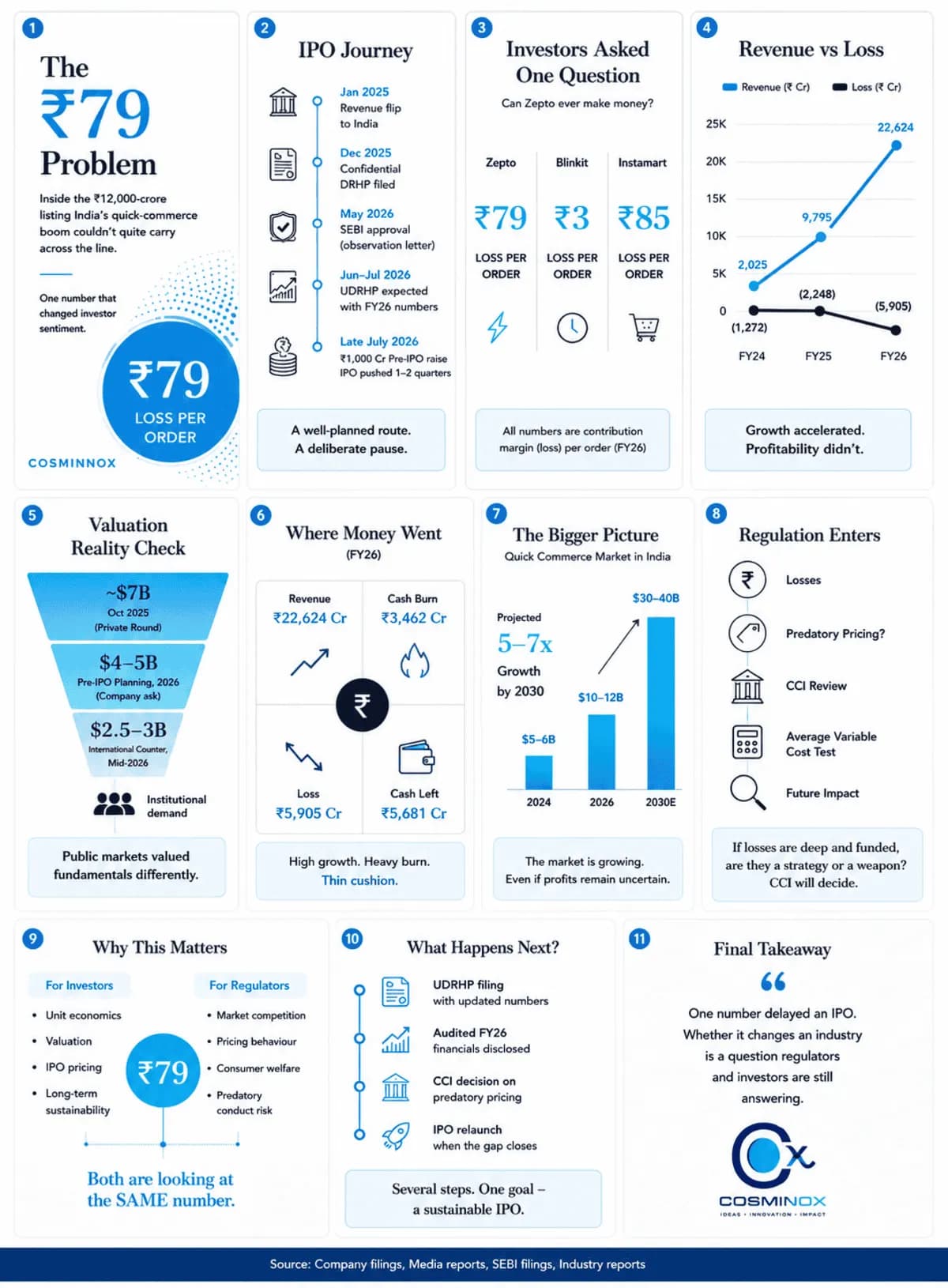
Inside the ₹12,000-crore listing India's quick-commerce boom couldn't quite carry across the line
Zepto cleared SEBI's confidential filing route in May, arranged a ₹1,000-crore pre-IPO cushion in July, and pushed the actual listing back by a quarter or two. The company calls it a pause. The number domestic institutions kept coming back to — a loss of roughly ₹79 on every order, against ₹3 for Blinkit — suggests it was also a correction. And it's the same number a competition regulator would need if it ever tried to prove the opposite argument: that the losses are cheap enough, and funded enough, to be a weapon rather than a mistake.
Five Steps to a Stalled Listing
Zepto's route to market is fully documented, and the documentation is worth laying out before the argument starts, because the sequence itself carries information: this was not a company caught off guard by a bad number. It restructured, filed, cleared regulatory review, and only then stopped.
● January 2025 — Zepto's Singapore-incorporated parent, Kiranakart Pte Ltd, merged into an Indian entity following NCLT approval, completing a reverse domicile flip ahead of any public filing.
● December 26, 2025 — Zepto filed a confidential Draft Red Herring Prospectus with SEBI under the pre-filing route.
● May 8, 2026 — SEBI issued its observation letter clearing the confidential filing, with the offer sized at roughly ₹11,000–12,000 crore.
● June–July 2026 — An Updated DRHP reflecting FY26 financials and a revised price band was expected to follow.
● Late July 2026 — Instead of filing the UDRHP, Zepto arranged a roughly ₹1,000-crore pre-IPO placement from existing investors and pushed the public listing back an estimated one to two quarters.
SEBI rules cap a pre-IPO placement of this kind at 20% of the proposed fresh-issue component, with the amount later adjusted against the IPO's own fresh issue. Co-founder Aadit Palicha reportedly told employees internally that the delay would run "one to two quarters" — a company characterization, not a confirmed date.
Where the Number Came From
The proximate cause of the delay is a gap between what private markets had priced Zepto at and what domestic institutions were prepared to pay in public markets — wide enough that the company chose to wait rather than close it.
Point in time | Valuation | Basis |
October 2025 | ~$7 billion | Private round led by CalPERS and General Catalyst |
Pre-IPO planning, 2026 | $4–5 billion | Company's own reduced ask ahead of the DRHP process |
Reported investor counter, mid-2026 | $2.5–3 billion | Level at which institutions indicated willingness to invest, per people familiar with the matter |
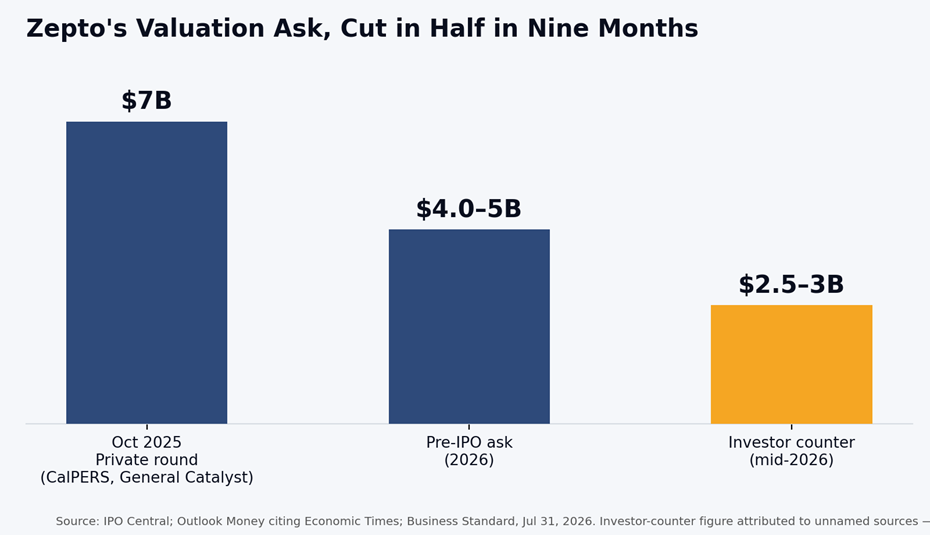
Some domestic mutual funds and insurers reportedly sought a further 30–40% cut below even that reduced ask, citing Zepto's lack of a food-delivery vertical as one factor — unlike its listed peers. These figures sit at Tier 3: attributed to unnamed sources across several outlets, not to a filing or a named institution. They're reported consistently enough to treat as directionally reliable, not as audited fact.
The unlisted-share market offers a rougher but independent check on the same story. Zepto's grey-market price fell from roughly ₹58 at its peak to the ₹21–24 range by late July 2026 — a drop of more than half — tracking the reports of the pause almost exactly.
Why the public only saw the outcome, not the negotiation
Zepto filed under SEBI's confidential pre-filing route — Chapter IIA of the ICDR Regulations, introduced in November 2022 — rather than the standard public DRHP process. The mechanism lets a company submit its draft prospectus to SEBI and the exchanges without making it public, test institutional appetite quietly, and take up to 18 months to list instead of the standard 12. Adoption has moved fast: of roughly 22 companies that have used the route since 2022, about 18 filed in 2025 alone, Zepto among them, alongside OYO and Groww.
The trade-off is exactly the one this story turns on. A company gets to negotiate valuation with institutions before the number is public, and can walk away quietly if the price doesn't clear — which is functionally what Zepto did in July. But it also means the valuation gap that eventually became public knowledge was fully negotiated, in private, before retail investors, analysts, or the financial press had the draft prospectus to check it against. The institutions that pushed Zepto's ask down from $4–5 billion toward $2.5–3 billion had the numbers months before anyone outside that room did. For a regulator, that's a legitimate design choice — competitor-shielding and orderly price discovery are real goals. For a public-market investor evaluating the next quick-commerce listing, it's worth knowing that the loudest signal in this story happened somewhere they couldn't see it.
What the Ledger Actually Says
The gap isn't sentiment. It tracks specific, disclosed numbers.
Growth without narrowing losses
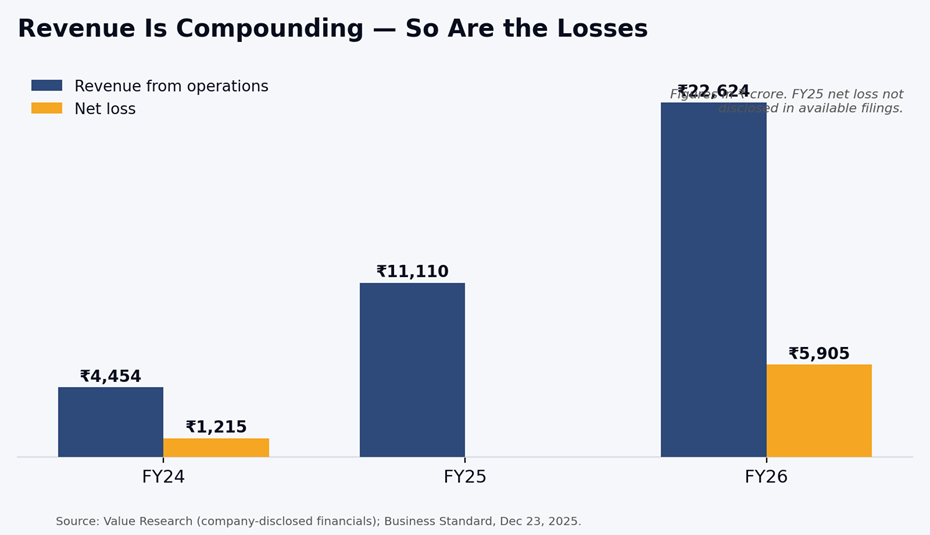
Zepto's revenue from operations more than doubled in FY26, to approximately ₹22,624 crore from ₹11,110 crore in FY25 — itself up 149% on FY24's ₹4,454 crore. Net losses moved the other way over the same stretch, widening from about ₹1,215 crore in FY24 to roughly ₹5,905 crore in FY26. Operating cash consumption ran to about ₹3,462 crore for the year, and cash on hand fell from ₹7,441 crore to ₹5,681 crore over the same twelve months.
The per-order gap investors are actually pricing
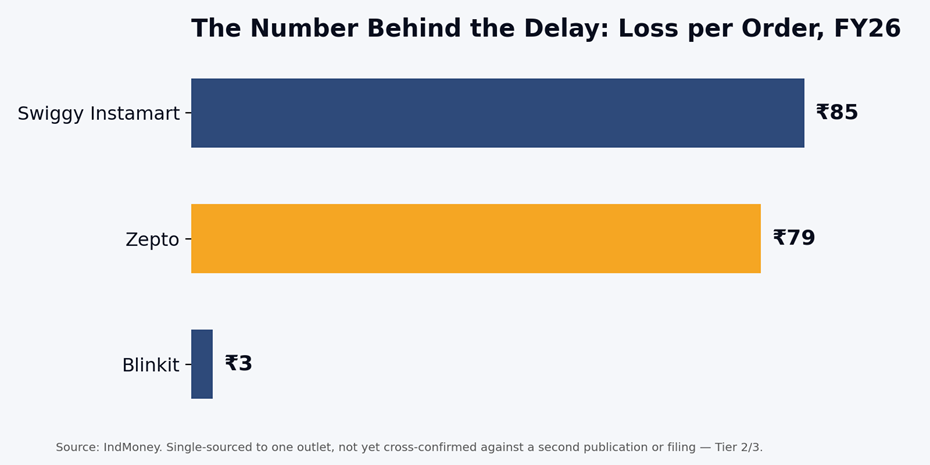
The comparison doing the real work in investor conversations is loss per order, set against Eternal's (formerly Zomato's) Blinkit and Swiggy's Instamart — both public, and therefore checkable against exchange filings in a way Zepto's private numbers aren't. Reported FY26 figures: roughly ₹3 loss per order for Blinkit, versus roughly ₹79 for Zepto and ₹85 for Swiggy Instamart. That ₹79-versus-₹3 gap is the single most-cited number behind why Zepto, specifically, is drawing this level of scrutiny while Blinkit isn't. One flag: the figure is currently single-sourced to one outlet and hasn't been cross-confirmed against a second publication or filing — treat it as directional pending the UDRHP.
Two benchmarks that didn't exist before
Public investors now have reference points Zepto's earlier private rounds were priced without: Eternal's market capitalization sits at roughly ₹2,91,778 crore, Swiggy's at roughly ₹78,655 crore. A private valuation set before either company listed is, by construction, untested against them — which is a plain enough reason for the ask to move.
The Housekeeping Before the Listing
Two structural changes preceded the IPO filing, aimed at two different regulatory targets rather than one.
The reverse domicile flip moved Zepto's holding structure from Singapore to India in January 2025, cleared by both a Singapore court and India's NCLT. It followed a wider pattern — PhonePe, Groww, and later Flipkart made similar moves ahead of planned domestic listings, helped along by regulatory changes that made the flip easier and by the relative appeal of India's public markets.
Separately, Zepto set an internal target of lifting domestic ownership to at least 40% ahead of filing, with some reporting citing a later target above 50%. This is a different question from the domicile flip — who holds the equity, not where the parent is incorporated — though both moves point the same direction: aligning the company with what Indian regulators and public-market investors expect before asking them for capital.
The Case the Same Numbers Also Make
The evidence above supports a narrower, company-specific reading. It doesn't, on its own, support a sector-wide one — and the same data set has more to say on the other side.
Revenue growth here is real and compounding, not a one-off spike: 149% from FY24 to FY25, then more than doubling again in FY26. A widening loss alongside more-than-doubling revenue is also the shape a scaling business investing ahead of demand takes — the same pattern Blinkit and Instamart went through before their own loss-per-order figures improved.
A pause is not a withdrawal. The ₹1,000-crore pre-IPO raise sits inside SEBI's existing placement rules and is sized against Zepto's already-disclosed ₹8,010-crore fresh-issue plan — an adjustment, not a replacement. The company continues to draw participation from existing backers, including Motilal Oswal Financial Services, General Catalyst, Goodwater Capital, Glade Brook, and Nexus Venture Partners, rather than facing an exit of investors.
The category itself is still expanding. Quick commerce reached an estimated gross merchandise value of ~₹963 billion (~$11.3 billion) in CY2025, with industry forecasts projecting 5–7x growth by CY2030. Being skeptical of Zepto's specific valuation doesn't require being skeptical of the category's growth trajectory.
And the caution may not be Zepto-specific at all. Bernstein's January 2026 note on Indian e-commerce described 2026 as another year of discovery, not profits, for the sector broadly — arguing that both Eternal's and Swiggy's fortunes are driven by performance and competitive dynamics rather than any broad-based consumption theme. If a leading sell-side house applies that lens to companies that are already listed and already profitable in places, then Zepto facing harder scrutiny as a pre-IPO, loss-making entrant is consistent with the same standard, not a judgment reserved for it alone.
The Regulation That Could Reprice This Number
A separate process has been running on almost exactly the same clock as Zepto's IPO, involving the same three companies, and it changes what the ₹79 figure could mean beyond this one listing.
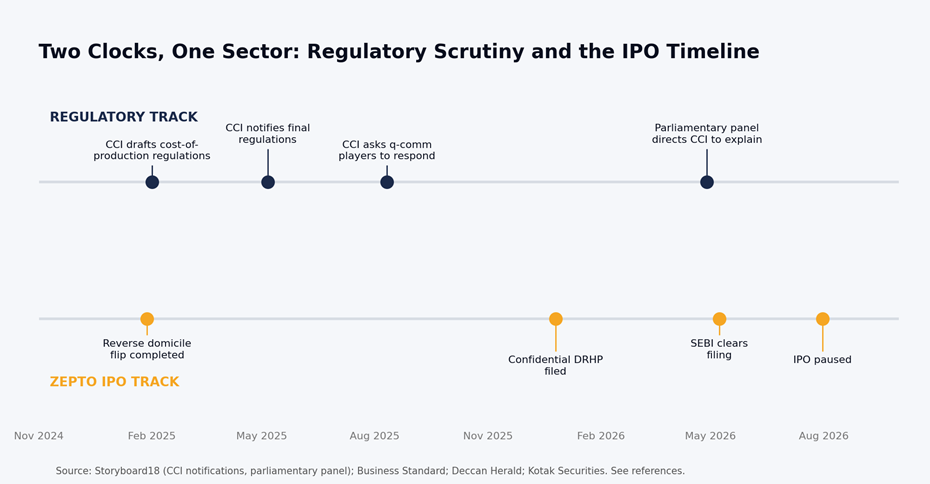
In February 2025, the Competition Commission of India released draft regulations to redefine how it measures "cost of production" in predatory-pricing cases — the legal test under Section 4(2)(a)(ii) of the Competition Act for whether a dominant firm is selling below cost to eliminate rivals. The CCI notified the final version, the Determination of Cost of Production Regulations, 2025, on May 6, 2025, replacing a framework that had stood since 2009. The change that matters here: the new rules make average variable cost the primary benchmark, evaluated case by case rather than against a fixed sector metric, with the Commission able to call in outside experts to assess digital-market costs specifically. By August 2025, the CCI had asked quick-commerce platforms to respond to predatory-pricing allegations under this framework. In April 2026, a parliamentary standing committee directed the CCI to explain what it was doing to protect small retailers.
None of this is a finding against Zepto, Blinkit, or Instamart — the process is still at the response-and-review stage, and no public order has been reported as of this writing. But the mechanics are worth sitting with: a cost-based predatory-pricing test built around average variable cost is, in substance, asking the same question this piece has been asking about Zepto's unit economics — is the price below cost, and by how much. The ₹79-per-order figure that domestic institutions used to knock down Zepto's IPO ask is the same category of number a CCI investigation would need to build a case. The regulatory and investor tracks aren't just running in parallel; they're pricing the same underlying fact from two different chairs. A finding against the sector's pricing practices would land on unit economics investors are already treating as a valuation risk — and a valuation correction like Zepto's, driven by the market rather than a regulator, doesn't resolve the CCI's question either way.
The claim driving the regulatory side is the All India Consumer Products Distributors Federation's estimate of roughly 200,000 kirana store closures over a recent one-year period, attributed to quick-commerce competition and concentrated in metro markets. Set against India's estimated 12 million-plus kirana stores nationally, that's on the order of 1.5–2% of the total — a modest share nationally, though the federation's own framing (concentrated in the cities where quick commerce actually operates) means the national percentage almost certainly understates the effect in the specific metro markets where Zepto, Blinkit, and Instamart compete for volume. No verified metro-only denominator exists in the public record to size that more precisely. Separately, quick commerce is now reported to account for 70–75% of e-grocery order volume, and traditional retailers — kirana owners and their households — are estimated to make up roughly a fifth of India's population, which is the scale of political constituency behind the parliamentary committee's interest. That figure is a Tier 3 estimate, not a Census count, and should be read as an order of magnitude.
The federation's 200,000-closures figure and its CCI complaint are, again, an interested industry body's claims — Tier 3, not a CCI finding — and belong in this piece as the thing the regulatory process is testing, not as an established fact about Zepto's conduct specifically. The point of pairing the two tracks isn't to suggest Zepto is implicated by association; the CCI's question spans three companies and a sector-wide pricing pattern, not one firm's IPO. It's that a bureaucrat weighing whether to accelerate the CCI's review, and an investor weighing whether the ₹79 figure is a one-off or a sector floor, are, without much overlap in how they'd describe it, asking the same question about the same number.
What the Record Supports
Zepto's IPO delay reflects a documented, quantifiable gap between its FY26 unit economics — specifically, loss per order relative to its closest listed comparable — and the price domestic institutional investors were willing to pay, at a moment when two listed peers now exist as public benchmarks that didn't exist when Zepto's private valuation was set. The revenue growth, the structural moves toward Indian listing norms, and the stated one-to-two-quarter timeline are all independently documented and consistent with a deferred listing, not an abandoned one.
What it doesn't support: that quick commerce is structurally unprofitable as a category — Blinkit's markedly lower loss-per-order figure argues against that — or that the sector's competitive practices are displacing traditional retail unlawfully. That question sits with the CCI, running under a cost-of-production framework barely a year old, and remains open. Anything beyond these two bounded claims isn't supported by the sourced record as of end-July 2026.
What would move either question forward is specific and checkable, not speculative: on the investor side, the UDRHP itself, whenever Zepto files it, since it will finally put Zepto's audited FY26 numbers — and the real loss-per-order figure, not a single-sourced estimate — into the public record SEBI's confidential route has kept out of view. On the regulatory side, any CCI order applying the 2025 cost regulations to a named quick-commerce platform, which would be the first real test of whether the average-variable-cost standard can actually distinguish aggressive scaling from predatory pricing in a sector where every major player is still losing money. Until one or both of those documents exists, the ₹79 figure is doing more analytical work than a single-sourced number should have to.
The public DRHP has not been filed as of this writing. Several figures above — marked Tier 3 in the source list — aren't independently checkable against a primary regulatory document yet and should be revisited once the UDRHP is public.
References
Numbered in order of first citation. Tier 1: regulatory/exchange filings, court records. Tier 2: credible secondary reporting of original facts. Tier 3: attributed to unnamed sources, brokerage/analyst opinion, or company statements — never stated as bare fact.
Regulatory & IPO Filings
Kotak Securities — "Zepto IPO 2026 Date, Price, GMP, Allotment, Review & Analysis" (citing SEBI Observation Letter), May 2026. Tier 2 — Regulatory action.
Kotak Securities — UDRHP Timeline Update, June 2026. Tier 2.
Corporate Professionals — "SEBI's Confidential IPO Route: A Controlled Path to the Public Market." Tier 2 — Legal analysis.
Finshots — "Understanding Confidential IPOs." October 2025. Tier 2 — SEBI Chapter IIA framework and adoption trends.
Business Standard — "Zepto Preparing to Confidentially File Draft IPO Papers Tomorrow." December 25, 2025. Tier 2.
Business Standard — "Zepto Delays IPO by Two Quarters as Investors Push for Lower Valuation." July 31, 2026. Tier 2/3 — Investor figures attributed to unnamed sources.
Business Standard — "Zepto FY25 Revenue Increases 149% to ₹11,110 Crore Ahead of IPO Plans." December 23, 2025. Tier 2.
Business Standard — "Zepto FY25 Revenue Increases 149%." July 30, 2025. Tier 2/3 — Domestic ownership reporting.
Business Standard — "Zepto Set to Raise IPO Size to $800M–$1B, Targets $5.5B Sales by FY26." January 22, 2026. Tier 2/3.
Business Standard — "US-Based Bernstein Sees Volatile 2026 for India's E-commerce Market." January 13, 2026. Tier 2.
Business Standard — "Quick Commerce Led to Closure of 200,000 Kirana Stores: Retailers' Body." Tier 3 — Industry-body claim.
Business Standard — "Complaint Against Q-Commerce Players: Distributors Submit Additional Info to CCI." August 11, 2025. Tier 2.
IPO Central — "Zepto IPO News." April 8, 2026. Tier 2.
Outlook Money — "Zepto IPO Hits Standoff: Indian Mutual Funds Demand 40% Valuation Cut." Tier 3 — Citing unnamed sources.
Inc42 — "Zepto Pauses IPO Amid Valuation Concerns, To Raise ₹1,000 Crore Pre-IPO Round." Tier 3.
Business Today — "Zepto IPO: Unlisted Shares Tumble as Listing Plans Stall." Tier 3 — Grey-market pricing.
Value Research — "Zepto's IPO Is Off. The Mutual Funds You Own Did It for You." Tier 2.
IndMoney — "Why Zepto Paused Its IPO: The Story Behind the Valuation Gap." Tier 2/3.
Kotak Securities — Quick Commerce GMV & TAM Projections. Tier 3 — Industry estimates.
Deccan Herald — "Zepto Completes Reverse Flip from Singapore to India Ahead of IPO: CFO." January 28, 2025. Tier 1/2.
PTI (via Newsdrum) — "Zepto Completes Reverse Flip from Singapore to India Ahead of IPO." January 28, 2025. Tier 1/2.
TechCrunch — "Zepto Shifts HQ to India as Local Listings Gain Appeal." Tier 2.
CB Insights — "Bigger Than E-commerce? Digitizing the Kirana Store Is the Biggest Opportunity in Indian Retail." Tier 2.
Reuters (via MarketScreener) — "Indian Retail Group Seeks Antitrust Probe of Quick-Commerce Companies." Tier 2.
Storyboard18 — "CCI Notifies New Norms to Assess Predatory Pricing Practices." May 8, 2025. Tier 1/2.
Storyboard18 — "Parliamentary Panel Seeks CCI Response on Safeguarding Small Retailers Amid Quick Commerce Dominance." April 15, 2025. Tier 2.
Finshots — "The Quick Commerce vs. Kirana Stores Debate Is Back!" April 2026. Tier 2.