Founders: Vijay Shekhar Sharma (Founder & CEO, One97 Communications)
Category: Digital Payments & Financial Services | Headquarters: Noida, Uttar Pradesh, India | Founded: December 2000 (One97 Communications); Paytm launched August 2010
EXECUTIVE SUMMARY
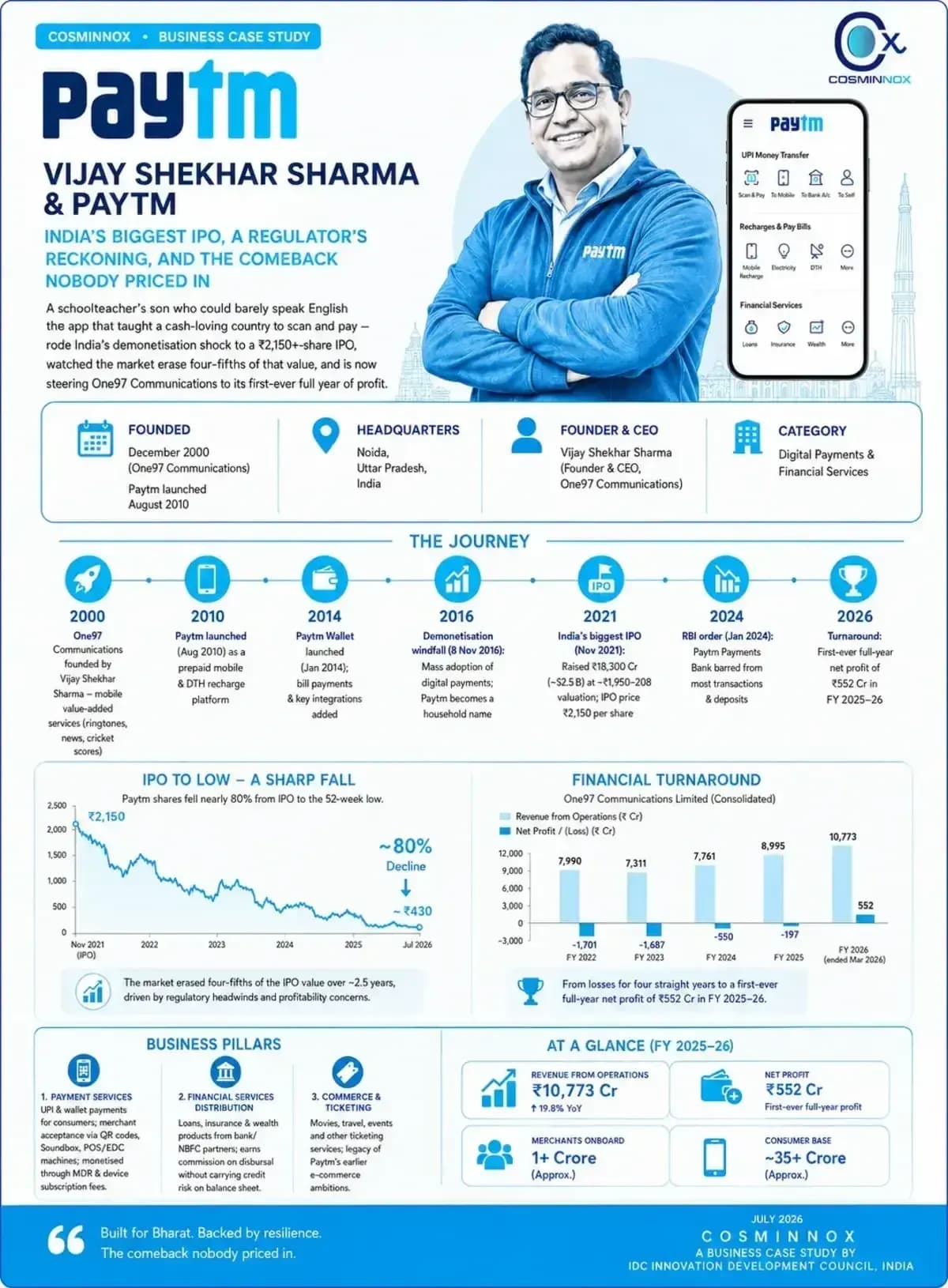
Paytm — the consumer brand of One97 Communications Limited — is India's most recognised digital-payments platform, built by Vijay Shekhar Sharma from a dial-a-tune mobile content business he founded in December 2000 into a mobile recharge app launched in August 2010, and eventually into a payments-and-financial-services distribution company serving hundreds of millions of Indians. Its single biggest headline fact is a study in extremes: in November 2021 it delivered India's largest-ever initial public offering, raising ₹18,300 crore (about $2.5 billion) at a roughly $19–20 billion valuation, only to see the stock collapse nearly 80 per cent over the following two-plus years — a fall accelerated by the Reserve Bank of India's January 2024 order effectively shutting down Paytm Payments Bank. This case study traces that full arc: the founding, the demonetisation-fuelled rise, the record IPO and its unwinding, the regulatory reckoning, and the operational turnaround that delivered One97 Communications its first-ever full-year net profit — ₹552 crore in the financial year ended March 2026.
HOW IT STARTED
Vijay Shekhar Sharma was born on 7 June 1978 in Aligarh, Uttar Pradesh, the third of four children of a schoolteacher father and homemaker mother. He grew up in a Hindi-medium household and struggled with English even as he was admitted to Delhi College of Engineering (now Delhi Technological University) at 15, graduating with a degree in electronics and communications at 19 — reportedly unable to comfortably follow lectures delivered in English in his first year.
College is also where his entrepreneurial instincts surfaced. Inspired by the first wave of internet companies, he co-founded a content management venture called XS Communications while still a student, and built indiasite.net, a web-hosting business he later sold for roughly $1 million. After brief stints in business development at RiverRun Software Group and as tech head at India Today Group Online, Sharma founded One97 Communications in December 2000 — a mobile value-added-services company that, in the pre-smartphone era, let customers dial a number to access ringtones, cricket scores and news for telecom operators such as Airtel and Vodafone.
By his own accounts, the early 2000s were lean years: Sharma has spoken of periods when he could not cover basic living expenses and had to borrow money to get by, even as he kept One97 running on a modest founder's salary. The pivot that created Paytm came a decade later, in August 2010, when One97 launched Paytm — an acronym for 'Pay Through Mobile' — as a prepaid mobile and DTH recharge platform, later adding bill payments, a digital wallet (launched January 2014), and integrations with services like Uber and Indian Railways.
WHAT PAYTM IS
Paytm operates as a mobile-first payments and financial-services distribution platform under its listed parent, One97 Communications Limited. Its business today rests on three pillars. The first is payment services: UPI and wallet-based payments for consumers, and merchant acceptance infrastructure — QR codes, Soundbox audio devices, and point-of-sale/EDC machines — monetised through transaction (MDR) revenue and recurring device-subscription fees paid by merchants.
The second pillar is distribution of financial services: Paytm connects its merchant and consumer base to loans, insurance and wealth products underwritten by bank and NBFC partners, earning commission on disbursal rather than carrying the underlying credit risk on its own books — a model reinforced after regulatory restrictions curtailed Paytm Payments Bank's deposit-taking activities. The third, smaller pillar is commerce and ticketing (movies, travel, events), a legacy of Paytm's earlier, more diversified e-commerce ambitions under the now-largely-wound-down Paytm Mall. Across all three, Sharma has increasingly framed the company's edge as operational: using AI to cut servicing costs, tighten fraud detection and improve collections rather than compete purely on cashback-led growth.
THE DEMONETISATION WINDFALL
Paytm's defining growth moment arrived on 8 November 2016, when Prime Minister Narendra Modi announced the overnight demonetisation of ₹500 and ₹1,000 notes — roughly 86 per cent of India's currency in circulation. Sharma, attending an industry event in Mumbai when the announcement broke, later called it among the boldest decisions in independent India's financial history; Paytm ran front-page newspaper advertisements praising the move and rolled out its 'Paytm Karo' campaign in eleven regional languages.
What the numbers show
Event | Detail |
Trigger | Demonetisation of ₹500/₹1,000 notes announced 8 November 2016, removing roughly 86% of cash in circulation |
Wallet users, pre-event | Around 125 million |
Wallet users, ~3 months post-event | Around 185 million |
Merchant reach at the time | Reported presence across roughly 850,000 stores, petrol pumps and outlets in over 1,200 Indian cities |
Marketing backlash | The ad 'Drama Bandh Karo… Paytm Karo' was criticised as classist and tone-deaf toward domestic workers; Paytm withdrew it for a reworked 'Ab ATM Nahin, Paytm Karo' campaign |
The episode cemented 'Paytm karo' as shorthand for cashless payment in everyday Indian speech and made Sharma, then 38, one of the most sought-after voices in Indian business media within days. It also set a pattern that would recur: aggressive, high-visibility marketing that built the brand faster than it built durable unit economics.
THE ₹18,300-CRORE IPO — AND THE CRASH
Five years after demonetisation, Paytm went public. The build-up to the November 2021 listing was propelled by a string of marquee funding rounds through the 2010s — from Alibaba/Ant Financial's roughly 40% stake in 2015, to SoftBank's Vision Fund entering in 2017, to Warren Buffett's Berkshire Hathaway investing $300 million in 2018 — that pushed One97's private valuation from roughly $1.5 billion in 2015 to around $16 billion by late 2019.
Deal terms
Deal Term | Detail |
Amount raised | ₹18,300 crore, reported as roughly $2.5 billion (some outlets cite $2.44 billion) |
Issue price | ₹2,150 per share — the top of the ₹2,080–2,150 price band |
Valuation | Approximately $19–20 billion; India's largest IPO by local-currency value at the time, surpassing Coal India's 2010 listing |
Anchor investors | BlackRock and the Canada Pension Plan Investment Board, contributing roughly $1.1 billion between them ahead of listing |
Founder status | Sharma stepped down as a listed 'promoter' of the company ahead of the IPO, continuing as founder and CEO |
Listing-day result | Debuted at ₹1,955 (a 9% discount to issue price) and closed the first day down roughly 27% |
Subsequent trajectory | Stock fell as much as 80% from its issue price by February 2024, touching an all-time low of around ₹310 |
Analysts were split even before the bell rang: brokerage Macquarie cut its target price 40% ahead of listing, arguing Paytm's business lacked focus across payments, banking, e-commerce and gaming. The market's early scepticism proved prescient — the stock's anchor lock-in expiry a month later triggered a further slide, and the losses would compound sharply once regulators intervened in the payments-bank business two years later.
THE RBI RECKONING
Paytm's most serious crisis was regulatory, not competitive. It played out over roughly two years, in escalating stages, before a resolution began to take shape through 2025.
Timeline of action
Date | Action |
March 2022 | RBI bars Paytm Payments Bank from onboarding new customers, citing supervisory concerns and ordering a comprehensive IT systems audit |
November 2022 | RBI separately halts Paytm Payments Services Limited, the payment-aggregator arm, from onboarding new merchants pending compliance with FDI-related rules |
31 January 2024 | RBI directs Paytm Payments Bank to stop accepting fresh deposits, top-ups and credit transactions after 29 February, citing 'persistent non-compliances and continued material supervisory concerns'; the deadline was later extended to 15 March |
Early February 2024 | Stock falls roughly 40% over two trading days, erasing about $2 billion in market value |
August–November 2025 | RBI grants in-principle, then final, Certificate of Authorisation for Paytm Payments Services to operate as an online payment aggregator, lifting the November 2022 onboarding ban |
Sharma publicly downplayed the severity in the immediate aftermath, telling investors on a February 2024 call that the RBI action was 'more of a speed bump' and that Paytm would operate through partner banks going forward rather than its own payments bank. In a separate but related move, in August 2023 Sharma — through his firm Resilient Asset Management — bought out Ant Financial's roughly 10.3% stake in One97 Communications in a no-cash swap worth about $628 million, a step widely read as an effort to reduce the company's foreign-ownership exposure ahead of future licensing decisions; Ant's remaining Paytm holding was fully divested by August 2025.
REVENUE AND FINANCIAL TRAJECTORY
Paytm's capital history is one of the most heavily funded in Indian startup history, followed by one of its steepest listed-market drawdowns, and — most recently — a sharper-than-expected swing to profitability.
Milestone | Reported Figure | Timeframe |
Seed funding | $10 million from Sapphire Ventures | October 2011 |
Series D | $246 million from Alibaba Group and SAIF Partners; valuation reported between $1.5–2.6 billion across sources | 2015 |
Series E | Ant Financial (Alibaba affiliate) acquires roughly 40% stake | September 2015 |
Growth round | $680 million from SoftBank Group, SAIF Partners and Discovery Capital; valuation around $7 billion | 2016 |
Series G | $1.4 billion from SoftBank Vision Fund and existing backers; valuation around $10 billion | 2017 |
Strategic investment | $300 million from Berkshire Hathaway for a 3–4% stake; valuation around $10 billion | August 2018 |
Series H | $1 billion from T. Rowe Price, Ant Financial and SoftBank Vision Fund; valuation around $16 billion | November 2019 |
IPO | ₹18,300 crore (~$2.5 billion) raised; valuation ~$19–20 billion | November 2021 |
Post-IPO trough | Share price down as much as 80% from issue price, low of roughly ₹310 | February 2024 |
First full-year profit | Consolidated net profit of ₹552 crore versus a ₹663 crore loss the prior year; revenue from operations up 22% YoY to ₹8,437 crore | FY26 (year ended March 2026) |
The FY26 turnaround was broad-based rather than a one-off: quarterly profit after tax reappeared in Q1 FY26 (₹122.5 crore, against a ₹838.9 crore loss a year earlier — Paytm's first quarterly profit since the September 2024 quarter), strengthened through Q3 FY26 (₹225 crore PAT, EBITDA swinging from a loss of ₹223 crore to a positive ₹156 crore), and held for the full year. Payment-processing margins crossed 4 basis points, ahead of the company's own 3-basis-point guidance, on a richer mix of MDR-bearing instruments including credit-on-UPI and EMI options, while revenue from distribution of financial services grew 52% year-on-year to ₹2,593 crore, with repeat borrowers accounting for more than half of merchant loan disbursements.
CUSTOMER GROWTH
Stage | Metric | Timeframe |
Pre-demonetisation base | Around 125 million wallet users | Pre-November 2016 |
Demonetisation surge | Wallet users rise to around 185 million | Within ~3 months of November 2016 |
IPO-era scale | 337 million registered users; roughly 50 million monthly active users | November 2021 |
Post-RBI-ban contraction | User base shrinks 24% to about 80 million active users; active devices fall by roughly 1 million | First four months of 2024 |
Merchant-base rebuild | Subscription-paying merchants grow from 6.8 million (March 2023) to 13 million (June 2025); total merchant base grows from 3.4 crore to 4.5 crore over the same period | March 2023 – June 2025 |
Current reported scale | More than 540 million cumulative users; around 46 million daily active users | Most recent public estimate |
Growth has come through three distinct channels over Paytm's history: a demonetisation-era advertising blitz that built consumer habit almost overnight; sustained merchant-side distribution of QR codes, Soundbox devices and EDC machines that turned small shopkeepers into a recurring subscription base; and, most recently, cross-selling financial-services products to that same merchant and consumer base rather than acquiring new users through high-cost marketing.
GROWTH TECHNIQUES USED
Technique | How It Was Applied |
Founder-led media narrative | Sharma's own rags-to-riches story — a schoolteacher's son who struggled with English — became inseparable from the brand, reinforced by his Time 100 (2017) and youngest-Indian-billionaire recognition |
Pre-positioned merchant distribution | Paytm had already built out QR-code and recharge infrastructure across hundreds of thousands of merchants before 2016, letting it respond instantly when demonetisation hit |
Regulatory-tailwind capture | Government-driven shocks — demonetisation in 2016, and later UPI's rise — were met with rapid, large-scale advertising rather than slow, organic rollout |
Layered capital-partner sequencing | Successive rounds from Alibaba/Ant, SoftBank and Berkshire Hathaway were sequenced to keep pushing valuation higher ahead of the 2021 IPO |
Category diversification, then retrenchment | Paytm expanded into e-commerce (Paytm Mall), gaming and banking through the late 2010s, then pruned back toward core payments and financial-services distribution after regulatory and market setbacks |
Regulatory-compliance rebuild | Following the 2022–2024 RBI restrictions, the company invested in systems audits, governance changes and a fresh payment-aggregator licence application to rebuild regulatory standing |
Promoter conviction buybacks | Sharma personally acquired Ant Financial's stake in 2023 to reduce foreign-ownership exposure ahead of relicensing decisions |
AI-led cost discipline | Deployment of AI across fraud detection, collections and engineering cut indirect expenses and was cited by management as a direct driver of the FY26 return to profit |
FUTURE GOALS
Goal | Detail |
AI-only reinvestment | Management has said fresh capital deployment — from a reported ₹13,315 crore of dry powder — will be directed only toward AI-related opportunities over the next 12 months |
Agentic AI and wealthtech expansion | Sharma has flagged agentic AI tools and wealth-management distribution as priority growth areas on recent earnings calls |
Full omni-channel payment-aggregator status | Having secured its online payment-aggregator licence in late 2025, Paytm is working toward offline and cross-border aggregator approvals to match rivals such as Razorpay and PayU |
Sustained, not one-off, profitability | Management's stated priority is to hold and build on FY26's ₹552 crore net profit rather than treat it as a single good year |
Deeper financial-services distribution | Continued scale-up of merchant lending distribution, which grew 52% year-on-year in FY26, with an emphasis on repeat borrowers |
Stabilising user engagement | Management has pointed to early sequential improvement in monthly transacting users (7.4 crore, still down 6% year-on-year) as a metric it wants to turn positive |
SUMMARY
Vijay Shekhar Sharma's arc with Paytm is not a straight line from struggle to triumph — it is a genuine rollercoaster. A schoolteacher's son who once borrowed money to get by turned a dial-a-tune telecom business into India's most recognisable payments brand, rode a once-in-a-generation policy shock to hyperscale, took that story to India's largest-ever IPO, watched regulators and the market erase most of the paper wealth that IPO created, and then rebuilt the company — leaner, more compliant, and finally profitable — around payments infrastructure and financial-services distribution rather than the diversified conglomerate ambitions that had drawn early scepticism. Where Paytm goes next depends on whether an AI-only reinvestment strategy and a newly restored payment-aggregator licence can convert a single profitable year into a durable one.
Sources: Company statements and press coverage from Business Standard, Bloomberg, Reuters, CNN Business, Fortune, Forbes, Forbes India, Medianama, Inc42, TechCrunch, Crunchbase News, Outlook Business/Money, FirstScroll, Filter Coffee, WhalesBook, ScanX, Tracxn, Clay, Storyboard18, Quartz and Wikipedia (2015–2026).