The lede: 3.69 crore firms, one missing line of credit
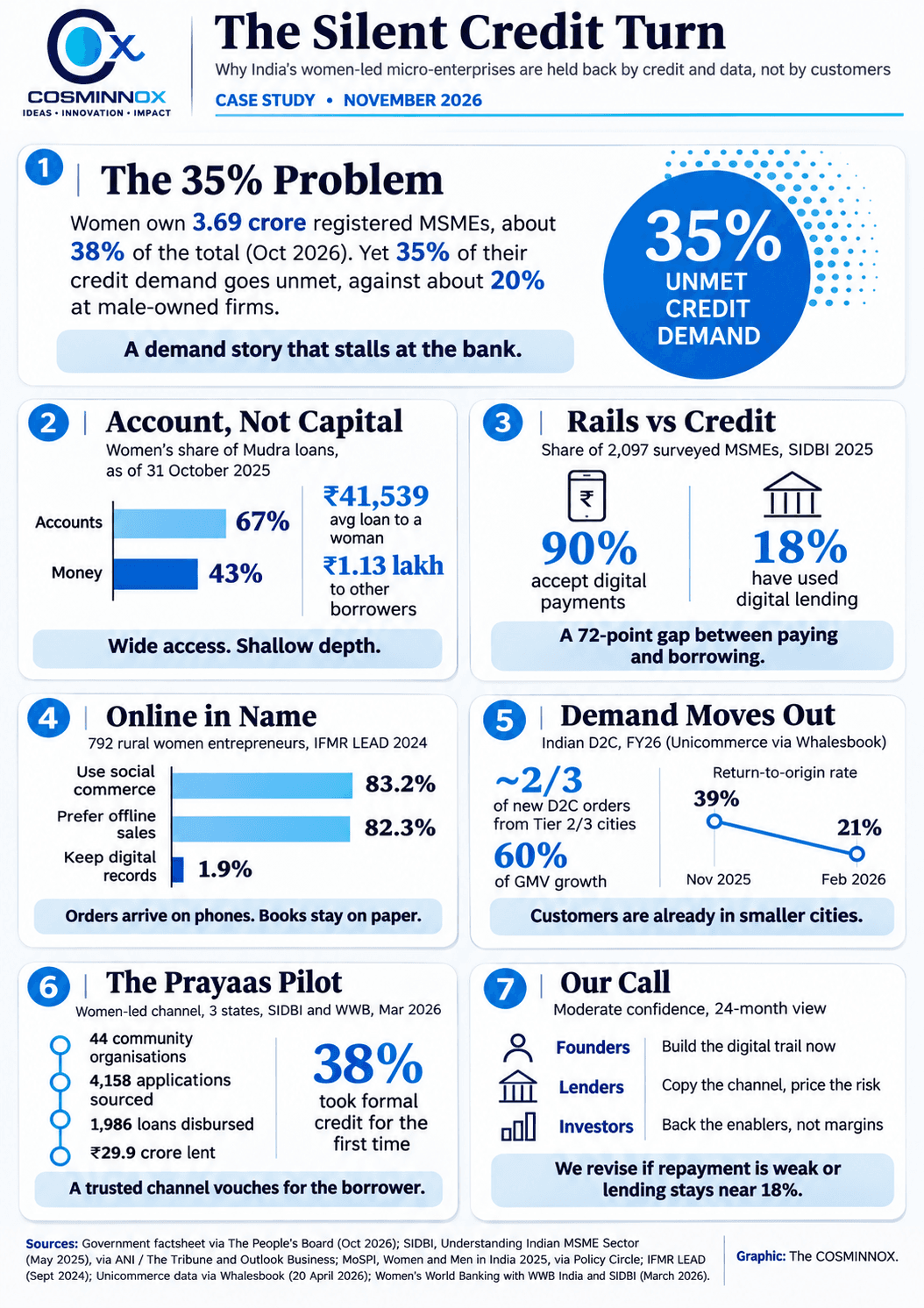
Women own about 3.69 crore registered MSMEs in India, roughly 38% of all registrations, according to a government factsheet released on 15 October 2026. Their share of the country’s enterprise base is no longer small. Their share of its credit is. SIDBI’s 2025 study of the sector puts the unmet credit demand of women-owned MSMEs at 35%, against about 20% for male-owned firms.
Our thesis: the binding constraint on women-led enterprises is not demand. Customers are arriving through digital channels in smaller cities. What has not arrived is the data trail that lets a lender say yes: nearly every MSME accepts digital payments, but only a small fraction have borrowed digitally. The enablers who convert that activity into a creditworthy record will capture the next tier of growth.
Figure 1. Four numbers that frame the case. Source: government factsheet, SIDBI, MoSPI and Outlook Business, as cited on the graphic. Graphic: The COSMINNOX.
Background: wide access, shallow depth
India has spent a decade widening the door. The Mudra scheme, launched in April 2015, shows how far women have come in: as of 31 October 2025 they held 37.07 crore of the 55.39 crore accounts, about 67%, according to MoSPI’s Women and Men in India 2025 report. Smaller cities have become the centre of gravity for online retail too: Unicommerce data reported in April 2026 shows Tier-2 and Tier-3 cities supplying nearly two-thirds of new D2C orders and 60% of D2C GMV growth in FY26.
Access and demand are therefore real. The question is what happens after the first loan and the first online order.
Evidence in three beats
1. Women get the account, not the capital
SIDBI’s May 2025 report estimates an addressable credit gap of about 24% of demand, or roughly ₹30 lakh crore, across MSMEs. For women-owned firms, the gap is 35%, the highest of any ownership group the report examines. A separate reading of the SIDBI-Crisil 2025 data, reported by YourStory, finds 76% of women-led enterprises have accessed formal credit against 84% of male-owned ones.
Figure 2. Credit gap by ownership. Source: SIDBI (May 2025) via ANI / The Tribune. Chart: The COSMINNOX.
Mudra shows the same pattern in rupees. Women hold two-thirds of accounts but received ₹15.40 lakh crore of the ₹36.18 lakh crore disbursed, or 43%. The average loan to a woman was about ₹41,539, against ₹1.13 lakh for other borrowers, roughly 37% of the size.
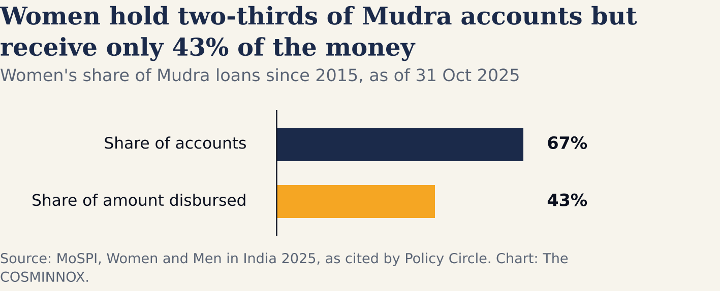
Figure 3. Women’s share of Mudra accounts and amounts, as of 31 October 2025. Source: MoSPI via Policy Circle. Chart: The COSMINNOX.
Our observation: the system is good at opening doors and poor at growing tickets. A woman who borrows ₹41,539 and repays on time is not automatically offered the next, larger loan. That is the difference between a household income supplement and an enterprise that can stock inventory for a festival season. One caveat: the source compares women with “other borrowers”, not with men alone.
2. The payment rails exist; the credit rails do not
SIDBI’s survey of 2,097 MSMEs across 19 sectors found that 90% accept digital payments but only 18% have used a digital lending platform. These figures cover all owners, not women alone, so they describe the system rather than one group.
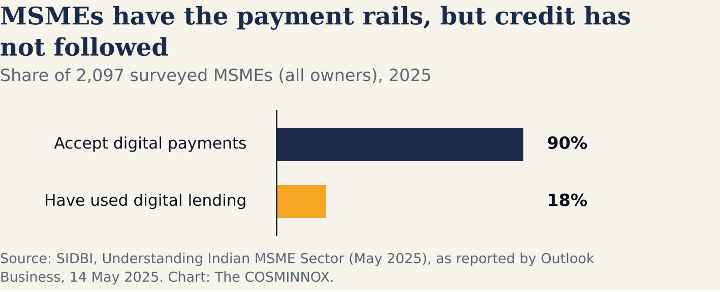
Figure 4. Digital payments versus digital lending among MSMEs. Source: SIDBI (May 2025) via Outlook Business. Chart: The COSMINNOX.
Our observation: a 72-point gap between taking payments digitally and borrowing digitally means the transaction data already exists in most firms’ bank and UPI histories, but lenders are not using it at scale. Group-based lending shows that quality can hold when information is solved another way: self-help group loans stood at about ₹3.04 lakh crore across 84.94 lakh groups at the end of March 2025, with a gross NPA ratio of 1.74%, per NABARD figures tabled in the Lok Sabha on 11 August 2025. The data we found does not split that figure by gender, so we draw no conclusion about women’s repayment from it.
3. Demand is digital; the books are still on paper
Social commerce is widespread among women entrepreneurs, but it is not yet the way they run their businesses. IFMR LEAD’s September 2024 study of 792 rural women entrepreneurs in 24 districts found 83.2% take part in social commerce and 82.3% still prefer offline sales and marketing. Only 27.8% use social media “always” for business, and 1.9% keep digital sales records. Note the scope: this is a rural sample, not a Tier-2 city sample.
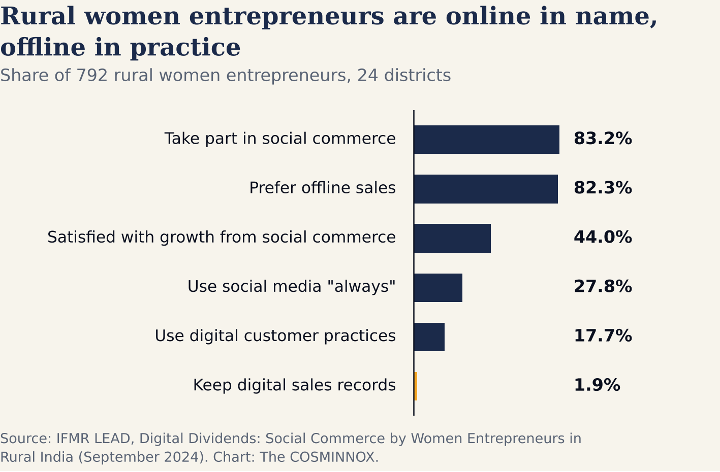
Figure 5. Social commerce use among rural women entrepreneurs. Source: IFMR LEAD (September 2024). Chart: The COSMINNOX.
Figure 6. D2C snapshot. Source: Unicommerce data and estimates via Whalesbook (20 April 2026). Table: The COSMINNOX.
Our observation: orders arrive on a phone, but the ledger stays in a notebook. A lender cannot underwrite a notebook. This is also why we do not claim that women-led Tier-2 brands earn higher margins than venture-backed ones: we found no verified margin data for them. What the market data does show is that D2C as a whole is hard to run profitably, with an unattributed estimate that only 24 of 170-plus established firms were profitable in FY23.
The case in practice: what a channel can do
Women’s World Banking, WWB India and SIDBI piloted the Prayaas Individual Enterprise Scheme in Maharashtra, Bihar and Assam. Women-led community-based organisations under the National Rural Livelihood Mission acted as the last-mile channel, with digitised processing and capability support. The pilot sourced 4,158 loan applications through 44 community organisations and disbursed 1,986 loans worth ₹29.9 crore. About 38% of borrowers took formal credit for the first time.
Figure 7. The Prayaas pilot funnel. Source: Women’s World Banking with WWB India and SIDBI (March 2026). Flowchart: The COSMINNOX.
Our observation: the pilot converted roughly 48% of applications into loans (our calculation), at an average of about ₹1.5 lakh (our calculation), well above the average Mudra ticket for women. The community organisation did the job the missing digital record cannot yet do: it vouched for the borrower. One limit: the published material reports no repayment or portfolio-quality figures, so this is evidence of reach, not yet of performance.
The counterpoint
Sceptics argue that these enterprises are too small to matter. The IFMR LEAD study supports part of that view: about three-quarters of its sampled enterprises report earnings below ₹1 lakh a year, and only 44.0% of social-commerce users are satisfied with the growth it brings them.
Our answer: the size is the finding, not the rebuttal. Firms at that scale are small because the credit they can reach is small. The ₹41,539 average Mudra ticket and the 35% unmet demand describe the same ceiling from two sides. The sceptics are right that most of these firms will not become national brands; they are wrong to conclude that the segment is not investable. Moving even a fraction up one ticket band is a large lending opportunity across 3.69 crore firms.
What it means
• For founders: route sales through UPI, invoice digitally and keep dated records now. Our evidence says the missing record, not the missing customer, is what blocks the next loan.
• For lenders and banks: copy the channel, not just the product. The Prayaas model shows community organisations can source and vouch for borrowers at scale; pair that with the 90% digital-payment footprint to build cash-flow underwriting. Publish repayment data so the model can be priced.
• For investors and funders: back the enablers (bookkeeping, logistics, credit-data tools for vernacular users) rather than expecting high margins from the firms themselves. We found no verified evidence of those margins.
The call
We rate with moderate confidence that, over the next 24 months, the strongest returns in this segment will go to lenders and enablers who turn digital sales activity into a credit record, rather than to stand-alone women-led brands scaling alone. This is an editorial forecast made on 14 November 2026.
What would change our mind: published repayment data from channel-led pilots such as Prayaas showing portfolio quality materially worse than the 1.74% gross NPA seen in self-help group lending, or a fall in the 18% digital-lending figure in SIDBI’s next survey.
Our View Women in smaller cities have the customers and the payment apps. What they lack is a record a lender can read. Fund the people who write that record, and the loans will follow. Wait for the firms to prove themselves on paper, and the gap will stay where it is. |
Sources
• SIDBI MSME report on digital lending and payments, Outlook Business, 14 May 2025
• Women entrepreneurs in MSMEs: rising numbers, unequal access, YourStory, May 2025
• Women now own 3.69 crore MSMEs, 38% of all registrations, The People’s Board, 16 October 2026
• Digital Dividends: Social Commerce by Women Entrepreneurs in Rural India, IFMR LEAD, September 2024
• Unlocking enterprise credit in rural India for women, by women, Women’s World Banking, March 2026