Who was in the room
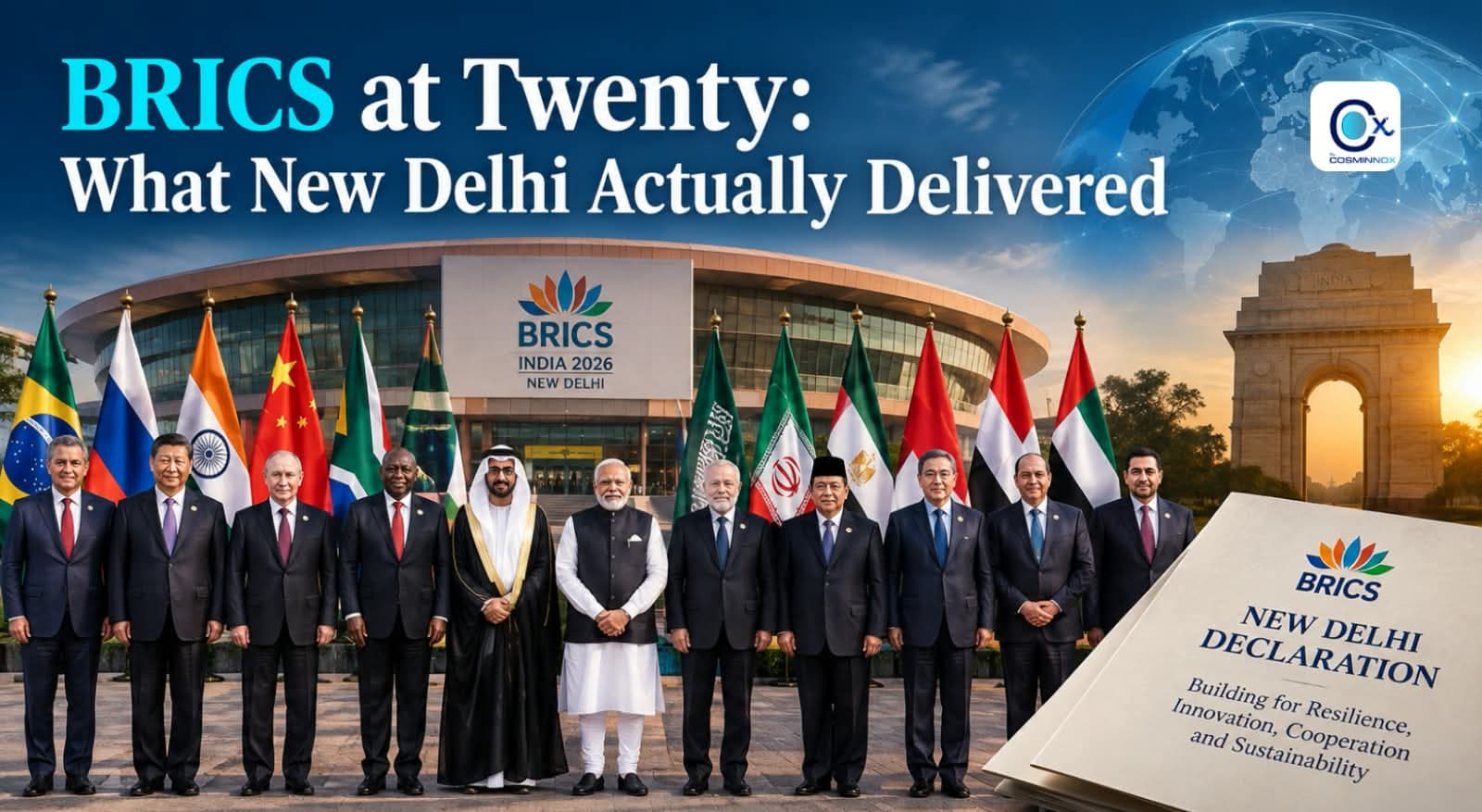
The 18th BRICS Summit was held on 12–13 September 2026 at Bharat Mandapam, New Delhi, under India's fourth BRICS chairship, with Prime Minister Narendra Modi presiding. The formal membership going into the summit stood at eleven states — Brazil, China, Egypt, Ethiopia, India, Indonesia, Iran, Russia, Saudi Arabia, South Africa and the United Arab Emirates — with ten further countries (Belarus, Bolivia, Cuba, Kazakhstan, Malaysia, Nigeria, Thailand, Uganda, Uzbekistan and Vietnam) holding partner-country status.
Leader-level attendance included Chinese President Xi Jinping — his first visit to India in seven years — Russian President Vladimir Putin, South African President Cyril Ramaphosa, Iranian President Masoud Pezeshkian, Egyptian President Abdel Fattah El-Sisi, Indonesian President Prabowo Subianto, and Kazakhstan's President Kassym-Jomart Tokayev, who also represented the Eurasian Economic Union. Brazilian President Luiz Inácio Lula da Silva was a notable absence at leader level, staying in Brazil because of the country's presidential election campaign, with first-round voting scheduled for early October 2026; Brazil was instead represented by Foreign Minister Mauro Vieira, who had separately called for urgent UN and WTO reform at BRICS' May 2026 foreign ministers' meeting. The UAE was represented by Khaled bin Mohamed Al Nahyan, Crown Prince of Abu Dhabi; Saudi Arabia sent Foreign Minister Faisal bin Farhan Al Saud, participating with invitee rather than full-member status, since Riyadh has still not publicly confirmed it completed formal accession to BRICS.
Outreach participants — leaders invited to represent regional blocs rather than BRICS membership itself — included Malaysian PM Anwar Ibrahim, Philippines President Ferdinand "Bongbong" Marcos Jr. (representing ASEAN), Uruguay's Foreign Minister Mario Lubetkin (representing CELAC), and Burundi's President Évariste Ndayishimiye (representing the African Union). International-organisation representation included UN Secretary-General António Guterres, WHO Director-General Tedros Adhanom Ghebreyesus, WTO Director-General Ngozi Okonjo-Iweala, New Development Bank President Dilma Rousseff and Asian Infrastructure Investment Bank President Zou Jiayi. Bangladesh, invited in its capacity as BIMSTEC chair, announced on 10 September that it would not send a government representative.
The two-day programme opened with a BRICS Business Forum and the "Bharat Innovates" exposition of 37 Indian deep-tech startups on 11 September, followed by a closed BRICS-members-only plenary on 12 September and an expanded open plenary on 13 September that brought in partner countries, outreach leaders and international organisations.
What the New Delhi Declaration actually commits to
The summit's central deliverable was the New Delhi Declaration: Building for Resilience, Innovation, Cooperation and Sustainability, adopted by consensus on 12 September and running to 140 numbered paragraphs. It records more than 400 preparatory meetings held across 30 Indian cities over the course of India's chairship.Four substantive threads run through the text:
Global governance reform. The declaration reiterates BRICS' long-standing call for a more representative multilateral system, including reform of the UN Security Council and other institutions, on the argument that current arrangements do not reflect present-day economic and political weight.
Terrorism. The declaration specifically condemns the 2025 Pahalgam attack and restates a "zero tolerance" position on terrorism, including terrorist financing, safe havens and cross-border movement of terrorists — a formulation India had pushed for as chair.
Trade and tariffs. Members criticised the rising use of unilateral tariff and non-tariff measures and reaffirmed the WTO as the anchor of the multilateral trading system, while calling for reforms giving developing economies more say. Bloomberg News read this language, alongside criticism of unilateral sanctions not authorised by the UN Security Council, as several governments currently at odds with Washington "finding common ground" without naming the United States directly.
Middle East and Ukraine. On West Asia, the declaration records "deep concern" over escalation, calls for "maximum restraint," protection of civilians and civilian infrastructure, and a long-term settlement through dialogue; it also reiterates support for humanitarian access in Gaza and for UNRWA. On Ukraine, the text acknowledges that members hold differing national positions and welcomes mediation efforts, without naming a preferred outcome.
Notably, the declaration does not establish a common BRICS currency. It instead backs continued technical work by the BRICS Payment Task Force on interoperability between national payment and messaging systems and on trade settlement in local currencies, and encourages the New Development Bank to expand local-currency lending. The Financial Times specifically noted that sharper proposals to accelerate a move away from the dollar were avoided in the final text.
The hardest test: getting Iran and the UAE into the same document
The single biggest procedural achievement of the summit, by most accounts, was reaching unanimous text at all. BRICS' foreign ministers had failed to agree even a joint communiqué at their May 2026 meeting in New Delhi over disagreements tied to the Gulf war, forcing India to issue a chair's statement instead .Going into the leaders' summit, Reuters described consensus-building as a "particularly challenging task for host New Delhi" precisely because Iran and the UAE held sharply diverging positions on the conflict.
That consensus was reached appears to owe something to direct diplomacy on the sidelines: Iranian President Masoud Pezeshkian and the UAE's Khaled bin Mohamed Al Nahyan held talks on 12 September that Reuters described as the highest-level Iran–UAE meeting since the war broke out, focused on regional stability as negotiators worked out the declaration's final Middle East language. Al Jazeera's read of the outcome was that the bloc was "reasonably satisfied with the modest outcome," crediting India's behind-the-scenes bridging role between the two governments as the decisive factor.
The economic and technology tracks
Beyond the headline declaration, India's chairship pushed a set of narrower institutional initiatives: a BRICS Incubator Network, a BRICS MSME Portal, a proposed Startup Innovation Fund, and a Logistics Supply-Chain Cooperation Framework, all previewed at the Business Forum session where Modi asked BRICS business representatives to identify the concrete barriers to intra-BRICS trade .
On technology policy, members endorsed continued cooperation on artificial intelligence, digital public infrastructure, quantum technologies and startup ecosystems, alongside a proposed repository for digital public-infrastructure solutions. On health, the declaration backs a BRICS Mission for Healthy Lifestyle with a 2026–2029 roadmap and a mental-health centres-of-excellence network coordinated by India's National Institute of Mental Health and Neurosciences. On agriculture, it supports continued work on a proposed BRICS Grain Exchange. On energy, the declaration frames energy security as foundational to development, states that fossil fuels will keep playing "an important role" in the energy mix of developing economies, and separately reaffirms support for a "just, orderly, equitable and inclusive" transition under the Paris Agreement.
Delegate and attendance tables
Table 1: BRICS full members and their New Delhi representation
Country | Represented by | Role / status |
Brazil | Mauro Vieira, Foreign Minister | President Lula did not attend, citing Brazil's presidential election campaign (first-round vote scheduled early October 2026); Vieira led the delegation instead |
China | Xi Jinping | President; first India visit in 7 years |
Egypt | Abdel Fattah El-Sisi | President |
Ethiopia | — | Full member since 2024 accession |
India | Narendra Modi | Prime Minister; summit chair and host |
Indonesia | Prabowo Subianto | President; joined as full member in 2025 |
Iran | Masoud Pezeshkian | President |
Russia | Vladimir Putin | President |
Saudi Arabia | Faisal bin Farhan Al Saud | Foreign Minister; participated as invitee, not full member — accession status still unconfirmed |
South Africa | Cyril Ramaphosa | President |
United Arab Emirates | Khaled bin Mohamed Al Nahyan | Crown Prince of Abu Dhabi, chairman of Abu Dhabi Executive Council |
[Deccan Herald/Deccan Chronicle, 10–11 Sep 2026; Reuters, 8 May 2025; ThePrint, 11 Sep 2026; Wikipedia, "18th BRICS summit"]
Table 2: Partner countries and outreach representatives at New Delhi
Country / Organisation | Represented by | Capacity |
Kazakhstan | Kassym-Jomart Tokayev, President | BRICS partner country + Eurasian Economic Union |
Thailand | Sihasak Phuangketkeow, Deputy PM & Foreign Minister | BRICS partner country |
Uzbekistan | Jamshid Kuchkarov, Deputy PM & Minister of Economy and Finance | BRICS partner country |
Belarus | Maxim Ryzhenkov, Foreign Minister | BRICS partner country |
Bolivia | Arlette Gabriela Bustamante García, Chargé d'affaires | BRICS partner country |
Cuba | Bruno Rodríguez Parrilla, Foreign Minister | BRICS partner country |
Malaysia | Anwar Ibrahim, Prime Minister | Outreach invitee |
Philippines | Ferdinand "Bongbong" Marcos Jr., President | Outreach invitee, representing ASEAN |
Uruguay | Mario Lubetkin, Foreign Minister | Outreach invitee, representing CELAC |
Burundi | Évariste Ndayishimiye, President | Outreach invitee, representing the African Union |
Bahrain | Abdullatif bin Rashid Al Zayani, Foreign Minister | Outreach invitee |
Vietnam | Lê Minh Hưng, Prime Minister | BRICS partner country |
Bangladesh | — | Invited as BIMSTEC chair; declined to send a representative |
[National Revealed, 11 Sep 2026; The Daily Star, 10 Sep 2026; Wikipedia, "18th BRICS summit"]
Table 3: International organisations represented
Organisation | Representative | Title |
United Nations | António Guterres | Secretary-General |
World Health Organization | Tedros Adhanom Ghebreyesus | Director-General |
World Trade Organization | Ngozi Okonjo-Iweala | Director-General |
New Development Bank | Dilma Rousseff | President |
Asian Infrastructure Investment Bank | Zou Jiayi | President and Chair of the Board of Directors |
International Solar Alliance | Ashish Khanna | Director-General |
Coalition for Disaster Resilient Infrastructure | Amit Prothi | Director-General |
[National Revealed, 11 Sep 2026; Wikipedia, "18th BRICS summit"]
Summit sequence, day by day
Table 4: Programme itinerary
Date | Event | Participants |
11 Sep | BRICS Business Forum (5 sectoral panels + leaders' session) | Governments, businesses, financial institutions, startups, BRICS Business Council, BRICS Women's Business Alliance |
11 Sep | Bharat Innovates Exposition opens (37 Indian deep-tech startups) | Runs alongside Business Forum |
11 Sep | Modi–Putin bilateral meeting | India, Russia |
12 Sep | Arrival and official welcome of BRICS leaders | BRICS members |
12 Sep | Closed plenary: "Inclusive Global Governance and Strengthening Multilateralism" | BRICS members only |
12 Sep | Adoption of the New Delhi Declaration | BRICS members |
12 Sep | Visit to Bharat Innovates exposition | BRICS member leaders |
12 Sep | Family photograph and joint tree-planting ceremony | BRICS member leaders |
12 Sep | Modi–Xi bilateral meeting | India, China |
12 Sep | Pezeshkian–Al Nahyan bilateral meeting (Iran–UAE) | Iran, UAE |
12 Sep | Gala dinner hosted by PM Modi | All summit participants |
13 Sep | Arrival of partner countries and outreach delegations | Partner countries, invitees |
13 Sep | Open plenary: "Resilience, Innovation, Cooperation and Sustainability: Shaping the Future for Inclusive Global Growth" | BRICS members, partner countries, invitees, international organisations |
[Wikipedia, "18th BRICS summit," citing Business Today and Mint scheduling reports, 9 and 12 Sep 2026; Reuters, 11–12 Sep 2026]
The declaration's commitments, by track
Table 5: New Delhi Declaration — what was agreed, by policy track
Track | What the declaration commits to | Binding / concrete? |
Global governance | Reform of UN Security Council and multilateral institutions; greater voice for emerging economies | Aspirational language, no mechanism |
Terrorism | Condemns 2025 Pahalgam attack by name; "zero tolerance" for terrorism, its financing, safe havens and cross-border movement | Declaratory; no enforcement mechanism |
Trade | Criticises unilateral tariffs/non-tariff measures; reaffirms WTO centrality; calls for WTO reform | Declaratory |
Sanctions | Opposes unilateral coercive measures not authorised by the UN Security Council | Declaratory |
Middle East | "Deep concern," calls for "maximum restraint," protection of civilians, support for UNRWA and Gaza humanitarian access | Declaratory |
Ukraine | Notes differing national positions; welcomes unspecified mediation efforts | Generic, no named outcome |
Finance/payments | Continued Payment Task Force work on interoperability and local-currency settlement; NDB encouraged to expand local-currency lending | Technical work continues; no common currency established |
Technology | Cooperation on AI, digital public infrastructure, quantum tech; BRICS Incubator Network endorsed; Startup Innovation Fund and DPI repository "under consideration" | Incubator Network endorsed; fund/repository still proposals |
Health | BRICS Mission for Healthy Lifestyle, 2026–2029 roadmap; mental-health centres-of-excellence network (coordinated by India's NIMHANS) | Roadmap agreed |
Agriculture | Continued work on proposed BRICS Grain Exchange; cooperation on food security and climate-resilient farming | Still a proposal, not operational |
Energy | Fossil fuels to retain "important role" for developing economies; simultaneous support for "just, orderly, equitable and inclusive" transition under Paris Agreement | Declaratory, holds both positions |
2027 chairship | Support for China's BRICS chairship and the 19th summit being held in China | Confirmed |
[PMO declaration text, 12 Sep 2026; Indian Express, 12 Sep 2026 (multiple articles cited above); Reuters, 10 Sep 2026; FT, 12 Sep 2026]
Bilateral sidebars
Several sideline meetings arguably carried more forward-looking signal than the declaration itself. Modi and Putin met on 11 September, discussing trade, energy, defence and both the Ukraine and Middle East wars, and reiterated a target of raising bilateral trade to US$100 billion by 2030 . On 12 September, Modi and Xi Jinping met on the sidelines during Xi's first India visit in seven years, discussing border stability, trade imbalances, market access and transport links — widely read as a cautious step toward stabilising China–India relations.
Counter-evidence: what the summit did not resolve
A think-tank reading of New Delhi has to hold the achievements against what remained unsettled:
Table 6: Open questions leaving New Delhi
Issue | Status after the summit | Source tier |
Saudi Arabia's BRICS membership | Listed as full member by India/BRICS; participated as invitee; independent reporting says accession unconfirmed since 2023 invitation | Tier 2 (Reuters) vs. Tier 1 (Indian govt listing) — genuinely contested |
Bangladesh's non-attendance | Confirmed 2 days before summit; Dhaka disputes it was properly invited | Tier 2 (Daily Star) |
Ukraine war language | Generic call for "dialogue, consultation, diplomacy"; no named outcome; Russia's founding-member status unaddressed | Tier 1 (declaration text) |
Common BRICS currency | Not established; only payment-interoperability and local-currency-settlement work continues | Tier 1 (declaration) / Tier 2 (FT, Indian Express) |
India–China strategic competition | "Tentative thaw" via Modi–Xi meeting; underlying rivalry and differing views of BRICS' purpose unresolved | Tier 2 (Guardian, Indian Express) |
Domestic optics in Delhi | AAP alleged poverty-concealment via street screening; residents of Vasant Vihar's Coolie Camp reported feeling hidden from delegations | Tier 2 (Times of India, Brut) — a domestic political dispute, separate from summit substance |
● Saudi Arabia's status stayed ambiguous. Despite being listed as a full member by Indian government and BRICS sources, Saudi Arabia participated with invitee status, and independent reporting continues to describe the kingdom as not having formally completed accession three years after its 2023 invitation.
● Bangladesh's absence. Dhaka's decision not to send a representative, despite an invitation tied to its BIMSTEC chairship, was confirmed only two days before the summit and was reported without an on-record explanation of the underlying rationale beyond the government's own statement that no invitation had, in its view, been extended to the Prime Minister personally.
● Ukraine language stayed generic. The declaration does not take a position on the war's resolution beyond welcoming unspecified "mediation and good-offices proposals," reflecting the fact that Russia is a founding member while other members maintain different postures toward the conflict.
● No currency, no deeper financial integration. The Financial Times and Indian Express both flag that the most ambitious dedollarisation proposals were set aside in favour of continued technical work on payment interoperability — a materially narrower outcome than "BRICS currency" framing sometimes used in commentary before the summit .
● India–China rivalry persisted alongside the thaw. The Guardian's reporting on the Modi–Xi meeting explicitly frames it as a "tentative thaw," not a resolution of underlying strategic competition, and notes that Beijing's institutional preference for BRICS as a counterweight to the US sits uneasily with India's preference for a bridging role between the West and the Global South.
● Domestic friction over hosting optics. The opposition Aam Aadmi Party criticised the central government over curtains and screens placed along summit routes near low-income settlements in Delhi, characterising it as an attempt to conceal poverty rather than address it; residents of one such settlement told Brut they felt deliberately hidden from visiting delegations. This is a domestic political dispute over optics and is separate from the summit's substantive outcomes, but it is part of the record of how the event was received within India.
What the evidence does — and doesn't — establish
The 18th BRICS Summit demonstrates that the expanded, eleven-member BRICS can still produce a unanimous consensus document even when two of its members are on opposite sides of an active war — a real and non-trivial procedural achievement, given the foreign ministers' failure to do the same four months earlier. It also demonstrates that India, as chair, was able to use bilateral leverage with both Tehran and Abu Dhabi to broker that consensus, and that Xi's presence opened a cautious, still-unresolved thaw in India–China relations.
What the summit does not establish is a structural shift in BRICS' economic architecture. There is no common currency, no binding financial mechanism beyond continued technical work on payment interoperability, and no resolution of open questions about Saudi Arabia's membership status or the bloc's internal position on Ukraine. The initiatives with the clearest near-term traction — the Incubator Network, MSME Portal, Startup Fund, Grain Exchange proposal and payment-interoperability work — are institution-building measures that will take years to show up in trade or investment data, not immediate policy changes. Readers should treat "BRICS turns anti-dollar" or "BRICS unveils new currency" framings, which circulated before the summit, as unsupported by what was actually adopted on 12 September.
Sources cited
● Prime Minister's Office, Government of India, BRICS New Delhi Declaration: Building for Resilience, Innovation, Cooperation and Sustainability, 12 September 2026 — pmindia.gov.in
● Government of India, BRICS India 2026 — brics2026.gov.in
● Reuters: "BRICS adopts joint declaration, urges 'maximum restraint' in Mideast" (12 Sep 2026); "India hosts BRICS summit as Iran war tests bloc unity" (10 Sep 2026); "India to push BRICS digital currency link despite hurdles" (10 Sep 2026); "Iran and UAE back joint BRICS statement urging restraint in war" (12 Sep 2026); "Modi, Putin seek stronger ties" (11 Sep 2026); "India's Modi and China's Xi push business links, border peace" (12 Sep 2026); "BRICS talks end without joint statement" (15 May 2026); "Saudi Arabia sits on fence over BRICS" (8 May 2025)
● The Indian Express: "BRICS declaration condemns Pahalgam terror attack" (12 Sep 2026); "BRICS unanimously condemns unilateral tariffs, pushes for WTO reform" (12 Sep 2026); "Main takeaways from the BRICS declaration" (12 Sep 2026); "Need 'orderly & inclusive' energy transition" (12 Sep 2026); "Leaders set to fine-tune incubator network" (11 Sep 2026); "No fire & brimstone" (12 Sep 2026)
● Financial Times: "Brics push for Gulf peace as war worries mount" (12 Sep 2026)
● Bloomberg News: "Trump's Foes Find Common Ground at Modi's New Delhi Summit" (12 Sep 2026)
● Associated Press: "BRICS leaders voice concern over Middle East, condemn unilateral sanctions" (12 Sep 2026)
● Al Jazeera: "BRICS summit 2026: What are the key takeaways?" (13 Sep 2026)
● The Guardian: "Xi Jinping gets red carpet at Brics summit amid thaw in India-China relations" (12 Sep 2026)
● The Daily Star: "No scope for Bangladesh to join BRICS Summit" (10 Sep 2026)
● Times of India: "'Like calling 2.6% GDP growth 7.8%': AAP targets Centre over 'hiding' Delhi slums" (11 Sep 2026)
● Deccan Herald / Deccan Chronicle: leader-attendance reporting (10–11 Sep 2026)
● ThePrint: "BRICS Summit 2026: 13 world leaders in town" (11 Sep 2026); ANI/Brasil 247 reporting on Brazil's delegation (9 Sep 2026)
● Business Standard: "Brics Summit 2026 ticks all boxes on practical, actionable outcomes" (13 Sep 2026)
● Wikipedia, "18th BRICS summit" (accessed 13 Sep 2026) — used as a secondary aggregator of the above primary and wire-service reporting; original sources listed above where independently verifiable
Note on sourcing tiers: government declaration text and PIB/PMO releases are treated as primary (Tier 1); wire-service and major outlet reporting (Reuters, AP, Bloomberg, FT, Guardian, Al Jazeera) as credible secondary (Tier 2); the Wikipedia summary was used to identify and cross-check original sources, not cited as an independent authority for contested claims.
All figures and characterisations current as of 13 September 2026. This is a fast-developing story; commitments described as "proposed" or "under discussion" (Startup Innovation Fund, Grain Exchange, digital-currency interoperability) had not been finalised as of publication and should be checked against later BRICS documentation before being cited as settled policy.