01 THE QUESTION
Does the Bishkek Declaration mark a genuine deepening of the Shanghai Cooperation Organisation's mandate, or is it primarily an anniversary document that restates existing positions while papering over live disputes among its own members? The record supports both readings simultaneously — the declaration and its accompanying package are substantive on paper, even as the summit floor exposed exactly the frictions the document claims the bloc has moved beyond.
02 WHAT HAPPENED
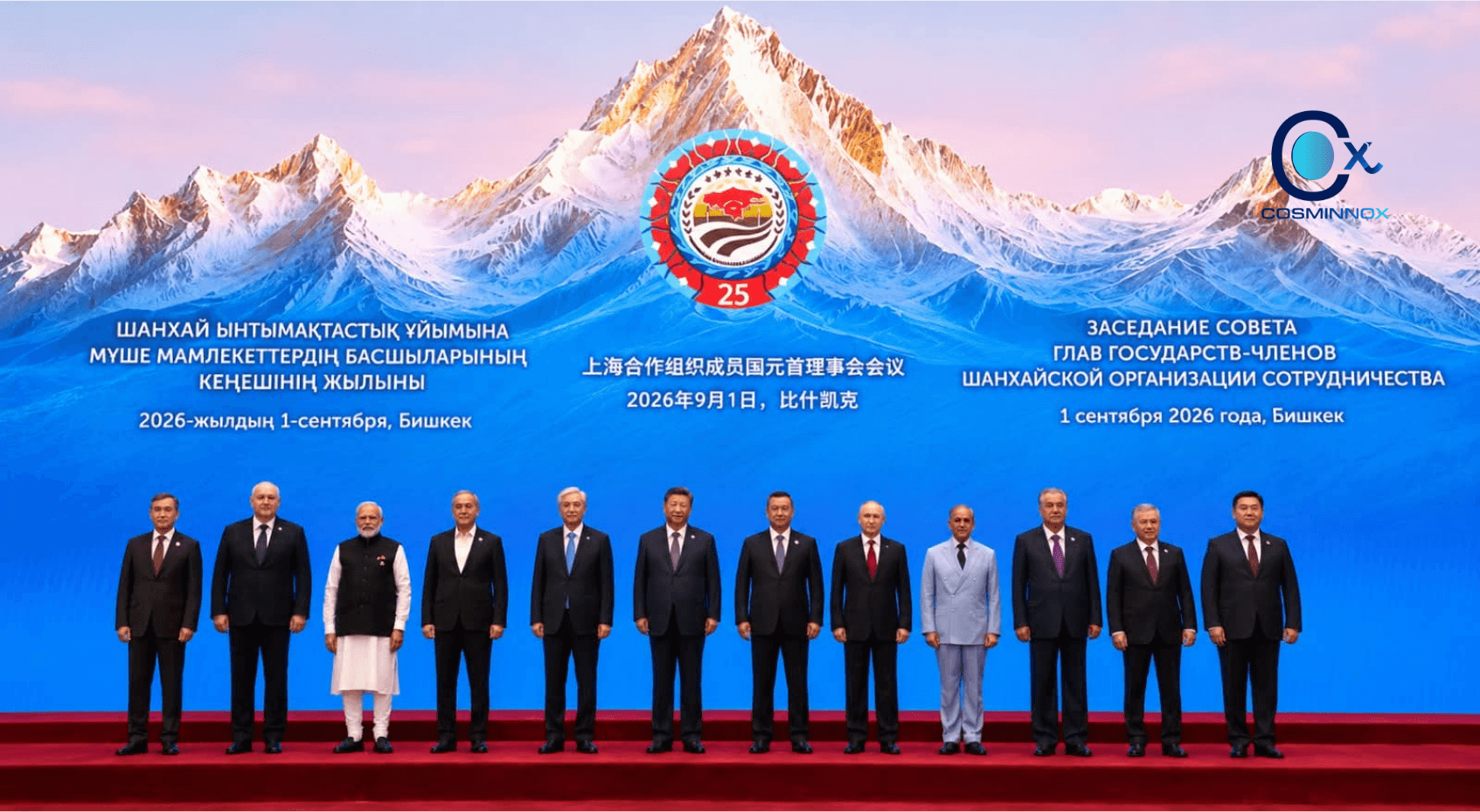
The 26th Council of Heads of State meeting of the SCO ran from August 31 to September 1, 2026, in Bishkek, Kyrgyzstan, closing out Kyrgyzstan's 2025–2026 chairmanship and marking the organisation's 25th anniversary since its 2001 founding. Leaders of all ten member states — China, Russia, India, Pakistan, Iran, Kazakhstan, Kyrgyzstan, Tajikistan, Uzbekistan and Belarus — signed the Bishkek Declaration on September 1, alongside more than 20 additional documents covering security, drug trafficking, technology, transport, energy and environmental cooperation. Pakistan assumed the rotating chairmanship for 2026–27.
SCO by the numbers
Metric | Figure |
Founded | 2001, Shanghai — 6 founding members |
Current membership | 10 full members |
Membership expansion | India & Pakistan (2017), Iran (2023), Belarus (2024) |
Share of world population | 42.8% |
Share of global nominal GDP | 23.6% |
Share of global GDP (PPP) | 33.8% |
Share of Eurasian landmass | Over 60% |
2026–27 chairmanship | Pakistan (assumed Sept 1, 2026) |
03 THE ECONOMIC WEIGHT BEHIND THE BLOC
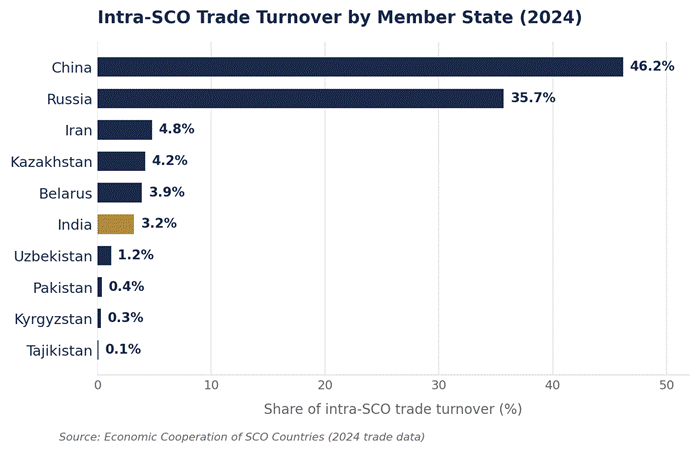
Intra-SCO trade remains heavily concentrated in its two largest economies. China and Russia together account for over four-fifths of total trade turnover among member states, a concentration that shapes how much practical weight the bloc's economic-governance language can carry for smaller and mid-sized members.
04 WHAT THE DECLARATION COMMITS TO
The text condemns terrorism "in all its forms and manifestations," states that double standards in counter-terrorism are unacceptable, and calls for cross-border action against terrorist financing and movement. It addresses the "responsible use of artificial intelligence," calls for reforms to global economic governance, and emphasises what it calls the SCO's non-military character — members "adhere to an approach that excludes bloc-based and confrontational methods." Separately, the bloc agreed to adopt English as an official SCO language and to establish a new Universal Centre for Countering Security Threats.
05 WHAT IT MEANS FOR INDIA
India's Ministry of External Affairs framed the summit as yielding 13 outcomes for India, including four MoUs and participation in the broader 20-plus document package. Prime Minister Narendra Modi structured India's address around three pillars — Security, Connectivity and Opportunity, and pressed for dismantling terrorist financing and safe havens without double standards, a formulation read domestically as a reference to the April 2026 Pahalgam attack. He also announced India will host the first SCO Civilisation Dialogue Forum later in 2026, and reiterated that connectivity initiatives should respect sovereignty and territorial integrity — a reference bearing on China's regional infrastructure projects.
India-specific outcome | Detail |
Total outcomes (per MEA) | 13 key outcomes from India's participation |
MoUs signed | 4, as part of the broader 20+ document package |
India's stated pillars | Security, Connectivity, Opportunity |
Hosting commitment | First SCO Civilisation Dialogue Forum, later in 2026 |
Bilateral meeting w/ Pakistan | None scheduled |
06 THE COUNTER-EVIDENCE
The declaration's unity language sat alongside open friction on the summit floor. Pakistani Prime Minister Shehbaz Sharif used his plenary address to criticise India over the Indus Waters Treaty, injecting a live bilateral dispute into the proceedings. No bilateral meeting was scheduled between the Indian and Pakistani prime ministers, and Modi's aircraft avoided Pakistani airspace despite Islamabad's offer of overflight access — both signals that the diplomatic freeze between the two members persists underneath the joint declaration. The SCO also has no mechanism to resolve the India-China boundary dispute, even as officials from the two sides held renewed boundary talks in Beijing days before the summit. Analysts covering the summit noted these as structural fault lines the bloc's consensus language does not address, rather than problems the anniversary declaration resolves.
07 THE BOUNDED CLAIM
The summit confirms that the SCO's ten members can still produce a substantial joint document — one covering counter-terrorism language, AI governance, and institutional expansion — twenty-five years after founding, and that India secured specific, named outcomes from its participation, including a hosting commitment and MoUs. It does not establish that the bloc's stated non-confrontational character reflects the actual state of relations among its members: the Sharif-Modi exchange, the absence of a bilateral meeting, and the unresolved India-China border dispute all persisted through the same two days that produced the declaration. Whether the new Universal Centre for Countering Security Threats or the economic governance language translates into operational change will be visible only in the bloc's activity over the next year, under Pakistan's incoming chairmanship — not in the text signed at Bishkek.
As of September 3, 2026. Sources: Al Jazeera, The Express Tribune, ANI, ETV Bharat, Wikipedia, Vajiram & Ravi, The Diplomatic Affairs, IBTimes, Centre for Peace Studies, Free Press Journal, The Diplomatic Insight (August–September 2026). Figures and quotes sourced from named outlets above; hyperlinks lead to the original reporting cited.