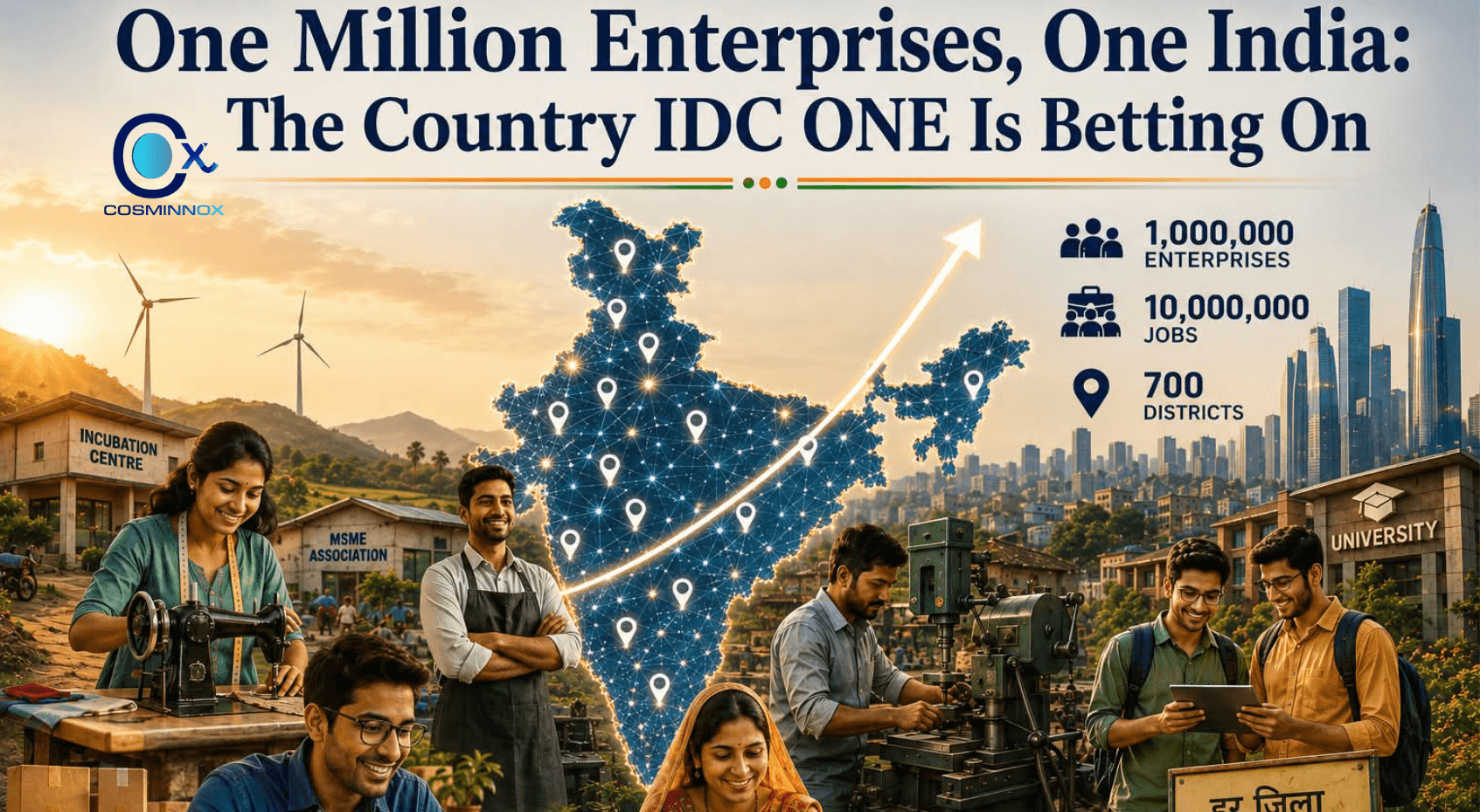
India's enterprise story has always had a geography problem. Capital clusters in Bengaluru, Gurugram and Mumbai; ambition doesn't. Every year, a founder in Kishanganj or Kohima builds something real, and every year, most of them stay invisible to the systems — banks, incubators, government schemes — built to find and fund them. IDC ONE's founding bet is that this is a plumbing problem, not a talent problem, and that fixing the plumbing across 700 districts could put a formal enterprise, and the jobs that come with it, within reach of far more of the country than currently has it.
What follows isn't an account of the platform's technology or its ten modules. It's an attempt to trace what the platform's own stated numbers would mean for the country if they land — for a district's job market, for a woman running a two-person unit out of her home, for a state government's tax base — and where that promise still has to prove itself.
Beyond the Metros: A Job Market That Reaches the 700
The single most consequential number in IDC ONE's design isn't 1 million or 10 million — it's 700. That's the number of districts the platform is structured to reach, using universities, incubators, MSME associations and government partners as on-the-ground distribution rather than relying on a handful of metro hubs to pull the whole country's enterprise activity toward them.
For India's welfare calculus, this matters more than the headline targets. A startup ecosystem concentrated in five or six cities creates jobs that pull people out of their home states — the well-documented pattern of migration to Bengaluru or the NCR for opportunity that doesn't exist locally. A platform architected around district-level partners, by contrast, is a bet on jobs meeting people where they are: in tier-2 and tier-3 towns, on campuses outside the metro belt, inside MSME clusters that have long operated below the radar of formal credit and formal employment data.
If even a modest share of the platform's own worked capacity — 700 districts, five growth partners each, 300 enterprises a year, over five years — converts into active, formally registered enterprises, the multiplier isn't just economic. It's regional. It's the difference between a district that exports its young workforce and one that starts to import opportunity instead.
The Jobs Behind the Jobs: Why 10 Million Is a Family Number, Not Just a Labour Number
IDC ONE's ten-million-jobs figure is built by multiplying its enterprise target by an average of ten direct-and-indirect jobs per enterprise. As a piece of arithmetic, it's simple. As a social proposition, it's not — because “indirect jobs” is where the welfare story actually lives.
A single formally registered micro-enterprise doesn't just employ its founder. It pulls in a supplier, a delivery partner, a bookkeeper, a landlord who now has a paying tenant, a local vendor who now has a steady customer. Multiply that across a million enterprises spread through 700 districts rather than five cities, and the platform's real proposition isn't ten million individual jobs — it's ten million households with a new, formal, and traceable source of income, in places where informal and precarious work has long been the default.
Formal versus informal is where a platform like this could do work that no single scheme has managed at scale: bringing enterprises that already exist, informally, into a system where their employees are on the books, eligible for the protections and credit history that come with formality. |
Who Gets Counted: Micro-Enterprises, MSMEs and the Founders Business India Often Misses
One design choice in IDC ONE quietly does more for inclusion than any single feature: its “1 million enterprises” target isn't defined as venture-backed startups alone. It explicitly folds in micro-enterprises, MSMEs and campus ventures.
That's a meaningful welfare distinction. Venture capital, by its nature, chases a narrow slice of high-growth, high-risk businesses — overwhelmingly urban, overwhelmingly male-founded, overwhelmingly clustered around a handful of sectors. A platform that counts the roadside-to-registered MSME, the campus venture that never raises a rupee of outside capital, and the woman-run micro-enterprise formalising for the first time, is counting a version of entrepreneurship that looks much more like India's actual small-business economy — the one that already employs the vast majority of the country's non-agricultural workforce, largely without formal recognition.
If IDC ONE's free founder tier and institutional partnerships with universities and MSME associations do what they're designed to do, the platform's most significant socio-economic contribution may not be minting new unicorns. It may be pulling India's enormous, already-existing informal enterprise base into visibility — where it can access credit, be taxed fairly, and be counted in the statistics that shape future policy.
The Multiplier State Governments Are Watching For
A formal enterprise sector spread across 700 districts, if it materialises anywhere close to scale, changes what a state can measure, plan around, and claim credit for: GST registrations, EPFO enrolments, MSME credit disbursed, women-led formalisation — all of it visible in a way informal activity by definition is not.
That's the socio-economic bet inside IDC ONE, stated plainly: fewer people leaving home for work, more households with a formal income to show a bank, and a startup economy whose benefits are distributed across a map rather than concentrated on it.
The Last Word
The platform's own document is candid that none of this has been demonstrated yet — the first 90-day pilot across five districts hasn't run, and the targets remain internally generated rather than externally verified. But the shape of the ambition is itself worth attention: an enterprise platform designed from the outset to measure its success in districts reached and households formalised, not just capital raised. If IDC ONE closes even a fraction of the gap between where India's entrepreneurial energy already exists and where the systems to recognise it currently reach, its most important number may turn out to be neither the million nor the ten million — but the 700 places it was built to show up in first.
The Cosminnox • Analysis based on IDC ONE's internal strategy document, supplied for review. Targets are the platform's own stated goals as of August 2026 and have not yet been independently verified or piloted.