What the statement actually commits members to
The Critical Minerals Statement is four paragraphs of hedged language. Ministers "support a collaborative, flexible, and voluntary dialogue," state they "may strive to leverage voluntary information exchange," and describe partnerships they "may consider" rather than partnerships they will form. G20 Energy Abundance Ministerial Statement, Pillar III: Critical Minerals, September 16, 2026 The word "voluntary" appears five times in three pages; "may" appears eleven times. The statement creates no fund, no timeline, no reporting mechanism, and no enforcement body. Its three operative sections — information sharing, innovation cooperation, and investment mobilization — each stop at the level of intent: members "may consider voluntary partnerships," "may bolster partnerships via expanded cooperation among export credit agencies and multilateral development banks," and "may cooperatively foster supportive investment environments." G20 Energy Abundance Ministerial Statement, Pillar III
This is consistent with how the US hosts characterized the broader Ministerial. Interior Secretary Doug Burgum framed the outcome as reducing "overreliance on any single supplier" while explicitly respecting "each nation's sovereignty over its natural resources" — language that signals coordination on principle rather than a supply commitment to any single country, including India. White House, September 21, 2026
The dependency the statement is meant to address
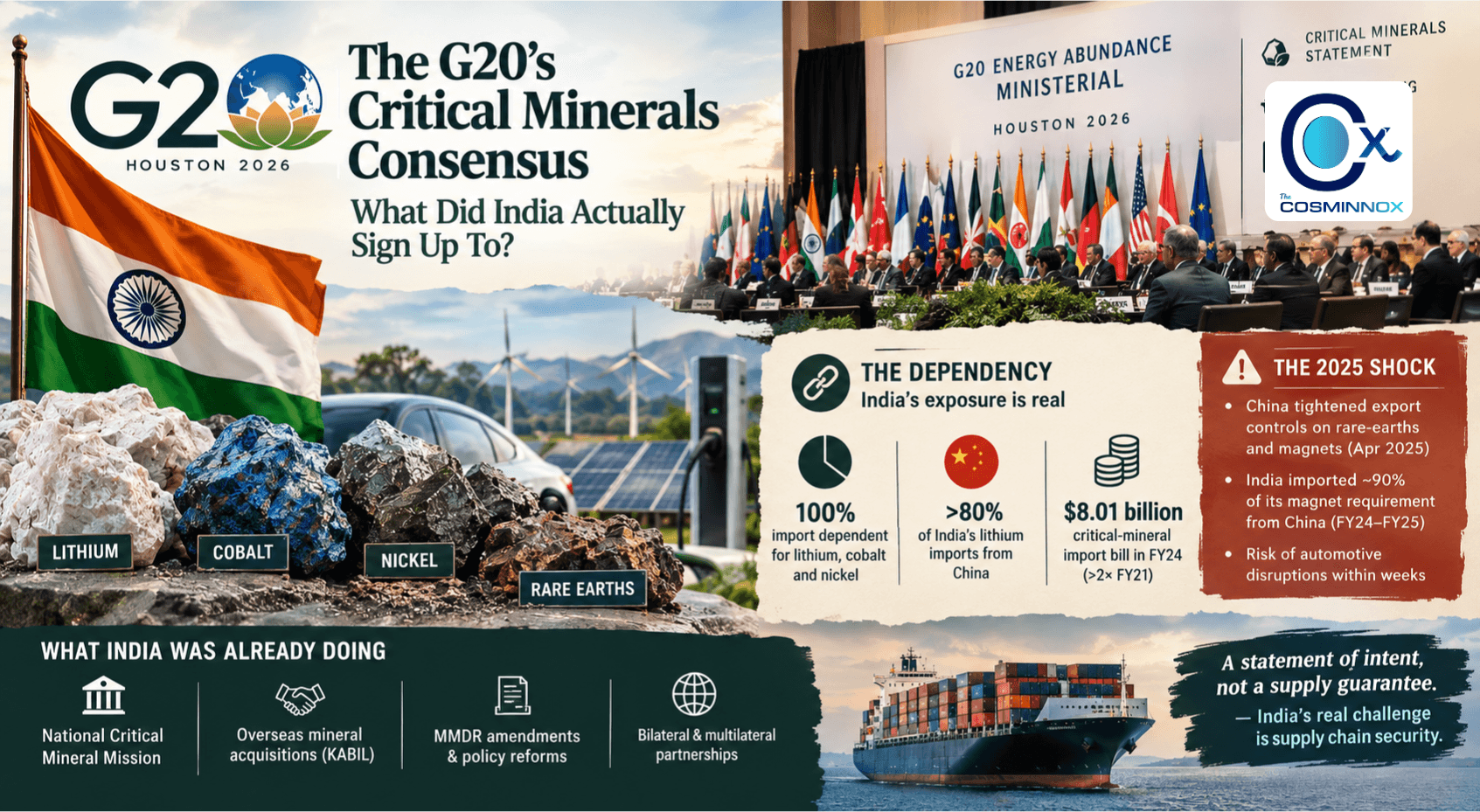
India's exposure is not abstract. The Ministry of Mines has classified 30 minerals as critical since 2023, and government data shows India is 100 percent import-dependent for lithium, cobalt, and nickel — the three inputs central to battery manufacturing. US Department of Commerce, "India - Mining and Critical Minerals," accessed September 2026 A 2025 analysis using Ministry of Mines' own 30-mineral list found China supplies over 80 percent of India's lithium imports and the overwhelming majority of its battery-grade graphite. Observer Research Foundation, "India's Critical Minerals Challenge in the Electric Mobility Era," July 2026 The same analysis puts India's critical-mineral import bill at $8.01 billion in FY24, more than double the $3.03 billion recorded in FY21, while exports of the same minerals fell over the same period. ORF, July 2026
That dependency was not theoretical in 2025. China tightened export licensing on seven rare-earth elements and finished magnets in April 2025; India had imported roughly 90 percent of its permanent-magnet requirement from China in FY24-FY25, and ratings agencies warned that automotive production could be disrupted within weeks as magnet inventories depleted. CareEdge Ratings, cited in Autocar Professional, June 12, 2025 Beijing began issuing conditional licences to select Indian firms only in late 2025, as part of a broader US-China trade arrangement that paused the curbs for one year — not as a resolution specific to India. Drishti IAS, "India Gains Access to Chinese Rare Earth Magnets," October 31, 2025 As of this writing, that pause is nearing the end of its stated one-year window, and neither the G20 statement nor any bilateral text since has replaced it with a standing arrangement.
What India was already doing before Houston
India's critical-minerals policy did not originate with, and does not depend on, the G20 statement. The Union Cabinet approved the National Critical Mineral Mission in January 2025 with an outlay exceeding ₹34,000 crore, aimed at domestic exploration, overseas acquisition, and recycling. PIB / Ministry of Mines, cited in Discovery Alert, September 2026 Khanij Bidesh India Limited (KABIL), a public-sector joint venture, had already signed an exploration agreement with Argentina's state-owned CAMYEN in January 2024 and holds a standing MoU with Australia's Critical Minerals Office since March 2022; the Ministry of Mines has separately pursued government-to-government cooperation with Brazil and the Dominican Republic on rare earths. PIB press release via GlobalSecurity.org, July 2025 Parliament has also been told that the government removed six minerals — including lithium — from the restrictive atomic-minerals list via the 2023 MMDR amendment, opening them to private exploration, and eliminated customs duties on 25 critical minerals in the FY25 budget. PIB, "Import of Critical Minerals for EVs" None of this required, or referenced, multilateral consensus language; it was built through bilateral MoUs and domestic legislation running in parallel with, not derived from, G20 processes.
The counter-evidence: where the statement could still matter
The strongest case for the statement having real consequence lies in its investment-mobilization clause, which points explicitly to "expanded cooperation among export credit agencies and multilateral development banks" and "collaborative funding of feasibility and prefeasibility studies." G20 Energy Abundance Ministerial Statement, Pillar III KABIL's own record shows it is still at the "due diligence" stage for lithium and cobalt projects in Australia rather than production — precisely the kind of capital-intensive, multi-year overseas asset development that export-credit-agency co-financing could accelerate. PIB, cited in "National Critical Mineral Mission" overview There is also a recent template for turning this kind of G20-adjacent language into something bilateral and concrete: the US-Australia Framework for Securing of Supply in Critical Minerals and Rare Earths, signed in October 2025, converted similar principles into a named agreement between two governments. White House, "United States-Australia Framework," October 20, 2025 If India used the Houston statement as a platform to negotiate a comparable bilateral instrument with the US or another G20 partner, the multilateral text would have done real work — as a diplomatic entry point rather than as the mechanism itself. No such bilateral instrument involving India has been announced as of this writing.
A Platform, Not a Guarantee
The Critical Minerals Statement does not, on its own text, create any obligation, funding line, or supply guarantee that changes India's mineral-security position. It restates, at a 20-country consensus level, cooperation principles India was already pursuing bilaterally through KABIL, the National Critical Mineral Mission, and MMDR amendments — programmes whose funding, timelines, and legal basis exist independently of Houston. What the statement does establish is a shared diplomatic vocabulary — "resilient, affordable, secure, and diversified" supply chains — that India, like other members, could use to seek specific bilateral commitments from export-credit agencies or multilateral development banks, following the precedent the US and Australia set five weeks after signing their own framework. Whether Houston becomes that kind of entry point, or simply the fourth item on a press release, is not something the statement's own text can answer; it will be visible only in whether a named bilateral agreement follows, and on what timeline.
Sourcing note: this piece draws primarily on the White House release and the underlying Critical Minerals Statement text (Tier 1), Ministry of Mines/PIB releases on India's mineral programme (Tier 1), and secondary analysis from ORF, CareEdge Ratings, and Drishti IAS (Tier 2), each cited inline. Import-dependency and pricing figures are as of the dates stated in the cited sources and may have moved since; readers relying on current numbers should check the Ministry of Mines and DGCI&S trade data directly.