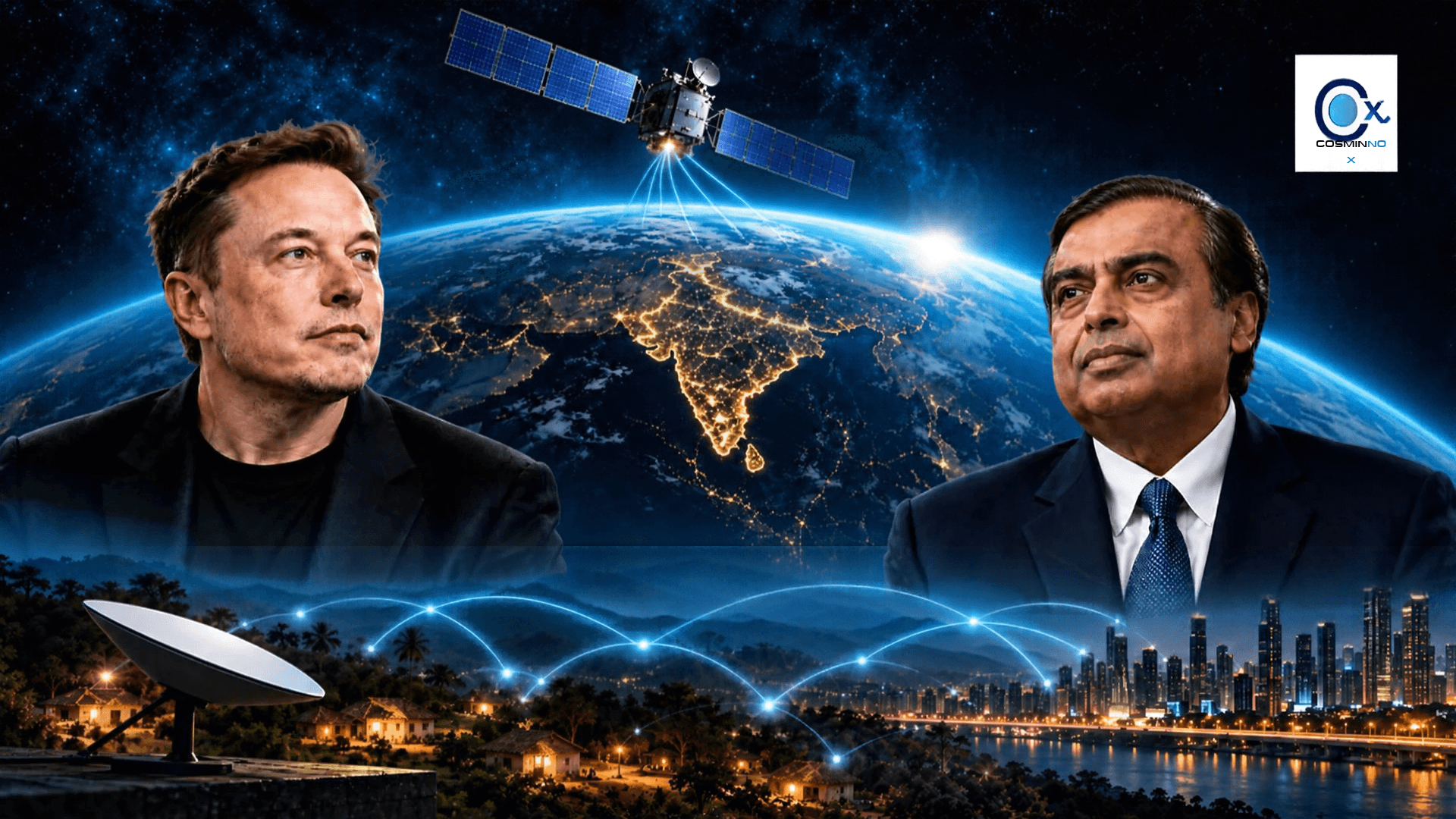
Elon Musk’s confrontation with Mukesh Ambani has brought India’s satellite internet debate into public view. The stakes extend beyond the two billionaires: who can enter the market, what households can afford, and whether remote communities will gain dependable connectivity.
Musk’s remarks are documented. On 8 October, he questioned whether Ambani was the “real boss of India”; Reuters reported that he supplied no evidence against Ambani. The following day, he escalated the criticism in a sarcastic post. These are allegations, not established findings of interference. [1–2]
The commercial question is equally important: Starlink could compete with Jio, but Jio has also agreed to distribute Starlink services. India’s emerging satellite market combines rivalry with potential cooperation.
Where Indias internet market stands
India’s broadband economy is large and concentrated. Official August 2026 data report 1,101.21 million broadband subscriptions, including machine-to-machine cellular connections. Excluding those machine connections, the total is 1,010.28 million. Neither figure counts unique internet users. [3]
Provider | Broadband subscriptions, million | Calculated share |
Reliance Jio | 538.03 | 48.86% |
Bharti Airtel | 386.39 | 35.09% |
Vodafone Idea | 130.88 | 11.89% |
BSNL | 27.82 | 2.53% |
ACT | 2.48 | 0.23% |
Other providers | 15.61 | 1.42% |
Source: TRAI data published by PIB, August 2026. Shares calculated against 1,101.21 million total broadband subscriptions; rounding applies. This is combined wired and wireless broadband, not satellite-market share. [3]
Jio and Airtel together account for approximately 83.95%. Concentration deserves scrutiny, but it does not establish a legal monopoly or prove that either company controls regulatory decisions.
The access mix is heavily mobile: 1,033.24 million mobile broadband subscriptions, compared with 48.63 million fixed wired and 19.34 million fixed wireless subscriptions. The fixed wireless category includes several technologies, including satellite; it must not be treated as a satellite-only count. [3]
The challenge is therefore broader than adding subscriptions. A mobile connection may still be inadequate for a school, clinic or business that needs consistent capacity.
Starlink has approvals but has not completed the launch process
Reporting on 9 October indicates that Starlink, Jio’s satellite venture and Bharti-backed Eutelsat OneWeb have licences, while commercial operations remain conditional on security compliance and spectrum assignment. The government says the three operators are at broadly comparable regulatory stages. [1,4]
An operator licence, authorisation for a satellite system, security clearance and assignment of radio frequencies are distinct milestones. Describing Starlink as either fully cleared to sell services or entirely unlicensed would obscure the remaining requirements.
The spectrum dispute concerns both allocation and cost. TRAI’s May 2025 recommendations proposed administrative assignment of shared satellite frequencies, revenue-linked spectrum charges and safeguards for coordination between operators. They included a 4% adjusted gross revenue charge, subject to a minimum annual charge of ₹3,500 per MHz, plus ₹500 annually per urban subscriber for non-geostationary fixed satellite services. Rural and remote subscribers would be exempt from that additional subscriber charge. [5]
These are recommendations, not a substitute for the final notified framework. The minister said on 9 October that spectrum pricing was nearing finalisation. [4]
Government companies and consumers see different priorities
The government’s stated position is that authorisation is fair and security obligations apply to all licensees. From a policy perspective, credible oversight and predictable approval timelines need to work together: firms should know what remains unresolved and how compliance will be assessed. [1,4]
Starlink argues that delayed entry denies underserved communities opportunities in education and commerce. Those are its stated claims; actual benefits will depend on service availability, price and local adoption. [2]
Jio’s documented position is more complex than outright opposition. Its March 2025 agreement with SpaceX envisages selling Starlink equipment through retail and online channels and supporting installation and activation, subject to authorisations. Airtel announced a similar conditional agreement. [6–7]
For consumers, a useful distinction is between availability and affordability. A remote household may welcome a connection yet be unable to buy the equipment. A business may accept a premium if outages otherwise interrupt sales or operations. Urban users with satisfactory fibre may have little reason to switch.
These are assessments of consumer interests, not survey findings. The reviewed sources do not establish what proportion of Indians supports Musk, Ambani or a particular regulatory approach.
Rising bills and the uncertainty around Starlinks price
Tariff increases are documented. Jio’s July 2024 revision raised a 28-day, 2 GB-per-day prepaid plan from ₹299 to ₹349: approximately 16.7%. Its 1.5 GB-per-day plan rose from ₹239 to ₹299: approximately 25.1%. These are historical comparisons, not claims of a new October 2026 hike. [8]
Jio framed the revision around sustainable growth and investment in 5G and AI. The consumer concern is the recurring household bill, particularly where several members need separate connections. A 28-day recharge also renews more often than a calendar-month plan.
Jio currently advertises fibre plans starting at ₹399 plus GST and a 100 Mbps option at ₹699 plus GST, subject to availability and applicable conditions. [9]
There is no verified final Indian Starlink retail tariff in the sources reviewed. The widely circulated ₹8,600 monthly charge and ₹34,000 equipment price appeared in December 2025 and were subsequently disowned as dummy data exposed by a configuration glitch. They should not be presented as confirmed launch prices. [10]
A proper comparison must include equipment, installation, taxes, power and recurring fees. For illustration only, a ₹3,000 monthly service with ₹25,000 equipment would cost ₹61,000 in its first year before taxes, installation and power. These are assumed values, not Starlink’s tariff or a price forecast.
What Starlink could change
Satellite connectivity could make remote sites commercially reachable without extending fibre all the way to each location. Schools, clinics, tourism businesses and geographically dispersed enterprises are plausible beneficiaries. It could also provide an additional communications route during disruption.
However, a satellite terminal still needs power, suitable installation and a clear view of the sky. Starlink’s own guidance identifies obstructions and severe weather among operational concerns. Satellite service should not be described as immune to outages. [11]
The strongest initial opportunity is likely to be where existing connectivity performs poorly or is unavailable. This is an analytical judgment, not a forecast of subscriber numbers.
Starlink’s conventional dish-based broadband service should also be distinguished from direct-to-phone satellite services. Buying household satellite broadband does not automatically replace a mobile SIM for everyday use.
For small enterprises, the relevant test is whether better connectivity creates benefits exceeding its total cost. For community institutions, shared access could improve affordability, but authorised service terms, capacity and ongoing support would need to be assessed.
What could Jio and Ambani actually lose
The financial exposure is primarily Jio’s business exposure; it cannot automatically be translated into a personal loss for Mukesh Ambani.
Starlink could divert some prospective fixed broadband customers, compete for enterprise connectivity contracts and reduce Jio’s ability to charge a premium in locations with few alternatives. It could also compete against Jio’s own satellite ambitions. Jio’s established SES partnership was designed around GEO and MEO satellite capacity serving enterprises, backhaul and retail connectivity. [12]
Yet a Starlink subscriber need not be a lost Jio subscriber. Someone previously unconnected expands the market. A household buying satellite backup may retain Jio. A customer acquired through Jio’s distribution channels could create revenue opportunities, although the published agreement does not disclose commission economics. [6]
Illustrative full-year customer displacement | Assumed monthly Jio revenue per connection | Gross annual revenue displaced |
100,000 connections | ₹600 | ₹72 crore |
1,000,000 connections | ₹600 | ₹720 crore |
Scenario calculation: displaced connections × assumed monthly revenue × 12. These are sensitivity examples, not predicted losses. They assume every connection would otherwise have remained with Jio for the full year.
Gross revenue displacement is not profit loss. Avoided costs, distribution income, customer timing and retention efforts could change the net result. Enterprise contracts would require separate modelling.
For scale, Reliance reported FY2025–26 digital-services revenue from operations of ₹1,49,965 crore. The two illustrative amounts equal about 0.05% and 0.48% of that figure. This comparison gives context; it does not estimate the exposure of a particular broadband segment. [13]
The more significant threat could be reduced future growth or bargaining power in attractive niches rather than an immediate collapse of Jio’s existing business.
The COSMINNOX policy perspective
India should assess this contest through measurable outcomes: new coverage, affordable access, dependable service and effective competition.
A transparent approval process should disclose milestones and unresolved requirements as far as security permits. Compliance should be tested consistently across operators. Rural support should use competitive procurement and clear service obligations, rather than assume that the arrival of a famous brand guarantees inclusion.
Market monitoring should distinguish satellite subscribers from mobile and fixed wireless totals. It should also examine whether distribution partnerships broaden access or create restrictive arrangements. Shared institutional connections warrant attention alongside individual household subscriptions.
Starlink could improve India’s connectivity choices, especially in underserved locations. Jio could lose customers and contracts, while potentially gaining distribution and network opportunities. The size of either outcome remains uncertain until final tariffs, operating conditions and actual adoption are known.
The public-interest test is whether this competition delivers reliable internet to people and businesses that still struggle to obtain it.
Sources and research notes
1. Reuters, 9 October 2026, “India rejects monopoly claim after Musk accuses Ambani of blocking Starlink launch” Source link
2. Indian Express, updated 10 October 2026, “Dear Prime Minister Ambani” Source link
3. PIB / TRAI, 28 September 2026, August 2026 telecom subscription data Source link
4. Financial Express, 9 October 2026, spectrum pricing and minister’s statement Source link
5. PIB / TRAI, 9 May 2025, satellite spectrum recommendations Source link
6. Reliance, 12 March 2025, Jio–SpaceX agreement Source link
7. Airtel, 11 March 2025, SpaceX agreement Source link
8. Reliance, 27 June 2024, new tariff table Source link
9. Jio, broadband plan page, accessed 10 October 2026 Source link
10. Business Standard, 9 December 2025, pricing clarification Source link
11. Starlink, installation / troubleshooting guidance Source link
12. SES, 14 February 2022, Jio satellite joint venture Source link
13. Reliance, FY2025–26 digital-services report Source link
Method: official statistics, corporate disclosures and dated reporting were compared. Allegations are attributed; company promises are distinguished from realised outcomes. Market shares are calculations, and financial scenarios are illustrative. No representative public-opinion survey or audited satellite-only market-share series was established from the reviewed sources.