THE TRANSACTION, ON THE RECORD
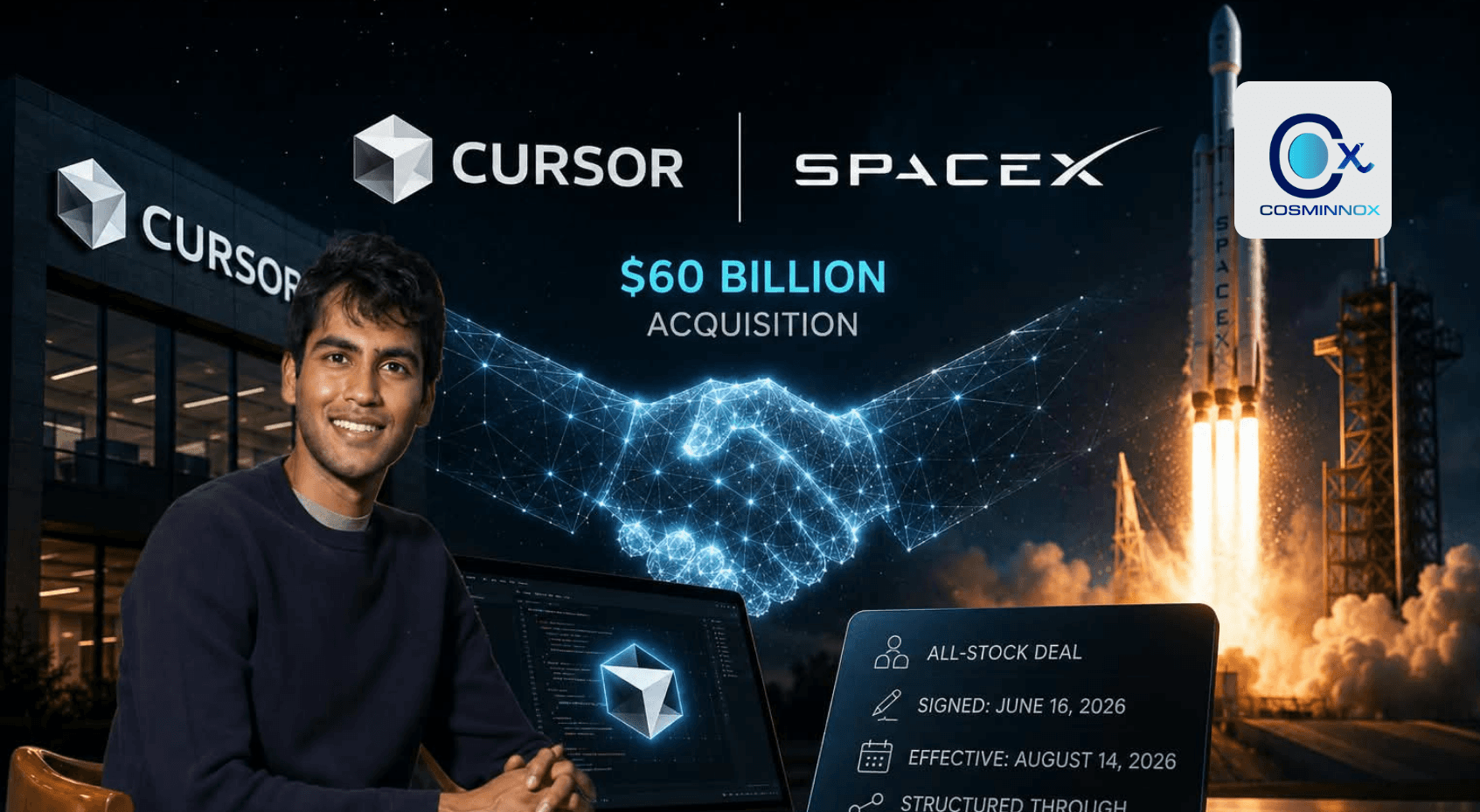
SpaceX announced it had completed the acquisition of Anysphere, the company behind AI coding platform Cursor, in a transaction valued at $60 billion. The merger agreement was signed on June 16, with SpaceX subsidiary X67 Inc. merging into Anysphere, leaving the startup as a wholly owned SpaceX subsidiary.
The deal was structured as all-stock. Anysphere shareholders received roughly 389.3 million shares of SpaceX Class A common stock, priced off the seven-trading-day volume-weighted average ahead of closing, plus 1.75 million additional shares converting from vested restricted stock units. The merger took effect on August 14, per an SEC filing dated that day, carried out through X67 Inc.
The path to that closing began earlier: SpaceX had locked in an option in April to either buy Cursor outright for $60 billion or pursue a $10 billion partnership instead. It exercised the buy side two months later.
WHO HOLDS THE STAKE
Anysphere was founded in 2022 by four MIT classmates, Sanger among them. He currently serves as the company's chief operating officer; earlier career stops, per reporting, include Bridgewater Associates and Google. His father, Arvind Sanger, is an IIT Bombay-trained hedge fund professional, and his mother, Shilpa Sanger, is an orthodontist and entrepreneur — placing his trajectory inside a familiar Indian-diaspora professional-to-founder pattern, though the company itself is a Silicon Valley product with no India operating footprint disclosed in the filing record.
Forbes has estimated the four co-founders could be worth roughly $2.7 billion each post-transaction — a figure this piece flags as a media estimate, not a disclosed SEC valuation, since the filing itself does not break out individual founder stakes.
WHAT THE FILING DOESN'T SAY — AND WHY THAT MATTERS
The SEC filing does not provide a separate revenue figure, profit contribution, or post-merger valuation for Cursor beyond the $60 billion implied equity value used to calculate the transaction. Everything beyond that — including Morgan Stanley's projection that Cursor's annual recurring revenue could climb from about $4 billion in June to $8 billion by end-2026 and near $33 billion by 2030 — sits in analyst-forecast territory, not filed fact. Forbes had separately reported Cursor's annualised revenue had already crossed $4 billion ahead of the deal closing, a figure that predates and roughly aligns with Morgan Stanley's starting point but comes from a different source entirely.
The market's own reaction adds a counter-note to any "unambiguous win" reading: SPCX shares fell on the day the acquisition closed, trading as low as $135.53 before partially recovering to around $140 — a reminder that a landmark private-to-strategic deal and a positive public-market verdict are not the same thing.
WHAT THIS ESTABLISHES — AND WHAT IT DOESN'T
The record supports a narrow claim: a startup co-founded by an Indian-origin technologist in 2022 was absorbed into one of the world's most valuable companies within four years, at a price that made his equity stake worth billions on paper — confirmed by SEC filing rather than press estimate. What it doesn't establish is Cursor's actual standalone profitability, the durability of its revenue trajectory once analyst forecasts are stripped away, or how SpaceX's near-term stock movement will settle once markets digest the deal. Those figures aren't yet on the public record, and won't be evaluable until SpaceX's own consolidated filings begin reporting the segment.
The Cosminnox wishes Aman Sanger and the Anysphere team warm congratulations on this milestone — a remarkable moment for Indian-origin talent in frontier tech.
Sources: U.S. Securities and Exchange Commission filing (Aug. 14, 2026, via SpaceX 8-K); Reuters, CNBC, Bloomberg and Forbes reporting on the Anysphere transaction; Morgan Stanley research estimates as reported by crypto.news (Aug. 2026); YourStory profile of Aman Sanger (Sept. 1, 2026).