
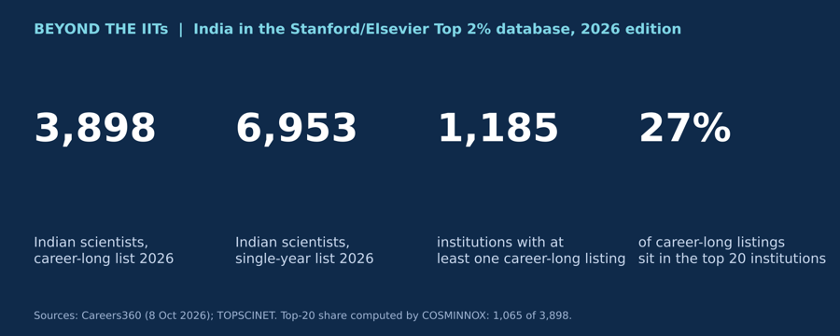
India in the Stanford/Elsevier Top 2% scientists list, 2026 key numbers: 3,898 career-long, 6,953 single-year, 1,185 institutions, 27% in the top 20
Does India’s presence in the Top 2% scientists list reflect a few elite institutions, or a widening research base? The 2026 edition lists 3,898 Indian scientists on its career-long ranking and 6,953 on its single-year ranking [1][2]. The evidence points to widening: the six IITs that led in 2024 grew more slowly than the national total over two years. It also points to limits. India sits 12th on the career-long list, and a share of the single-year growth comes from institutions whose citation patterns have drawn scrutiny.
Quick answer: The Top 2% scientists list is a Stanford-led, Elsevier-published database of the world’s most-cited researchers. In the 2026 edition, India has 3,898 scientists on the career-long list (12th by country count) and 6,953 on the single-year list (8th), across 1,185 institutions on the career-long list [1][3][4].
What the Top 2% scientists list measures
The database was developed by John Ioannidis and colleagues and is published through the Elsevier Data Repository [11]. Each edition rests on a fixed Scopus snapshot and is not changed after publication [10]. Researchers are scored on a composite citation indicator, the c-score, which combines total citations, the h-index, a correction for co-authorship and author position. It is computed with and without self-citations, across 22 fields and 174 sub-fields [1][7].
Two lists are released each year. The career-long list ranks citations across a researcher’s whole career. The single-yearlist ranks citations from one year only. A scientist qualifies by ranking in the top 100,000 worldwide by c-score or in the top 2% of their sub-field [3]. So “2%” labels a two-route rule, not a fixed share of all scientists. The indicator counts citations. It does not measure the quality of a discovery.
How many Indian scientists are on the list in 2026?
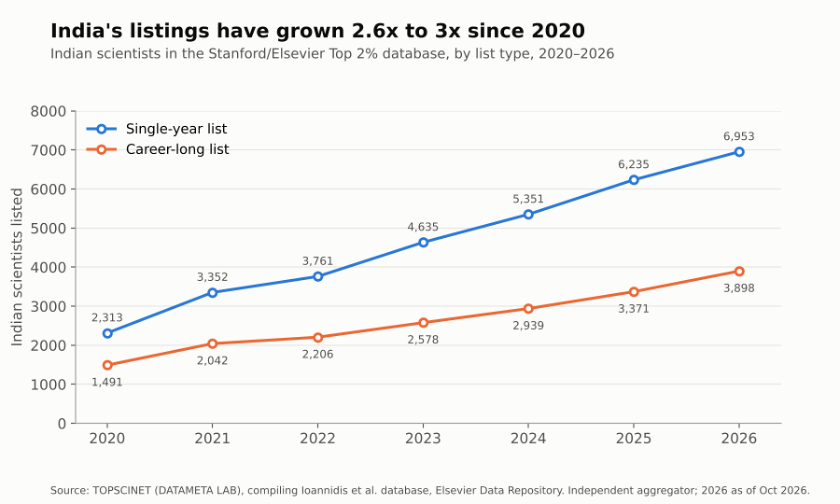
Line chart of Indian scientists on the Top 2% lists, single-year and career-long, 2020 to 2026
On the career-long list, India’s count rose from 1,491 in 2020 to 3,898 in 2026, an increase of 161.4%. On the single-year list it rose from 2,313 to 6,953, an increase of 200.6% [2][3]. Year on year in 2026, the career-long list grew 15.6% and the single-year list 11.5% [3][2]. Sources differ by a few units for 2025 (3,371 or 3,372 career-long; 6,235 or 6,239 single-year) [2][5].
A reading trap: 6,239 versus 3,898
One report set the 2025 total of 6,239 against the 2026 total of 3,898 and described a 37.5% decline [7]. Those numbers come from different lists. The 6,239 is the 2025 single-year count and the 3,898 is the 2026 career-long count [5][3]. On a like-for-like basis, career-long listings rose from 3,371 to 3,898 and single-year listings from 6,235 to 6,953 [2][3]. Careers360’s own 2026 report notes that a year-over-year comparison was removed from it [1].
Where do the listed scientists work?
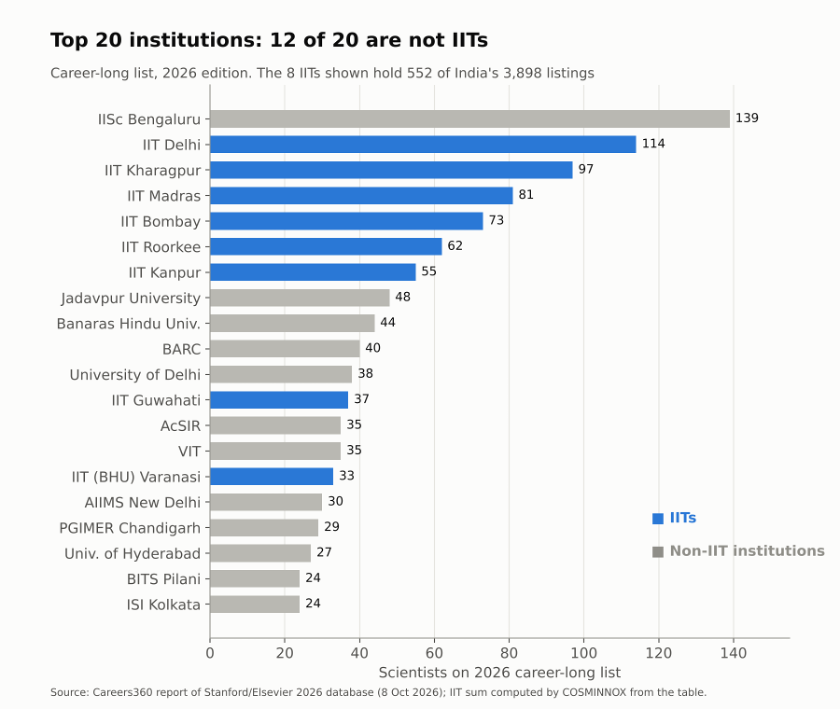
Bar chart of the top 20 Indian institutions on the 2026 career-long list, IITs highlighted
IISc Bengaluru leads the 2026 career-long list with 139 scientists, followed by IIT Delhi (114), IIT Kharagpur (97), IIT Madras (81) and IIT Bombay (73) [1]. Of the top 20 institutions, 8 are IITs and 12 are not. The non-IIT group includes Jadavpur University (48), Banaras Hindu University (44), the Bhabha Atomic Research Centre (40), the University of Delhi (38), AcSIR and VIT (35 each), AIIMS New Delhi (30) and PGIMER Chandigarh (29) [1].
The top 20 together hold 1,065 of the 3,898 career-long listings, or 27.3% (COSMINNOX sum of the published table). The other 2,833 listings sit across the remaining institutions, about 1,165 of the 1,185 total, an average of roughly 2.4 each [1]. Examples named in the report include NIT Rourkela with 30 (19 career-long), KIIT with 34 (13 career-long), Shoolini University with 25 (7 career-long) and Nagaland University with 4 [1].
What share do the IITs hold?
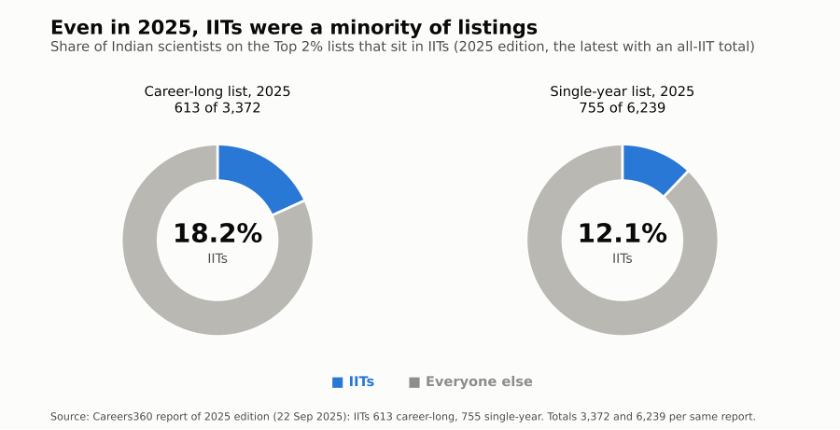
Two donut charts: IITs held 18.2% of career-long and 12.1% of single-year Indian listings in 2025
The 2026 reports reviewed give no all-IIT total. The latest edition with one is 2025: IITs held 613 of 3,372 career-long listings (18.2%) and 755 of 6,239 single-year listings (12.1%) [5]. In the same report, NITs held about 140 career-long and about 330 single-year listings, IISc 134 and 117, AIIMS (combined) 39 and 80, ICAR 43 and about 90, and the IIMs 10 and 36 [5].
For 2026, the eight IITs in the top 20 account for 552 listings, 14.2% of 3,898. That is a floor for the IIT share, since other IITs may also be listed [1]. A direct two-year comparison is possible for the institutions that led in 2024:
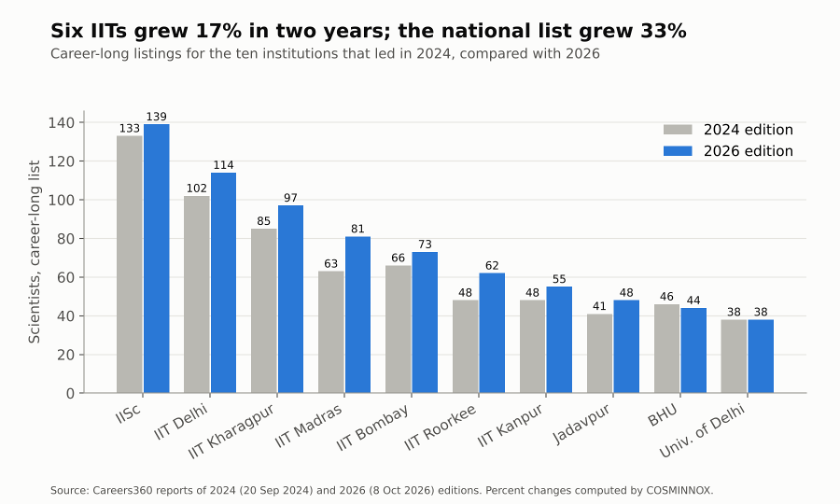
Grouped bars comparing career-long counts for ten leading institutions in the 2024 and 2026 editions
The six IITs among the 2024 top 10 (Delhi, Kharagpur, Bombay, Madras, Kanpur, Roorkee) held 412 of 2,939 career-long listings in 2024, or 14.0% [6]. In 2026 the same six hold 482 of 3,898, or 12.4% [1]. Their combined count rose 17.0%, while the national total rose 32.6% (COSMINNOX calculations). Over the same period Banaras Hindu University moved from 46 to 44 and the University of Delhi stayed at 38, while Jadavpur rose from 41 to 48 [6][1].
The single-year list and younger institutions
The single-year list shows a different mix. In TOPSCINET’s 2026 single-year ranking the top ten are IISc (113), IIT Delhi (104), IIT Kharagpur (84), VIT (77), IIT Roorkee (73), IIT Bombay (72), AIIMS New Delhi (61), IIT Madras (61), and two Saveetha entities with 59 each [2]. Five of the ten are IITs.
Several institutions list far more scientists on the single-year than on the career-long ranking. In 2025 the ratio was about 1.2 for the IITs as a group, but higher elsewhere:
Institution (2025 edition) | Single-year | Career-long | Ratio (computed) |
IITs (all) | 755 | 613 | 1.2 |
Amity University | 80 | 26 | 3.1 |
VIT (total) | 73 | 26 | 2.8 |
Saveetha School of Engineering | 52 | 9 | 5.8 |
Chitkara University | 59 | 8 | 7.4 |
Lovely Professional University | 49 | 7 | 7.0 |
Source: Careers360 report on the 2025 edition [5]. Ratios are COSMINNOX arithmetic.
A high ratio means many scientists with strong citation counts in one recent year and fewer with a long cumulative record. It does not by itself say anything about the reasons.
How India compares with other countries
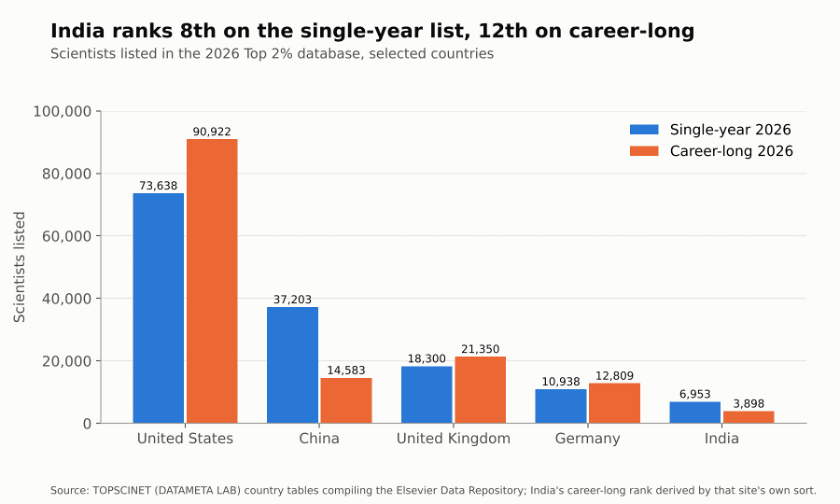
Bar chart of 2026 listings for the US, China, the UK, Germany and India on both lists
On the 2026 single-year list India ranks 8th with 6,953 scientists, behind the United States (73,638), China (37,203), the United Kingdom (18,300), Germany (10,938), Australia, Italy and Canada. On the career-long list, a sort of TOPSCINET’s table puts India 12th with 3,898, against the United States (90,922), the United Kingdom (21,350), China (14,583) and Germany (12,809) [4]. India’s count equals 18.7% of China’s on the single-year list and 26.7% on the career-long list (COSMINNOX calculations).
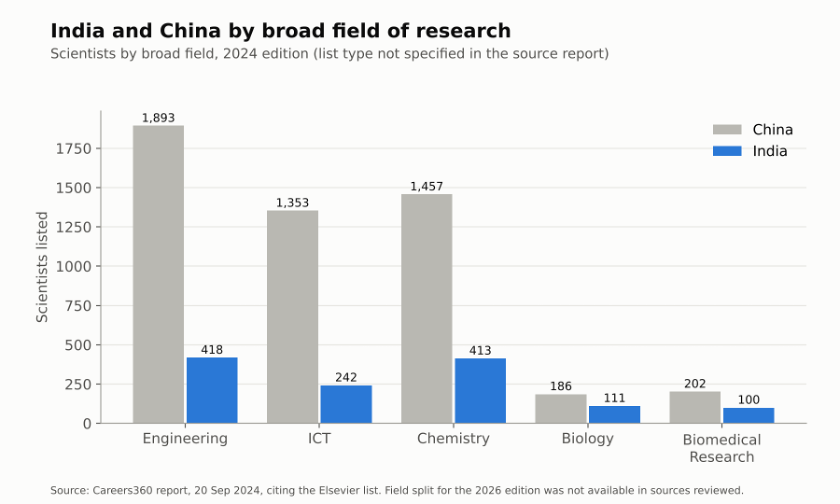
Bar chart comparing India and China by broad field in the 2024 edition
By field, the 2024 edition’s table shows China ahead of India in every category given: engineering 1,893 to 418, ICT 1,353 to 242, chemistry 1,457 to 413, biology 186 to 111 and biomedical research 202 to 100. The source does not state which list the table uses [6]. Among Indian listings in that edition, materials (307), energy (207) and AI and image processing (169) were the largest sub-fields:
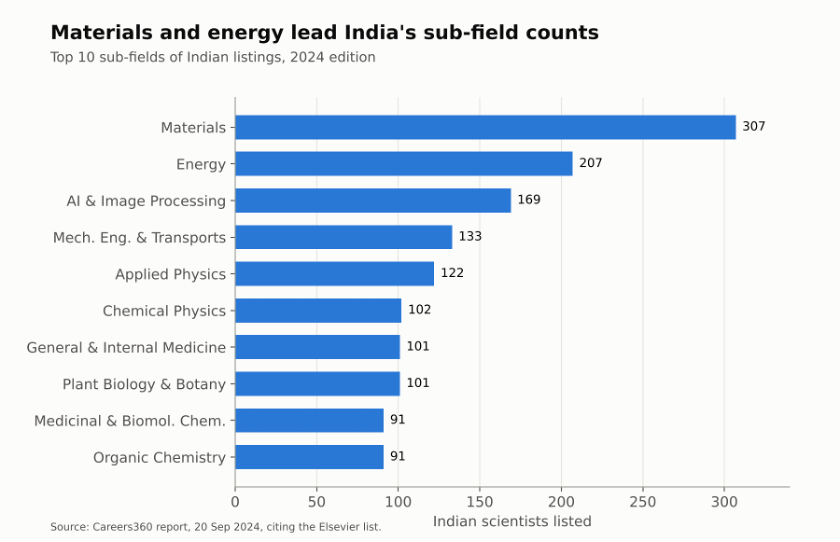
Horizontal bars of India’s top 10 sub-fields in the 2024 edition
On inputs, India’s gross expenditure on R&D was Rs 2.45 lakh crore in 2023-24, or 0.84% of GDP, with the private sector at Rs 1.27 lakh crore and government at Rs 1.18 lakh crore, according to figures given in a Rajya Sabha reply and reported by ANI on 31 July 2026 [8]. The list data do not test whether spending and listings are linked.
Counter-evidence: what these numbers do not show
Citation-based lists have critics. An analysis published by DORA on 3 April 2026 contrasts the Scopus-based “Top 2%” list of 2025, which it says includes more than 6,000 Indian researchers, with Web of Science’s Highly Cited Researchers list, which it says includes six Indian researchers because Web of Science reviews for unusual citation patterns [9]. The same analysis reports that 14 of India’s top 50 institutions had self-citation rates of at least 15% in at least two years between 2015 and 2024. It says private institutions among the top 50 by Scopus output rose from 12 in 2015 to 25 in 2024. It also reports that Saveetha’s output grew from 749 papers to 12,140 over that period, and gives sponsored research funding of about $133 million for IISc against about $0.37 million for Saveetha. The author argues that publication-based metrics should leave academic evaluation and funding decisions [9]. These are the author’s claims, drawn from the analysis; COSMINNOX has not independently verified them.
The database itself addresses part of the concern by publishing c-scores with and without self-citations [7]. Elsevier’s FAQ index for the database lists self-citation, possible citation gaming, anomalies and retractions among its topics, though the answers were not retrievable for this article [10]. Whether the 2026 institutional counts above use the with- or without-self-citation ranking is not stated in the reports reviewed [1]. COSMINNOX does not resolve the disagreement between the two positions.
What the evidence does and does not establish
Established by the sources cited here:
• India’s counts rose every year from 2020 to 2026 on both lists [2][3].
• In 2025, IITs held about one in five career-long listings (18.2%) and about one in eight single-year listings (12.1%) [5].
• The top 20 institutions hold 27.3% of 2026 career-long listings; most listings sit elsewhere [1].
• Among the 2024 leaders, six IITs grew more slowly (17.0%) than the national career-long total (32.6%) [6][1].
Not established:
• Research quality or impact beyond citation counts.
• A causal link between R&D spending, institutional type and listings.
• The all-IIT share in 2026, or the 2026 field split, which the reports reviewed do not give.
• Whether single-year gains at fast-growing institutions will persist in later editions.
Conclusion
The Top 2% scientists list shows a base that is wider than the IIT brand, with most listings outside the top 20 institutions and the leading IITs growing more slowly than the whole. It does not show whether that breadth is measured research strength. Readers should watch the career-long list, which moves more slowly, and ask each institution for its with- and without-self-citation counts. Policymakers can do the same: request institution-level c-score data directly from the Elsevier repository before using any list in funding decisions.
Frequently Asked Questions
What is the Stanford Top 2% scientists list?
It is a database of the world’s most-cited researchers, built by Stanford researchers led by John Ioannidis and published by Elsevier. It uses Scopus data and a composite citation score. Two lists are released each year: one for career-long citations and one for a single year. It measures citation impact, not the quality of research.
How many Indian scientists are in the Top 2% list in 2026?
The 2026 edition lists 3,898 Indian scientists on the career-long ranking, from 1,185 institutions, and 6,953 on the single-year ranking, according to Careers360 and TOPSCINET. India ranks 8th on the single-year list and 12th on the career-long list by country count, based on TOPSCINET’s tables.
Which Indian institution has the most scientists in the Top 2% list?
The Indian Institute of Science, Bengaluru, leads the 2026 career-long list with 139 scientists, ahead of IIT Delhi with 114 and IIT Kharagpur with 97. On the single-year list, TOPSCINET also shows IISc first, with 113, followed by IIT Delhi with 104.
Are IITs the main source of India’s top 2% scientists?
Not by share. In the 2025 edition, IITs held 613 of 3,372 career-long listings (18.2%) and 755 of 6,239 single-year listings (12.1%). In 2026, 12 of the top 20 career-long institutions are not IITs, and the top 20 together hold 27.3% of listings. The 2026 all-IIT total was not available.
What is the difference between the career-long and single-year lists?
The career-long list ranks scientists on citations accumulated over their whole career. The single-year list ranks them on citations in one year only. A scientist can appear on one list and not the other. In 2026 India has 3,898 names on the first and 6,953 on the second, so the two counts should not be compared directly.
Did the number of Indian scientists fall from 6,239 to 3,898?
No. That comparison sets the 2025 single-year count against the 2026 career-long count. Like for like, career-long listings rose from 3,371 to 3,898 and single-year listings from 6,235 to 6,953, according to TOPSCINET. One report did describe a 37.5% decline, and Careers360 later noted a year-over-year comparison had been removed.
How does India compare with China in the Top 2% list?
China is well ahead. In 2026, China has 37,203 scientists on the single-year list against India’s 6,953, and 14,583 on the career-long list against India’s 3,898. India’s count is 18.7% of China’s on the single-year list and 26.7% on the career-long list, by COSMINNOX arithmetic from TOPSCINET figures.
Does being in the Top 2% list mean a scientist is among the best in the world?
Not necessarily. Inclusion reflects citation counts, h-index and related measures from Scopus. Critics cited by DORA argue that citation metrics can be inflated by self-citation or citation circles. The database publishes scores with and without self-citations. Treat the list as one indicator of influence, not a verdict on research quality.
Sources
Tier labels follow The COSMINNOX sourcing hierarchy. The primary dataset (Elsevier Data Repository) could not be opened in this session, so counts are taken from the secondary and aggregator sources below.
1. Careers360, “3,898 Indian scientists feature in 2026 ‘World’s Top 2%’ list; IISc leads with 139, IIT Delhi follows”, 8 Oct 2026 (Tier 2). Link
2. TOPSCINET (DATAMETA LAB), “India’s Top 2% Scientists 2026: List & Growth Since 2020” (Tier 2, independent aggregator of the Elsevier dataset). Link
3. TOPSCINET, “India’s Top 2% Scientists 2026: Career-Long List & Growth” (Tier 2). Link
4. TOPSCINET, country tables for the 2026 single-year and career lists (Tier 2). Link
5. Careers360, “6,239 Indian scientists in Stanford’s top 2% list; IITs lead with 755, ahead of NITs, IISc, AIIMS together”, 22 Sep 2025 (Tier 2). Link
6. Careers360, “India has 2,939 researchers on Stanford University’s list of top 2% scientists, a fifth of China’s 10,687”, 20 Sep 2024 (Tier 2). Link
7. BioTecnika, “3,898 Indian Scientists Among World’s Top 2%! IISc & IITs Lead the Way”, Oct 2026 (Tier 2). Link
8. The Tribune (ANI), “Private sector leads India’s R&D spending for first time as total investment reaches Rs 2.45 lakh crore in FY24”, 31 Jul 2026, reporting a Rajya Sabha reply (Tier 2; the underlying Parliament reply is Tier 1). Link
9. DORA, “Even on their own terms university rankings have failed in India”, 3 Apr 2026 (Tier 3: advocacy analysis, attributed; claims not independently verified). Link
10. Elsevier Support, “Top-cited scientists database FAQs” (Tier 2). Link
11. Ioannidis, Boyack and Baas, “Updated science-wide author databases of standardized citation indicators”, PLOS Biology, 2020 (Tier 2, peer-reviewed; cited for the database’s origin only). Link