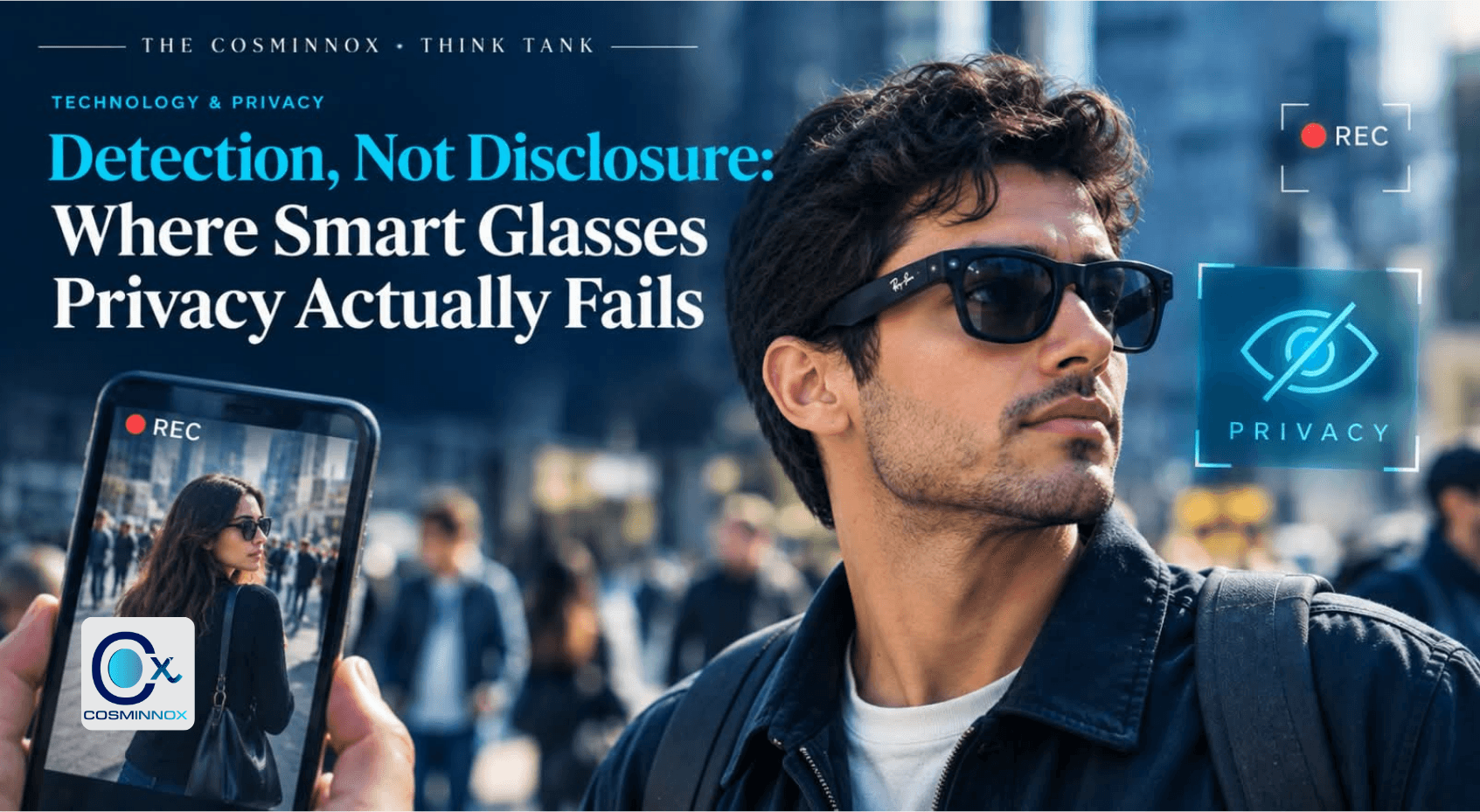
Can a blinking LED and a reassurance campaign fix a privacy problem that was built into the hardware itself? The evidence around Meta's AI glasses suggests reassurance alone has not settled the question — because the backlash was never really about marketing copy. It was about consent, and about how quickly a wearable camera can outrun the social contract that used to make in-person recording obvious.
THE CONSENT GAP
Smartphones announce themselves — a raised hand, a visible screen. Smart glasses do not. A University of Sydney study, drawing on 350 publicly posted Instagram videos filmed between 2023 and 2026, found a consistent shift toward what researchers termed “ambient capture” — discreet, point-of-view recording that bystanders struggle to detect, since smart glasses often provide no clear signal beyond a small flashing light that can easily be missed, limiting a person's ability to consent or opt out. The same research found around 60% of the covert videos it analysed showed behaviour classifiable as potential harassment, with filming continuing even after discomfort or refusal in 43% of cases — and some subjects were later identified and doxxed.
Source: University of Sydney research, reported by Gazette NGR
The pattern has surfaced repeatedly in reporting from Cork to CNN: Irish Examiner coverage documented a well-known content creator in Cork City using the glasses to record people without their knowledge, while CNN spoke to women who discovered, only after footage reached millions of views, that men they'd briefly spoken to had filmed the entire interaction on smart glasses. BBC reporting quoted Rebecca Hitchen of the End Violence Against Women Coalition describing the trend as a predictable consequence of technology being turned toward harassment.
Sources: Irish Examiner · CNN / gotranscript · BBC via Freevacy
THE DISNEY WORKAROUND
Out of that gap grew an improvised, crowd-sourced defence. The idea: if someone suspects they are being filmed by Meta Ray-Ban glasses, playing a recognisable Disney song nearby may trigger automated copyright-detection systems on platforms like YouTube, Instagram, Facebook and TikTok, which can mute, restrict, demonetise or remove videos containing copyrighted audio. The tip has circulated across LinkedIn, Threads and X as an informal way to make secretly recorded footage harder to publish — though it is not a guaranteed shield.
Source: International Business Times UK
The trick's popularity carries its own commentary. Critics online have framed it as evidence that “Disney music is more protected than women” — not a complaint about Disney specifically, but frustration that automated copyright enforcement can flag protected songs within moments, while a person filmed without consent must first discover the footage, then report it, then wait. An Italian outlet, Open, reported the same tactic circulating among women in Europe specifically as a countermeasure to Meta Glasses filming.
Source: Open (Italy)
META'S RESPONSE
Meta has leaned on the recording indicator as its primary technical answer: all Meta smart glasses carry a capture LED that blinks white when content is recorded, and the company has said it is enhancing privacy features following the backlash while running a marketing push — including a partnership with Kylie Jenner — aimed at rebuilding trust, particularly among women. Company spokespeople have repeatedly pointed to that light and to on-device storage defaults as evidence the system is built for consent, not against it.
Source: Irish Examiner
NOT THE FIRST TIME
The friction created by Meta's glasses has a precedent. When George Eastman's hand-held Kodak camera reached the market in 1888, it produced a comparable panic: subjects photographed without warning by amateur photographers nicknamed “Kodak fiends” prompted etiquette codes, camera bans at seaside resorts, and a British “Vigilance Association” formed to confront offending photographers. The same backlash produced an early legal response — Samuel Warren and Louis Brandeis's 1890 Harvard Law Review article, “The Right to Privacy,” widely credited with laying groundwork for privacy law in the United States.
Source: Smithsonian Magazine
A closer parallel arrived with Google Glass. After its 2013 launch, the device's built-in camera — with no clear indicator to bystanders that recording was underway — drew bans from bars, restaurants, casinos and cinemas across multiple cities, and its wearers were nicknamed “Glassholes.” The Motion Picture Association of America warned theatres to watch for the device over film-piracy concerns. Google withdrew Glass from the consumer market in 2015, two years after its release, though the same covert-recording objection has resurfaced against Meta's glasses a decade later.
Source: ABC News
WHERE INNOVATION OUTPACES GUARDRAILS
The glasses controversy is one instance of a broader pattern: capability shipping ahead of the norms and safeguards needed to govern it. A parallel lawsuit alleges footage from the glasses, including nudity and other intimate content, was reviewed by contracted workers in Kenya as part of Meta's AI training pipeline, despite marketing that promised the product was “designed for privacy”. Elsewhere, AI's generative capabilities have been weaponised differently: engineering firm Arup lost roughly $25.6 million in Hong Kong after an employee was convinced, over a video call, that deepfaked images and voices of the company's CFO and colleagues were genuine, and wired funds across 15 transactions.
Sources: Courthouse News Service · CNN Business
WHAT THE EVIDENCE ESTABLISHES
Taken together, the record supports a bounded claim: reassurance campaigns and a status-indicator LED address disclosure in theory, not detection in practice — and the gap between the two is what pushed users toward informal, unreliable workarounds like copyright-song deflection. Whether Meta's forthcoming feature changes close that gap, or whether regulatory scrutiny in the UK and litigation in the US force structural redesign, remains open and untested as of this writing.
As of September 2026. Figures and case status may change with ongoing litigation and regulatory review — check linked sources for updates.