
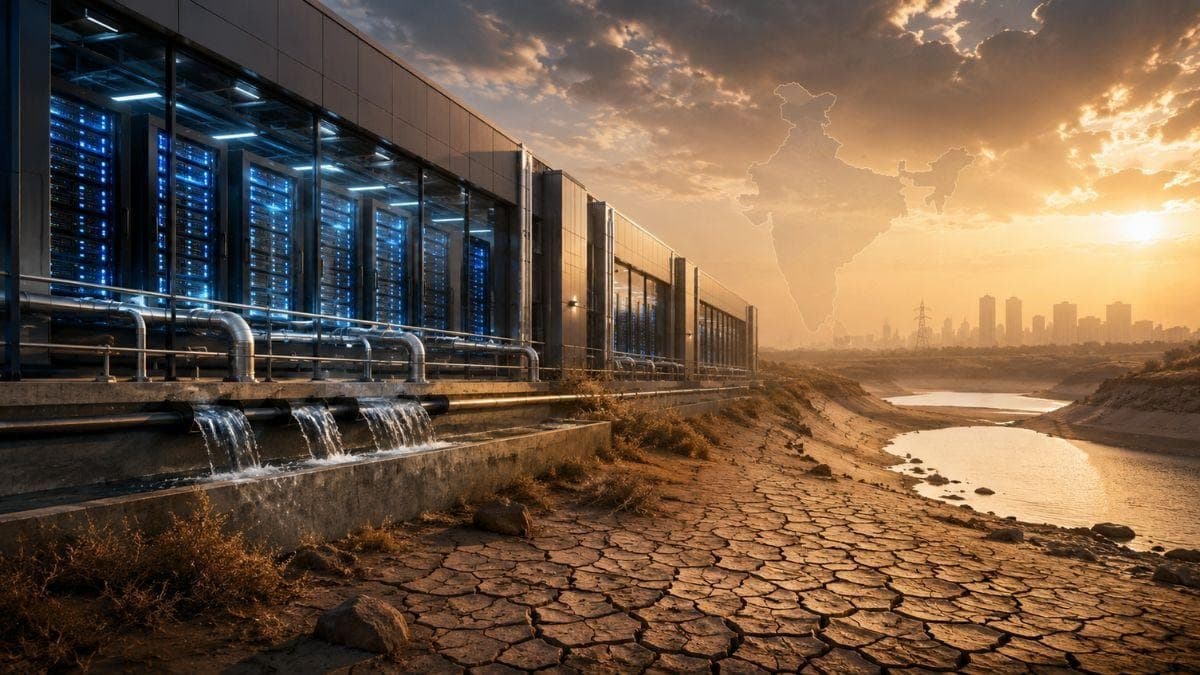
India stands at the intersection of two defining ambitions: securing water for its population and agricultural economy, and establishing itself as a major global centre for artificial intelligence, cloud computing and digital infrastructure.
These ambitions are not inherently incompatible. However, they compete for a resource that is already under considerable pressure.
Data centres support India's expanding digital economy, enabling everything from financial transactions and public services to AI research and enterprise computing. Yet the physical infrastructure behind this seemingly intangible digital world requires electricity, land, cooling systems and, in many configurations, substantial quantities of water.
The resulting policy question is both economic and ethical: How should India govern water allocation when households, farmers and digital industries depend on the same increasingly stressed resources?
This analysis examines the water footprint of data centres, the geographical risks of infrastructure expansion, the economic trade-offs between technological growth and agricultural sustainability, and the regulatory safeguards required to ensure that India's digital transformation does not undermine its water security.
1. India's Water Crisis: A Scarcity That Is Unequally Experienced
India's water challenge is not simply a question of insufficient rainfall. It is a complex interaction between geographical inequality, groundwater depletion, agricultural dependence, rapid urbanisation and institutional management.
According to the Central Ground Water Board's 2024 assessment, India's annual groundwater extraction reached approximately 245.64 billion cubic metres (BCM). Agriculture accounted for the overwhelming majority, followed by domestic and industrial uses.
India's groundwater extraction by sector, 2024
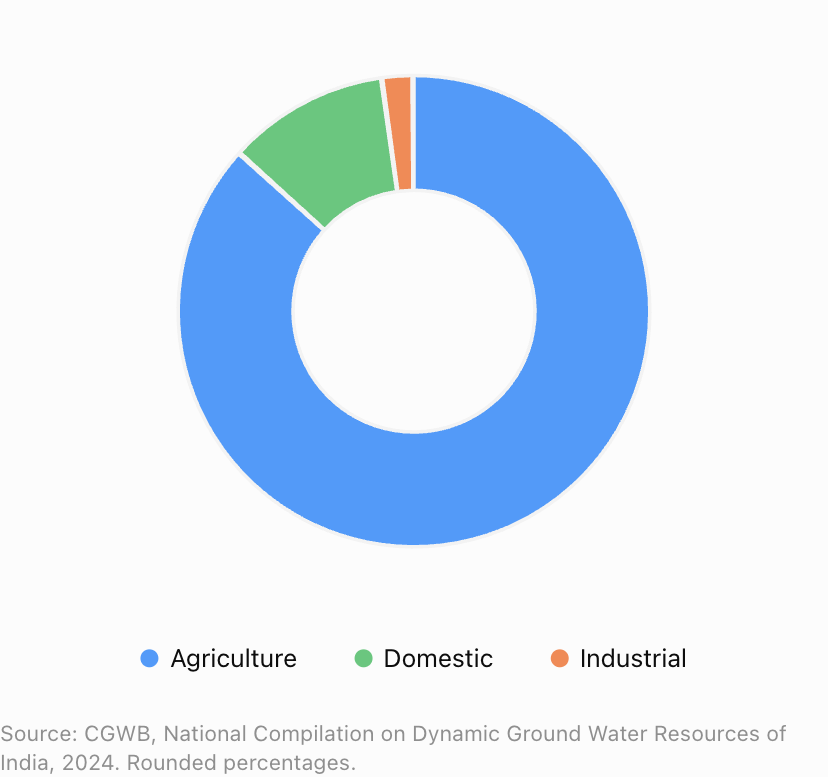
These figures reveal an important distinction: agriculture is by far the largest national user of extracted groundwater, while industrial extraction represents a much smaller proportion. However, national averages cannot adequately describe local water conflicts.
A data centre consuming water in a stressed urban or peri-urban watershed may create significant local pressure even if its contribution to national groundwater extraction remains relatively small.
The World Resources Institute (WRI) India reported in May 2026 that more than half of India's data centres are situated in water-stressed regions. Its analysis also found that 75% of facilities were concentrated in five states: Maharashtra, Tamil Nadu, Karnataka, Telangana and Uttar Pradesh.
This geographical overlap matters because water availability fluctuates seasonally, and the same source may be required for households, farming, industry and ecological systems.
The fundamental issue, therefore, is not merely how much water India possesses, but how water is distributed, priced, regulated and protected.
2. The Invisible Thirst of Artificial Intelligence
Artificial intelligence appears to operate in an intangible digital environment. A user enters a question, an algorithm processes it, and a response appears within seconds. Behind this interaction, however, are physical facilities containing thousands of processors, networking systems and storage devices.
These machines generate heat during operation. Without effective cooling, their performance, reliability and lifespan can deteriorate.
Data centres employ different cooling technologies, including air cooling, evaporative cooling, chilled-water systems and liquid cooling. Their water requirements differ substantially.
How a data centre creates a water footprint
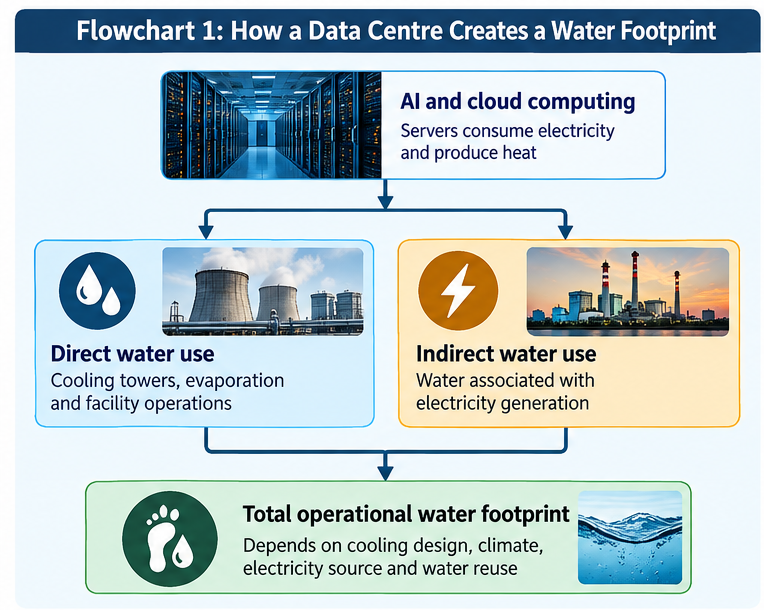
Two measurements are especially relevant. Water withdrawal measures the water taken from a source, while water consumption measures the portion not returned to that source, such as water lost through evaporation.
This distinction prevents misleading comparisons between cooling technologies. A closed-loop liquid cooling system, for instance, may circulate the same coolant repeatedly, whereas an evaporative cooling system can consume freshwater continuously through evaporation.
In March 2026, India's Ministry of Jal Shakti acknowledged the industry's adoption of direct-to-chip liquid cooling, immersion cooling and other efficiency-enhancing technologies. These innovations can reduce water requirements, although actual savings depend on the entire cooling system.
The policy implication is straightforward: India should evaluate the water performance of each facility rather than treating all data centres as equally water-intensive.
3. India's Data Centre Boom: Economic Opportunity Meets Environmental Responsibility
India's digital infrastructure industry is expanding rapidly.
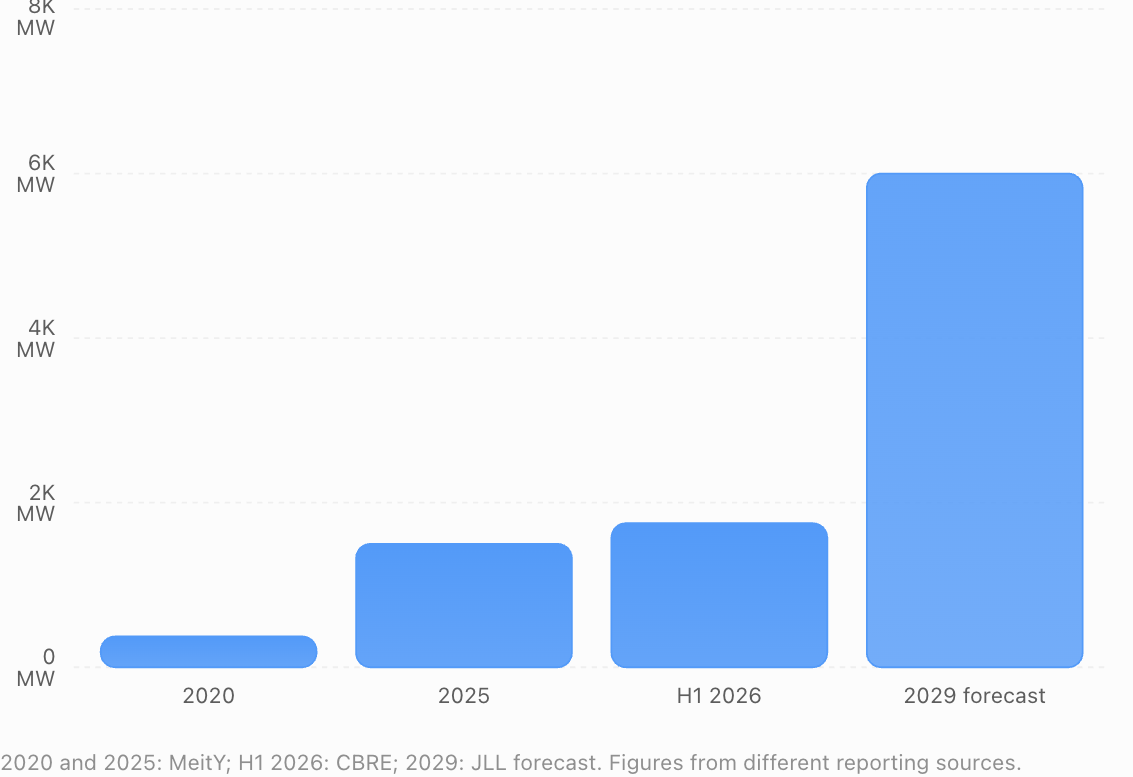
The Ministry of Electronics and Information Technology reported that national data centre capacity increased from approximately 375 megawatts in 2020 to 1,500 megawatts in 2025.
More recent industry research places operational capacity at approximately 1.75 gigawatts by the end of the first half of 2026. JLL projects that the market could reach 6 gigawatts by 2029, although this remains a forecast rather than committed operational capacity.
India's expanding data centre capacity
This growth reflects legitimate economic opportunities. Data centres support domestic cloud services, financial technology, scientific research, digital public infrastructure and AI applications. They also stimulate investment in construction, electrical equipment, connectivity and engineering services.
The economic argument for expansion is therefore substantial. Yet infrastructure development cannot be assessed solely through announced investment or installed computing capacity.
Water and electricity availability determine whether this expansion can be sustained without imposing additional costs on surrounding communities.
In October 2026, NITI Aayog's Frontier Tech Hub proposed a data centre evaluation framework emphasising infrastructure readiness, seasonal water availability, environmental safeguards and measurable economic benefits. The proposal represents an important shift from investment-led approvals towards evidence-based infrastructure planning, although implementation will depend on adoption by the relevant authorities.
4. Farmers, Households and Servers: Are They Competing for the Same Water?
The question of competition requires careful examination.
India's farmers depend heavily on groundwater, particularly where irrigation canals, reservoirs and rainfall cannot provide reliable supplies. Groundwater depletion can increase pumping costs, threaten agricultural productivity and disproportionately affect small and marginal farmers.
Households, meanwhile, require dependable access to safe drinking water and water for sanitation. Urban expansion and uneven distribution infrastructure can place additional pressure on local sources.
Data centres introduce another category of demand, often concentrated in locations selected for fibre connectivity, electricity infrastructure, land availability and proximity to major markets.
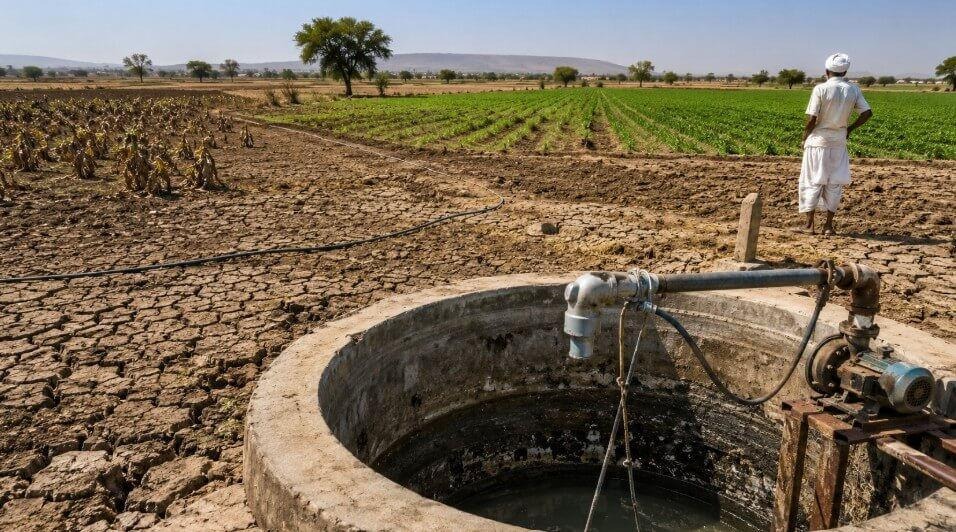
However, it would be inaccurate to suggest that every litre consumed by a data centre would otherwise have reached a farmer or household. Different users may draw from separate water networks, treated wastewater systems or alternative sources.
The central concern emerges when facilities share a constrained aquifer, municipal supply or watershed with existing users.
This creates three interconnected challenges.
First, allocation. In a water-stressed region, additional industrial demand may increase competition for limited supplies, particularly during the dry season.
Second, affordability. Large corporations may possess greater financial and technical capacity to secure water through dedicated infrastructure, storage or alternative procurement. Smaller users may lack equivalent options.
Third, accountability. Without transparent information on facility-level withdrawals, consumption and sourcing, communities cannot reliably evaluate whether new developments affect local water security.
The relevant policy question is not whether agriculture should automatically prevail over every other economic activity. It is whether essential human needs, existing livelihoods and ecological requirements are adequately protected when new industrial demand is authorised.
5. The Geography of Risk: Why Location Matters More Than National Totals
INDIA'S MAJOR DATA CENTRE MARKETS
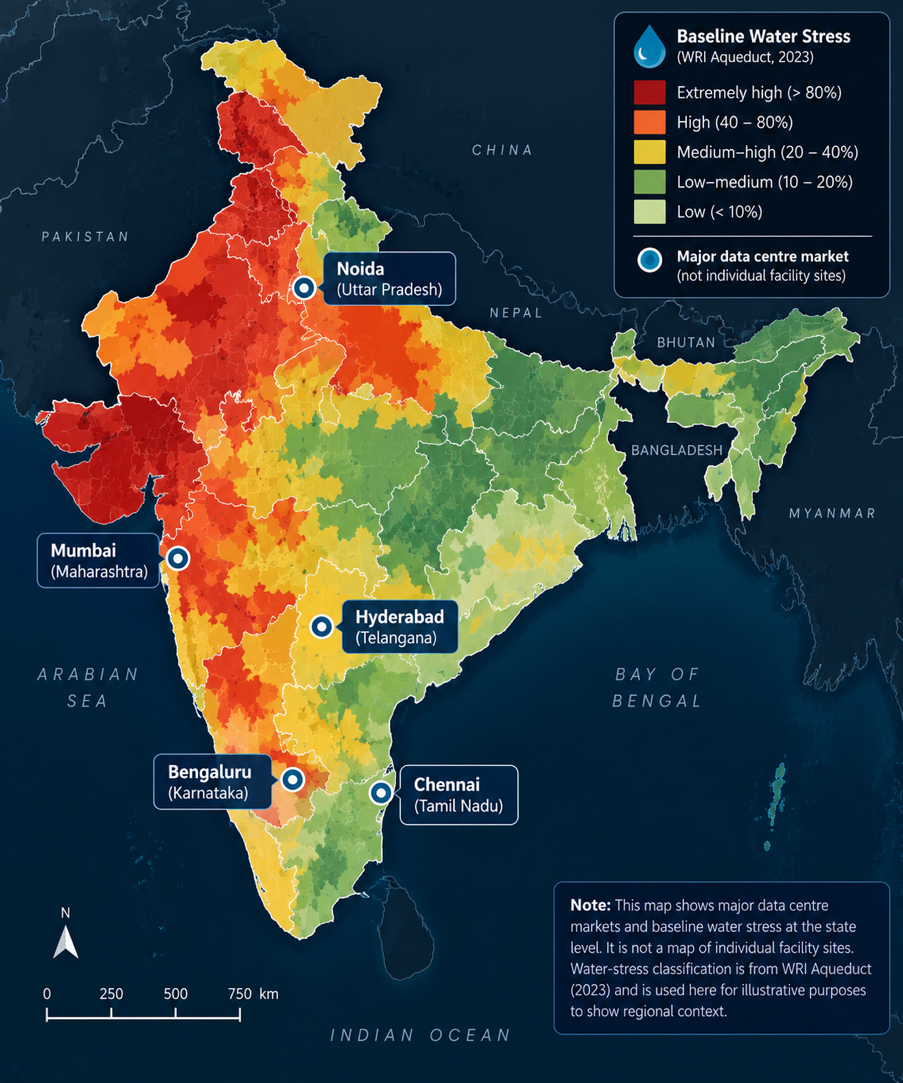
The geographical concentration of India's data centres raises important planning questions. Mumbai, Chennai, Bengaluru, Hyderabad and the National Capital Region have emerged as important infrastructure markets, but their water systems differ considerably.
Coastal cities may have access to desalination or alternative water infrastructure, although such systems require energy and careful environmental management. Inland cities may depend more heavily on reservoirs, groundwater or transferred water.
WRI India's finding that more than half of data centres are located in water-stressed regions does not establish that these facilities caused the underlying stress. It does, however, establish the importance of examining how future demand could interact with existing vulnerabilities.
The debate is no longer hypothetical. Reuters reported in October 2026 that residents near a proposed Amazon data centre development in the Mumbai region had raised concerns involving environmental impacts, water and electricity demand, and community consultation. Amazon maintained that it was pursuing mitigation measures, including water-free cooling.
This case demonstrates why public confidence depends not only on corporate sustainability commitments but also on verifiable local assessments.
A facility may meet technical efficiency standards while still being poorly situated relative to seasonal water availability. Conversely, a facility using reclaimed wastewater in a water-secure location may impose relatively limited additional freshwater demand.
Sustainable infrastructure requires both efficient technology and responsible geographical planning.
6. India's Regulatory Framework: Are Existing Safeguards Sufficient?
India does not operate in a complete regulatory vacuum. Groundwater extraction is governed through central and state-level mechanisms, and certain large construction projects require environmental clearance.
However, the distinction between regulating groundwater abstraction and regulating the total water footprint of a data centre is important.
In August 2026, the Ministry of Environment, Forest and Climate Change clarified in Parliament that AI data centres do not automatically require environmental clearance under the Environmental Impact Assessment Notification, 2006. Clearance becomes necessary when applicable construction or area-development thresholds are met. For qualifying projects, environmental appraisal considers freshwater availability, water balance, wastewater generation and recycling.
The Central Ground Water Authority also regulates groundwater extraction through its permission framework, including impact assessments for projects meeting specified withdrawal thresholds and groundwater-stress conditions.
The challenge is whether these mechanisms collectively provide sufficient visibility into the cumulative demands of multiple facilities located within the same watershed.
An individual project may satisfy applicable conditions while the combined demands of industrial expansion, urban growth and agricultural extraction exceed the capacity of local water systems.
This is where India's emerging data centre policy debate becomes particularly relevant.
NITI Aayog's Data Centre Evaluation Framework to Help States Plan for Sustainable Growth, published on 14 October 2026, recommends assessing power, water, land and supporting infrastructure alongside economic benefits. It also calls for planned efficiency metrics, including Water Usage Effectiveness (WUE), and safeguards for existing users and local communities.
The framework offers a foundation for more coordinated governance. Its effectiveness will depend on whether states translate its recommendations into enforceable approval conditions, monitoring arrangements and public accountability.
7. The Global Perspective: Lessons from Singapore
Singapore offers a useful comparison because it faces substantial resource constraints while seeking to remain a competitive digital infrastructure hub.
Its Green Data Centre Roadmap, launched in 2024, connects new capacity development with improvements in efficiency and access to greener energy. The country has also developed technical standards for operating data centres at higher temperatures in tropical conditions, reducing cooling energy requirements without compromising equipment reliability.
This approach offers three lessons for India.
First, digital infrastructure planning should incorporate environmental performance from the design stage rather than treating sustainability as an afterthought.
Second, efficiency improvements must be measurable. Power Usage Effectiveness (PUE), Water Usage Effectiveness (WUE) and carbon-related metrics can help distinguish genuinely efficient facilities from those relying primarily on sustainability claims.
Third, public authorities and private operators should share responsibility for infrastructure readiness. Companies can invest in efficient cooling and water recycling, while governments establish resource limits, transparent standards and appropriate locations.
Singapore's model cannot be replicated without modification. India's geographical scale, agricultural dependence and differences between state water systems require a more decentralised approach. Nevertheless, the underlying principle remains relevant: digital infrastructure growth should be conditional on demonstrable resource sustainability.
8. The COSMINNOX Policy Perspective: A Water-Secure Digital Economy
India's policy challenge is not to choose between agriculture and artificial intelligence. It is to establish conditions under which technological development does not compromise essential water needs.
COSMINNOX proposes a six-part policy framework.
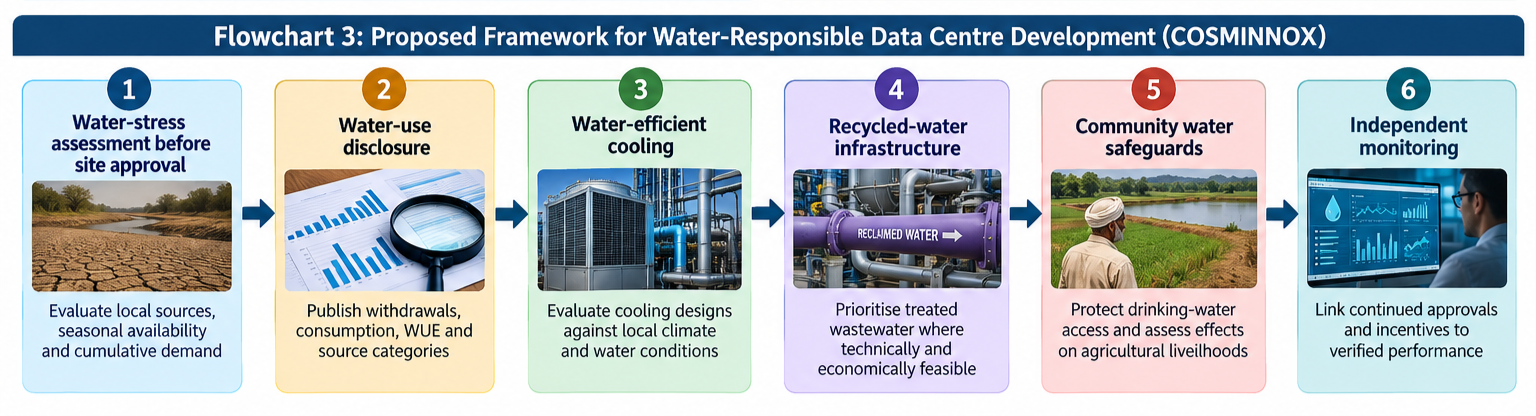
Integrating technology with environmental accountability
Water-efficient cooling should become an important consideration in project evaluation. However, efficiency must be measured across the complete facility. A technology that reduces on-site water consumption may increase electricity demand, transferring part of its environmental footprint to the power sector.
Similarly, using treated wastewater may reduce dependence on freshwater, but it requires reliable treatment facilities, distribution infrastructure and safeguards against contamination.
For water-stressed locations, authorities could require developers to demonstrate that their projects will not materially undermine existing drinking-water services or agricultural access. Independent assessments should consider seasonal shortages and cumulative impacts, not simply average annual supply.
State incentives could also be linked to measurable outcomes, including verified water savings, recycled-water utilisation and compliance with publicly disclosed operating conditions.
The larger objective is to move from voluntary environmental commitments towards a transparent, evidence-based system of digital infrastructure governance.
9. Economic Growth Cannot Be Separated from Resource Security
The debate surrounding data centre water consumption reflects a broader challenge in India's development model.
Agriculture remains essential to food security, rural employment and household livelihoods. Digital infrastructure, meanwhile, supports economic diversification, technological capability and future competitiveness.
These sectors serve different but interconnected national interests.
A simplistic comparison between the economic output of a data centre and that of an agricultural field would overlook the social value of food production, water access and livelihood stability. Equally, rejecting digital infrastructure expansion without considering its economic benefits would neglect important opportunities for technological development.
The more productive approach is to evaluate the marginal costs and benefits of each proposed project within its local environmental context.
A data centre that draws heavily on scarce freshwater in an already stressed watershed presents a different policy proposition from one operating on treated wastewater with independently verified efficiency measures.
India's digital economy must therefore be assessed not only by the scale of investment it attracts, but also by the environmental costs it avoids and the public value it creates.
10. Conclusion: Who Gets the Water?
The question, "How is there no water for humans and agriculture, but enough water for data centres?", expresses a concern that deserves rigorous investigation rather than a simplistic answer.
Available evidence does not establish that India's data centres are the principal cause of national water scarcity. Agriculture accounts for a much larger share of groundwater extraction, and the water requirements of data centres vary significantly according to their design and location.
Nevertheless, the geographical concentration of digital infrastructure in water-stressed regions creates a legitimate need for scrutiny. Rapid expansion without adequate planning could intensify local resource pressures, particularly where freshwater availability is already unreliable.
India's technological ambitions and its water-security obligations should not be treated as competing national priorities. They are interconnected requirements of sustainable development.
The country's ability to build a competitive AI economy will increasingly depend on whether it can provide reliable infrastructure without transferring environmental costs to surrounding communities.
The measure of progress must therefore extend beyond server capacity, investment commitments and computational performance.
A digitally advanced India cannot be considered sustainably developed if the infrastructure powering its intelligence places additional strain on the water security of its people.
The challenge is not to halt the digital revolution, but to ensure that the foundations supporting it are environmentally responsible, economically defensible and socially equitable.
References
Central Ground Water Board. (2024). National Compilation on Dynamic Ground Water Resources of India, 2024.
World Resources Institute India. (2026). More Than Half of India's Data Centres Are in Water-Stressed Regions.
Ministry of Electronics and Information Technology. (2026). Data Centre Capacity and Cooling Technology: Parliamentary Information.
Ministry of Jal Shakti. (2026). Water Consumption by Data Centres in the Country.
Ministry of Environment, Forest and Climate Change. (2026). Effective Use of Water in AI Data Centres.
NITI Aayog, Frontier Tech Hub. (2026). Data Centre Evaluation Framework to Help States Plan for Sustainable Growth.
CBRE. (2026). India Data Centre Market Monitor H1 2026.
JLL. (2026). India Data Centre 2026 Mid-Year Report.
Singapore Infocomm Media Development Authority. (2024). Green Data Centre Roadmap.
Reuters. (9 October 2026). Modi Wants India to Power the AI Age. Residents Are Pushing Back.
Editorial note: This is a desk-based policy analysis using published government, institutional, industry and news sources. It does not establish project-specific water withdrawals or causation between an individual data centre and a local shortage. The policy recommendations are analytical proposals, not statements of existing legal requirements.