What The Project Is
Kishau is one of three linked storage projects — alongside the Renukaji dam on the Giri river and the Lakhwar project on the Yamuna itself — that the six Upper Yamuna Basin states (Himachal Pradesh, Uttarakhand, Uttar Pradesh, Haryana, Rajasthan and Delhi) agreed in 1994 to develop jointly for irrigation, drinking-water supply and hydropower. [The Tribune India, archival report, 11 January 2016]
Of the three, Lakhwar and Renukaji had already reached inter-state agreement; Kishau — the largest of the three by reservoir storage and power capacity, and the only one requiring a new dam straddling an interstate border — is the one that took an additional decade of renegotiation after the other two were settled.
What Was Actually Agreed
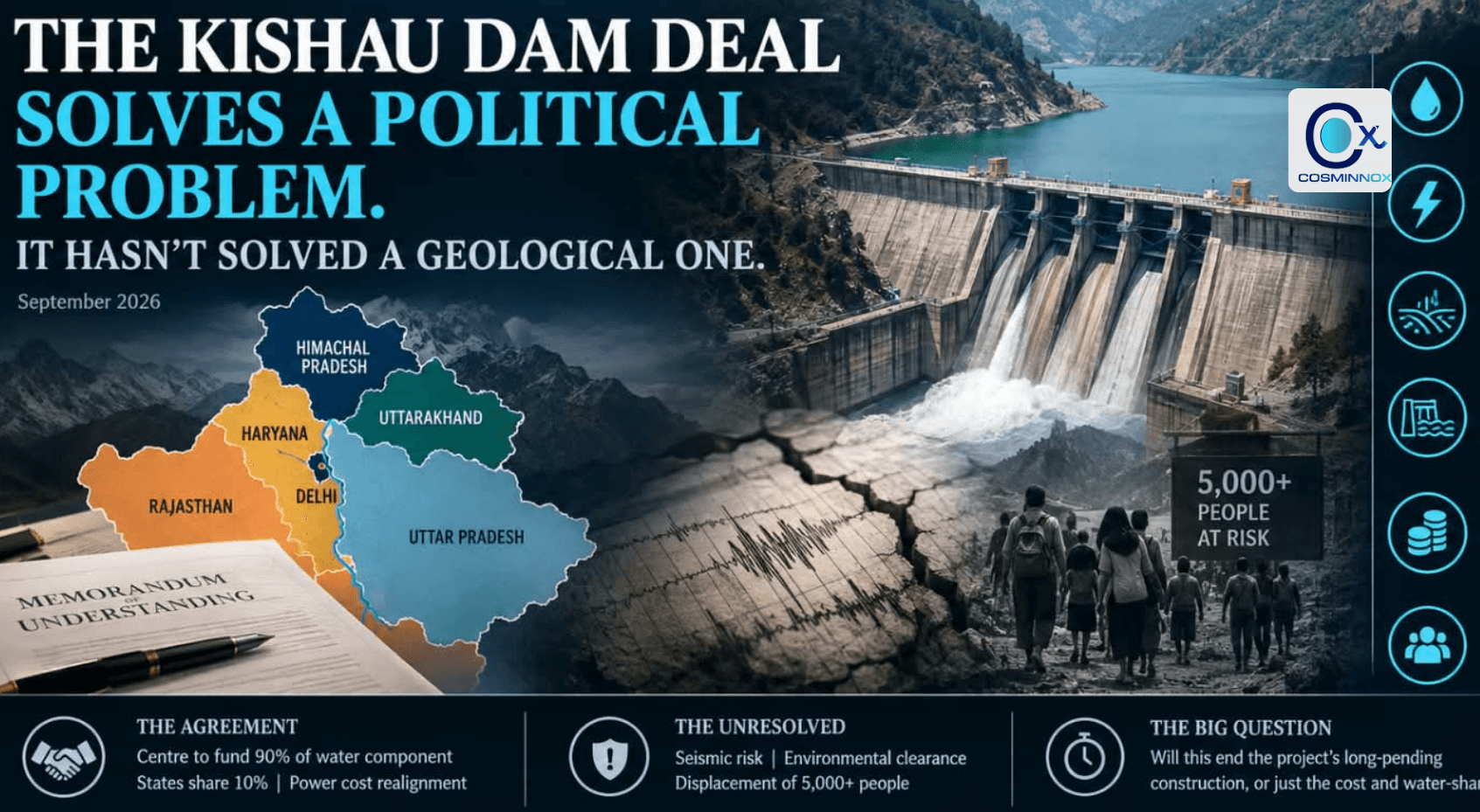
On September 15, 2026, Union Home Minister Amit Shah chaired a meeting in New Delhi at which the chief ministers of Himachal Pradesh, Uttarakhand, Delhi, Uttar Pradesh, Haryana and Rajasthan signed a Memorandum of Understanding for the Kishau Multipurpose Project, in the presence of Union Jal Shakti Minister C.R. Patil. The Centre declared the project a National Project at the same event, after which it moves to the Union Cabinet for final approval. [The Tribune India, 15 September 2026; The Statesman, 15 September 2026]
The agreement is narrow and specific: the Centre will fund 90% of the water component's cost as central assistance, with the six states sharing the remaining 10% under the formula set by the states' 1994 basin agreement. On the power component, Himachal Pradesh agreed to forgo a portion of its dam-water share — sending it instead to Delhi and Rajasthan — in exchange for those two states covering Himachal's share of the power-component cost. [The Tribune India, 15 September 2026; Punjab Kesari (IANS), 15 September 2026]
The dam itself is a concrete gravity structure on the Tons river, a Yamuna tributary on the Himachal–Uttarakhand border. Government statements issued at the September signing describe it as 232.6 metres high, with 1,562 million cubic metres (MCM) of live storage, designed to generate 660 MW of hydropower (4 × 165 MW) — an estimated 1,476 million units annually — and to irrigate roughly 97,000 hectares. [The Statesman, 15 September 2026; ANI, 15 September 2026]
Current-affairs briefs published before the signing cite a slightly different set of figures — a 236-metre dam height and 1,324 MCM of storage. This piece uses the figures given in government statements at the September signing; the variance between the two sets of numbers is noted here rather than resolved. [Vajiram & Ravi current-affairs brief, 2026]
Fig. 1 — Sixty years of stop-start history: interstate cost-sharing was only one of the barriers
Project parameter | Figure (Sept. 2026 signing) |
Dam type / height | Concrete gravity, 232.6 m (earlier briefs: 236 m) |
Location | Tons river, Himachal Pradesh–Uttarakhand border |
Installed capacity | 660 MW (4 × 165 MW) |
Annual generation (est.) | 1,476 million units |
Reservoir storage | 1,562 MCM (earlier briefs: 1,324 MCM) |
Drinking-water allocation | 517 MCM / year |
Irrigation potential | ~97,000 hectares |
Estimated cost | ₹15,000 crore (originally ~₹6,000 crore) |
Beneficiary states | HP, Uttarakhand, Delhi, UP, Haryana, Rajasthan |
Table 1 — Kishau Multi-Purpose Dam Project: vital statistics [The Statesman; ANI; Vajiram & Ravi; ThePrint, 30 May 2025]
Cost component | Centre share | State share | Notes |
Water component | 90% | 10% (split across 6 states, per 1994 formula) | Core of the September 2026 MoU |
Power component (HP's portion) | — | Borne by Delhi & Rajasthan | In exchange for a share of HP's dam water going to Delhi/Rajasthan |
Table 2 — The funding and water-allocation formula agreed in September 2026 [The Tribune India; Punjab Kesari (IANS), 15 September 2026]
Why It Took A Decade To Get Here
The interstate dispute Kishau just resolved wasn't new, and it wasn't only about the total cost. Three elements recur across a decade of reporting on the project.
The upstream-downstream asymmetry. Himachal Pradesh — one of the two states, along with Uttarakhand, where the dam and reservoir physically sit — argued for years that it should not carry a financial burden proportional to states that receive the water and power without absorbing the submergence, displacement and construction impact. [The Tribune India, 16 September 2026]
Uttarakhand raised a parallel objection into this year's talks. The Centre's own statements at the signing describe the state's concerns as still being "accommodated" going forward rather than resolved at the MoU stage — Home Minister Shah said the government would help Uttarakhand "bear the financial burden that may fall upon the state." [The Statesman, 15 September 2026; The Hans India, 15 September 2026]
A formula renegotiated at least three times. The six states first agreed to jointly develop Kishau under the 1994 Upper Yamuna River Board framework. A Union-mediated meeting in January 2016 revised the power-sharing split between Himachal Pradesh and Uttarakhand to an equal 330 MW-each formula, modeled on the arrangement used for the Lakhwar project. [The Tribune India, archival report, 11 January 2016]
That, too, did not hold. Himachal Pradesh and Uttarakhand had separately signed a joint-venture MoU around 2015 that, per Land Conflict Watch's account, left the project stalled because it lacked a workable benefit-sharing formula — even after the two directly affected states had notionally agreed to build it together. The formula signed this September is different again: Himachal forgoes a share of its water in exchange for Delhi and Rajasthan funding its power-cost obligation, rather than the 2016 equal-power-split model. [Land Conflict Watch, "Community members protest the interstate Kishau dam project"]
Rising cost as a moving target. The project's estimated cost has roughly doubled since it was first proposed, from about ₹6,000 crore to the ₹15,000 crore figure government officials cited at the September signing — and, per reporting on the project, each escalation reopened the argument over who absorbs the increase, on top of the underlying water-and-power split. [ThePrint, 30 May 2025; OrissaPost, 16 September 2026]
ThePrint's reporting attributes the roughly decade-long slippage from the project's original mid-2010s completion target to this combination of interstate disagreement, funding disputes and bureaucratic delay — layered on top of the environmental and seismic objections detailed below. [ThePrint, 30 May 2025]
What The Agreement Doesn't Touch
The interstate dispute is not the only reason Kishau has never been built. A 1965 detailed project report for a 236-metre dam at this site was rejected by the Central Water and Power Commission on the grounds that the location sits in an active seismic zone. In 2000, the Central Electricity Authority's Technical Advisory Committee deferred techno-economic clearance for lack of established economic viability. A 2010 detailed project report seeking environmental Terms of Reference reportedly went unanswered by the environment ministry. [Scroll.in, "Indian government is yet again considering a dam that has been rejected repeatedly over 50 years"]
The physical scale of displacement is also unresolved. Project estimates cited in reporting put the submergence area at roughly 2,950 hectares — split between Himachal Pradesh and Uttarakhand — affecting an estimated 5,498 people across 17 villages who would need to be relocated. [Scroll.in; Land Conflict Watch, "Community members protest the interstate Kishau dam project"]
Fig. 2 — Displacement is concentrated more heavily in Uttarakhand than the submergence-area split alone suggests
Residents in the affected villages have organized protests, citing loss of fertile riverside farmland used for cash crops and common grazing land central to their livestock-based livelihoods. [Land Conflict Watch]
Environmentalist Kulbhushan Upmanyu, commenting on the project, acknowledged the downstream case for the water supply while raising concerns about how displaced families are resettled and compensated. [ETV Bharat, 23 June 2026]
None of the September statements from the Home Ministry or the participating chief ministers address a revised environmental-clearance timeline, a resettlement package, or an updated seismic assessment. The MoU, as described in available government statements, resolves who pays and who gets water — not whether the site clears the regulatory and geological hurdles that stalled it in 1965 and again in 2000.
What The Agreement Is Meant To Signify
Beyond ending the interstate deadlock, the Centre and state governments have framed the September signing as significant on four fronts. Each is stated below as a claim, attributed to its source — not adopted here as this magazine's own assessment.
A river-restoration commitment. Home Minister Shah said the agreement allocates 25% of the Kishau reservoir's water to the Yamuna's own environmental flow — a category he said was "not calculated at all" when the river's waters were first divided among states — and that he expects the Yamuna to be clean by 2029. Both the allocation share and the 2029 date are Shah's statements; neither appears in this piece as an independently verified projection. [The Statesman, 15 September 2026; ANI, 15 September 2026]
Downstream water security. Government and state statements describe Delhi as the project's largest single beneficiary via a 517 MCM-a-year drinking-water allocation, and Rajasthan's government has framed the deal as strengthening supply to the water-scarce Shekhawati region — Sikar, Churu and Jhunjhunu districts. [ThePrint, 30 May 2025; The Hans India, 15 September 2026]
Hydropower framed as clean energy. The project is billed as adding 660 MW of capacity and an estimated 1,476 million units of power annually, described in government statements as clean hydropower — without a stated emissions or displacement-cost baseline attached to that comparison. [The Statesman, 15 September 2026]
A template for interstate river disputes. The Centre has folded Kishau into a list of ten interstate water disputes it says it has resolved during its tenure, alongside the Renukaji dam, a separate Yamuna-sharing agreement with Haryana, the Chambal-Kalisindh-Parbati link, and the Narmada-sharing arrangement among Gujarat, Madhya Pradesh, Maharashtra and Rajasthan — a list Rajasthan's chief minister cited directly at the signing. [OrissaPost, 16 September 2026; The Statesman, 15 September 2026]
The mechanism repeated across that list is consistent: the Centre absorbs the large majority of project cost — 90% in Kishau's case — as the condition under which states set aside their own share dispute, rather than the states reaching an independent, durable formula on their own. Kishau's water-for-power-cost swap between Himachal Pradesh, Delhi and Rajasthan fits that pattern rather than departing from it. Whether this becomes a repeatable template other river-basin disputes can use, or a bespoke fix that has to be renegotiated project by project, is not something the public record answers yet.
Resolution
What the September 2026 agreement resolves: the specific interstate deadlock over cost and water-sharing that had survived at least three renegotiated formulas since the six states' original 1994 basin agreement — most recently the roughly 2015 Himachal Pradesh–Uttarakhand joint-venture MoU that, per Land Conflict Watch's account, lacked a workable benefit-sharing formula. That deadlock is now broken, and the project is positioned to reach the Union Cabinet.
What it does not resolve: the seismic-safety and economic-viability objections that twice stopped the project outright (1965, 2000), the unanswered 2010 environmental scoping request, and the resettlement of 5,498 people across 17 villages — none of which are mentioned in the government's September statements as having a revised clearance timeline or compensation framework. The "National Project" designation and the stated Yamuna-restoration and clean-energy benefits are framing choices made by the agreement's signatories; they are not, on the available record, new regulatory clearances. A signed MoU on cost-sharing is a necessary condition for the dam to proceed. On the public record so far, it is not a sufficient one.