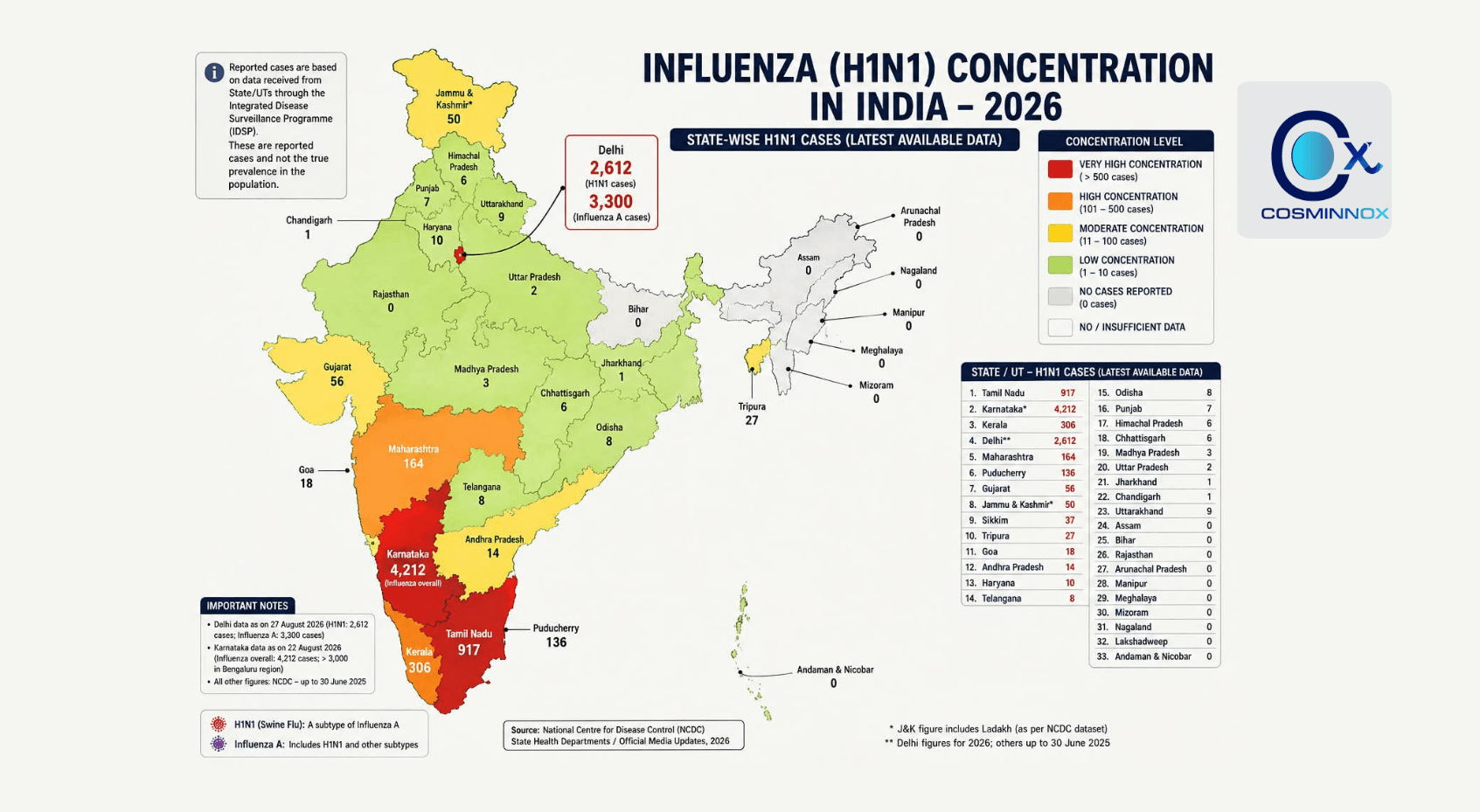
WHEN IT STARTED, AND WHERE IT CONCENTRATED
This year's rise tracks India's recognized monsoon-season influenza peak, which typically runs from roughly May/June through August–October. Kerala's case count began climbing in May and continued through July, reaching 7,421 cumulative cases by August 17. Karnataka's state health department recorded 855 H1N1 cases by July 31 — nearly seven times the 118 recorded over the whole of the previous year — with Bengaluru accounting for the largest share within the state.
Delhi's Health Minister put the city's 2026 H1N1 count at roughly 2,308 cases as of late August, against about 229 in the same period the year before, with cumulative Influenza A and B cases in the city crossing 3,000. Mumbai and Chennai have also reported elevated case volumes this season, per multiple outlets, though city-level case counts for both were not specified in the same official detail as Delhi and Karnataka.
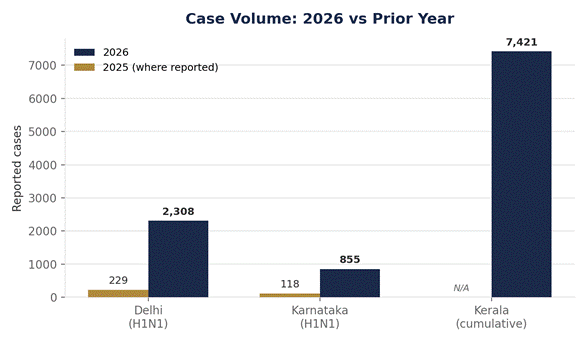
Fig. 1 — Case volume, 2026 vs. prior year, by state/city. Kerala's prior-year comparable was not specified in sourcing.
Table 1 — State/city case counts and dominant strain, 2026 season.
HOW THIS YEAR IS DIFFERENT
The clearest structural shift is the dominant strain. Delhi's Health Minister confirmed H3N2 was the predominant subtype circulating in the city last year; this year, H1N1 has taken over as the predominant strain. Doctors at Delhi hospitals have also described a change in severity rather than just volume: physicians at one major hospital noted that while ICU admissions were rare last year, this year they have risen, with some patients experiencing falling oxygen levels and secondary bacterial infections developing after recovery from the initial flu illness — and patients with previously controlled asthma or COPD reporting symptom worsening.
HOW MANY DEATHS HAVE BEEN RECORDED
The death toll varies sharply by state, and the available numbers should be read as state-specific rather than combined into a single national figure, since reporting standards differ. Kerala recorded 88 deaths by August 17, with most fatalities among people over 50. Karnataka has recorded 10 H1N1-linked deaths since January, including two deaths where H1N1 was the confirmed primary cause — a 15-year-old boy in Mysuru and a 48-year-old woman in Doddaballapur — with three further deaths among H1N1-positive patients attributed by officials to comorbidities and advanced age rather than the virus alone.
Madhya Pradesh recorded one reported death, a woman in her 60s in Ujjain who died on August 19, a day after leaving a private hospital in Indore against medical advice. Delhi's government stated on August 6 that no deaths had been officially confirmed due to H1N1 in the city this year; a small number of media reports have described Delhi deaths linked to H1N1, which authorities have disputed — both sides of that disagreement are sourced here rather than resolved.
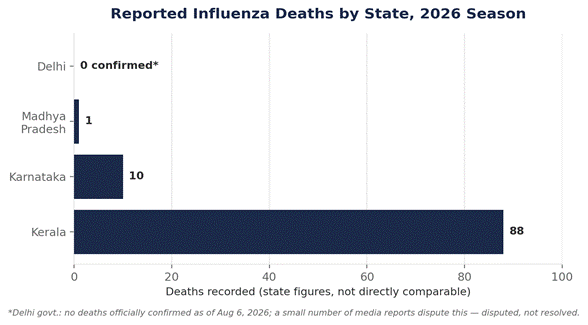
Fig. 2 — Reported influenza deaths by state, 2026 season. State figures are not directly comparable due to differing reporting/surveillance practices.
THE TRIAGE FRAMEWORK HOSPITALS ARE RUNNING ON
Underneath this season's hospital response sits a categorization system the Ministry of Health & Family Welfare set out in guidelines dated February 25, 2019. That framework sorts influenza-like-illness patients into three categories at first contact, before any lab result exists.
Table 2 — MoHFW seasonal influenza categorization framework (25.02.2019).
WHERE THE PROTOCOL MEETS THE GROUND THIS SEASON
The care patterns hospitals are describing this season map closely onto that structure. Officials at government facilities say patients showing warning signs are sampled immediately, while those with severe influenza or pneumonia symptoms are admitted — language that mirrors the Category-C hospitalization trigger. Facilities like Ram Manohar Lohia Hospital are managing influenza-like-illness cases through outpatient departments while holding beds in reserve, consistent with Category-A and B's home-based, non-hospitalization default.
Some hospitals have gone further than the base protocol by pre-building dedicated capacity — one facility earmarked a 70-bed unit with 10 ICU beds and 60 High Dependency Unit beds specifically for flu-related escalation, while Baba Saheb Ambedkar Hospital runs an established, routine seasonal flu clinic rather than an emergency addition.
WHAT THIS ESTABLISHES — AND WHAT IT DOESN'T
The evidence supports a bounded claim: India's 2026 influenza season shows a genuine strain shift toward H1N1 in cities like Delhi, a measurable rise in case volume across multiple states, state-specific death tolls ranging from single to double digits, and a hospital response still organized around a 2019 triage framework rather than any protocol revised for this season's apparent severity shift.
It does not support a single national death count, since no consolidated all-India figure appears in the sourcing available here, and it does not establish that Delhi's disputed death reports are either confirmed or false — nor does it establish whether the 2019 categorization thresholds themselves have been reassessed against this year's higher rate of ICU admissions and secondary infections. That remains unaddressed in the sourcing available.
Sources: Ministry of Health & Family Welfare, Government of India — "Guidelines on categorization of Seasonal Influenza cases during screening for home isolation, testing, treatment and hospitalization" (25.02.2019); state health department data and official statements as reported by Newslaundry, The Print, Deccan Herald, The Week, and Chennaionline (July–August 2026). Figures current as of early September 2026 and subject to revision as the season progresses.