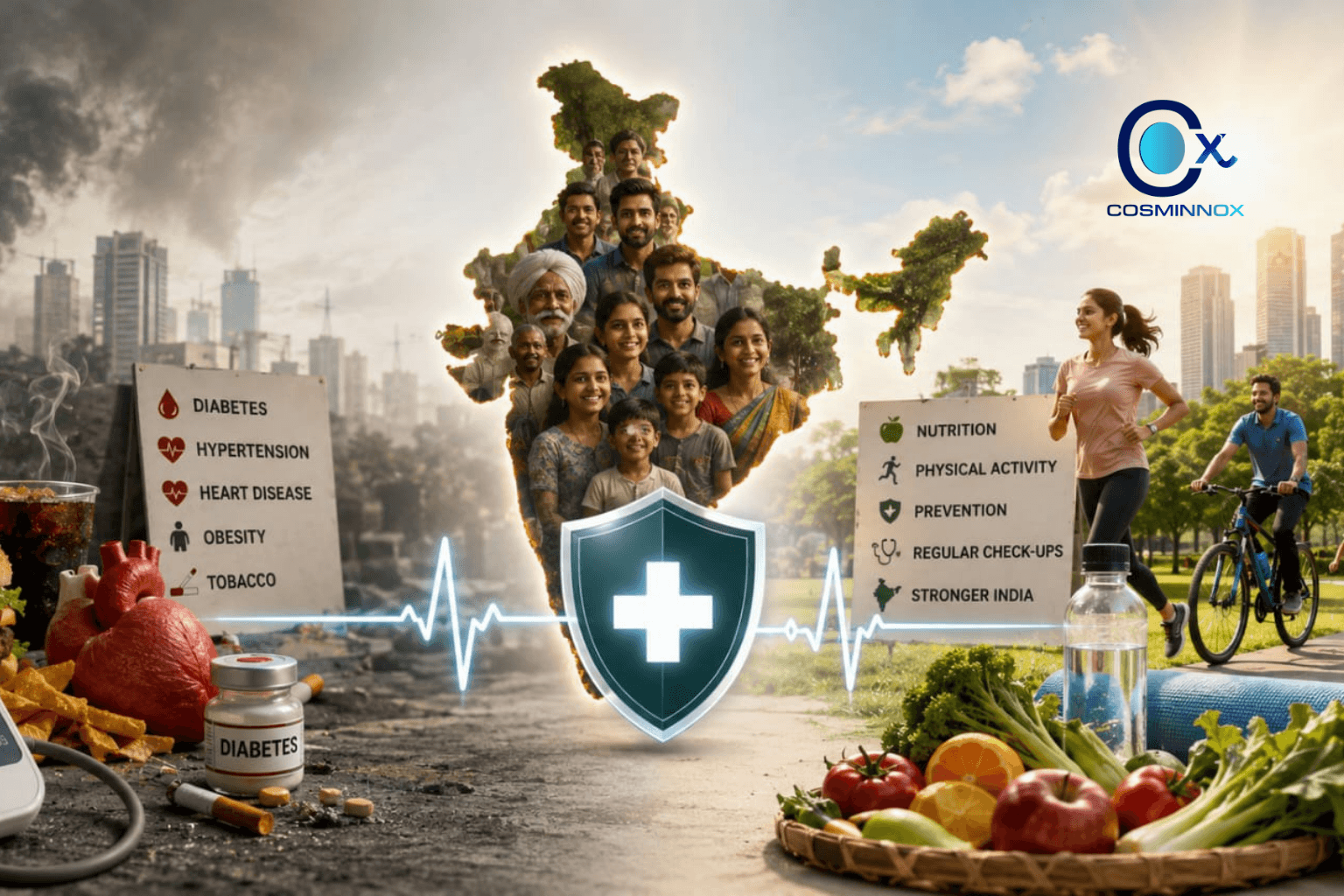
A recurring argument in India's development discourse runs like this: national strength — economic, strategic, geopolitical — cannot be built without a healthy population; a country cannot claim superpower status while its citizens remain unhealthy. The premise is intuitive and hard to dispute in principle. The analytical question this piece answers is narrower and more concrete: by the government's own data, how far is India's population from being “healthy,” and which specific gaps stand between the current state and the aspiration the argument describes?
The Scale of the Non-Communicable Disease Burden
The largest, best-documented gap is not infectious disease but non-communicable disease (NCDs) — conditions such as heart disease, diabetes, hypertension, and chronic respiratory illness. A WHO report found that roughly 63% of all deaths in India are linked to NCDs (The Wire, April 2026). The Ministry of Health and Family Welfare's “India: Health of the Nation's States” report found that NCDs' share of total disease burden (measured in disability-adjusted life years, or DALYs) rose from 30% in 1990 to 55% in 2016, while their share of all deaths rose from 37% to 61% over the same period.
The ICMR-backed national diabetes study (ICMR-INDIAB) estimates that India now has roughly 101 million people with diabetes, 136 million with prediabetes, and 315 million with hypertension. Researchers link this rise to sedentary lifestyles, processed diets, and early-life nutritional deficiencies (Drishti IAS, October 2025). One projection estimates India could lose $4.58 trillion by 2030 due to NCDs and mental health conditions combined — a figure that ties the health argument directly to the economic-strength argument underpinning the “superpower” framing.
Food Safety: A Persistent but Narrower Gap
One visible, government-tracked layer of this problem is food adulteration and non-compliance with safety standards. Parliamentary data shows that in FY 2025-26, of 2,23,808 food samples analysed nationwide, 40,023 — roughly one in five — were found non-conforming. Of these, 31,878 cases were settled with civil penalties, while only 1,918 resulted in criminal conviction (The Tribune, August 2026).
This is not a one-year anomaly. Over the five years from 2021-22 to 2025-26, a cumulative 1,85,780 samples were found non-conforming, of which 75% were resolved through penalty alone and only 3.3% (6,203 cases) resulted in conviction; the annual count of non-conforming samples has fluctuated between roughly 33,000 and 44,000 without a consistent downward trend (ThePrint, July 2026). In five South Indian states, 22,969 of 1,60,130 samples tested between 2021 and 2024 — about one in seven — were non-conforming (The South First, April 2025).
Food safety enforcement therefore addresses a real and persistent problem, but it is one input among several into the larger NCD picture — alongside dietary composition, physical activity, and tobacco use — rather than the central lever on its own.
Counter-Evidence: Enforcement Capacity Is Itself Uneven
Even within the narrower food-safety domain, enforcement outcomes vary sharply by state, which complicates any simple “more inspections equal a healthier population” reading. Parliamentary data shows that Uttar Pradesh and Rajasthan together accounted for 62.5% of all non-conforming food samples nationally in 2025-26 but only about 19% of convictions, while Gujarat converted roughly 8% of its non-conforming samples into convictions (ThePrint, July 2026). Where the underlying problem is largest, judicial follow-through is often weakest.
FSSAI's own data also shows that in 75% of cases, a monetary penalty is the only sanction — for larger food businesses, this can function as a routine cost of doing business rather than a strong deterrent. This points to a structural limitation in enforcement capacity and legal design, separate from the scale of the underlying health problem.
What the Evidence Does and Doesn't Establish
The data supports the core premise that a healthy citizenry is a measurable precondition still substantially unmet: NCDs account for a majority of deaths and disease burden, the underlying risk factors are widespread, and the projected economic cost runs into trillions of dollars by 2030. It also confirms that food safety violations remain common and are not reliably deterred, given a national conviction rate of just 3.3%.
What the evidence does not establish is that food-safety enforcement, on its own, is a sufficient or even primary lever for closing India's health gap — since NCDs are driven mainly by diet composition, inactivity, and tobacco, factors that sit outside the scope of adulteration enforcement. Nor does it establish that current enforcement mechanisms, given their uneven state-wise capacity and low conviction rates, can scale to match the size of the underlying problem without separate investment in judicial and public-health infrastructure. Closing the distance between the current state and the “healthy India” premise described above would, on this evidence, require action across dietary policy, NCD-prevention programme funding, and enforcement capacity — not any single one of these in isolation.
All figures are current as of the date cited in the respective source and may be revised. Any subsequent update will be recorded with a dated correction note.