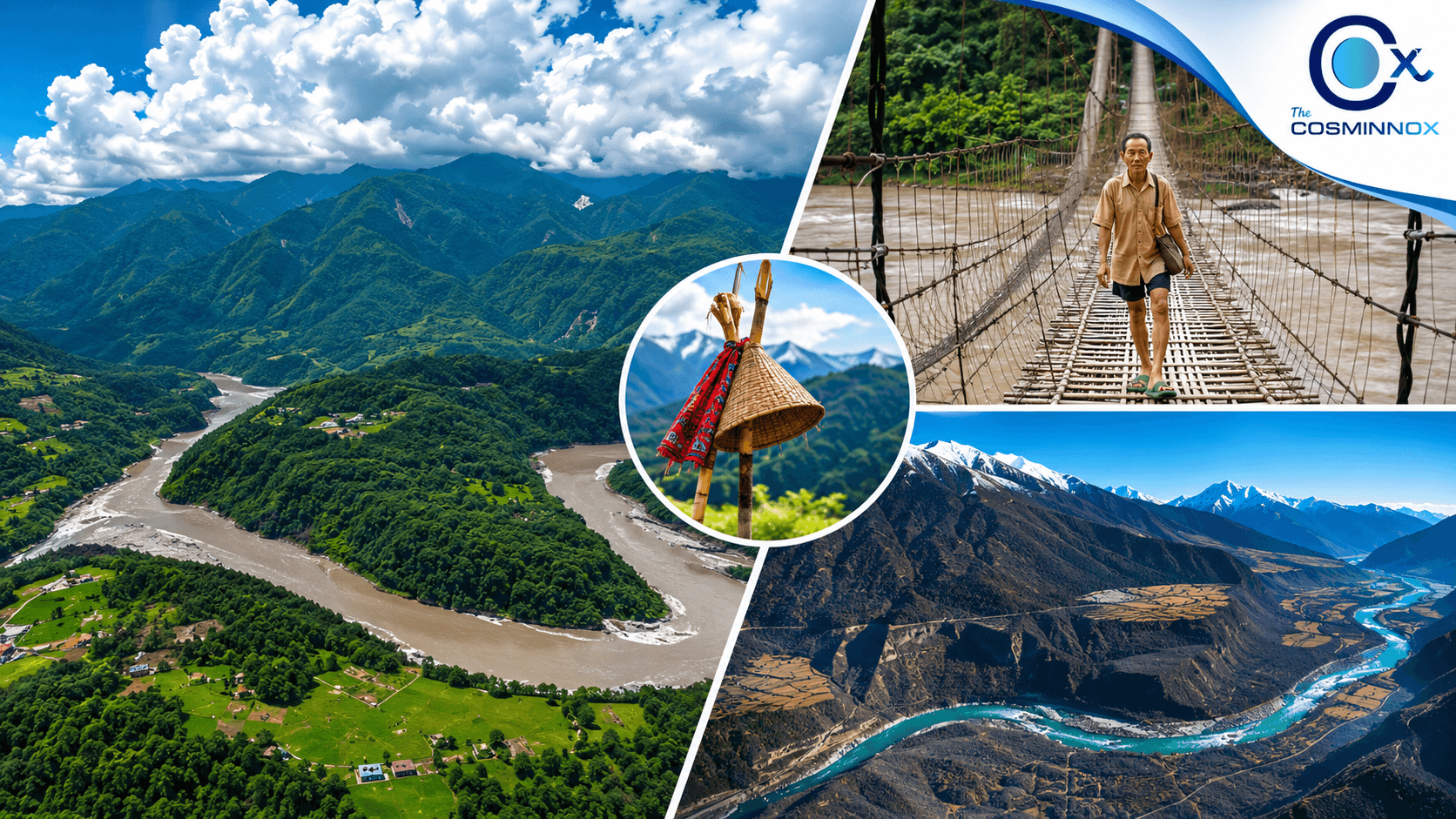
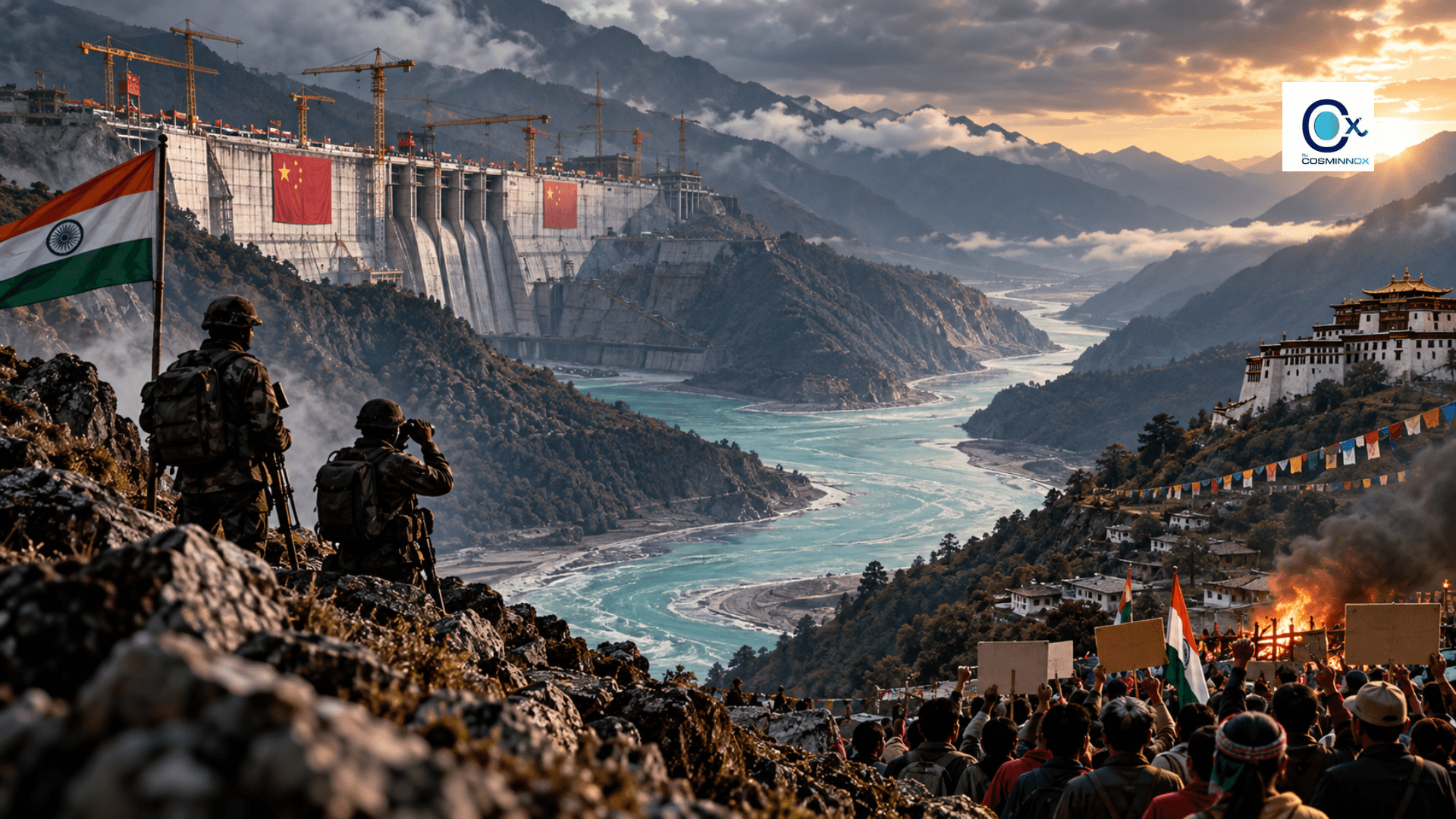
On the night of Friday 23 October, stones flew and fires were lit in Upper Siang district of Arunachal Pradesh. The target was not an army post. It was a dam that India has not yet begun to build. According to NewsBytes, the house of the BJP's state president was attacked, a 12-hour bandh shut parts of three districts, and protesters demanded the release of ten detainees.
Far to the west, on the Line of Actual Control (LAC) in Ladakh, patrolling arrangements agreed in October 2024 have largely held. The two facts belong to one story.
Our thesis is simple. The Himalayan contest has changed address. The ridgelines are calmer than during the 2020 standoff, but the river is not, and the Great Bend of the Yarlung Tsangpo, known in India as the Siang and then the Brahmaputra, is now the central front. India's weakest point there is not military. It is that Delhi cannot pour concrete in the Siang valley without the consent of the people who live in it.
Calm on the ridge, and why it is thin
India and China agreed patrolling arrangements for Depsang and Demchok on 21 October 2024, ending a standoff of more than four years that began in May 2020. In a written reply to the Lok Sabha in August 2025, the Ministry of External Affairs said the agreement had been implemented as per modalities and timelines. The same reply, however, confirmed that de-escalation, the pulling back of massed forces from the front, had only been discussed. Disengagement is not de-escalation. The troops are still there.
The people who stand between the two armies are the Indo-Tibetan Border Police (ITBP). The force was raised in October 1962, weeks after the Sino-Indian war, and answers to the Ministry of Home Affairs. It guards the 3,488 km frontier from the Karakoram Pass in Ladakh to Jachep La in Arunachal Pradesh, with more than one lakh personnel manning posts between 9,000 and over 14,000 feet, according to the Deccan Chronicle.
Look at what the force has been doing during the thaw. ITBP Director General Praveen Kumar said on 22 November 2025 that forward-deployed border outposts had risen to 215 from 180. That is a 19 per cent increase in the number of posts at the front. It follows the Cabinet's 2023 sanction of seven new battalions and about 9,400 personnel for 47 new outposts, 34 of them in Arunachal Pradesh. India is negotiating for calm while building for permanence.
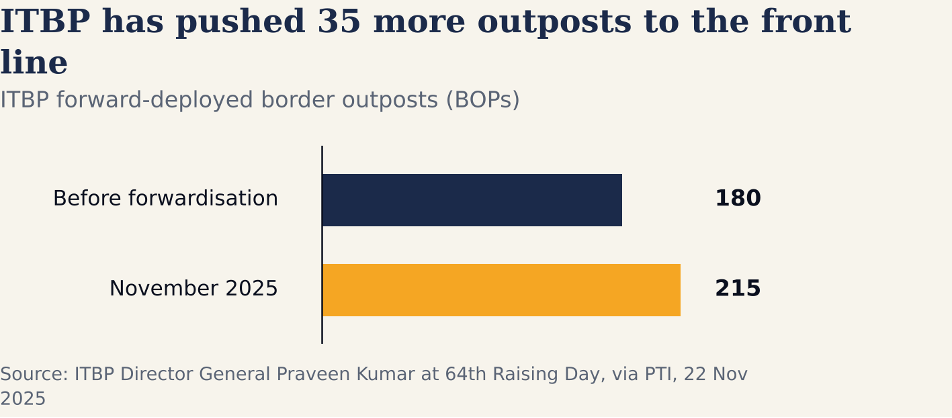
Chart: The COSMINNOX. Source: ITBP Director General Praveen Kumar, 64th Raising Day, via PTI, 22 November 2025.
Why the friction persists
The cause is not cartographic confusion. The LAC is undemarcated and each side holds a different perception of it, but the pressure comes from three asymmetric objectives.
First, Aksai Chin. China built a military highway there to link Xinjiang with Tibet, and protecting that corridor requires depth, which means pushing Indian positions back. Second, high ground. Whoever holds the watershed ridges and passes can look down into the other side's valleys. Third, containment. Constant pressure in the north forces New Delhi to spend money and manpower on mountain defence. That last point is our reading, not an official Chinese position, but the budget lines support it.
China's method is incremental. Analysts call it salami-slicing: a post here, a patrol road there, a dual-use village near the line. A US Department of Defence report, cited by The Tribune, said China built a 100-home civilian village inside disputed territory between Tibet and Arunachal Pradesh. Each village bolsters Beijing's claim that Arunachal is "Zangnan", southern Tibet.
This means the frontier is now contested by settlement as much as by patrol. India's reply is the Vibrant Villages Programme, funded at Rs 4,800 crore and covering 2,967 villages in 46 border blocks across 19 districts, according to Equipment India. A village that stays populated is a sensor, a supply point and a claim on the map at once. Arunachal's Deputy Chief Minister Chowna Mein added in 2023 that the Centre had sanctioned a 1,500 km Frontier Highway at about Rs 44,000 crore.
Tawang: where faith meets the map
Tawang sits in western Arunachal Pradesh, and it carries three kinds of weight at once. The 17th-century Tawang Monastery is a major seat of the Gelugpa, or Yellow Hat, school of Tibetan Buddhism and ranks among the largest monasteries in the world. The sixth Dalai Lama was born in Tawang. The fourteenth entered India through it in 1959, fleeing Chinese rule. And its ground controls approach routes into the Himalayan foothills.
The religious dimension turned acute on 2 July 2025. The Dalai Lama said that the institution would continue and that only the Gaden Phodrang Trust has the authority to recognise his reincarnation. Beijing replied that any successor must be approved by the central government, according to Al Jazeera. The Dalai Lama has previously said his successor will be born outside China, as Reuters reported.
Here is the observation that the raw dates do not give you. Two rival processes now claim the same succession, and one of them will almost certainly be conducted on Indian soil. A recognition ceremony in the Himalayan Buddhist belt would turn Tawang from a border district into a stage for the contest over Tibetan Buddhism's legitimacy. That is our reading of the incentives, and it is why Indian planners treat Tawang as a line they cannot trade. They argue that losing it would leave the defence of the Assam plains with little depth.
The Bend: 60 gigawatts at the top of a river
The Yarlung Tsangpo crosses the Tibetan plateau, wraps around the Namcha Barwa peak in a U-turn known as the Great Bend, and drops into Arunachal Pradesh as the Siang. Chinese planners have long seen the drop as one of the great untapped power sites on earth.
It is no longer a plan. Construction of the Medog Hydropower Station began on 19 July 2025, eight months after Beijing approved it. Wikipedia's project summary puts the planned cost at one trillion yuan, about $137 billion, while The Pioneer reports estimates up to $170 billion, with completion expected around 2033. Planned capacity is 60 gigawatts, roughly 2.7 times the 22.5 gigawatts of Three Gorges, the largest dam now operating.
The cost comparison carries a twist. Medog is budgeted at four times the cost of Three Gorges but delivers 2.7 times the capacity. On our arithmetic, that is about 50 per cent more per gigawatt (roughly 16.7 billion yuan against 11.1 billion), before allowing for the cost differences of two different eras. Beijing is paying a premium to build in a seismic gorge, which tells you how much it values the site.
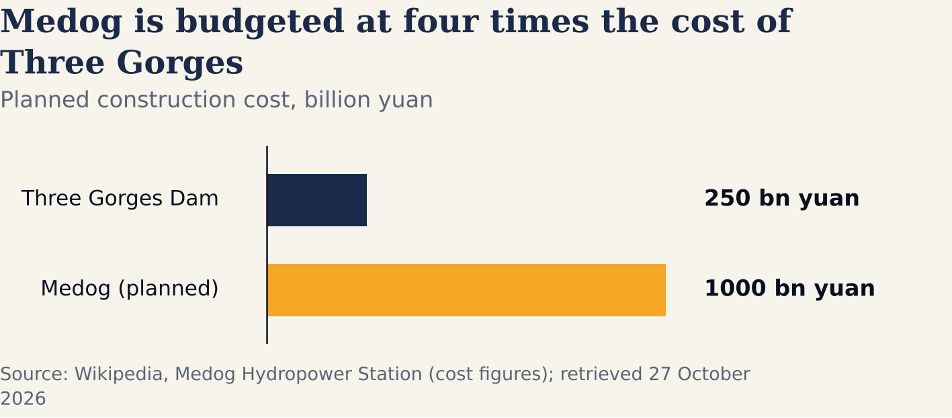
Chart: The COSMINNOX. Source: Wikipedia, Medog Hydropower Station; single-source figure, see flags.
The danger for India is less a "water weapon" in the dry season than the cost of an accident. Medog lies near the fault zone where the Indian and Eurasian plates meet. The Pioneer notes that a strong tremor could trigger landslides and mudflows that affect the river even if the dam holds, and recalls that a dam breach upstream in Tibet flooded parts of the Northeast in 2000. Arunachal Chief Minister Pema Khandu has called the project a "water bomb".
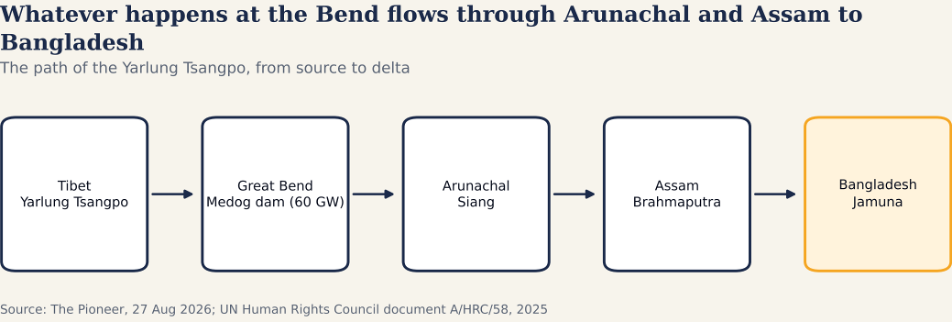
Chart: The COSMINNOX. Source: The Pioneer, 27 August 2026; UN Human Rights Council, 2025.
The fair counter-argument
Beijing's case deserves a hearing. China describes Medog as clean energy for its economy. Premier Li Qiang has asked for environmental protection during construction, according to Vozpopuli. And the project is not a conventional wall holding a vast reservoir: Arunachal's own Deputy Chief Minister put Medog's live storage at about 5.5 billion cubic metres, against 9.2 billion for India's proposed Siang dam. That is a smaller reservoir than the Indian project would hold.
We accept the point on storage. We do not accept that it settles the matter. Leverage over a river does not need a big reservoir. It needs control over timing and information: when water is released, and whether downstream governments are told. A cascade of four dams and five power stations, as Wikipedia describes the plan, gives its operator that control. Analysts cited by EastMojo add that no binding water treaty covers the Brahmaputra, which we have not been able to confirm from a primary source and flag for the copy desk.
India's answer, and the problem inside it
India's counter is the Siang Upper Multipurpose Project (SUMP): 11,200 MW, about 9.2 billion cubic metres of live storage and an estimated Rs 1.13 lakh crore, to be built by NHPC. Arunachal's leaders sell it as a flood buffer first and a power plant second. Mein argued on 5 October that its storage could regulate sudden releases from upstream.
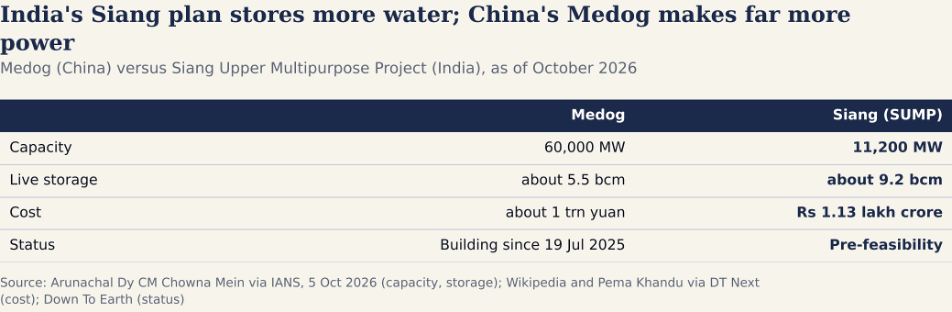
Chart: The COSMINNOX. Sources as printed in the table; mixed-source comparison flagged for the copy desk.
The table tells you who is ahead. Medog makes about 5.4 times the power. SUMP stores about 1.7 times the water. But Medog is under construction and SUMP is not. Down To Earth describes it as still at the pre-feasibility stage, with a social impact assessment, an environmental impact assessment and a detailed project report still to come.
Then there are the people. Reuters reported that at least 16 Adi villages would be lost to the reservoir, directly affecting about 10,000 people, and that construction could take a decade after ground-breaking. The protests that began as opposition to surveys have escalated into clashes with security personnel, according to Down To Earth, and by 23 October they had turned violent.
Our arithmetic is uncomfortable. If a decade of building starts only after the clearances are done, Siang's storage will come online after Medog's target date of about 2033. India's counter-dam is a bet on a timetable it does not control, in a valley whose residents have not been persuaded.
The older logic: Tibet as platform
Behind the water lies a long strategy. China absorbed Tibet in 1950, and Indian analysts describe its Himalayan thinking through a "palm and five fingers" image, with Tibet as the palm and Ladakh, Nepal, Sikkim, Bhutan and Arunachal as the fingers. We have not found this doctrine in Chinese official sources, so we treat it as an Indian framing, not a stated Chinese policy.
What is documented is the build-up. The plateau has become a staging ground for airbases, logistics hubs and missile units aimed at South Asia, which is the sense in which commentators call it an unsinkable aircraft carrier. And the logic of claim is linked. If Arunachal belongs to India, then the McMahon Line stands, and Beijing's argument that Tibet could not sign treaties as a sovereign falls with it. That is why a dam, a monastery and a village can all matter to the same capital.
What it means
For downstream states and households in Assam and Arunachal: the first ask should be data, not dams. A flood warning that arrives hours earlier is worth more than a reservoir that arrives in 2040. The Brahmaputra already overflowed this monsoon, killing at least 50 and displacing about seven lakh people in Assam, according to reports carried by NewKerala. Whatever China does, the baseline is already dangerous.
For Delhi: consent comes before concrete. The 16 villages, the compensation, and the independence of the impact assessments are not side issues. They decide whether the strategic project exists at all. A dam that needs 10,000 people to move cannot be built by security forces alone, and it should not be.
For border communities and planners: the Frontier Highway and Vibrant Villages money is the cheapest strategic asset India has, because an inhabited village does what a post cannot. The test for 2027 is whether villages that sit exactly on the line, which a Michigan Public report said were missed in the first phase, are brought in.
The call
We expect water, not patrolling, to be the main source of India-China friction in the east by 2030. The ridges will keep their uneasy truce. The river will not, because Medog's construction is under way while the only serious Indian response is still on paper and under protest.
Confidence: moderate to high. The facts on Medog are firm. The forecast depends on political choices in Delhi and Beijing.
What would change our mind: a binding agreement on real-time flood-season data sharing, or a visible halt to works at Medog. Either would shrink the risk we describe. Without one, the trend runs one way.
OUR VIEW The border dispute is a permanent structural competition, not a passing irritant. The ITBP and border infrastructure hold the ridgelines. But India's strategic autonomy will be decided at the Bend, and the first test there is at home: winning the consent of the Siang valley. |
Timeline
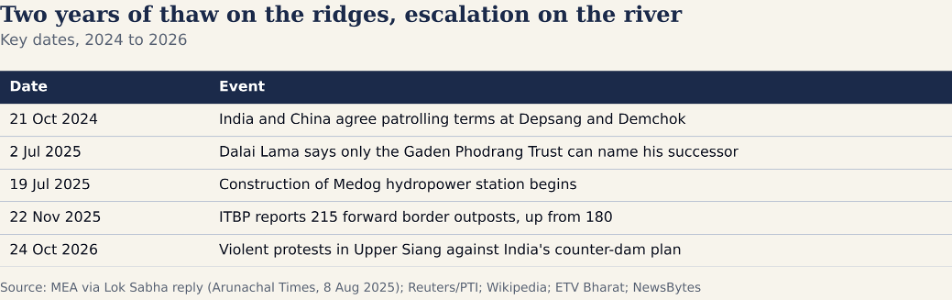
Chart: The COSMINNOX. Sources as printed.
Sources
Ministry of External Affairs reply in Lok Sabha, 8 August 2025, via Arunachal Times (patrolling agreement, 21 October 2024).
ITBP Director General Praveen Kumar, 64th Raising Day, via PTI/ETV Bharat, 23 November 2025 (215 outposts).
Deccan Chronicle, ITBP strength and altitudes; The Tribune, Cabinet decision on seven battalions (15 February 2023).
Borderlens / Swarajya, distribution of 47 outposts (34 in Arunachal), August 2023.
Wikipedia, Medog Hydropower Station (cost, capacity, start date 19 July 2025); retrieved 27 October 2026.
The Pioneer, "Nepal devastation puts China's giant dam under scrutiny", 27 August 2026.
IANS via NewKerala and Morung Express, Arunachal Deputy CM Chowna Mein on SUMP, 5 October 2026.
Down To Earth, "Why Arunachal Pradesh is protesting a proposed 11,200-MW dam"; NewsBytes, 24 October 2026.
Reuters via The Sun (Malaysia), India's Upper Siang storage plan (villages affected, build time).
Al Jazeera, 2 July 2025, and Reuters via Malay Mail, 2 July 2025 (Dalai Lama succession statement).
Equipment India (Vibrant Villages scope); The Tribune (US DoD village report); EastMojo, 2023 (Frontier Highway).
Vozpopuli (Li Qiang remarks); EastMojo, 7 August 2025 (treaty claim); NewKerala, 26 August 2026 (Assam floods); Michigan Public, 17 February 2026.