As of 24 September 2026.
Who is in charge of the voter list?
Article 324 of the Constitution gives the Election Commission control over preparing the voter lists and running elections. The Commission has a Chief Election Commissioner and other Election Commissioners. Today that makes three people.
What if they disagree?
The 2023 law covers this. Section 18 says the Commission should decide matters together wherever possible. If members differ, the majority wins, so two out of three is enough. The same section says the Commission’s procedure and the division of work among its members are to be set by a unanimous decision.
The Supreme Court said in 1995 that the Constitution plainly plans for a Commission with several members. A constitution bench also held that the Chief Election Commissioner is not above the other commissioners.
What has been reported
These are newspaper reports and have not been proved.
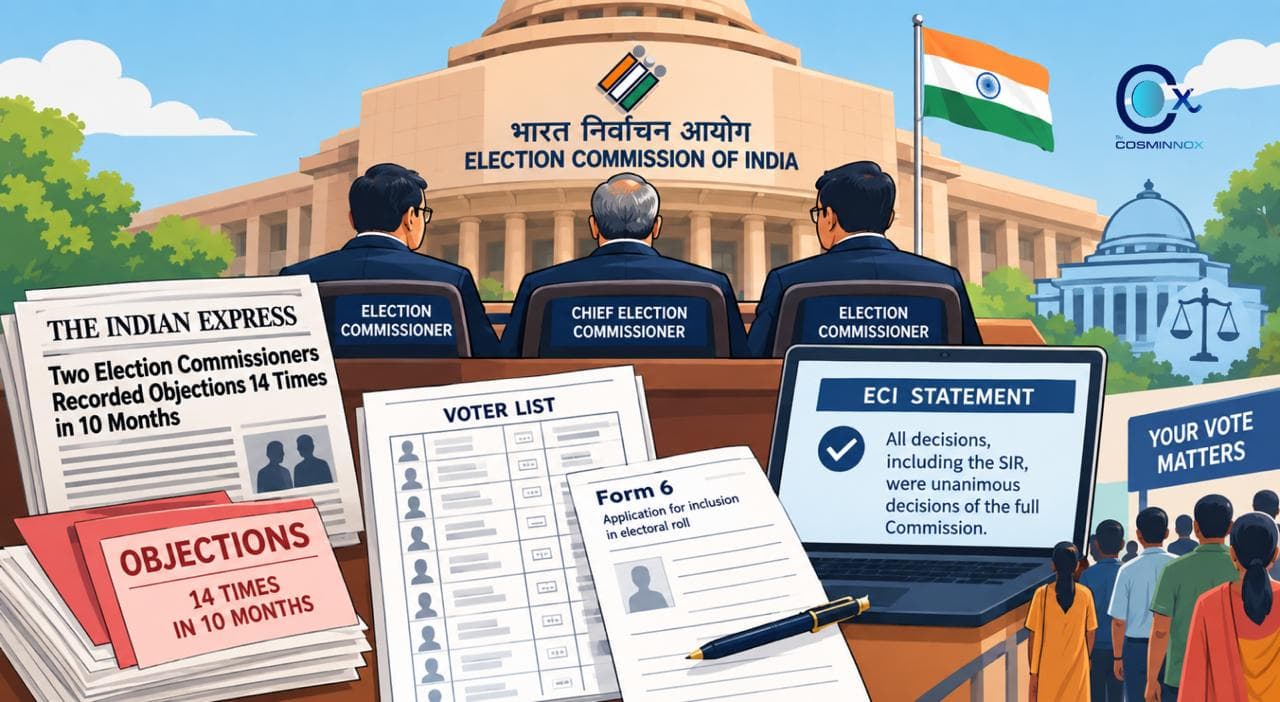
The Indian Express reported that Election Commissioners Sukhbir Singh Sandhu and Vivek Joshi recorded objections at least 14 times in 10 months. They are reported to have said some decisions were issued in the Commission’s name without their knowledge or approval. The objections are reported to cover how voters are added and deleted, the electoral roll database, and the software that runs it.
One example concerns Form 6, the form new voters fill in. Joshi is reported to have written in May that a form set by law cannot be changed without amending the Registration of Electors Rules, 1960. Sandhu agreed. A new declaration linking applications to the Special Intensive Revision (SIR) of voter lists still appeared on the online form in July. Sandhu is reported to have written in August that it had not been removed.
What the Commission says
The Commission issued an official statement. Its headline says all decisions, including the SIR, were unanimous decisions of the full Commission. Press reports of the statement say it called differences of opinion and technical suggestions during discussions normal, and said they do not mean a final decision was divided. It also said that picking out particular notes over ten months, while ignoring a much larger body of approvals, shows only part of the picture.
The two accounts agree that notes were written. They differ on whether the commissioners knew about the decisions and approved them. That cannot be settled from public information.
Has this happened before?
In May 2019, Commissioner Ashok Lavasa refused to attend some meetings until his disagreements were recorded. The Commission then decided that disagreement notes would stay in its records but would not form part of its orders. That was before the 2023 law came in.
Why it matters to voters
The voter list decides whether you can vote. Under the Commission’s published guidelines, you apply for a place on it through Form 6, with a photograph and proof of age and address. Giving false information in the declaration is a punishable offence.
O P Rawat, a former Chief Election Commissioner, said the reported differences could reduce public confidence in the Commission. That concern applies whichever account proves correct. On the question of whether the Form 6 change needed an amendment to the rules, only a court, or the rules and file notes themselves, can answer.
Sources: the Constitution (Part XV); Section 18 of the Chief Election Commissioner and Other Election Commissioners Act, 2023; T.N. Seshan v. Union of India (1995); ECI Form 6 guidelines; the Commission’s release on PIB; reports by the Indian Express, The Week, Millennium Post and others.