Has the revised US Senate bill on Russian oil sanctions moved from a stalled talking point into a near-term trade risk for India, or does the evidence still describe a bill with more political symbolism than enforceable teeth? The available record as of mid-July 2026 supports a specific, bounded answer: the bill now carries more institutional momentum — bipartisan co-sponsorship, an explicit White House sign-off, and added urgency following the death of its chief author — than any version introduced since April 2025. But the mechanisms that would have to activate before India faces an actual tariff remain discretionary, procedurally untested, and historically slow to move. The rest of this piece lays out what is established, what is contested, and what the record does not yet support.
What the Revised Bill Proposes
A bipartisan group of senators introduced the Sanctioning Russia Act of 2026 on 14 July, a revised package of sanctions and tariffs targeting Moscow's war financing that has already gathered more than 26 bipartisan co-sponsors. [1][2]
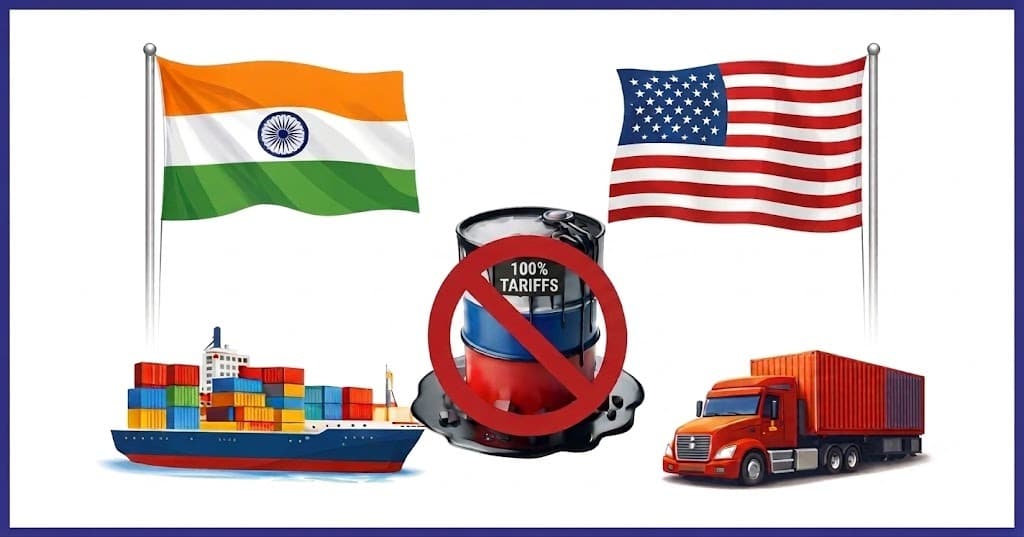
The bill sets a sliding tariff scale with a ceiling of 100 percent — down from the 500 percent proposed in the original 2025 draft — applied to the five largest purchasers of Russian oil and gas: India, China, Slovakia, Hungary, and Azerbaijan. [1][3] It carves out an exemption for countries that are taking demonstrable steps to reduce their own Russian gas imports, a provision aimed chiefly at European buyers still working through phase-out timelines under EU energy regulation. [3]
Senator Richard Blumenthal, the bill's lead Democratic sponsor, has described the tariff provision as only one part of a broader package that also imposes blocking sanctions on Russia's energy, financial, and defence sectors, and on named oligarchs and President Vladimir Putin — sanctions he has characterized as “sledgehammer sanctions” against Russia and its enablers. [3] The 2026 draft also narrows the presidential waiver relative to earlier versions, requiring the president to notify and report to Congress before any waiver is exercised — a change Democrats pushed for specifically. [3][4]
Why the Bill Has New Momentum
The bill's trajectory changed sharply after Senator Lindsey Graham, its original architect, died on 12 July, one day after announcing from Kyiv that the White House had agreed to back the legislation. [1][2] Senate Democratic Leader Chuck Schumer has since called for an immediate floor vote “in honor of Lindsey,” and Senate Majority Leader John Thune told reporters that passing the bill “would be a great legacy, great tribute to Lindsey.” [2][4]
This is a materially different position from where the legislation sat for most of the past year. The original bill, introduced in April 2025, stalled in Congress for more than 15 months without a floor vote, as the Trump administration initially resisted signing on while it pursued direct negotiations with Moscow. [4][7] Ajay Srivastava, founder of the Global Trade Research Initiative (GTRI) and a former Indian Trade Service officer, has pointed to that 15-month precedent as evidence of limited congressional appetite for the bill's sweeping tariff powers, even in its current form. [7]
Why India Specifically Is Exposed
India's crude oil import dependence crossed 90 percent in FY26, according to an analysis of Petroleum Planning & Analysis Cell data — the highest level in the country's history, driven by rising domestic consumption against roughly flat domestic production. [10] Within that import basket, Russian crude has become the largest single source since 2022. Maritime intelligence firm Kpler recorded India's Russian crude imports climbing to a record 2.58 million barrels per day in June 2026, accounting for close to half of the country's total crude imports that month. [6]
Supply disruption elsewhere has reinforced that shift. Kpler's Sumit Ritolia has noted that India currently has “few alternative suppliers capable of replacing Russian crude at the same scale, reliability and economics,” a structural constraint that shapes how much room Indian refiners actually have to diversify away from Russian cargoes on short notice, tariff threat or not. [8]
India's Position and Outside Assessment
New Delhi has not issued a detailed public response to the July 14 bill specifically. A government official said discussions on the Senate legislation had not yet featured in the ongoing India-US interim trade talks, adding that “the trade deal is expected to address all the tariff-related concerns” from the bipartisan bill. [6] This is consistent with India's longstanding position that its energy purchases are driven by national interest and energy security rather than geopolitical alignment, and that it does not recognise unilateral sanctions lacking a United Nations mandate.
GTRI's Srivastava has argued that India's calculus should not change: “India should continue buying Russian oil, just as China does”, rather than letting external political pressure set energy policy, and separately noted that any attempt to enforce comparable tariffs against China — which absorbs a larger share of Russian seaborne crude than India — would likely draw retaliation that makes enforcement harder than the bill's text suggests. [7][8]
Counter-Evidence: Reasons the Threat May Not Materialize
Set against the bill's new momentum are several unresolved factors that argue for caution rather than alarm:
• Procedural history. The predecessor bill spent over 15 months in the Senate without a floor vote despite crossing the co-sponsor threshold needed to override a presidential veto. Momentum following Graham's death is real but has not yet translated into a scheduled vote. [4][7]
• The waiver mechanism. Even if enacted, the bill grants the president discretion to waive tariffs where he determines it serves the national interest — narrowed in the 2026 draft to require congressional notification, but discretionary all the same. [1][3]
• Legislative friction over tariff authority. Democrats have previously raised concerns about the bill's tariff provisions given pending litigation over the scope of presidential tariff power more broadly, which contributed to the bill's earlier stall. [4]
• Enforcement asymmetry. China absorbs a larger share of Russian seaborne crude exports than India does, and analysts argue that enforcing comparable tariffs against Beijing carries a materially higher risk of retaliation — a factor that could shape how, or whether, the provision is applied evenly across the five named countries. [8]
What the Evidence Does and Doesn't Establish
The record supports two things clearly: the Sanctioning Russia Act of 2026 has more bipartisan momentum and executive backing than its predecessor ever achieved, and India's exposure to any eventual tariff is real and rising, given record Russian crude volumes against a backdrop of 90-percent-plus import dependence.
The record does not yet establish that the bill will pass, that a floor vote has been scheduled, or that a 100 percent tariff would in practice be applied to India rather than waived, delayed, or narrowed in negotiation — as India's own trade officials expect it to be folded into the broader interim trade deal rather than treated as a standalone shock. [6] For now, India's Russian oil arithmetic — record volumes, a discount that keeps refiners buying, and no comparable alternative supplier at scale — remains unchanged by the bill's introduction alone.
Sources
Bloomberg: "China, India Face Up to 100% Tariffs Under New Russia Oil Sanctions Legislation," 14 July 2026. bloomberg.com
Radio Free Europe/Radio Liberty: "US Senate Unveils Revised Russia Sanctions Bill As Lawmakers Push To Cement Graham's Legacy," 15 July 2026. rferl.org
The Hill: "Senate's Russia sanctions bill would squeeze Vladimir Putin, honor Lindsey Graham," 14 July 2026. thehill.com
The Hill: "Russia sanctions bill may move as Congress looks to honor Lindsey Graham," 13 July 2026. thehill.com
Business Standard: "US bill proposes 100% tariff on Indian goods over Russian oil imports," 15 July 2026. business-standard.com
Business Today: "US Senate bill proposes 100% tariffs on India over Russian oil: What it could mean," 15 July 2026. businesstoday.in
Silicon India: "India's Russian Crude Imports Face Tariff Threat as US Senate Advances Sanctions Bill," 16 July 2026. siliconindia.com
EY India: "India's petroleum economy: Import dependence and unanticipated shocks," June 2026 (analysis of Petroleum Planning & Analysis Cell data). ey.com
Correction protocol: if any figure above is revised post-publish (e.g., co-sponsor count, floor-vote scheduling), this piece will carry a dated, visible correction note rather than a silent edit.