Policy analysis | 12 October 2026
India needs an appointments process that protects judicial independence and makes responsibility for delay visible. A redesigned commission could improve how candidates are assessed and decisions explained. The evidence does not establish that changing the body alone would reduce vacancies, clear pending cases or produce a more representative judiciary.
The debate often stops at a choice between the Collegium and the National Judicial Appointments Commission, or NJAC. A more useful inquiry concerns the rules beneath each institution: who initiates a vacancy file, who evaluates a candidate, who can stop a recommendation and who must explain the wait. Those rules determine whether accountability has practical force.
This article examines the constitutional limits, dated evidence on vacancies and representation, and lessons from England and Wales and South Africa. Its proposed reforms are policy recommendations rather than findings about a model already tested in India.
The constitutional test for a new commission
The Collegium developed through the Second Judges Case in 1993 and the Third Judges Case in 1998. Its recommendations pass through an appointments process involving constitutional authorities in the judiciary and executive. Describing the arrangement simply as judges appointing judges leaves out those stages. [1]
Parliament sought to replace it through the Constitution Ninety Ninth Amendment Act and the NJAC Act of 2014. The six-member commission comprised the Chief Justice of India, two senior Supreme Court judges, the Union Law Minister and two eminent persons. Any two members could prevent a recommendation. On 16 October 2015, the Supreme Court invalidated the scheme by a four-to-one majority. [2]
The objection cannot be reduced to a veto held by the Law Minister alone. Two eminent persons could defeat the unanimous view of the three judicial members. The majority reasoning also concerned insufficient judicial primacy and the constitutional protection of judicial independence. Removing the two-member veto would address one defect; it would not automatically make a replacement constitutional. [2]
Judicial plurality is not judicial primacy
A plurality means that judges hold more seats than any other single category. It does not necessarily give them control over the result: several non-judicial categories could combine to outvote them. A design claiming to preserve judicial primacy therefore needs to specify its voting threshold, quorum, treatment of recusals and the effect of a unanimous judicial recommendation.
This article proposes that any future design should undergo constitutional scrutiny before its composition is treated as settled. An ordinary statute cannot simply displace the existing constitutional appointments framework. Administrative improvements compatible with it may be possible; replacing the distribution of decision-making power would require a legally sound constitutional route and would remain subject to basic-structure review.
The distinction matters for public debate. A commission may be attractive as an administrative institution while still failing the constitutional test. Equally, retaining the Collegium does not prevent clearer criteria, better vacancy planning or more reliable reporting.
Vacancies reveal an unfinished appointments process
The official reply of 12 March 2026 recorded 810 working High Court judges against 1,122 sanctioned posts on 6 March. Of 312 vacancies, 132 proposals were under processing and recommendations for 180 were yet to be received. [1] These categories distinguish the absence of a recommendation from delay after a file enters the pipeline.
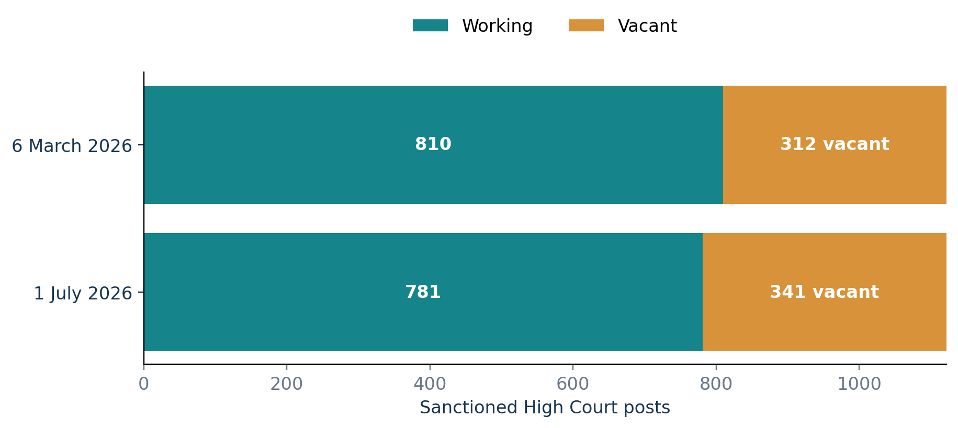
Figure 1. High Court staffing snapshots. March: official Rajya Sabha reply [1]. July: ministry figures reported by ThePrint [3]. Both use 1,122 sanctioned posts. Vacancy shares are 27.8% and 30.4%, respectively; these are dated snapshots, not current totals.
By 1 July 2026, the ministry figures reported by ThePrint showed 781 working judges and 341 vacancies. [3] The rise of 29 vacant posts between the two snapshots does not identify its cause. Retirements, appointments and other changes occur together; a national stock figure cannot attribute delay to a particular institution.
The clock must run at every stage
In PLR Projects v Mahanadi Coalfields, the Supreme Court addressed delays on both sides of the process. Its order of 20 April 2021 advised Intelligence Bureau inputs within four to six weeks of a High Court recommendation. The Centre was to forward files within eight to twelve weeks after receiving the State views and IB inputs. Appointment after unanimous Collegium reiteration was to follow within three to four weeks. [4]
Those periods have different starting points and should not be added into a guaranteed end-to-end deadline. The practical reform is a dated record for each stage, with the responsible authority identified and overdue files explained. A secretariat could make that record usable without deciding the merits of a candidate.
Representation requires better evidence as well as attention
The March parliamentary reply recorded 33 Scheduled Caste, 17 Scheduled Tribe and 104 Other Backward Classes judges among 849 High Court appointments since 2018 to 6 March 2026. It also recorded 114 women among 810 sitting High Court judges and one among 33 sitting Supreme Court judges. [1]
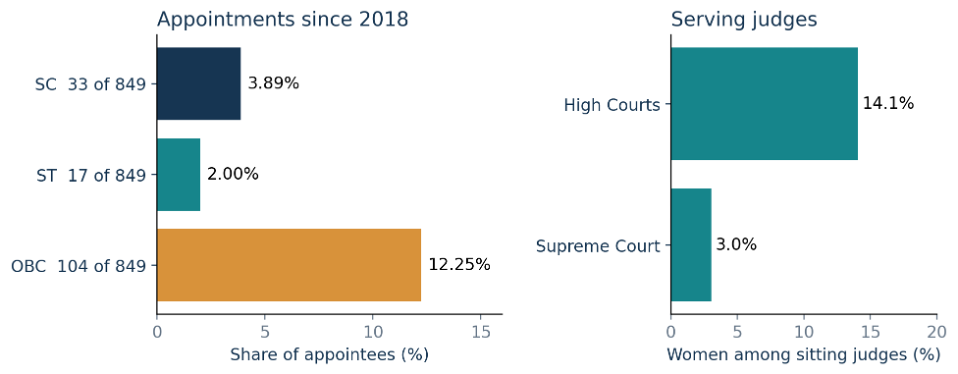
Figure 2. Two different denominators. Left: social categories among 849 High Court appointees since 2018. Right: women among judges serving on 6 March 2026. Calculations from [1]. These panels must not be combined into a single demographic distribution.
Appointments over a period and the composition of the serving judiciary answer different questions. Neither identifies the size or composition of the eligible candidate pool. These figures justify closer scrutiny of access and selection, but cannot by themselves prove why any group is underrepresented or predict what a commission would change.
The reply states that the relevant constitutional provisions do not provide caste or class reservation for these appointments. Social-background information has been sought from High Court recommendees since 2018. [1] That information should support consistent reporting rather than loosely comparable claims drawn from changing samples.
A proposed duty to consider diversity
The proposed approach is to assess professional merit through published criteria while documenting consideration of gender, region and social background. It would not treat identity as a substitute for suitability. Nor should it be presented as an existing reservation requirement.
Annual reporting should show how many people were considered, recommended and appointed, with missing information disclosed. Aggregate data can expose barriers without publishing confidential assessments of unsuccessful candidates. A diversity duty would need clear legal authority, privacy safeguards and a method for examining whether access improves over time.
International commissions offer lessons rather than templates
England and Wales has a fifteen-member Judicial Appointments Commission with a lay chair, five other lay members, seven judicial officeholder members and two professional members. [5] Counting only five judges understates the broader judicial category, which includes tribunal and non-legally-qualified judicial members. Its seven judicial officeholders form the largest category, but do not hold a majority.
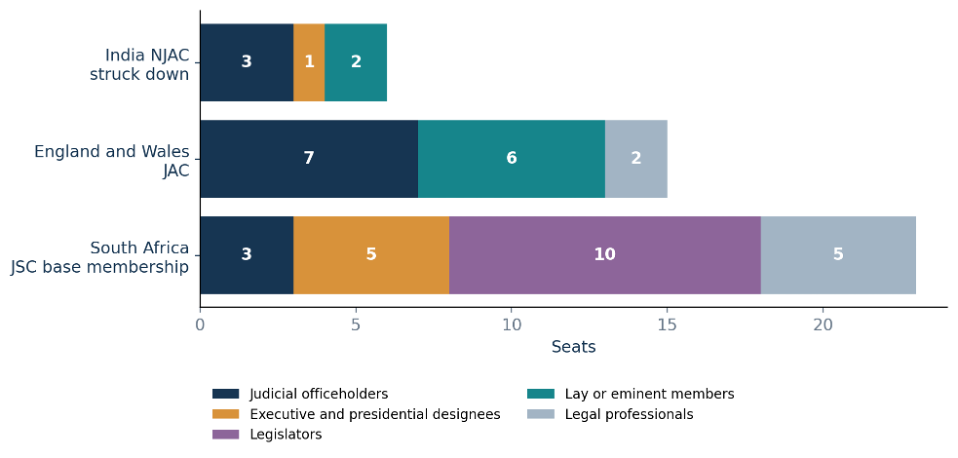
Figure 3. Membership by role, not political allegiance. Sources [2], [5] and [7]. England and Wales counts all seven judicial officeholders. South Africa uses the base 23 seats; relevant provincial participants can join for specified matters. Professional members there comprise four practitioners and one law professor.
The English system constrains ministerial review, but does not eliminate it. Applicable provisions allow acceptance, rejection or reconsideration on specified grounds within a staged process. Written reasons are required for rejection or reconsideration, and the final stage requires acceptance subject to statutory qualifications. The draft idea of one reasoned return followed by acceptance would be an Indian proposal, not a complete description of English law. [6]
South Africa’s base Judicial Service Commission has twenty-three members, including three judicial leaders, the Justice Minister, ten legislative representatives, four presidential designees and five legal professionals or academics. At least three of the six National Assembly designees must come from opposition parties. Provincial participation changes the membership for particular matters. [7]
These structures distribute power differently. A seat count cannot measure independence, informal influence or selection quality. The useful comparisons concern reasons, scrutiny and limits on obstruction; none supplies proof that its composition would satisfy India’s constitutional requirements.
A workable reform proposal needs operational rules
The following design is a proposal for debate. Its starting point is a permanent secretariat that forecasts vacancies, maintains complete files and publishes aggregate progress. These functions should be explored within the existing framework even if agreement on a new commission remains distant.
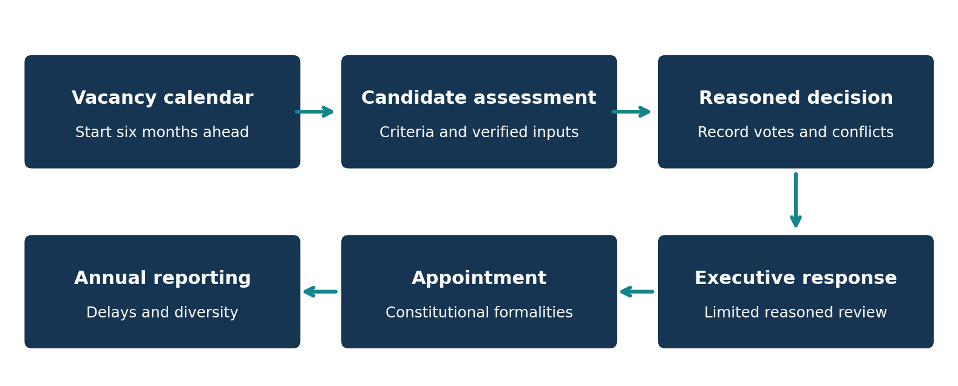
Figure 4. Proposed administrative workflow. This is an original policy diagram, not the current legal procedure. A redesigned selection body and executive review rule would require appropriate legal authority.
Reasoned decisions and protected assessments
Selection criteria should explain how legal ability, integrity, professional experience and temperament are assessed. Decision records should disclose conflicts and the reasons for the institutional choice. Public summaries can explain the process while protecting sensitive personal information and genuinely confidential inputs.
A voting rule that protects judicial independence
The NJAC’s two-member blocking rule should not return. Any alternative must state how judicial primacy survives its vote rule, including when members recuse themselves or seats are vacant. Judicial plurality alone does not answer that question. The composition and voting rule should be evaluated together.
A bounded executive response
One reasoned return, a specified response period and a legally defined consequence for inaction merit consideration. That consequence should compel a decision through a valid enforcement mechanism, rather than assume that silence alone creates an appointment. The President’s constitutional role cannot be replaced by an administrative shortcut.
Opposition participation with limits
An opposition seat could broaden scrutiny, but would introduce another political actor into selection. Its value depends on a defined role, recusal rules and protection against partisan bargaining. South Africa’s reserved opposition places offer a comparison, not evidence that this change would improve Indian appointments.
Measure the process before promising results
A reform should begin with a baseline: when a vacancy becomes foreseeable, when a recommendation is made, when each authority receives the file and when appointment follows. Aggregate medians and the oldest outstanding files would reveal more than a national vacancy percentage alone.
The proposed reporting framework should track the share of anticipated vacancies for which recommendations begin six months ahead, time at each stage, returns with recorded reasons, and completeness of social-background data. These are measures of institutional performance. They do not require an unsupported claim that a new commission will produce faster adjudication.
Appointments reform has a limited reach
Bar and Bench reported 4.98 crore pending cases in district and subordinate courts in July 2026. [8] Those courts account for a very large workload outside the direct scope of a commission for Supreme Court and High Court appointments. Their recruitment, staffing and case management require a separate programme.
Even in the higher courts, more appointments do not translate mechanically into a particular reduction in pending cases. Case inflow, the age and complexity of matters, court staff, infrastructure and litigation practices affect outcomes. A proper evaluation would compare appointment processing and adjudication measures separately, with clear dates and consistent definitions.
The strongest case for change
The evidence supports a demand for visible responsibility, reasoned selection and a reliable appointments calendar. It does not establish the superiority of a particular commission or assure its constitutional validity. A credible third design must explain how it protects judicial independence and makes delay harder to conceal.
India can begin with those process reforms while debating the larger constitutional change. Whether a commission eventually replaces the Collegium, its success should be judged by records that can be checked: who acted, when they acted and what reasons they gave. The institution’s name is less informative than the rules it can enforce.
Scope and data note. Prepared on 12 October 2026 using the sources below. Statistics retain their individual observation dates; they are not a live October dashboard. Judge transfers, subordinate judiciary recruitment and subsequent changes in sanctioned strength are outside this article’s scope. Charts reproduce sourced counts and show calculations where stated. The proposals have no claimed Indian operating record.
Sources and figure notes
[1] Department of Justice, Rajya Sabha Unstarred Question 2357, Appointments in Courts, answered 12 March 2026; figures as at 6 March. Official compilation, PDF pages 24–26. Open source
[2] Supreme Court Advocates on Record Association v Union of India, judgment of 16 October 2015. Primary judgment, including majority reasoning on composition and veto. Open source
[3] ThePrint, Over 30% judges posts lying vacant in high courts, 29 July 2026. Secondary reporting of the ministry parliamentary reply; observation date 1 July 2026. Open source
[4] Supreme Court, PLR Projects Pvt Ltd v Mahanadi Coalfields Ltd, order dated 20 April 2021, especially paragraphs 3–11. Open source
[5] UK Parliament, Hansard, Judicial Appointments Commission Amendment Regulations 2025, 8 December 2025. Official explanation of the 15-member composition. Open source
[6] Constitutional Reform Act 2005, relevant appointments provisions; read alongside the Judicial Appointments Regulations 2013. UK Parliament Constitution Committee also describes the staged ministerial choices. Open source
[7] Constitution of South Africa, section 178, and Judiciary of South Africa, About the JSC and Members of the JSC. Primary constitutional and institutional sources. Open source
[8] Bar and Bench, 26 cases pending in Supreme Court for 30 plus years, 28 July 2026. Secondary reporting of Rajya Sabha information; used for the district and subordinate courts total. Open source