Seshan-era reforms and landmark electoral rulings reveal the value of decisive leadership, and the safeguards needed to make credible election administration endure beyond any individual commissioner.
Can India’s Election Commission remain effective when the personality at its helm changes? The historical record supports a qualified answer: leadership can make electoral rules consequential, but lasting credibility requires lawful authority, collective decisions and procedures that citizens can scrutinise. The Seshan years offer evidence of administrative change; the judgments surrounding the institution explain why independence must coexist with accountability.[1–5]
This distinction matters for assessing T. N. Seshan’s legacy. The Election Commission of India (ECI) makes administrative decisions and exercises certain adjudicatory functions; the Supreme Court judgments examined here were not judgments delivered by the Chief Election Commissioner. Their importance lies in defining who may exercise electoral power, within what limits, and subject to which remedies.[1–5]
Authority and the capacity to intervene
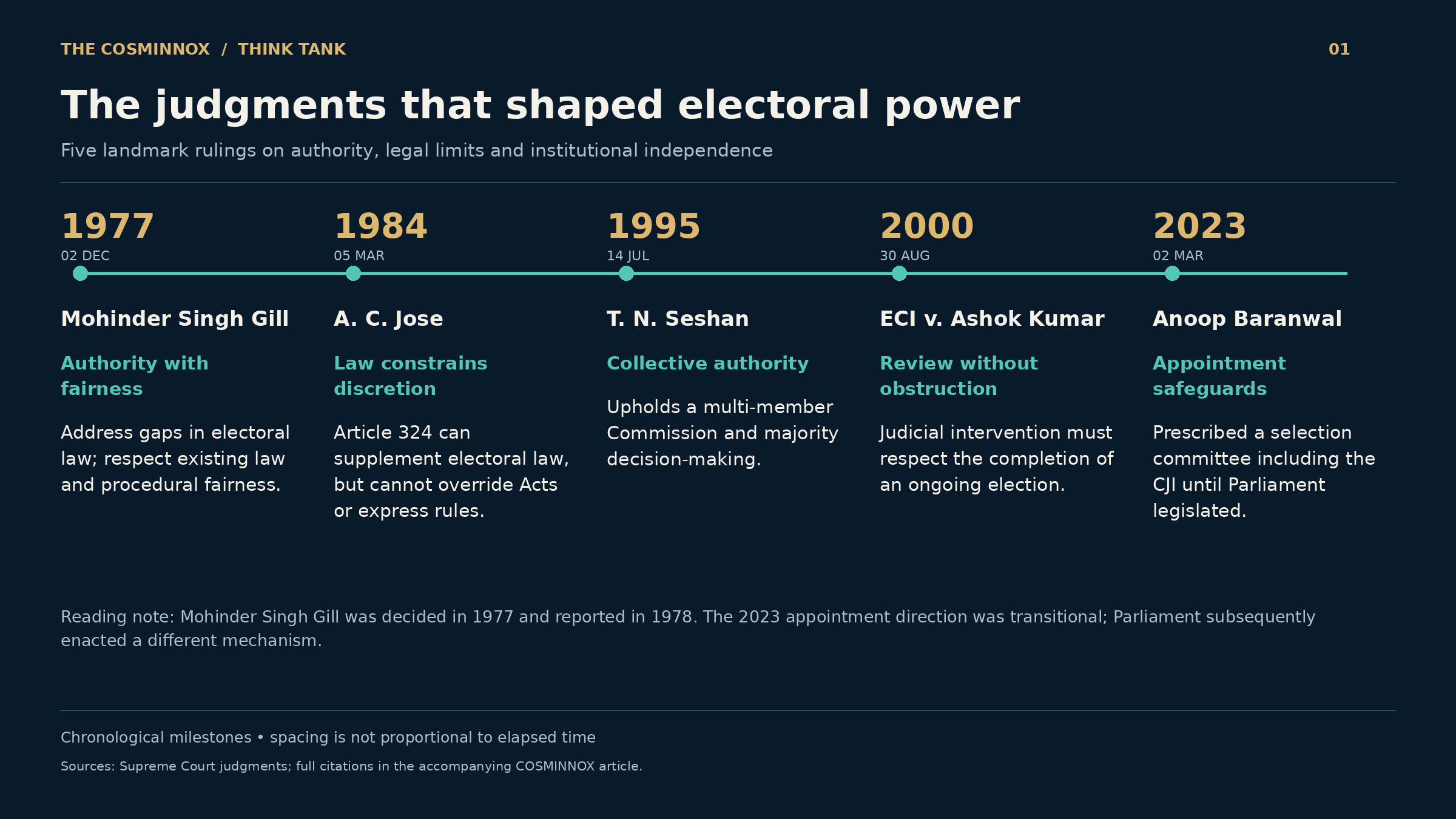
Article 324 places the supervision, direction and control of specified elections and electoral-roll preparation in the Election Commission. In Mohinder Singh Gill v. Chief Election Commissioner, decided on 2 December 1977 and reported in 1978, the Supreme Court recognised room for the Commission to address contingencies not covered by legislation. Existing electoral laws and rules nevertheless remain binding.[1]
This is an enabling power with a constitutional purpose. Administrators cannot anticipate every disruption, and an election authority needs capacity to respond when the rulebook leaves a genuine gap. The policy question is whether an intervention protects the electoral process through a defensible exercise of authority not simply whether it appears forceful.
The ECI’s institutional history credits Seshan with rigorous, publicly visible enforcement of the Model Code of Conduct. It also records an expanding role for election observers, whose statutory basis was incorporated in Section 20B of the Representation of the People Act, 1951, in 1996.[2] These are concrete administrative developments, although the Commission’s retrospective account is not an independent evaluation of their effects.
The distinction between mobilisation and invention is essential. An effective leader can make existing rules matter by insisting on compliance, securing administrative cooperation and making breaches visible. Institutional analysis should therefore ask which practices became repeatable after that leader departed.
Limits on discretion and individual authority
In A. C. Jose v. Sivan Pillai, decided on 5 March 1984, the Court examined electronic voting introduced under a legal framework that prescribed another method. It held that Article 324 could supplement electoral law where necessary but could not override an Act or express rules. The judgment concerned legal authorisation under the framework then in force; it should not be presented as a general finding that voting machines are inherently unreliable.[3]
The broader lesson applies to any electoral innovation: an administrative objective does not itself provide legal permission. Technology, speed and efficiency must operate within the applicable framework. Where that framework needs changing, reform requires the appropriate legislative or rule-making route.
T. N. Seshan v. Union of India, decided on 14 July 1995, addressed a different limit. Following the appointment of two additional commissioners in October 1993, Seshan challenged the institutional arrangement. The Court upheld the multi-member Commission and majority decision-making. The CEC’s stronger constitutional protection against removal did not make the other commissioners merely advisers or give the CEC a final individual veto.[4]
This judgment separates leadership from ownership of an institution. A chairperson can organise and lead without becoming the exclusive source of its authority. Collective decision-making also creates a practical obligation: members need timely access to the same evidence and a meaningful opportunity to disagree.
Procedural fairness supplies another constraint. Mohinder Singh Gill treated natural justice as relevant to electoral administration, while recognising that its form must respond to urgency and circumstances.[1] For policy design, that supports proportionate hearings and recorded reasons rather than an assumption that emergency action is exempt from explanation.
Judicial accountability also has a timing dimension. In Election Commission of India v. Ashok Kumar, decided on 30 August 2000, the Court distinguished litigation that interrupts an election from limited intervention that facilitates its completion. Article 329(b) constrains challenges that obstruct an ongoing election, but it does not place every Commission action beyond judicial scrutiny.[5] The institutional challenge is to preserve timely elections while keeping lawful remedies effective.
Results beyond public reputation
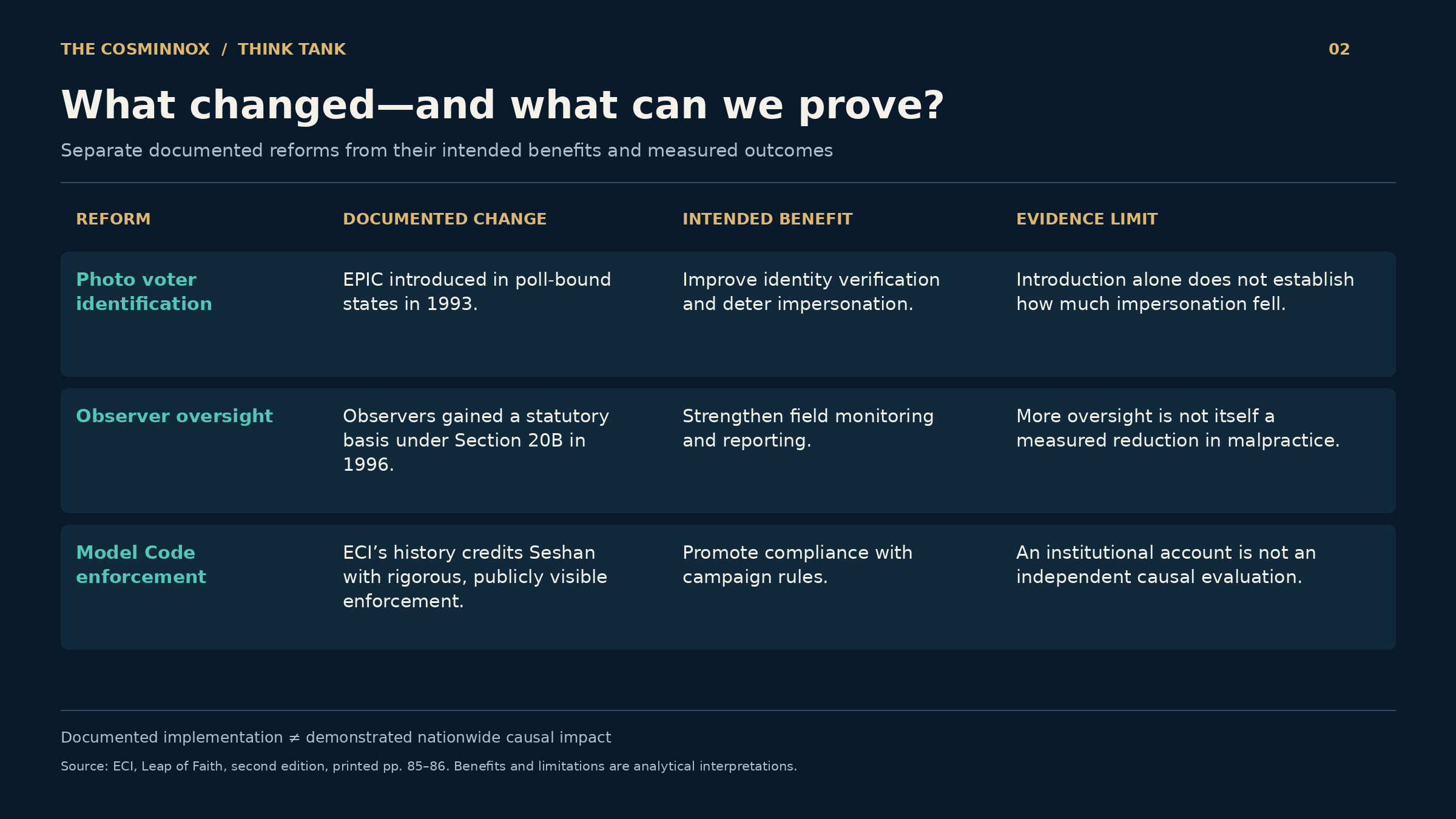
The evidence supports identifiable changes in electoral administration. The ECI’s history records the introduction of Electors Photo Identity Cards in poll-bound states in 1993. It also records election postponements in several states in early 1995 amid the identification-card implementation dispute.[6] Identity verification therefore illustrates both reform ambition and the operational difficulties of implementation.
Together with observer oversight, these developments identify mechanisms intended to improve administration: verifying identity, monitoring conduct and giving the Commission information from the field.[2,6] They are stronger evidence of institutional change than admiration for an official. They are not, by themselves, measurements of reduced impersonation, intimidation or partisan advantage.
The sources reviewed for this article do not establish a nationally comparable causal estimate of how much malpractice declined because of Seshan personally. Establishing that would require consistent before-and-after measures, attention to changes in reporting and enforcement, and a method for separating leadership effects from policing, political competition and other influences.
This limits what can responsibly be claimed. More detected violations might indicate better enforcement rather than deteriorating conduct. Fewer complaints might reflect improvement, weak reporting or inaccessible remedies. Higher turnout alone would not resolve those alternatives. A credible assessment needs several indicators, accompanied by explanations of how they were collected.
The most defensible conclusion is therefore narrower than a claim that one commissioner transformed every aspect of Indian elections: the period produced documented enforcement and administrative developments, while the available evidence here does not isolate their nationwide causal impact.[2,6]
Counter-evidence and institutional trade-offs
The 1995 judgment itself complicates an uncomplicated celebration of Seshan. The Court rejected the argument that the multi-member arrangement was established with mala fide intent, and criticised aspects of his conduct and some unsustainable decisions.[4] Those judicial observations belong alongside the evidence of reform. They show why an institution should be assessed through its decisions as well as its leadership’s reputation.
Collective structures are not sufficient on their own. Their value depends on whether participation is substantive, records are accessible and reasons can be examined. Equally, transparency requires boundaries: publishing personal information, security plans or untested allegations could harm voters and compromise administration. Accountability should disclose the basis of decisions while protecting legitimate confidentiality.
Appointment design remains part of this debate. Anoop Baranwal v. Union of India in 2023 prescribed a selection committee comprising the Prime Minister, the Lok Sabha opposition leader and the Chief Justice of India until Parliament legislated. The subsequent 2023 Act adopted a different committee, including a Union Cabinet minister nominated by the Prime Minister.[7]
In the verified order of 23 September 2026 in Dr. Jaya Thakur v. Union of India, the judges differed on referral and directed that the papers be placed before the Chief Justice for consideration of a Constitution Bench. That order did not finally decide the law’s constitutional validity.[7] The distinction between a disputed arrangement and an adjudicated constitutional violation must be preserved.
Reform that can survive a change of leadership
The COSMINNOX proposes five safeguards. These are policy recommendations, not claims about requirements already imposed by the judgments.
First, the ECI should publish a consistent decision format for significant enforcement actions: the issue, applicable authority, evidence relied upon, response received, reasons and available remedy. Comparable cases should be linked, with departures explained. Sensitive information should be redacted under stated criteria. This would make consistency assessable without forcing identical outcomes in materially different cases.
Second, collective decision-making should leave an auditable record. Commissioners should receive common briefing papers, adequate deliberation time and a record of the final decision. Reasoned dissent on significant matters should ordinarily be published, subject to justified confidentiality. Urgent operational action needs a defined process for subsequent collective review rather than procedural paralysis.
Third, Parliament should evaluate appointment safeguards through published eligibility criteria, documented selection reasons and a process that meaningfully accommodates more than the incumbent executive’s preference. Any redesign should explain how it balances independence, democratic responsibility and the risk of appointment deadlock. No committee composition can substitute entirely for professional conduct after appointment.
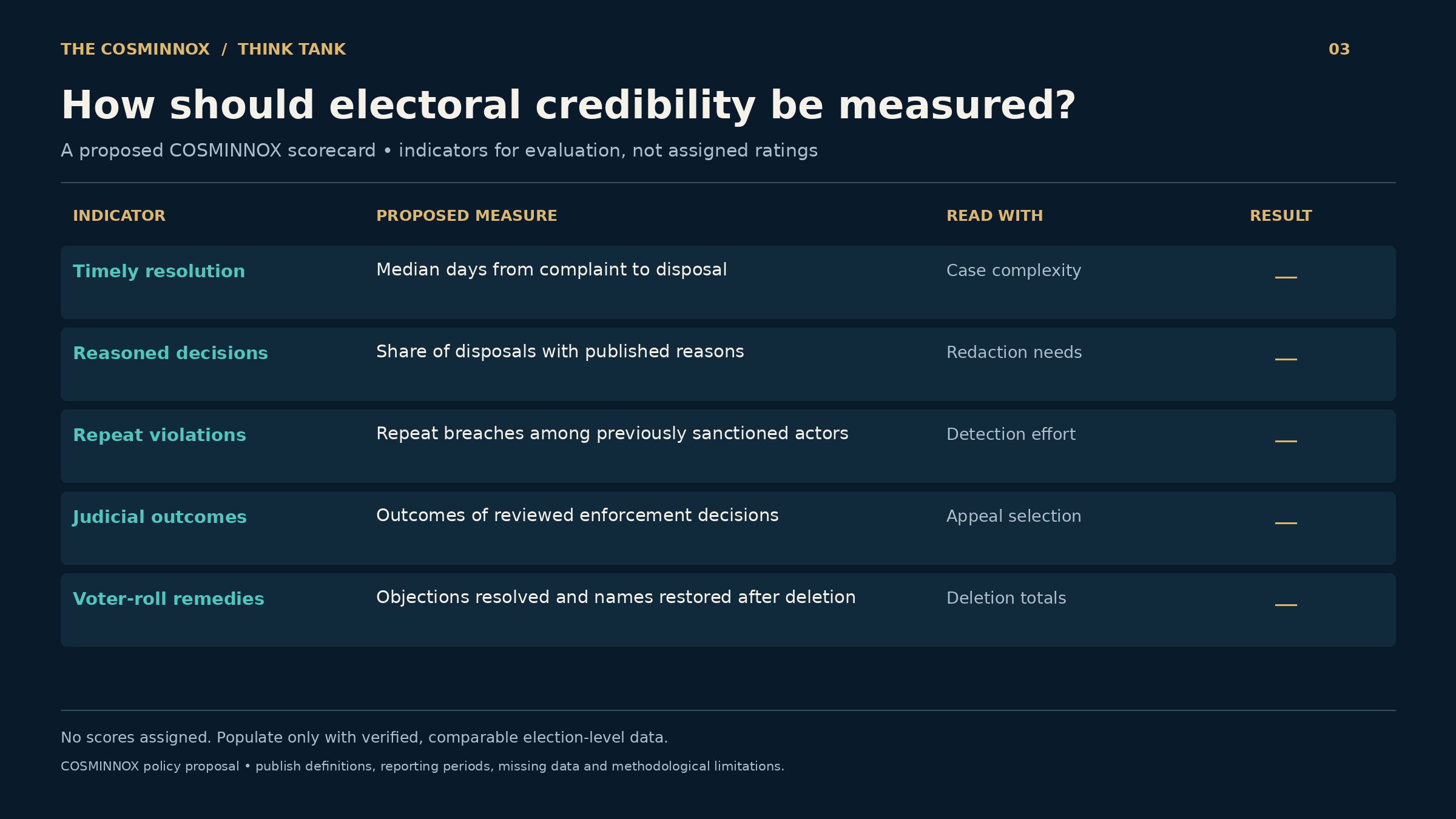
Fourth, the ECI should issue an election-by-election enforcement report with comparable definitions. Useful measures include complaint-resolution times, reasoned disposals, repeat violations and judicial outcomes. Voter-roll reporting should distinguish proposed deletions, completed deletions, successful objections and restorations, with privacy protection. Independent researchers should be able to test the data’s consistency and limitations.
Fifth, institutional capacity should receive sustained attention alongside senior appointments. Parliament and the Union government should examine stable staffing and funding arrangements, while the ECI strengthens training and evidence retention. Greater operational autonomy should be paired with audit and public reporting, so that independence does not weaken scrutiny of expenditure or performance.
These proposals respond to a recurring tension in the cases: election administration needs room to act, but that room must remain bounded and reviewable. The durable test of Seshan’s legacy is whether institutions can preserve decisive, lawful enforcement when another person holds office. Credibility rests on decisions that are timely, explainable, collectively owned and open to appropriate challenge.
References
[1] Supreme Court of India. Mohinder Singh Gill v. Chief Election Commissioner, 2 December 1977; (1978) 1 SCC 405. Discussions of Article 324, existing law and natural justice. Judgment reproduced by Indian Kanoon. Open source
[2] Election Commission of India. Leap of Faith, second edition, chapter 4, printed p. 86, web p. 104. Institutional account of Model Code enforcement and observer oversight. Accessed 20 October 2026. Open source
[3] Supreme Court of India. A. C. Jose v. Sivan Pillai, 5 March 1984; (1984) 2 SCC 656. Conclusions on the relationship between Article 324, legislation and rules. Judgment reproduced by Indian Kanoon. Open source
[4] Supreme Court of India. T. N. Seshan v. Union of India, 14 July 1995; (1995) 4 SCC 611. Collective authority, removal protection and rejection of the mala fides challenge. Judgment reproduced by Indian Kanoon. Open source
[5] Supreme Court of India. Election Commission of India v. Ashok Kumar, 30 August 2000; (2000) 8 SCC 216. Judicial-review conclusions, official PDF pp. 10–11. Open source
[6] Election Commission of India. Leap of Faith, second edition, chapter 4, printed p. 85, web p. 103. EPIC introduction and implementation difficulties. Accessed 20 October 2026. Open source
[7] Supreme Court of India. Dr. Jaya Thakur v. Union of India, 23 September 2026, 2026 INSC 1040. Discussion of Anoop Baranwal and the 2023 Act; joint operative order, paragraphs 1–3, PDF pp. 67–69. Open source