Does China's under-construction Yarlung Tsangpo dam give Beijing the technical ability to alter the Brahmaputra's flow into India — or does the evidence so far support a narrower, still-serious risk than ‘water weapon’ headlines suggest? The available record supports the narrower claim: the project gives China new leverage over timing and information, not proven capacity to cut the river's volume — and India is already building its own storage as a hedge against exactly that uncertainty.
01 WHAT IS ACTUALLY BEING BUILT
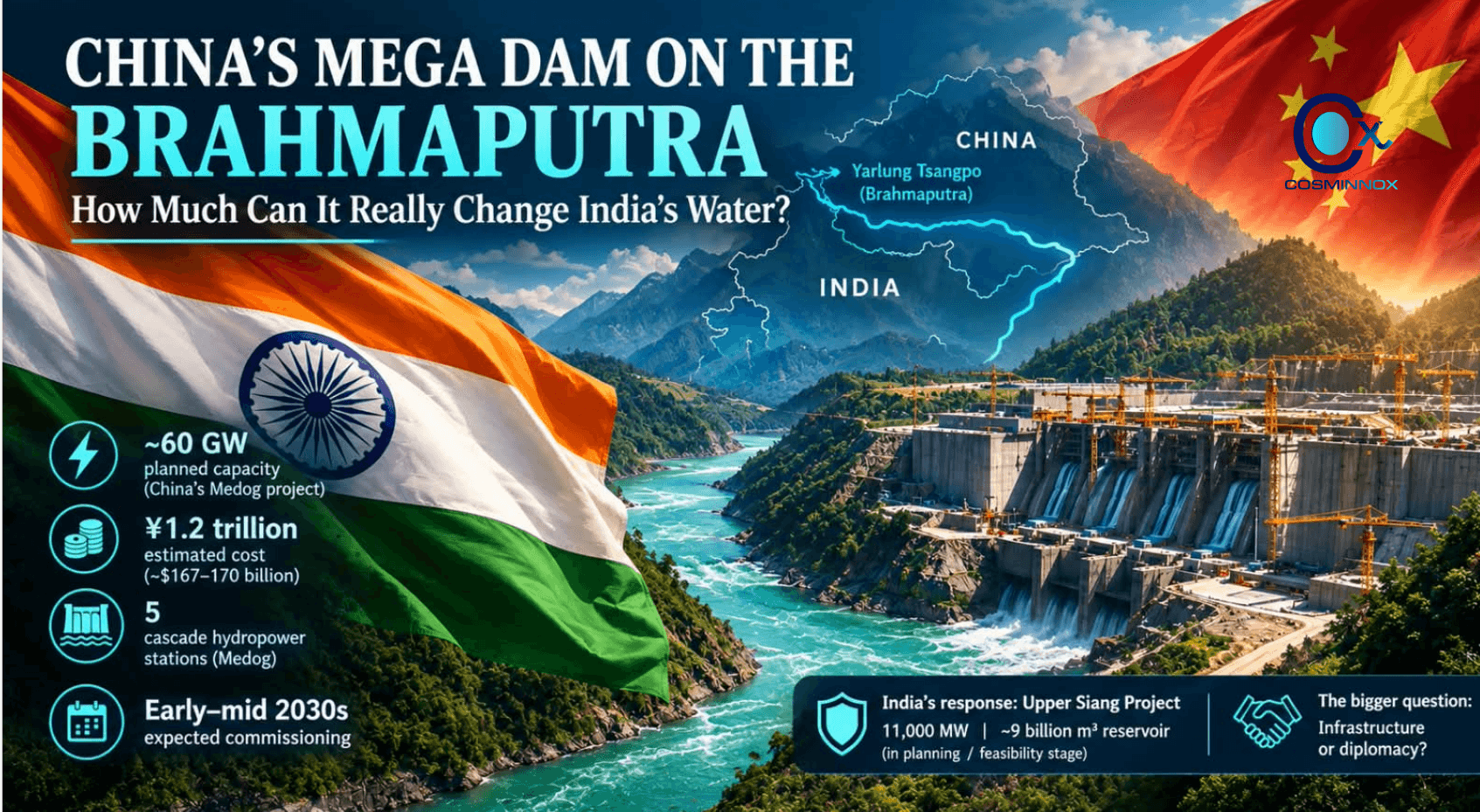
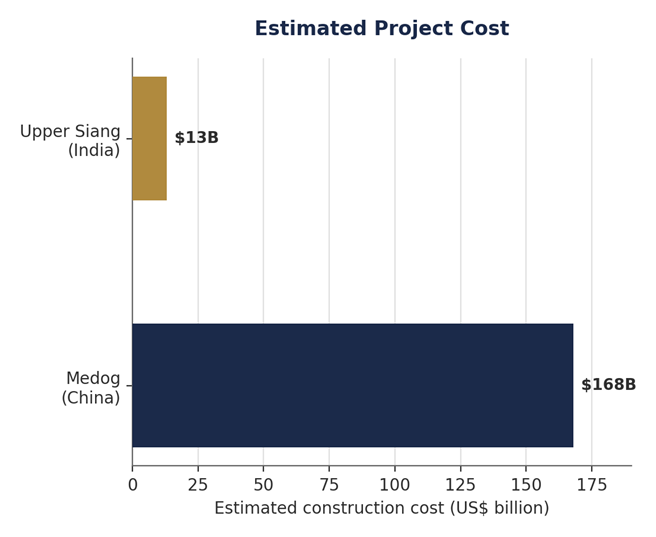
Construction began on 19 July 2025 at Nyingchi, on the lower reaches of the Yarlung Tsangpo — the Brahmaputra's name in Tibet — where the river drops roughly 2,000 metres over a 50-kilometre stretch inside the world's deepest canyon. The Medog (Motuo) Hydropower Station will comprise five cascade dams and stations, with a planned installed capacity above 60 gigawatts and estimated construction cost near ¥1.2 trillion (about $167–170 billion). Annual output is projected at roughly 300 billion kWh — about three times the Three Gorges Dam's generation — with commissioning expected in the early-to-mid 2030s.
Source: Reuters / Al Jazeera, 22 July 2025
| Medog (China) | Upper Siang (India) |
River | Yarlung Tsangpo (Brahmaputra) | Siang (upper Brahmaputra) |
Status | Under construction (started Jul 2025) | Pre-construction / feasibility |
Installed capacity | ~60 GW | 11,000 MW (11 GW) |
Reservoir / storage | Run-of-river cascade, 5 stations | ~9 billion m³ reservoir |
Est. cost | ~$167–170 billion | ~$13 billion |
Target completion | 2033 | 2032 (expected) |
Primary stated purpose | Clean energy, west-to-east power transfer | Hydropower + flood control / flow buffer |
Table 1. Project specifications, China's Medog dam vs. India's Upper Siang counter-project.
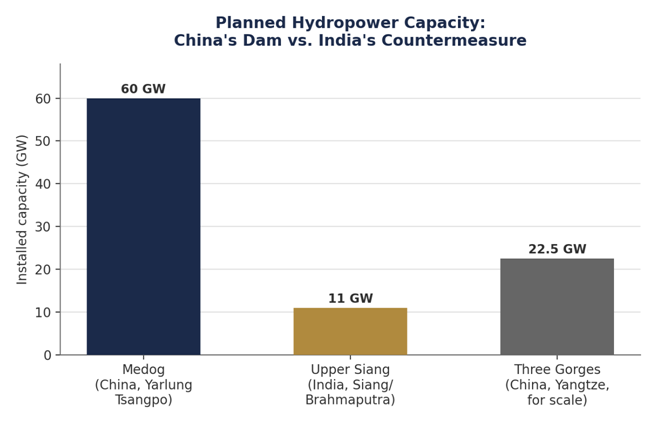
Figure 1. Planned installed capacity — Medog vs. Upper Siang, with Three Gorges shown for scale
.
Figure 2. Estimated construction cost, Medog vs. Upper Siang.
Note on the Medog cost figure: early reporting tied to China's December 2024 approval cited roughly $137 billion; the great majority of reporting since the July 2025 groundbreaking — including Reuters and Xinhua — has settled on ¥1.2 trillion, or approximately $167–170 billion, reflecting a revised estimate at the construction stage. This article uses the more current, more widely corroborated figure.
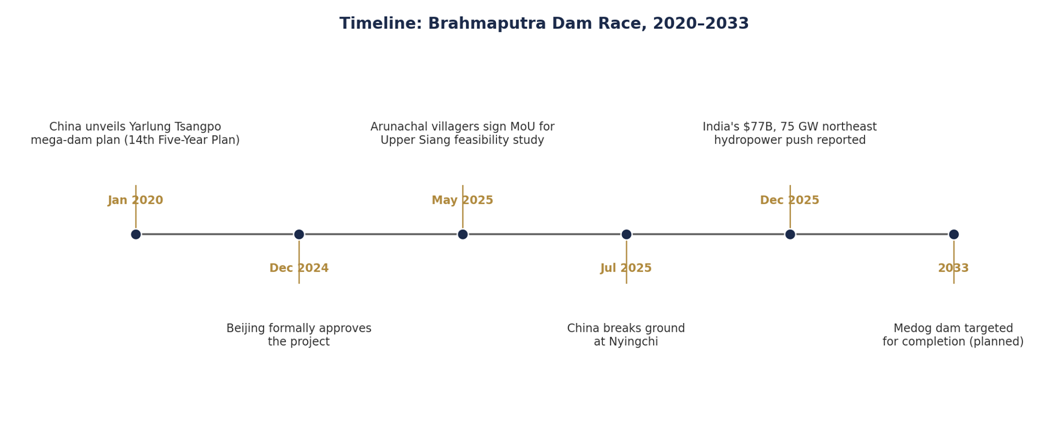
Figure 3. Timeline of the Brahmaputra dam race, 2020–2033.
02 WHERE THE INDIA RISK ACTUALLY COMES FROM
The technical concern analysts raise is not that China will ‘drain’ the river — a run-of-river cascade of this kind is not primarily a large storage reservoir — but that it gives Beijing operational control over when water is released, which matters for a river with sharp seasonal variation. India's Ministry of External Affairs has stated that as a lower riparian with established user rights, it has repeatedly conveyed its concerns to China through both expert-level and diplomatic channels.
Source: MEA spokesperson Randhir Jaiswal, via The Tribune, 2025
Data-sharing between the two sides currently runs through the 2006 Expert Level Mechanism, under which China provides flood-season hydrological data on the Brahmaputra and Sutlej — an arrangement that predates, and was not designed for, infrastructure of this scale. There is no bilateral water-sharing treaty covering the Brahmaputra.
Source: VisionIAS current-affairs analysis, 2026
03 INDIA'S COUNTERMEASURE, IN NUMBERS
India's response is the 11,000 MW Upper Siang Multipurpose Project in Arunachal Pradesh, with a reservoir designed to hold about 9 billion cubic metres of water, explicitly framed by the state government as a buffer for flood modulation and dry-season flow regulation rather than purely a power project.
Source: NHPC / Government of Arunachal Pradesh, via News Arena, 24 May 2025
Arunachal Chief Minister Pema Khandu has described the project as intended to counter China's upstream dam, while separately noting that villagers in the Siang and Upper Siang districts have protested it over displacement and ecological concerns. More broadly, India announced a $77 billion hydropower push across the northeast in 2025, targeting over 200 dams and roughly 75 GW of capacity.
Source: Pema Khandu, via ETV Bharat, Dec 2024; East Asia Forum, 15 Dec 2025
04 THE COUNTER-EVIDENCE
China's position, stated repeatedly, is that the project is run-of-river, has been studied for decades, and will not adversely affect downstream states. The Chinese Foreign Ministry has said the project responds to clean-energy and climate goals and will not harm downstream interests, while the Chinese Embassy in India has said explicitly that it sees no negative impact on lower reaches and intends to keep cooperating on disaster prevention. No independent, published hydrological modelling — Indian or third-party — has yet quantified how the cascade's operations would change downstream seasonal flow; India's own government has said it is monitoring developments and has studied cumulative impacts on Brahmaputra tributaries within its own territory.
Source: Chinese MFA / Embassy statements, via Deccan Herald & The Tribune, 2025
Position | Source, on record |
“No negative impact on the lower reaches” | Yu Jing, Chinese Embassy spokesperson, India |
Project responds to clean-energy and climate-disaster goals | Mao Ning, Chinese MFA spokesperson |
India has “established user rights”; concerns raised via expert and diplomatic channels | Randhir Jaiswal, MEA spokesperson |
Studies conducted on Brahmaputra tributaries to assess cumulative impact | Government of India statement, Feb 2025 |
Table 2. Stated positions of the Chinese and Indian governments, on record.
05 THE BOUNDED CONCLUSION
The record supports three bounded conclusions: China is building the largest hydropower project on earth on a river India depends on; no binding water-sharing treaty or real-time operational data-sharing arrangement exists to manage it; and India is responding with its own storage infrastructure rather than a diplomatic settlement. What the evidence does not yet establish is the actual magnitude of flow disruption the completed cascade would cause — that depends on operating rules neither government has published, and on independent modelling that does not yet exist in the public record.