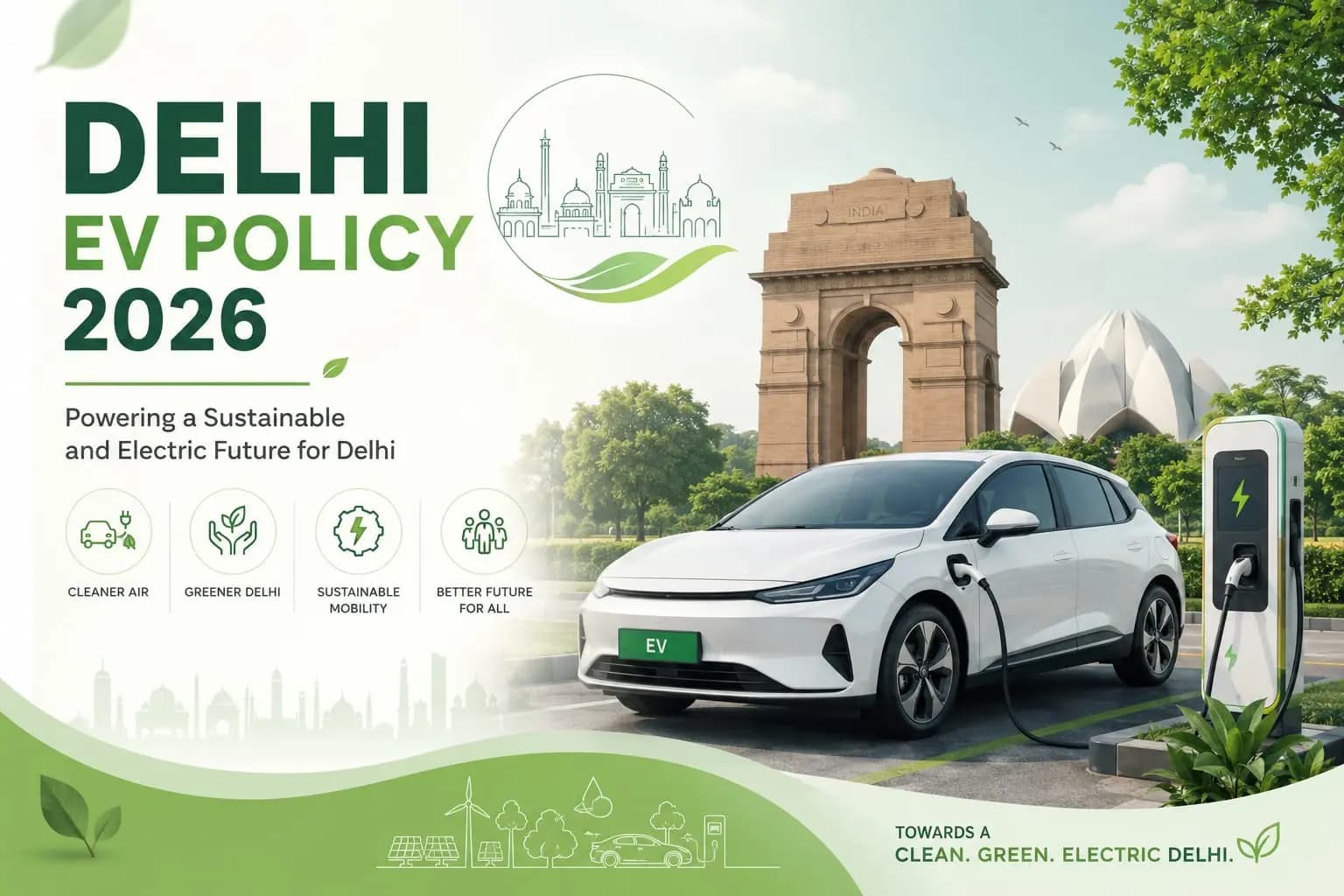
On July 1, 2026, a notification from the Lieutenant Governor's office turned Delhi's electric vehicle ambitions into enforceable policy. The Delhi Electric Vehicles Policy 2026 is now live, and with it comes one of the most detailed state-level EV frameworks in the country: tax breaks, cash incentives, a scrapping scheme, and firm dates by which certain new petrol and CNG vehicles will simply stop being registered in the capital.
1. Policy Scope and Budgetary Architecture
The policy, approved by the Delhi Cabinet under Chief Minister Rekha Gupta and notified with effect from July 1, 2026, remains in force until March 31, 2030. It carries a total outlay of roughly ₹15,000 crore, of which about ₹7,000 crore is earmarked for direct implementation. This includes close to ₹3,000 crore for purchase and scrappage incentives and around ₹1,000 crore for expanding charging infrastructure. Funding is drawn from a combination of the central PM E-Drive Scheme and the Delhi government's own state budget.
2. Fiscal Benefits and Incentives Matrix
Buyers of new electric cars priced up to ₹30 lakh (ex-showroom) get a full, 100 percent waiver on road tax and registration charges—a waiver officials estimate will cost the exchequer close to ₹3,000 crore in forgone revenue. Strong hybrid vehicles receive a 50 percent exemption, while electric cars priced above ₹30 lakh do not qualify for the waiver.
Purchase subsidies apply across vehicle categories: electric two-wheeler buyers can receive up to ₹30,000 in the policy's first year, with the amount reducing in subsequent years to reward early adoption. Structured subsidies also apply to electric three-wheelers and N1 commercial trucks, with the highest payouts available during the initial phase.
A scrappage component allows owners of older, BS-IV or lower-emission petrol and diesel vehicles to claim incentives of up to ₹1 lakh for scrapping them, with higher payouts set aside for commercial vehicle categories.
3. Infrastructure Commitments and Phase-Out Timelines
On infrastructure, the government has committed to installing 32,000 charging points across the city over the next four years to ease range anxiety. Concurrently, the policy sets firm, mandatory cut-off dates for new registrations of fossil-fuel vehicles in specific mass-market categories:
From January 1, 2027: Only electric three-wheelers will be eligible for new registration in Delhi.
From April 1, 2028: The restriction extends to two-wheelers, with only electric models permitted for new registrations.
Existing petrol, diesel and CNG vehicles already on the road are not affected and may continue to operate. The policy notably excludes hybrid vehicles from subsidy eligibility, positioning full electrification, rather than hybrid adoption, as the intended pathway.
“According to Delhi's transport department, commercial goods carriers and two- and three-wheelers account for a significant share of the city's vehicular pollution, which is why the policy targets these segments for accelerated conversion. Transport Secretary Niharika Rai has said the government's objective is to convert the entire fleet in these high-emission categories to electric power over time.”
4. Industry Response and Market Impacts
Automobile industry representatives have described the policy as a source of planning certainty for manufacturers and dealers. Vinkesh Gulati, Chairperson of the Automotive Skills Development Council and former President of the Federation of Automobile Dealers Associations (FADA), said the industry now has sufficient lead time to prepare for the phased transition.
Shailender Luthra, Delhi FADA State Chairperson, noted that Delhi records approximately 50,000 two-wheeler and 5,000 three-wheeler registrations every month, making the city one of India's largest automobile markets and a significant testing ground for the policy. Both industry figures said the framework could deeply influence neighbouring states and, eventually, a broader national EV policy.
What Comes Next
The policy applies only within Delhi for now. Industry observers point out that its success will depend on how quickly the promised charging infrastructure is actually built and how smoothly the phased registration cut-offs are enforced. Several commentators expect other states to observe Delhi's rollout before deciding whether to adopt comparable measures, with some suggesting the framework could eventually inform a wider, centralized EV policy for the country.
This report reflects the Delhi Electric Vehicles Policy 2026 notification and official public statements as of early July 2026. Readers are encouraged to consult the official notification from the Delhi government's Transport Department for complete eligibility terms.