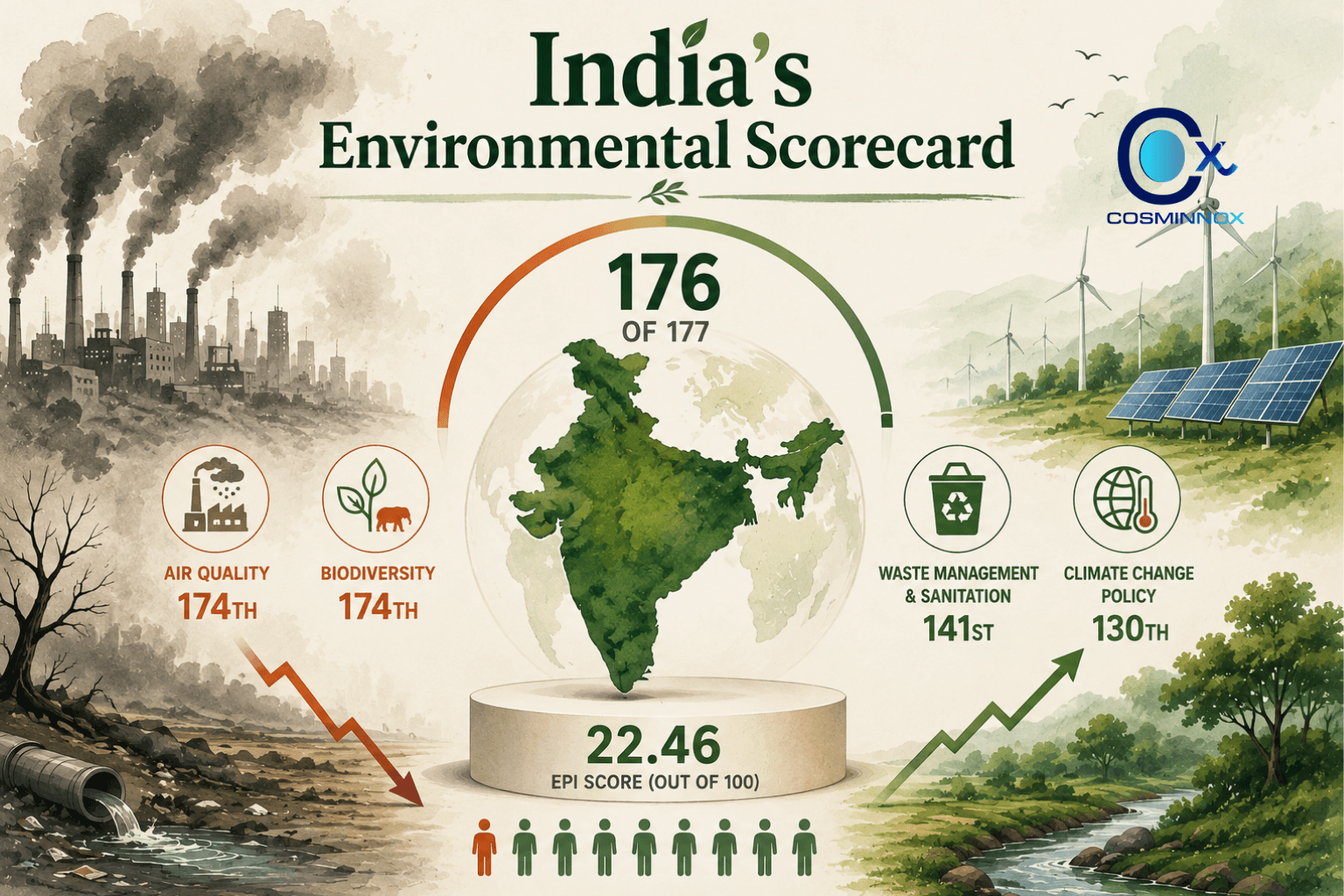
India has ranked 176th out of 177 countries in the Environmental Performance Index (EPI) 2026, according to the report released by the Yale Center for Environmental Law & Policy (YCELP) in collaboration with Columbia University's Center for International Earth Science Information Network (CIESIN). India's overall score stood at 22.46, ahead only of Laos, which finished last with a score of 21.78. Estonia topped the index with a score of 74.79, followed by Luxembourg, the United Kingdom, Finland, and the Netherlands, with European countries occupying all five top positions.
The Scoreboard: Estonia to Laos
The chart below sets India's score against the top five performers and the lowest-ranked country in the 2026 index.
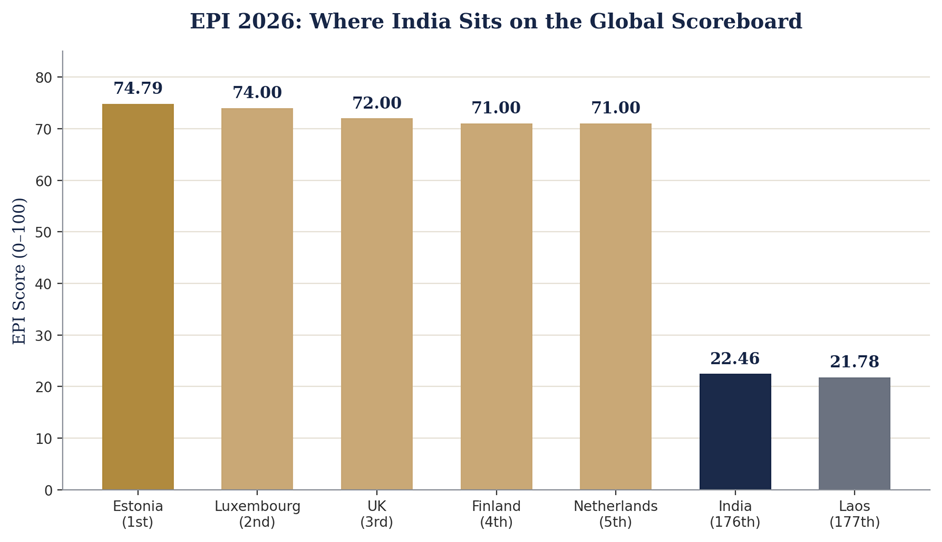
Fig. 1 — EPI 2026 scores: top five performers vs. India and Laos. Source: Yale EPI 2026 / YCELP–CIESIN.
The Numbers, By Category
The 2026 edition assessed 177 countries across 47 indicators grouped into 12 environmental issue categories, spanning environmental health, ecosystem vitality, and climate change policy. India's weakest categories were air quality and biodiversity, where it ranked 174th in both. On environmental health broadly, India also placed 174th, and 171st on ecosystem vitality. India performed comparatively better on climate change policy, ranking 130th, and on waste management and sanitation, ranking 141st.
Issue Category | India's Rank | Total Assessed |
Air Quality | 174th | of 177 |
Biodiversity | 174th | of 177 |
Environmental Health | 174th | of 177 |
Ecosystem Vitality | 171st | of 177 |
Waste Management & Sanitation | 141st | of 177 |
Climate Change Policy | 130th | of 177 |
Table 1 — India's rank by EPI issue category, 2026. Source: Yale EPI 2026.
Within South Asia, India placed 7th of 8 countries assessed, behind Bhutan, Sri Lanka, Nepal, Pakistan, Maldives, and Bangladesh. The report noted a positive 10-year change score of +7.47 for India, indicating gradual improvement in specific indicators over the past decade, even as the country's absolute global rank remained low.
A Consistent Pattern Since 2022
India's ranking history on the index shows a decade of movement near the bottom of the table, as the chart and table below show.
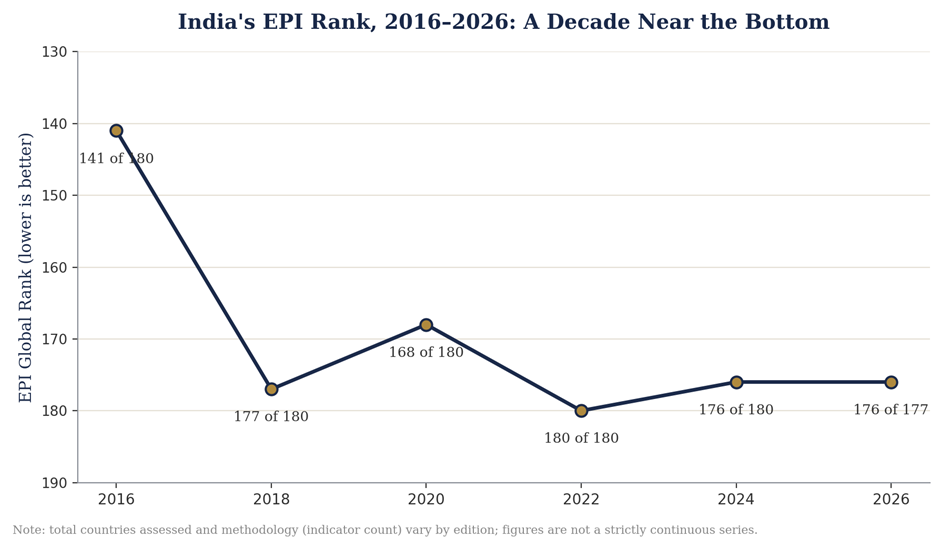
Fig. 2 — India's EPI global rank, 2016–2026. Source: Yale EPI, various editions.
EPI Edition | India's Rank | Countries Assessed |
2016 | 141st | 180 |
2018 | 177th | 180 |
2020 | 168th | 180 |
2022 | 180th | 180 |
2024 | 176th | 180 |
2026 | 176th | 177 |
Table 2 — India's EPI rank and total countries assessed, by edition. Source: Yale EPI, various editions.
The EPI's authors caution that rankings across editions are not directly comparable as a continuous time series, since the number of countries assessed, indicators used, and methodology are revised each cycle — the 2022 index used 40 indicators, the 2024 edition used 58, and 2026 introduced grassland conversion as a new indicator for the first time, given grasslands' role in carbon sequestration. India has remained among the five lowest-ranked countries in every edition since 2022.
The report attributed India's low overall placement to an “acute development-versus-pollution tension,” noting that per-capita emissions remain relatively low but are growing rapidly as access to modern energy expands, accompanied by urban air pollution and rising greenhouse gas emissions. India remains the world's third-largest greenhouse gas emitter after China and the United States, with total emissions having risen by approximately 32 percent over the past decade.
Government's Position
The Ministry of Environment, Forest and Climate Change (MoEFCC) has contested the EPI's findings in successive editions. Following the 2022 ranking, the Ministry stated it did not accept the index's “analysis and conclusions,” arguing that several indicators were based on “unfounded assumptions” and were “extrapolated and based on surmises and unscientific methods.” The Ministry has separately argued that composite indices of this kind can penalise expanding developing economies while overlooking historical emissions and per-capita baselines.
“The indicators used in the report rely on unscientific assumptions and flawed methodologies that fail to reflect the ground reality of developing nations.” — Ministry of Environment, Forest and Climate Change (MoEFCC) |
Yale researchers have responded to these objections. Martin Wolf, the EPI's principal investigator, has said the index measures current environmental conditions rather than policy intentions, and has stated that Yale regrets India's decision to reject “a useful data-driven tool” rather than use its findings to inform environmental policy.
The Way Forward: Recommendations and Ongoing Measures
Analysts tracking the EPI 2026 release have pointed to a set of priority areas for India to address its low ranking, particularly on air quality, biodiversity, and urban environmental management.
PRIORITY AREAS IDENTIFIED BY ANALYSTS • Strengthen monitoring and enforcement of existing environmental regulations. • Accelerate the shift to clean energy and reduce dependence on fossil fuels. • Improve urban air quality through cleaner transport, industrial emission controls, and dust management. • Expand wastewater treatment and integrated urban waste management. • Promote sustainable agriculture and reduce excessive pesticide use. • Expand ecosystem restoration, afforestation, and biodiversity conservation efforts. • Improve the quality, transparency, and outcome-based monitoring of environmental data. |
The Government of India has pointed to a set of existing measures it says are already under way. Pollution control continues under the Water Act, 1974, the Air Act, 1981, and the Environment Protection Act, 1986, with industries monitored through Online Continuous Emission Monitoring Systems (OCEMS), and river restoration tracked under the National Water Quality Monitoring Programme. The government also cites the National Clean Air Programme, the Green Hydrogen Mission, the International Solar Alliance, and afforestation and electric-mobility initiatives as part of its broader climate and pollution-control strategy, alongside its 2030 emissions-intensity targets and its Net Zero by 2070 commitment.
Methodology
The EPI is produced biennially and draws on internationally recognised datasets, including satellite data, to evaluate environmental outcomes across three broad policy objectives: environmental health, ecosystem vitality, and climate change mitigation. It is intended to help policymakers benchmark national performance against global peers and track progress toward frameworks including the UN Sustainable Development Goals and the Paris Agreement. According to the 2026 report, EPI scores show a correlation of 0.69 with national wealth, indicating that higher-income countries generally score better, though the report notes individual countries can outperform or underperform relative to their income group.
The Cosminnox • Source: Yale Center for Environmental Law & Policy / Columbia CIESIN, Environmental Performance Index 2026