
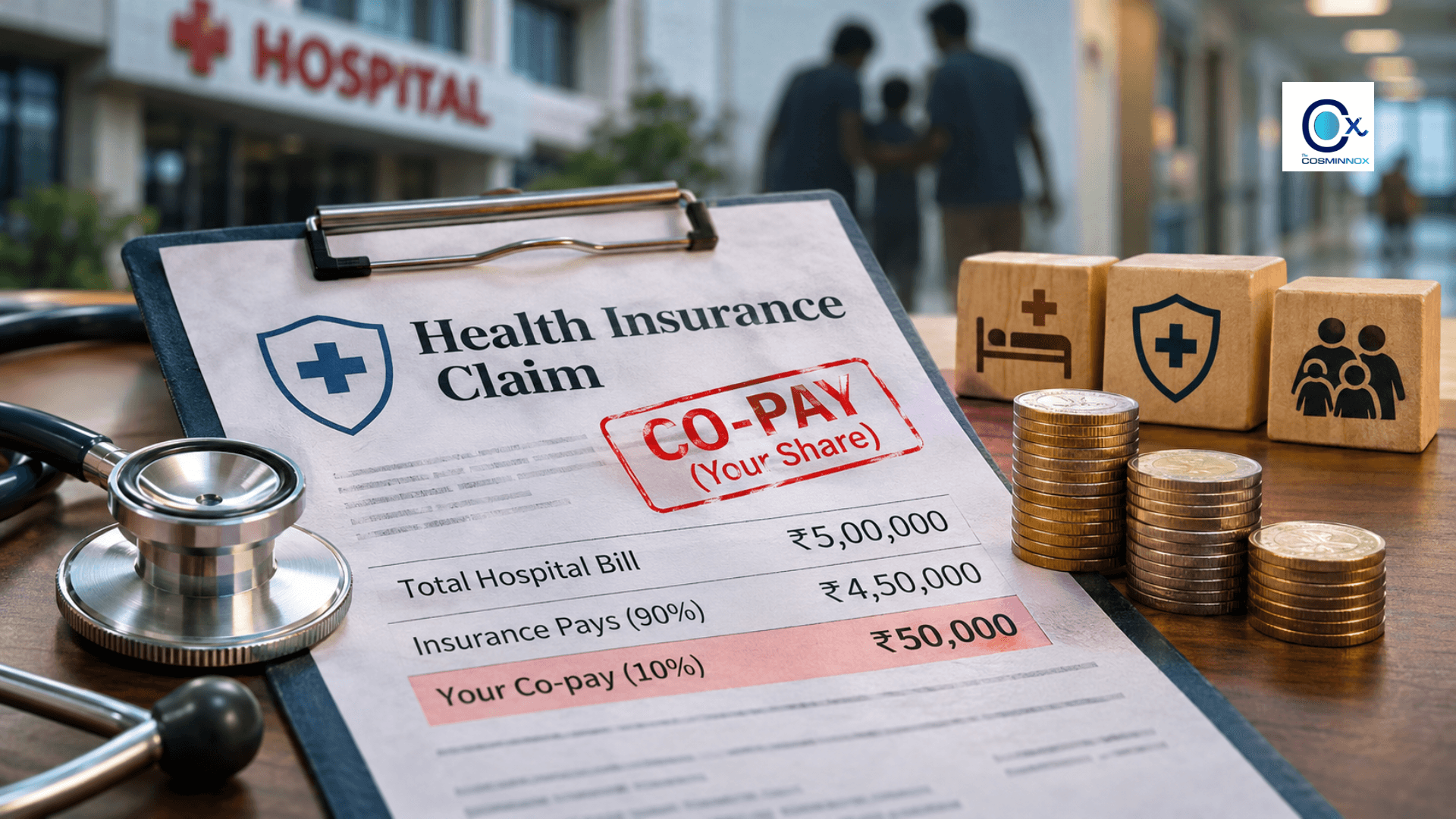
India’s health insurance market is expanding, but a growing question confronts policyholders: if they have already paid their premiums, why must they pay again when hospitalised?

1. Why co-payment is in the news
As of 4 November 2026 the 10% co-pay is a proposal, not a rule. The General Insurance Council (GIC), the industry body of general and health insurers, is reported to be considering a mandatory 10% co-payment on admissible inpatient costs in retail health policies, capped at ₹5 lakh per claim, from 1 January 2027 (1, 3, 4). It needs approval from the insurance regulator, IRDAI, and no approval has been reported in the sources reviewed.
Three points carry the rest of this piece:
Size. Co-pay applies only to admissible charges, so non-payable items sit on top of it. Business Standard's worked example puts a household's share of a ₹20 lakh bill at ₹3.35 lakh (16.75%) (1).
Rationale. Insurers argue a shared cost reduces "moral hazard" and can lower premiums (1). Critics argue patients cannot control hospital pricing and that the cost simply moves to households (3, 6).
Reaction. Industry executives and analysts quoted in the business press doubt IRDAI will approve a blanket mandate (1, 2). No poll of the public on this specific proposal, and no share-price move attributed to it, turned up in the sources reviewed.
2. What exactly is co-payment?
A co-payment is a fixed percentage of an admissible claim that the policyholder pays and the insurer does not. In Business Standard's explainer on senior-citizen cover, a 10% co-pay on a ₹1 lakh hospital expense means the policyholder pays about ₹10,000 and the insurer about ₹90,000. Policies with a co-pay typically carry lower premiums (25).
Co-pay is one of several conditions that can leave a patient responsible for part of a bill. Others listed by Newslaundry include policy limits, exclusions, deductibles, room-rent restrictions and non-payable items, which is why a claim can be cashless without being costless (3).
Example: admissible claim | Patient pays (10%) | Insurer pays (90%) |
₹1,00,000 | ₹10,000 | ₹90,000 |
₹5,00,000 | ₹50,000 | ₹4,50,000 |
₹10,00,000 | ₹1,00,000 | ₹9,00,000 |
Important: excluded expenses, deductibles, sub-limits and room-rent restrictions can add to the patient’s bill. A co-payment is not the same as a deductible.
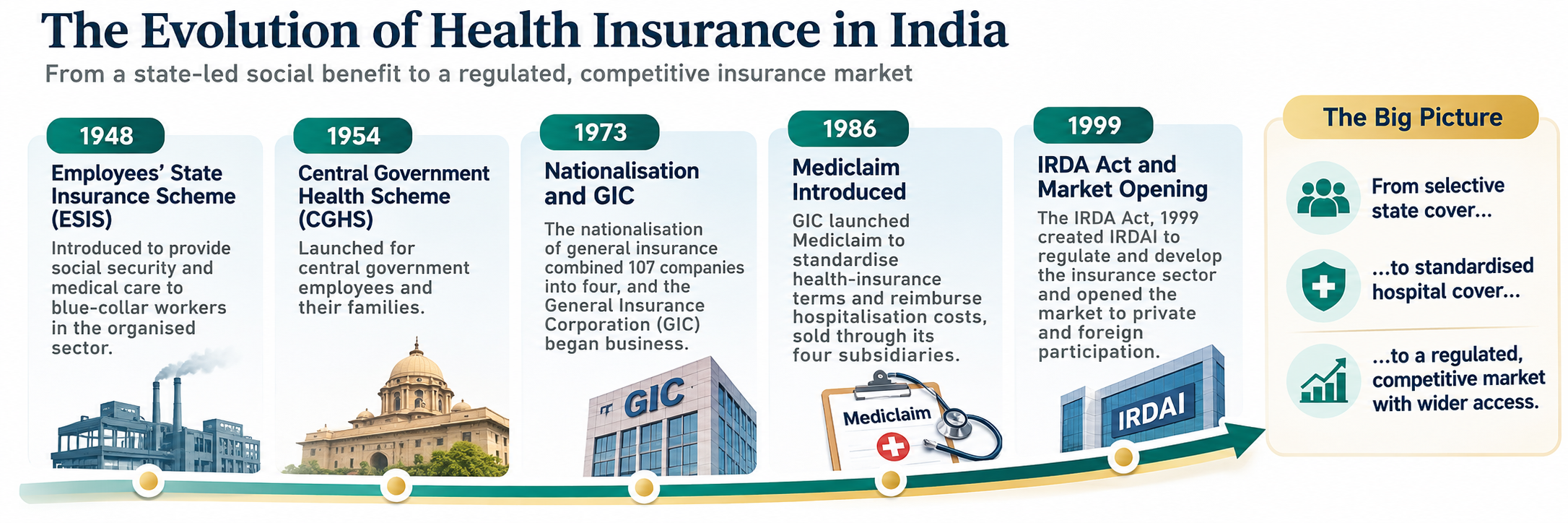
3. A short history: who started health insurance in India, and why
Indian health cover began as a state benefit, not a commercial product. The Employees' State Insurance Scheme (ESIS) started in 1948 to give social security to blue-collar workers in the organised sector, and the Central Government Health Scheme (CGHS) followed in 1954 for central government employees and their families (16, 18).
Commercial hospital cover came later and through government-owned insurers. The nationalisation of general insurance combined 107 companies into four and GIC began business in 1973 (20, 19). In 1986 GIC introduced Mediclaim to standardise health-insurance terms and reimburse hospitalisation costs, sold through its four subsidiaries (16, 17). The 1999 IRDA Act created IRDAI to regulate and develop the sector and, in one account, opened it to private and foreign participation (27).
4. Why insurers include co-payment
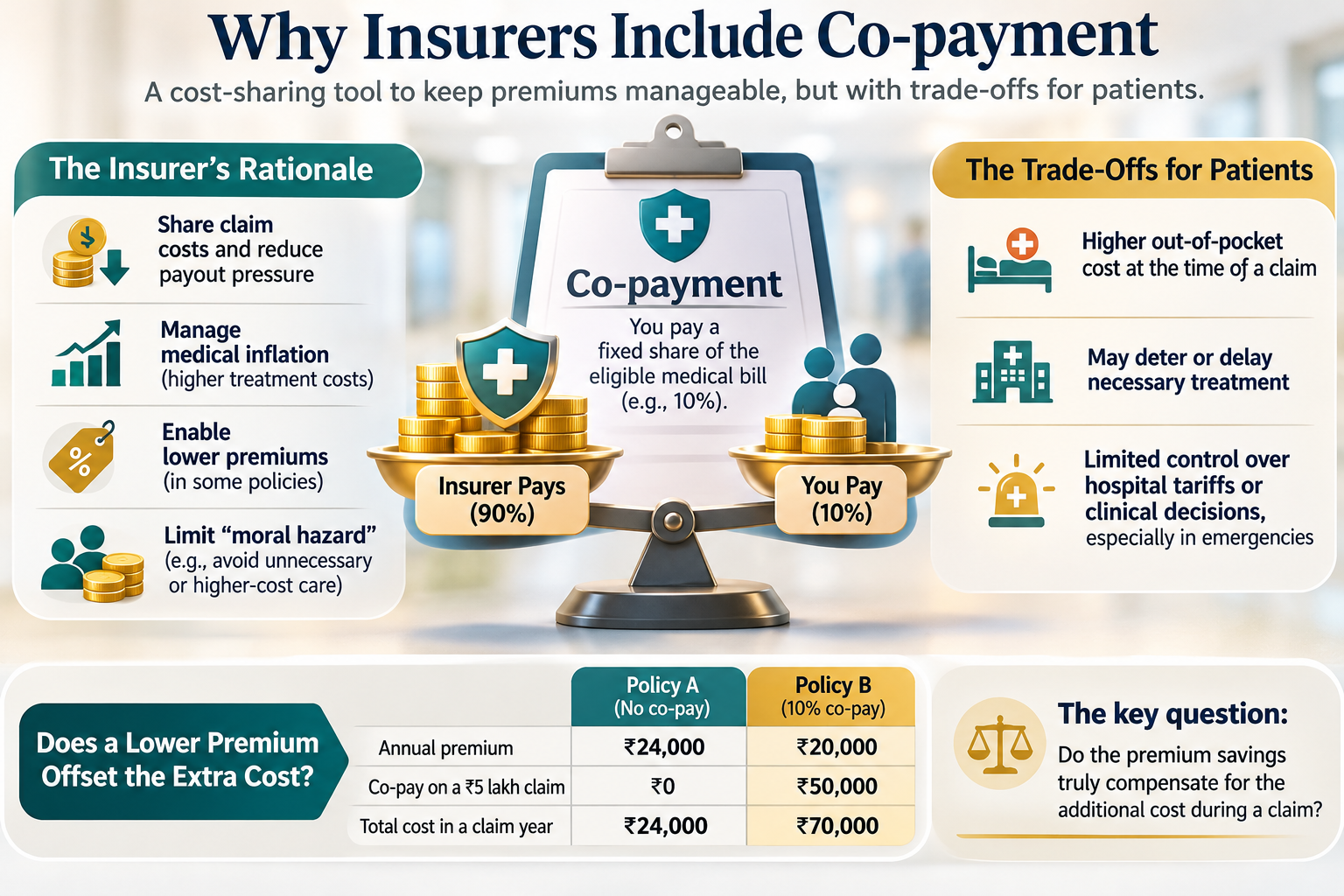
Insurers use co-payment to share claim costs, manage medical inflation and sometimes offer lower premiums. Economists also discuss “moral hazard”: insurance can change how much care is consumed or how closely prices are scrutinised. Yet emergency patients rarely control hospital tariffs or clinical decisions. Co-payment can therefore discourage necessary treatment as well as unnecessary spending. The central issue is whether lower premiums meaningfully compensate households for additional claim-time costs.
5. Terms and conditions consumers should examine
Term | Meaning |
Co-payment rate | Patient’s percentage share of an admissible claim. |
Applicability | All claims or only specified treatments, ages, hospitals or locations. |
Admissible claim | Amount accepted after relevant policy restrictions. |
Deductible | Initial expense borne before eligible insurer payment. |
Room-rent limit | Cap that may lead to additional deductions. |
Disease-specific sub-limit | Maximum payable for a specified condition. |
Waiting period | Period before specified conditions are covered. |
Cashless settlement | Insurer settles approved amount directly; patient still owes their share. |
Co-payment ceiling | Maximum patient co-payment, only if explicitly provided. |
Read the Customer Information Sheet and full policy wording together. The reported 2026 proposal’s 10% rate, per-claim cap and possible restrictions on waiver riders are not universal existing terms. [2, 6]
6. The numbers behind the debate
India’s share of total health expenditure paid directly by households declined from 64.2% in 2013–14 to 39.4% in 2021–22, according to National Health Accounts. A broad co-payment requirement could increase out-of-pocket expenses for some privately insured households, but national effects cannot be inferred from these two observations alone. [7]
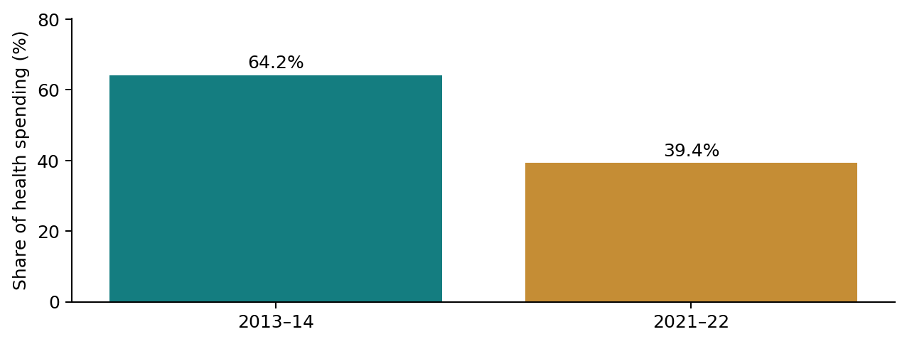
Figure 1. Household out-of-pocket spending as a share of total health expenditure. Source: National Health Accounts. [7]
Ministry of Finance reporting gave claim-paid ratios by number of 85.66% (FY2022–23), 82.46% (FY2023–24) and 87.5% (FY2024–25). These figures measure claims paid by count, not the proportion of each hospital bill reimbursed. [8]
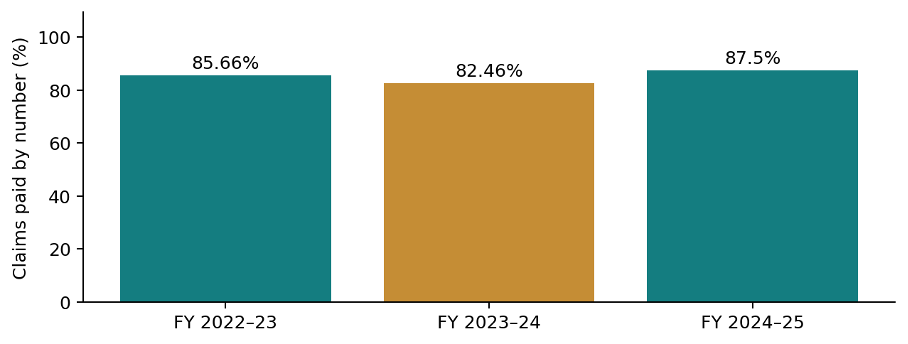
Figure 2. Claims paid by number, not rupee-value reimbursement. Source: Ministry of Finance. [8]
7. How are the public and market responding?
Consumer-oriented coverage has emphasised the possibility of unexpectedly large payments during hospitalisation and questioned whether premium reductions would be sufficient. Industry commentary has been divided: supporters see a claims-cost control mechanism; sceptics point to consumer choice and the difficulty of imposing an industry-wide uniform requirement. The hospital-pricing debate includes common empanelment and better dispute resolution. No reliable nationwide survey measuring public support for the October 2026 proposal was established in the reviewed sources; these are reported concerns, not measured national sentiment. [1–3]
8. Would lower premiums make it worthwhile?
Suppose a no-co-pay policy costs ₹24,000 a year and a 10%-co-pay policy costs ₹20,000. The latter saves ₹4,000 in premium. But one fully admissible ₹5 lakh claim generates ₹50,000 in co-payment, bringing the total annual patient cost to ₹70,000 rather than ₹24,000, assuming no other costs. The premium saving is exhausted above a ₹40,000 admissible claim. These are hypothetical prices, not market quotations.
Illustrative policy | Annual premium | Patient share on ₹5 lakh claim | Total annual cost |
A: no co-pay | ₹24,000 | ₹0 | ₹24,000 |
B: 10% co-pay | ₹20,000 | ₹50,000 | ₹70,000 |
9. Who controls hospital costs?
Patients cannot usually negotiate emergency surgery prices, ICU charges or medically necessary investigations. Transparent hospital pricing, better insurer-hospital negotiations, dispute resolution and clear policy disclosures are essential complements to any cost-sharing mechanism. A 2026 parliamentary discussion also highlighted medical inflation and the need for stronger oversight of private healthcare costs. [9]
10. The COSMINNOX verdict
Co-payment can be legitimate when voluntary, clearly disclosed and paired with meaningful premium reductions. Making it compulsory, however, reduces consumer choice and may transfer substantial risk back to households. Policymakers should preserve full-cover alternatives, require transparent comparisons, consider hardship protections, monitor care avoidance and improve hospital billing transparency. These are editorial recommendations, not announced regulatory provisions.
The test of good health insurance is not simply how affordable it is to purchase, but how reliably it protects a family when healthcare is needed.
Sources and further reading
[1] Business Standard, 5 October 2026, industry 10% co-pay proposal. https://www.business-standard.com/amp/finance/insurance/insurers-10-co-pay-plan-for-retail-health-claims-may-not-get-irdai-nod-126100500945_1.html
[2] Moneycontrol, 8 October 2026, proposed co-pay and implications. https://www.moneycontrol.com/banking/what-a-proposed-10-co-payment-means-for-health-insurers-and-why-it-may-fall-short-article-14047785.html
[3] Mint, October 2026, lower premiums and out-of-pocket implications. https://www.livemint.com/money/personal-finance/lower-premiums-higher-out-of-pocket-expenses-experts-decode-the-proposed-10-health-insurance-co-pay-rule-11791224700087.html
[4] Commonwealth Fund, India health system profile. https://www.commonwealthfund.org/international-health-policy-center/countries/india
[5] NITI Aayog, Health Insurance for India’s Missing Middle. https://www.niti.gov.in/node/352
[6] IRDAI Master Circular on Health Insurance Business, 29 May 2024. https://www.compliedai.com/updates/irdai/master-circular-on-health-insurance-business-29052024-pqhyzk
[7] Ministry of Health and Family Welfare, National Health Accounts. https://www.pib.gov.in/PressReleasePage.aspx?PRID=2058791&lang=2®=48
[8] Ministry of Finance, March 2026, health insurance claim data. https://www.pib.gov.in/newsite/erelcontent.aspx?lang=2®=48&relid=286915
[9] Parliamentary committee reporting on healthcare costs and inflation. https://www.pib.gov.in/