
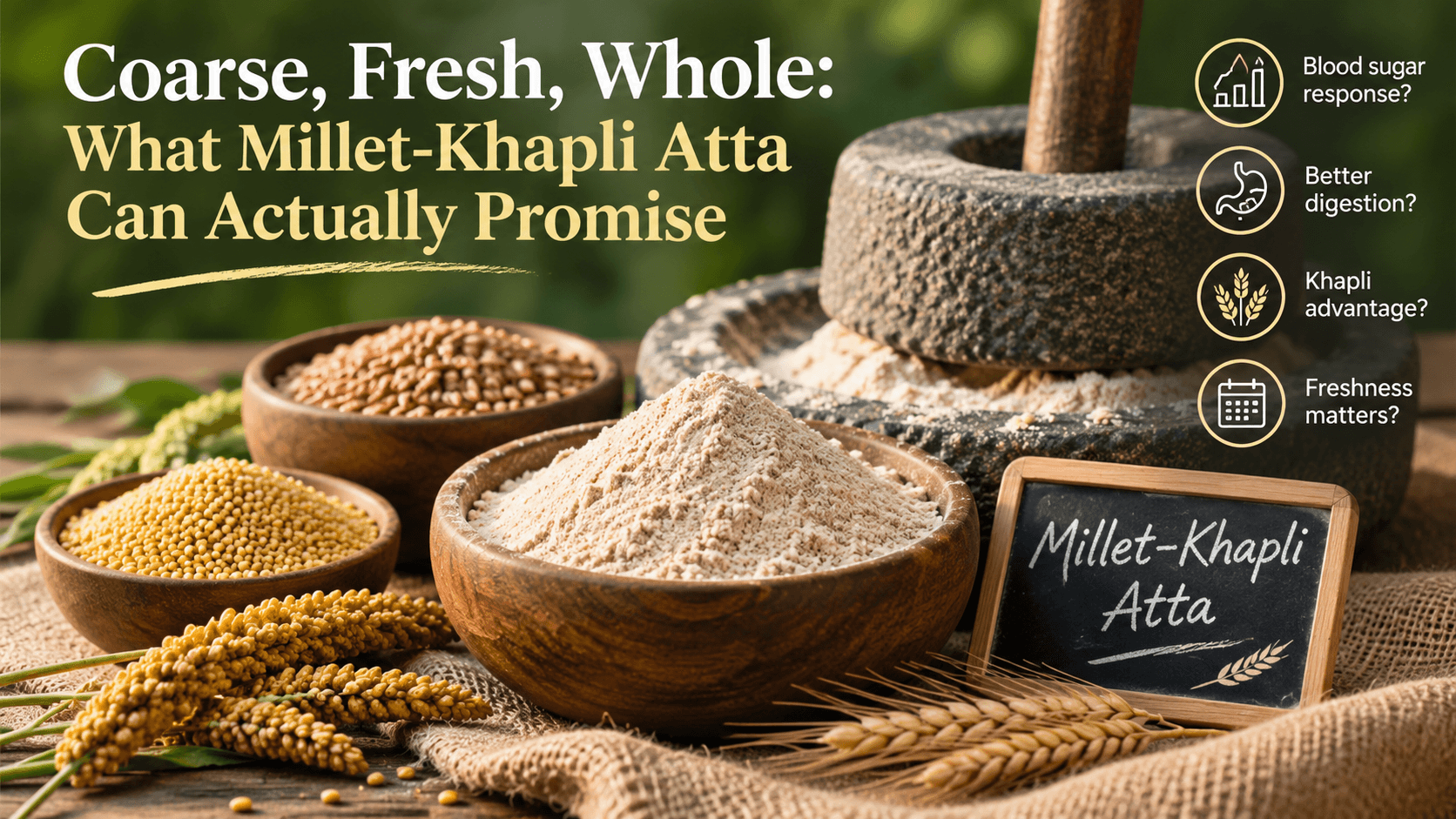
A stone-ground millet and khapli flour carries four health claims on its pack. We checked each against the research: one holds up in part, two are thinner than the label suggests, and one has no direct study behind it.
In a 2021 New Zealand trial, 23 adults aged 55 to 75 ate three wholegrain breads that differed only in how the flour was milled. The coarse stone-ground loaf did not move blood glucose in a statistically meaningful way. The researchers reported no evidence that particle size changed the glucose or insulin response in this group, who were overweight and inactive but mostly had normal blood sugar (Mete and colleagues, Nutrients, 2021).
That finding sits awkwardly beside a claim now common on Indian flour packs: that coarse, stone-ground, freshly milled khapli-and-millet atta gives a gentler glucose response and better digestion. The claim is not baseless, but it is narrower than the label. The research supports whole grain over refined flour, and grain left closer to intact over finely milled flour, mainly in people who already have type 2 diabetes. For khapli itself, and for freshness as a health benefit, we found no direct evidence.
Grind: the benefit belongs to intact grain
The better results come from people with type 2 diabetes, and from grain that stays close to whole. In a two-week crossover trial (Åberg and colleagues, Diabetes Care, 2020), 28 adults who completed it swapped their usual grain foods for less-processed whole-grain versions. Their post-meal glucose after breakfast was 9% lower than on finely milled equivalents (95% confidence interval: 3% to 15%). A 2021 trial of 18 adults with type 2 diabetes (Elbalshy and colleagues, Diabetologia) found that porridge from finely milled whole wheat raised glucose more than porridge from intact whole wheat.
Both trials set finely milled grain against grain left whole or nearly so. Neither tested a coarse flour. In an earlier bread test in 15 adults with type 2 diabetes (Diabetes Care, 2020), a loaf containing intact and kibbled grain produced the smallest glucose rise, an incremental area under the curve of 375 mmol/L·min. Bread from stone-ground flour came in at 503. Coarse flour sits in the middle of that range, not at the favourable end. The defensible label is "coarsely milled whole grain", not "low GI".
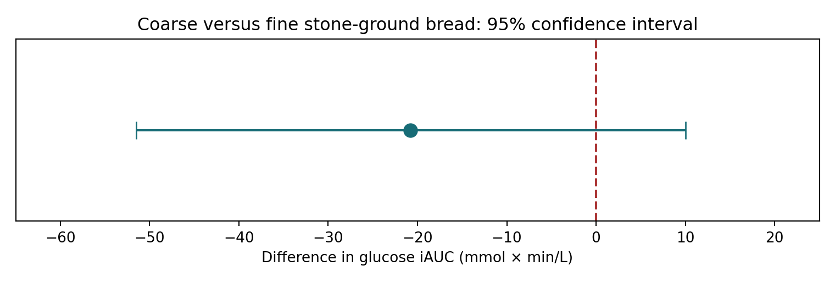
FIGURE 1. The interval crosses zero: no statistically significant difference in this 23-person trial. Source: Mete et al. (2021).
Grain: millet has data, khapli has retailer blogs
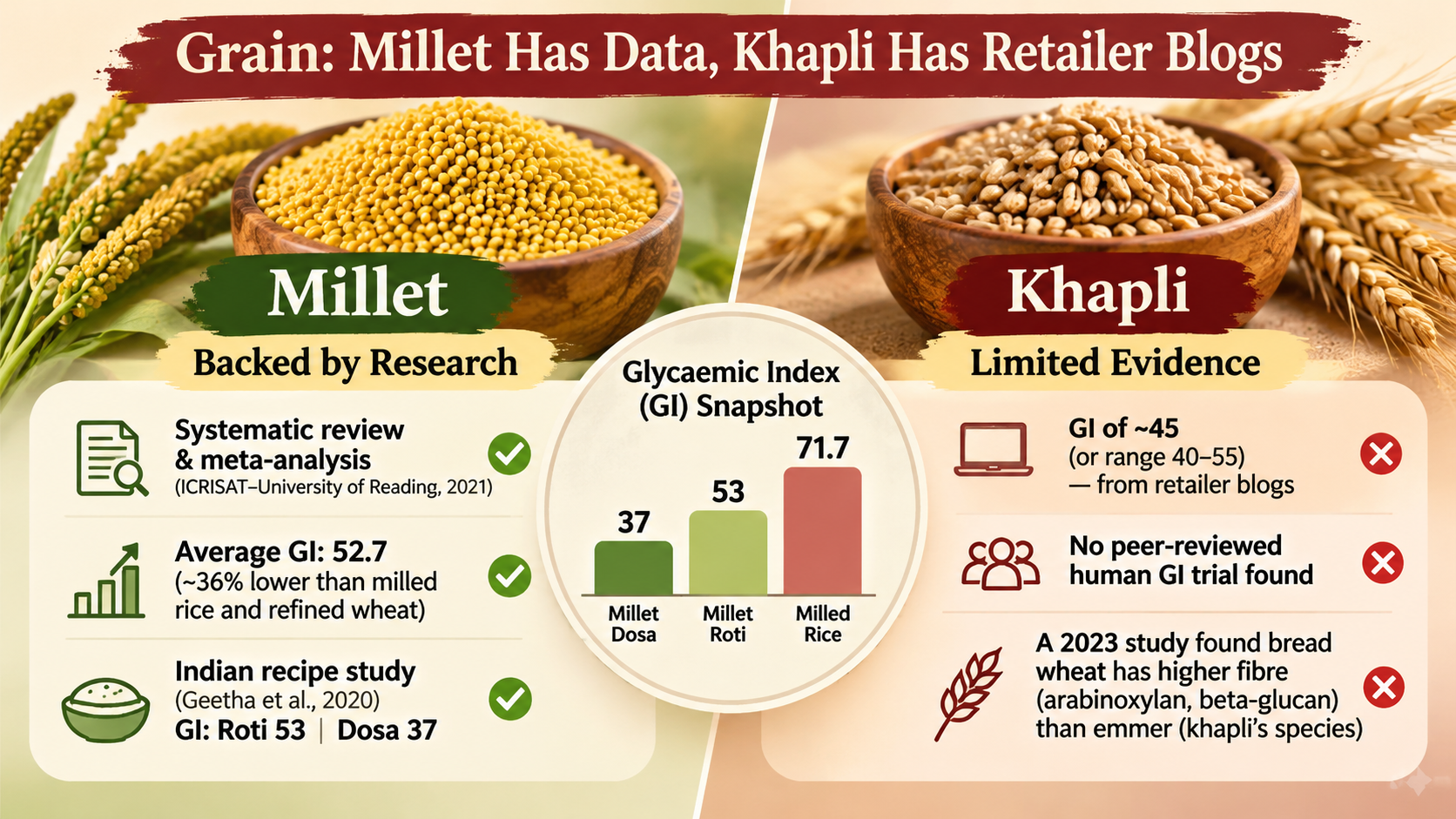
Millets have the stronger case. A systematic review and meta-analysis led by ICRISAT with the University of Reading (Frontiers in Nutrition, July 2021) put the average glycaemic index of millets at 52.7, about 36% below milled rice and refined wheat. That is an average across millet types and cooking methods. The one Indian recipe test of a millet-based mix we found, in 10 healthy adults aged 18 to 30 in Karnataka (Geetha and colleagues, Journal of Food Science and Technology, 2020), gave a GI of 53 for roti and 37 for dosa. A millet roti lands two points under the usual cut-off of 55 for "low".
Khapli is the weakest link. Retailer blogs quote a GI of about 45, or a range of 40 to 55; we found no peer-reviewed human GI test of khapli atta. A 2023 compositional study in Foods found that bread wheat had higher levels of the two main fibre types, arabinoxylan and beta-glucan, than emmer, the wheat species khapli belongs to. Whatever fibre advantage khapli offers, it is over refined flour, not over ordinary whole wheat.
Freshness: a quality rule, not a glycaemic one
The one-to-two-week rule rests on old evidence. The often-repeated figure that rancidity can appear 2 to 14 days after milling traces to a 1988 reference (Larsen), repeated in a baking-industry paper and in forum posts; we could not retrieve the original. Newer material is less dramatic. A US patent on stabilised whole wheat flour says off odours can develop in as little as 30 days at 75°F (24°C). A 2021 study in Processes held stone-milled whole wheat flours at 25 to 30°C for up to eight weeks and found that phenolic acid profiles shifted more with storage time than with storage conditions.
Whole flours do spoil faster than refined flour, because the bran and germ carry the lipids and the lipase that breaks them down. A one-to-two-week window is a sound flavour rule. But we found no study linking freshly milled flour to a lower glucose response or better digestion. Freshness protects taste and aroma; it has not been shown to change glycaemia.
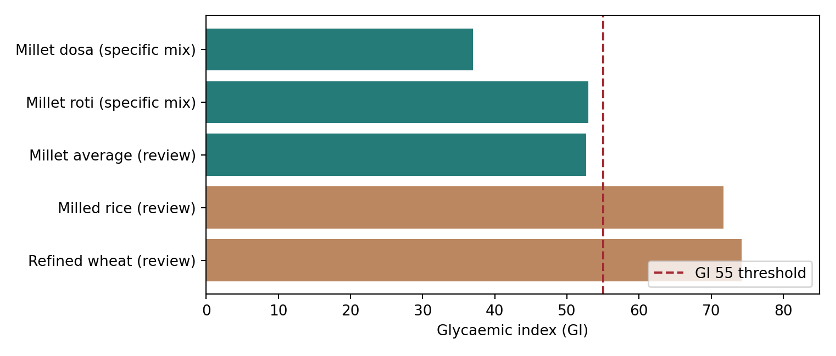
FIGURE 2. Review averages and individual recipe results are shown together for context, not as head-to-head tests. Sources: Anitha et al.
The fair objection
A brand would say the blend matters more than any single claim, and that a roti is never eaten alone. Both points have some support. A 2024 review in Food Chemistry: X (Naveed and colleagues) reports that adding legume flour to bakery products lowers their glycaemic index, by up to 25% in its abstract and by 20 to 30% in its highlights. That is legume flour inside the product, not dal on the side. No trial we found tests a khapli-millet blend against ordinary whole wheat atta.
What it means
• Food brands and MSME founders. Lead with what is verified: whole grain, coarse stone-ground, milling date on the pack. Do not print "low GI" or "diabetic-friendly" without a lab GI test, and have any health claim cleared against FSSAI rules before it goes on a label.
• Buyers managing blood sugar. The best evidence comes from small, short trials. Portion size and the rest of the plate matter alongside the flour; check diet changes with a doctor or dietitian. Khapli contains gluten and is unsuitable for coeliac disease or wheat allergy.
• Retailers and distributors. Whole stone-ground flour has a shorter shelf life than refined flour. Print the milling date, state the storage conditions, and set a use-by date that matches them.
The call
We have moderate confidence that "whole grain, coarsely milled" is the one claim in this category an Indian flour brand can defend today, and low confidence in any claim that credits khapli or freshness with a glycaemic benefit. A controlled trial of khapli-millet atta against ordinary whole wheat atta, with glucose measured, would change our view in either direction.