What the case establishes
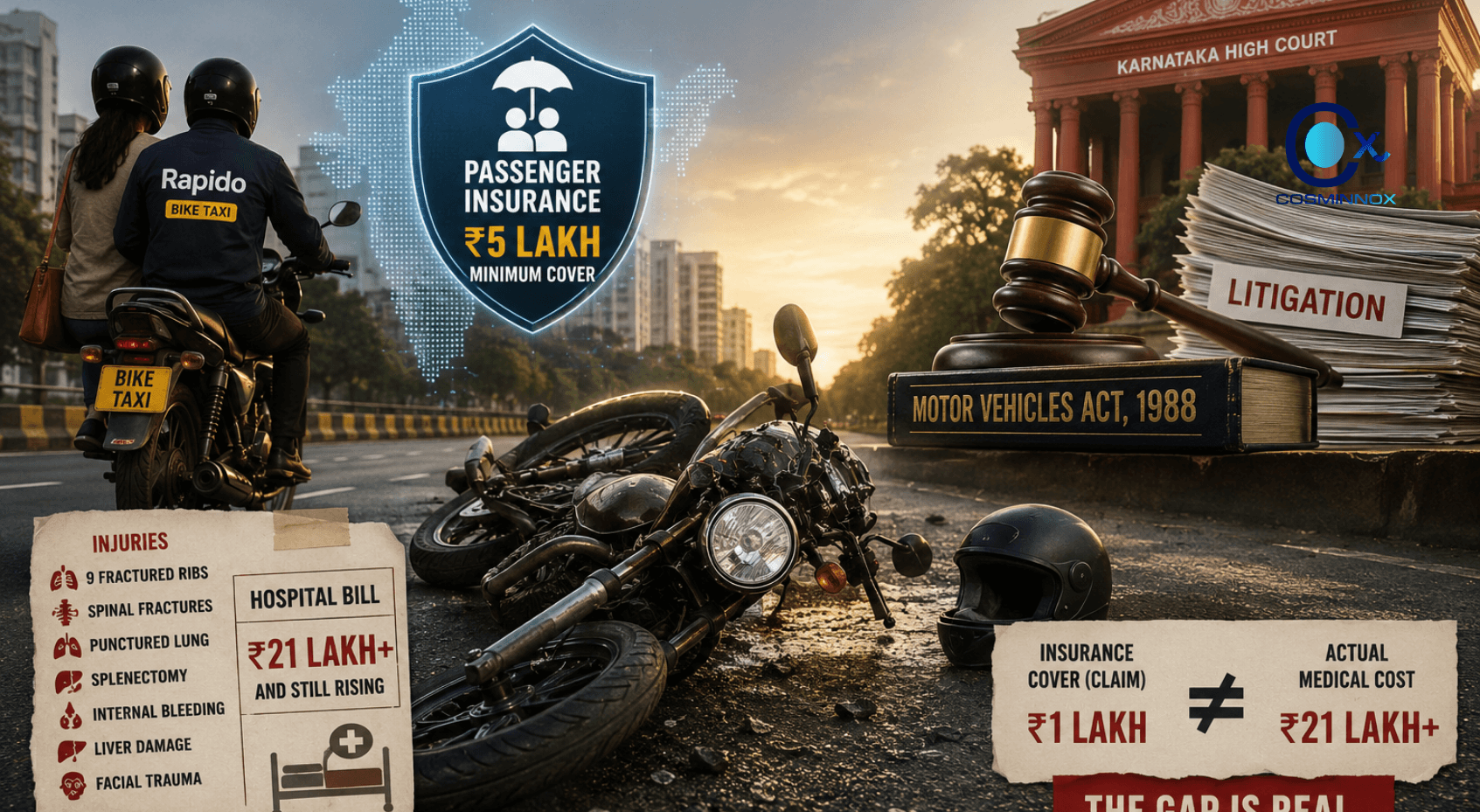
Sani Krishna, a 32-year-old interior designer, booked a Rapido bike taxi near her home on the morning of June 17. Roughly 300 metres into the ride, the rider allegedly attempted to overtake a tractor, lost control, and the bike went down; Krishna was run over by the tractor's rear tyre. The rider did not stop — she was taken to hospital by bystanders TOI Lifestyle Desk, Times of India, Aug 26, 2026. Her injuries, per that same account, included nine broken ribs, spinal fractures, a punctured lung, severe internal bleeding, a spleen that had split and required full removal, liver damage, and facial trauma requiring reconstructive surgery. An earlier round of coverage citing seven fractured ribs — via Newskarnataka and a widely circulated X thread — appears to have understated the injury; the nine-rib figure comes from Krishna's own account as reported by TOI and is treated here as the better-sourced number, though it remains self-reported rather than confirmed against a discharge summary.
Krishna's advocate sent Rapido a legal notice on August 6 seeking an apology and full compensation. Rapido's initial position was that its standard rider-and-passenger insurance policy, offered through a third-party insurer, capped claims at ₹1 lakh. A Newskarnataka report dated August 16 said Rapido had told the outlet it would process her full eligible medical expenses without applying that cap — but the same report noted that Krishna said Rapido "had not yet directly communicated its decision to her," and that she considered her fight for accountability unresolved Newskarnataka, Aug 16, 2026. TOI's account, published ten days later on August 26, is consistent with that gap rather than contradicting it: Krishna describes Rapido's corporate team going silent, redirecting her toward a third-party microinsurance claim process instead of direct compensation, and ignoring the legal notice — after which she announced she would pursue the matter in Consumer Court. Read together, the two reports describe a company that told the press it would pay before it told the claimant, and had not, as of the later date, actually resolved her claim.
The national mandate
The Ministry of Road Transport and Highways issued the Motor Vehicles Aggregator Guidelines, 2025 on July 1, 2025, updating the 2020 framework issued under Section 93 of the Motor Vehicles Act, 1988. Among its provisions: a minimum passenger insurance cover of ₹5 lakh is mandatory for aggregators operating under the guidelines MoRTH, Motor Vehicles Aggregator Guidelines 2025, official PDF. The 2025 guidelines also formally permit state governments to authorise private motorcycles for passenger service through aggregator platforms — the first time bike taxis have had an explicit place in the national framework, rather than existing in the regulatory space the 2020 guidelines left undefined.
Two things follow from the guidelines' own structure. First, the ₹5 lakh figure is a floor set for aggregators operating under a state-issued licence — it is not self-executing nationwide law that attaches automatically to every ride on every platform. Second, the guidelines explicitly delegate to states the decision of whether and how to bring bike taxis into that licensed category at all.
Where Karnataka stands
The timeline is now confirmed. A single-judge bench of the Karnataka High Court ruled on April 2, 2025 that bike taxis could not operate unless the state notified rules under Section 93 of the Motor Vehicles Act, 1988; enforcement of that ban began June 16, 2025 Deccan Herald, "Bengaluru: Bike taxis likely to stop operating from June 16," 2025. Aggregators appealed. On January 23, 2026, a division bench of Chief Justice Vibhu Bakhru and Justice C.M. Joshi set aside that order, calling the blanket ban an unreasonable restraint on trade, and directed the state to register motorcycles as transport vehicles and issue contract carriage permits Medianama, "Karnataka files appeal challenging the bike taxi ban lift in the Supreme Court," Apr 2026. Karnataka did not accept that outcome: by April 28, 2026, the state had filed a Special Leave Petition before the Supreme Court, arguing motorcycles are not legally "transport vehicles" and that permits should not be issued at all — a position it maintained through at least early August 2026, citing motorcycles' lack of passenger-safety features relative to autos and cabs Inventiva, "Karnataka Takes Ola, Uber And Rapido To The Supreme Court Over Bike Taxis And Passenger Safety". As of that same reporting, the SLP had not been listed for hearing, and the High Court's order remained in effect — meaning bike taxis could legally operate in Karnataka on June 17, 2026, the date of Krishna's ride Sansalegal, "Karnataka Bike Taxi Ban: High Court Lifts Prohibition, State Appeals to Supreme Court," Apr 2026.
Legal to operate is not the same as licensed and insured under a completed state framework, though. The High Court's January order directed the state to register motorcycles as transport vehicles and issue contract carriage permits — it did not itself constitute that registration. And the state government whose transport department would issue those permits was, at the same time, telling the Supreme Court that motorcycles should not be classified as transport vehicles at all. A government actively litigating against the premise of bike-taxi permits is not a government that had, in the interim, quietly finished issuing them. No source found for this piece confirms that Karnataka's Regional Transport Authority had completed permit issuance to Rapido, or notified state-specific bike-taxi insurance rules, by June 17, 2026 — and the state's own Supreme Court filings suggest the opposite was more likely true. That is the condition under which the MVAG 2025's ₹5 lakh passenger-insurance floor is supposed to attach; on the available evidence, it had not yet attached in Karnataka when Krishna was injured.
Counter-evidence
Two points cut against reading this as a clean, fully established regulatory failure. First, this is one case, and the ₹1 lakh cap Rapido initially cited was described as its "standard policy" — it is not established here whether that policy predates or departs from any Karnataka-specific terms that would apply once a licensing regime is completed. Second, the account of regulatory limbo here rests on the absence of confirming evidence (no source found states the RTA had issued Rapido a contract carriage permit or notified insurance rules by June 17, 2026) rather than a direct statement that it hadn't — an absence of proof is not proof of absence, and the Karnataka Transport Department has not been asked directly for this piece.
Krishna's claim, relayed via TOI, that "hundreds" of other riders responded to her post describing similar experiences of corporate silence and ignored legal notices is worth noting as a signal that this may not be an isolated incident — but it is a self-reported, crowd-sourced claim with no independent verification of scale or individual cases, and is treated here as exactly that: a claim, not an established pattern.
Policy options
Other states have approached the same underlying problem — a national floor with no automatic mechanism to reach the ground — differently. None of the following is presented as the fix; each is one jurisdiction's or one commentator's choice, sourced separately.
Maharashtra: a separate, dedicated bike-taxi licence. Rather than fold bike taxis into its general aggregator rules, Maharashtra drafted standalone Bike-Taxi Rules, 2025 alongside its broader Motor Vehicle Aggregator Rules, 2025, with public comment closing in October 2025 newsonair.gov.in, "Maharashtra Drafts Motor Vehicle Aggregator Rules 2025," Oct 2025. The draft sets passenger travel insurance at a mandatory ₹5 lakh, requires driver domicile certificates and government-issued badges, and funds enforcement through a per-ride state fee plus a 2% welfare-fund contribution from aggregators Outlook India, "Why India's Bike-taxi Boom Is Running Into A Legal Roadblock," Aug 2026. The state announced permits would issue from August 1, 2026 [same source]. The approach trades speed (a separate track for a fast-growing category, rather than waiting on a single omnibus process) for the administrative cost of running two licensing regimes in parallel.
Delhi: restrict the category to reduce the risk surface. Delhi's Motor Vehicle Aggregator Scheme 2023 covers cab aggregators broadly and explicitly promotes electric bike taxis as part of that scheme, framed around passenger safety and emissions together The Tribune, "Policy regulating cab aggregators, delivery service providers approved," May 2023; more recent reporting describes Delhi as permitting bike taxis only when electric Policy Circle, "Bike taxi regulation needs a common framework across India," Aug 2026. Narrowing eligible vehicles narrows the regulatory and insurance question to a smaller, more uniform fleet, at the cost of excluding the petrol two-wheelers that make up most of the existing bike-taxi supply.
A federal-floor proposal: make the MVAG a binding minimum, not a permissive ceiling. Policy Circle, a policy-commentary outlet, has argued that the Centre should convert the Motor Vehicle Aggregator Guidelines from a framework states may adopt into a common regulatory floor — so that "what insurance must be held and what protection applies if an accident occurs" would not vary by whether a state has gotten around to notifying its own rules, while leaving fares, congestion policy, and electrification schedules to remain state-specific Policy Circle, Aug 2026. This is a named outlet's argument, not a government proposal, and is attributed here as exactly that.
Precedent for state-level legalisation: Goa. Goa legalised bike taxis in 1981 and remains the earliest example of a state building a licensing regime around the category; 21 states and union territories now have some form of bike-taxi guidelines, with uptake and enforcement uneven across them 360info, "How new bike-taxi guidelines can solve India's urban mobility crisis," Jul 2025. Goa's example shows the category can operate under a stable state framework for decades; it does not, by itself, resolve what happens in states where that framework has not yet been settled.
What the evidence supports
On the available record, Krishna's ride was legal — the Karnataka High Court's January 2026 order was in effect and unstayed on June 17, 2026. But legal to operate and licensed under a completed state framework are different things, and the evidence points toward the latter not having happened: the state government whose transport department would issue bike-taxi permits and attach insurance conditions was, at the time, actively arguing before the Supreme Court that such permits should not be issued at all. Where that licensing step is incomplete, a passenger's actual insurance recourse appears to depend on whatever an aggregator's standard policy happens to offer — in this case, ₹1 lakh against ₹21 lakh in bills — and, beyond that, on how much public pressure a case attracts and how a company chooses to respond to it, rather than on a clear, standing entitlement to the ₹5 lakh floor MoRTH has set nationally. This is a bounded claim: it describes a structural gap in how a national mandate reaches a state whose bike-taxi licensing regime remains, as of this writing, unresolved and under litigation — not a finding that Rapido broke a specific law.
Correction protocol: figures and claims in this piece — particularly the rib-fracture count (nine, per Krishna's own account, superseding an earlier seven-rib figure), the status of Karnataka's bike-taxi permit issuance as of June 17, 2026 (inferred from the absence of confirming evidence, not a direct departmental statement), Krishna's unverified claim of "hundreds" of similar cases, and the status of Maharashtra's draft Bike-Taxi Rules and permit timeline (draft/proposed as of the sources used, not confirmed as finalised or in force) — should be treated as flagged above. Any further update will be added as a dated note rather than a silent edit.