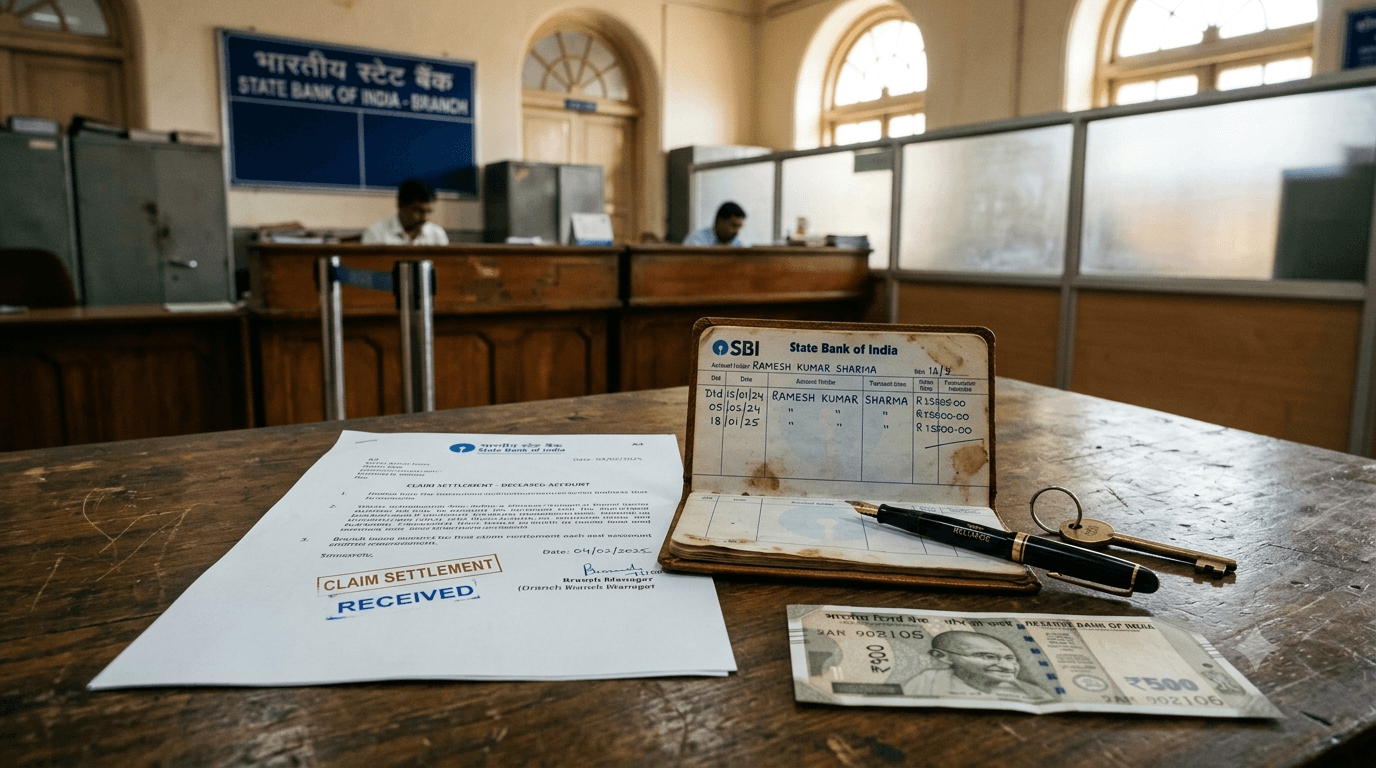
The question. Do the Reserve Bank of India's 2025 Directions on deceased-customer claims replace discretionary bank practice with fixed, checkable rules? On the text, mostly yes for the deposit-and-nomination pathway, with narrower limits elsewhere. The Directions fix a time limit, a document list and a compensation formula. They leave three matters to banks or to later data: the threshold above which surety may be demanded, what counts as delay "attributable to the bank," and whether compliance is actually happening.
1. What the instrument is
On September 26, 2025, RBI issued the Reserve Bank of India (Settlement of Claims in respect of Deceased Customers of Banks) Directions, 2025 (RBI/2025-26/82) [RBI, Circular Index, Id=12901, Sept 26, 2025, link]. The Directions say they respond to "divergent practices" among banks and aim to standardise documentation (Introduction). They apply to all commercial and co-operative banks, but not to Government savings schemes such as SCSS and PPF (para 6). Implementation is due "as expeditiously as possible but not later than March 31, 2026" (para 5), a date that has now passed. They repeal 16 earlier notifications and circulars dated between 1985 and 2021 (Annex II).
2. The fixed elements
Timeline. A bank must settle a deposit claim within 15 calendar days of receiving all required documents (para 31). For lockers and safe custody, the 15 days apply to processing the claim and fixing an inventory date with the claimant, not to handing over the contents (para 32).
Compensation. For deposits, delay "attributable to the bank" attracts interest of not less than the prevailing Bank Rate plus 4% per annum on the settlement amount, counted from the date all documents were received (para 33). For lockers and safe custody, compensation is ₹5,000 per day of delay (para 34).
Standard forms. Banks must use the standard forms in Annexes I-A to I-H, and make them available at all branches and on their websites (paras 27–28). A claimant may lodge a claim at any branch against an acknowledgment. Where documents are complete, the bank must issue a confirmation, and where they are incomplete it must list what is missing (para 29). Online lodgement and tracking are optional for banks ("may"), not mandatory (para 30).
3. Two pathways, two evidentiary burdens
With a nominee or survivorship clause. Payment to the nominee or survivor is a valid discharge of the bank's liability, subject to identity checks, no restraining court order, and written notice that the nominee receives the money as trustee of the legal heirs (paras 8–9). The bank "shall not insist" on a succession certificate, letter of administration, probate, or any indemnity or surety bond, "irrespective of the amount." It may ask only for the claim form, the death certificate and the nominee's Officially Valid Document (para 9).
Without a nominee or survivorship clause. The requirements depend on the claim amount (para 10):
• At or below the threshold: the "threshold limit" is ₹15 lakh for banks other than co-operative banks and ₹5 lakh for co-operative banks, "or such higher limit as may be fixed by the bank" (para 7(h)). The simplified procedure applies only where there is no Will, no contesting claim and no restraining order (para 10). Documents are the claim form, death certificate, claimant's identity proof, a bond of indemnity, any disclaimer letters from non-claimant heirs, and a legal heir certificate or an independent person's declaration. No third-party surety may be taken.
• Above the threshold: the bank settles on a succession certificate, or a legal heir certificate, or a notarised affidavit. It "may also call for" a third-party surety bond (para 10(b)).
• Wills and disputes: claims involving a Will need probate or a letter of administration, though banks may use discretion where the Will is undisputed and genuine (para 11(a)). Disputed claims need probate, a letter of administration, a succession certificate or a court order, and a court restraint suspends the claim while it is in force (para 11(b)).
4. Counter-evidence and open points
The 15-day clock starts late. It runs from receipt of "all the required documents" (para 31), not from the date of death or the first application. The Directions require banks to confirm in writing when documents are complete (para 29). That confirmation therefore fixes the start of the compensation period.
Compensation is conditioned. Interest is payable for delay "attributable to the bank" (para 33). The Directions do not define attribution. Banks must communicate reasons for delay, but the text does not say who decides disputed attribution.
The interest formula is a floor. The rate is "not less than" Bank Rate plus 4% (para 33). The Directions do not state a ceiling or a specific rate in force. Readers should check the current Bank Rate on RBI's website.
Thresholds can move upward. Banks may set a higher limit than ₹15 lakh or ₹5 lakh (para 7(h)). Claimants at different banks may therefore face different document burdens at the same claim amount.
Coverage gaps. Government savings schemes are excluded (para 6(b)). Missing-person claims follow a separate route requiring a court order under Sections 110 or 111 of the Bharatiya Sakshya Adhiniyam, 2023, with an FIR and non-traceable report accepted for amounts below ₹1 lakh or a higher bank-set limit (para 15).
5. What the evidence establishes, and what it does not
The RBI text establishes a uniform, checkable rulebook. It sets one document list for nominee claims, one for simplified non-nominee claims, one timeline and two compensation formulas. It also establishes that a nominee's claim cannot lawfully be conditioned on legal-succession documents.
It does not establish outcomes. This draft did not locate primary data on settlement times, delay-compensation payouts or claimant complaints since the March 31, 2026 implementation date. A follow-up piece could use RBI's Ombudsman reporting or bank disclosures, subject to confirming that such data exist and are broken out by claim type.
Sidebar: What the Directions specify for each pathway
Summary of the documents RBI's text names, by claim type. Paragraph numbers refer to the Directions. Banks may fix a higher threshold than the ₹15 lakh / ₹5 lakh defaults (para 7(h)). Claimants should check their bank's published list of documents (para 28).
Pathway (RBI para) | Documents the Directions specify | Conditions and limits |
Deposit: nominee or survivor (paras 8–9) | Claim form (Annex I-A); death certificate; nominee/survivor's Officially Valid Document. | No succession certificate, letter of administration, probate, or indemnity/surety bond, irrespective of amount. |
Deposit: no nominee, up to threshold, simplified (para 10(a)) | Claim form (I-B); death certificate; claimant's OVD; indemnity bond (I-C); disclaimer from non-claimant heirs (I-D), if applicable; legal heir certificate OR independent person's declaration (I-E). | Applies only if no Will, no contesting claim, no court restraint. No third-party surety. |
Deposit: no nominee, above threshold (para 10(b)) | Succession certificate plus claim form, death certificate, OVD; OR legal heir certificate / notarised affidavit (I-E) plus documents at para 10(a)(i)–(v). | Bank "may also call for" a third-party surety bond (I-C). |
Deposit: undisputed Will (para 11(a)) | Probate or letter of administration, plus claim form, death certificate, OVD. | Bank may act on the Will without probate if satisfied it is genuine and undisputed; it then adds the bond and disclaimer. No third-party surety (para 11(c)). |
Deposit: contesting claim or dispute (para 11(b)) | Probate, letter of administration, succession certificate, or court order/decree, plus claim form, death certificate, OVD. | A court restraint suspends the claim while in force. |
Locker/safe custody: nominee or survivor (paras 18–21) | Claim form (I-A); death certificate; OVD. Inventory (I-F) in presence of witnesses. | No legal documents or indemnity bond unless there is a discrepancy in nomination. |
Locker/safe custody: no nominee, simplified (paras 23, 25) | Claim form (I-B); death certificate; OVD; disclaimers (I-D); legal heir certificate or affidavit (I-E). Inventory (I-F); valuation and bond of indemnity (I-H). | No succession certificate, letter of administration or court order in simplified cases. Safe-custody articles use inventory form I-G. |
Endnotes
1. Reserve Bank of India, Reserve Bank of India (Settlement of Claims in respect of Deceased Customers of Banks) Directions, 2025, RBI/2025-26/82, DoR.MCS.REC.50/01.01.003/2025-26, September 26, 2025. Circular page | PDF. Paragraph references throughout are to this document.