
India’s 14 October 2026 approval of Fairfax Financial Holdings’ bid for IDBI Bank is best understood not as one transaction, but as three interlocking restructurings at different stages of completion.
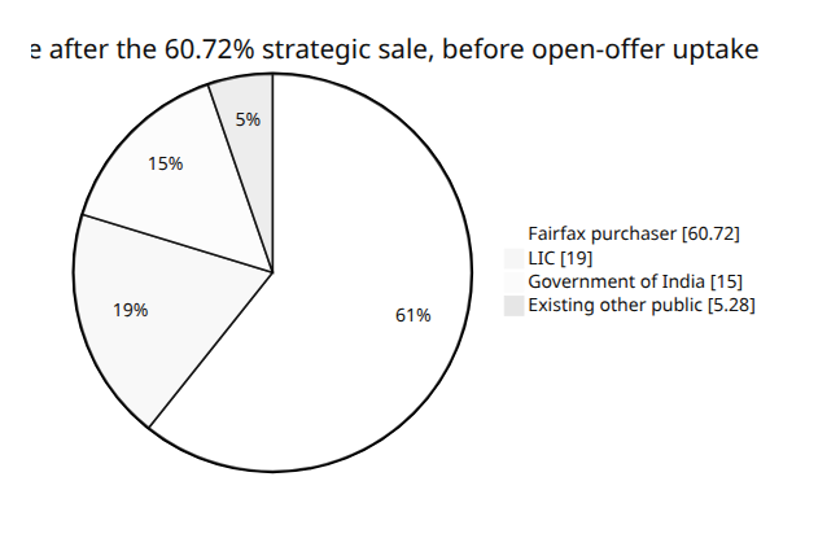
First, the Cabinet Committee on Economic Affairs has selected 10955230 Canada Inc., a wholly owned subsidiary of Canada’s Fairfax Financial Holdings Ltd (FFHL), as strategic buyer of 60.72% of IDBI Bank for ₹52,878.08 crore, or ₹81 per share. The Government of India will sell 30.48 percentage points and Life Insurance Corporation of India (LIC) 30.24 points, leaving them initially with 15% and 19%, respectively. Crucially, this is still an approved sale rather than a completed acquisition: Fairfax must re-present its credentials to the Reserve Bank of India (RBI), submit a regulatory-compliance roadmap, enter definitive agreements and complete the takeover/open-offer process. The government has said it hopes to close by March 2027. [1]
Second, the transaction changes the bank’s governance more radically than the residual 34% government-plus-LIC economic holding might suggest. The Finance Ministry says both existing state-linked shareholders will cease to have board nominees and will become public shareholders. LIC’s already disclosed SEBI reclassification conditions go further: its voting rights are capped at 10%, it cannot exercise control or enjoy special rights, it cannot have a board nominee, and it must reduce its residual 19% stake to 15% or less within two years of closing. Fairfax, meanwhile, may economically own more than 60%, but the Banking Regulation Act/RBI framework caps any individual shareholder’s exercisable voting rights at 26%. [2]
Third, and analytically distinct from the government sale, Fairfax proposes a much broader financial-conglomerate restructuring. FFHL intends to contribute its interests in Go Digit General Insurance and Go Digit Life Insurance, while Fairfax India Holdings Corporation (FIH) intends to contribute its interest in IIFL Capital Services, to IDBI Bank. Fairfax envisages IDBI becoming the group’s Indian banking, insurance, investment-banking and wealth-management hub. These contribution transactions have not been definitively agreed and require separate RBI, SEBI and, for Digit, IRDAI approvals; Fairfax expressly says the IDBI acquisition can proceed without either contribution. [3]
That distinction matters for the financial analysis. The ₹52,878-crore purchase is fundamentally a secondary share sale: the consideration goes to the Government of India and LIC, not into IDBI Bank’s regulatory capital. On a proportional basis, the government would receive about ₹26,544 crore and LIC about ₹26,335 crore. Only subsequent primary capital raising or an appropriately structured contribution of Digit/IIFL assets could directly enlarge IDBI’s capital resources. The terms, valuations, consideration mechanics and pro-forma regulatory-capital consequences of those contributions are not yet public. [4]
The sale is occurring from a position of dramatically greater financial strength than the distressed IDBI that entered the RBI’s Prompt Corrective Action framework in 2017. At 30 June 2026, IDBI reported a 26.92% capital adequacy ratio, 26.38% CET1 ratio, 2.30% gross NPA ratio, 0.16% net NPA ratio and 99.31% provision-coverage ratio including technical write-offs. By comparison, its capital ratio was only 6.22% in September 2018, its net NPA ratio was 17.3%, and its provision coverage 69%. The present transaction is therefore more accurately a change of ownership of a rehabilitated bank than a foreign-led rescue of an insolvent institution. [5]
The FDI structure is legally possible because IDBI has been classified by the RBI as a private-sector bank since 21 January 2019. Foreign investment in a private-sector Indian bank may reach 74%; up to 49% is under the automatic route and investment above 49% to 74% requires the government route, while at least 26% of paid-up capital must remain resident-held. RBI approval is separately required once an investor reaches the 5% major-shareholder threshold, with continuing fit-and-proper scrutiny. Fairfax’s announced 60.72% — or potentially up to 66% if it acquires the old 5.28% public float contemplated in the original disinvestment documents — fits within the 74% ceiling. [6]
The deal nevertheless creates an unusual economic ownership/control asymmetry. Fairfax could initially hold more than three-fifths of the equity but exercise no more than 26% of shareholder votes. DIPAM has said it must ultimately dilute its equity holding to 26% over a 15-year glide path. Fairfax also has to resolve its approximately 40% interest in CSB Bank within two years — by a route such as merger or disposal — although CSB said on 15 October that no merger discussions were then under way. The publicly available RBI materials do not yet include a transaction-specific final approval order spelling out these conditions; that document will be important for assessing the true allocation of control. [7]
For India, the transaction is both a privatisation milestone and a test of its willingness to accept foreign-controlled domestic banking franchises. It follows Emirates NBD’s completed 60% acquisition of RBL Bank in June 2026, while Reuters also points to sizeable Japanese investment in Indian financial institutions. The IDBI transaction differs materially from RBL: Emirates NBD put approximately US$2.75 billion of new primary capital into RBL, whereas Fairfax’s ₹52,878-crore IDBI purchase initially transfers value to the two selling shareholders. [8]
Geopolitically, the Canadian identity of Fairfax makes the transaction unusually visible. India and Canada have been rebuilding a relationship that had been severely strained: high commissioners were restored in August 2025, Prime Ministers Narendra Modi and Mark Carney launched a renewed strategic and commercial relationship, CEPA negotiations are intended to conclude by end-2026, the governments aspire to CAD70 billion/₹4.65 lakh crore of bilateral trade by 2030, and the finance ministers opened a dedicated economic and financial dialogue in August 2026. Approval of one of India’s largest foreign financial-sector investments to a Canadian group therefore has substantial signalling value, although there is no evidence that the banking approval itself was a diplomatic quid pro quo. [9]
For policymakers, the principal task is now to make the regulatory architecture around the transaction as transparent as the bidding process claims to have been. In particular, India should publish or clearly disclose the final RBI ownership-and-dilution conditions, make the open-offer mechanics transparent, insist on independent valuations and robust related-party safeguards for any transfer of Fairfax-controlled Digit/IIFL assets into IDBI, and require pro-forma capital, concentration and stress disclosures before those contributions are approved. For foreign investors, the central lesson is that India is increasingly willing to permit majority foreign economic ownership of banks, but ownership, voting power, promoter status and operational control are four different regulatory concepts and should never be modelled as interchangeable.
What was approved and how the transaction evolved
IDBI’s 2026 transaction is the culmination of a decade-long transformation from state-supported problem bank to private-sector regulated lender. The RBI placed IDBI under Prompt Corrective Action on 5 May 2017 because of poor asset quality and losses. In 2018 the Cabinet approved LIC’s acquisition of a controlling 51% stake; following that acquisition, the RBI categorised IDBI as a private-sector bank for regulatory purposes with effect from 21 January 2019. Government and LIC subsequently recapitalised it, and the RBI lifted PCA restrictions on 10 March 2021 after its financial health improved. [10]
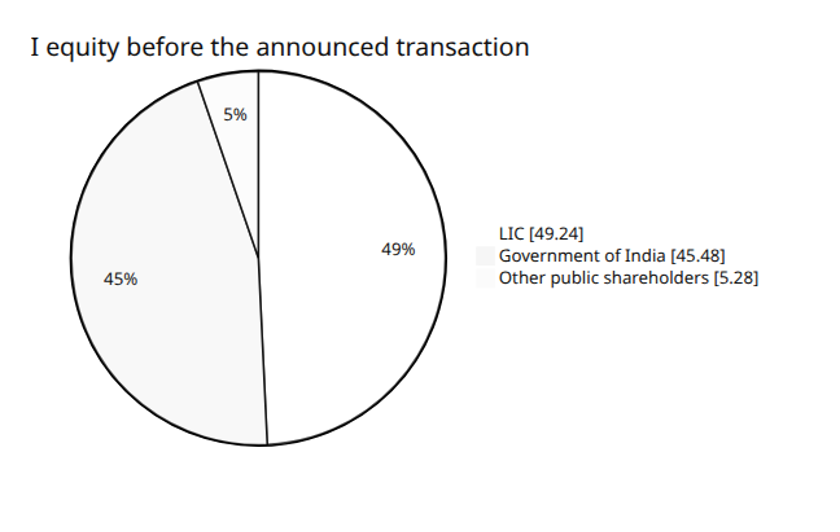
The political decision to transfer management control pre-dates the Fairfax bid by more than five years. On 5 May 2021, the CCEA gave in-principle approval for strategic disinvestment and transfer of management control. At that point, LIC held 49.24%, the government 45.48%, and the two together controlled more than 94% of equity. The government expressly argued that a strategic buyer should bring capital, technology and management practices, reduce future dependence on government/LIC support, while public proceeds could be used for development expenditure. LIC, for its part, had resolved to relinquish management control while taking account of valuation, market conditions, regulatory obligations and policyholder interests. [11]
The formal sale process began with the Preliminary Information Memorandum and expression-of-interest invitation on 7 October 2022. Five parties submitted expressions of interest; four qualified, after eligibility checks including RBI fit-and-proper screening and Ministry of Home Affairs security clearance, but only two submitted final techno-financial bids. [12]
The first financial bidding round, in FY2025–26, did not succeed. The government had fixed a reserve price of ₹94.42 per share, while IDBI’s market price immediately before the January 2026 invitation stood at ₹108.12. Both initial bids fell below the reserve. DIPAM subsequently invited “best offer” bids in FY2026–27. The Finance Ministry argues that IDBI’s narrowly traded market price had become too volatile and transaction-affected to be a reliable benchmark — ranging from ₹61.01 to ₹118.38 during its valuation period — and therefore based its revised benchmark on two independent methods: relative valuation using banking market multiples and asset valuation using IDBI’s 31 March 2026 accounts. Their average produced ₹75.99 per share. Fairfax’s ₹81 bid was 6.6% above that benchmark. [12]
Reuters reported that IDBI closed at ₹90.44 on 14 October, meaning the negotiated ₹81 consideration was about 10.4% below that day’s quoted market price. That does not mathematically contradict the government’s assertion that ₹81 exceeded its ₹75.99 fair-value benchmark: the two figures answer different valuation questions and use different reference dates. Fairfax, in turn, describes ₹81 as approximately a 23% premium to IDBI’s 30 June 2026 book value under Indian accounting standards. These competing reference points explain much of the public controversy over whether the state obtained an adequate price. [13]
The Cabinet decision is consequently a major milestone, not closing. Fairfax itself states that no binding definitive agreements for either the IDBI purchase or its subsequent Digit/IIFL contributions had been entered into as of its 14 October announcement, and that completion remains conditional on governmental, regulatory and other approvals. DIPAM Secretary Arunish Chawla told CNBC-TV18 on 15 October that the intended sequence is RBI clearance, signing of the share-purchase agreement, the mandatory open-offer process and then closing, with March 2027 the government’s target rather than a guaranteed date. [15]
Ownership, key actors and governance
A frequent source of confusion is the term “Fairfax”. The IDBI buyer is not Fairfax India Holdings Corporation itself. The approved strategic buyer is 10955230 Canada Inc., whose parent is FFHL. Fairfax India Holdings Corporation, or FIH, is a separate Fairfax investment vehicle; it is relevant because FIH’s IIFL Capital interest is proposed to be transferred into IDBI. FFHL’s interests in the Digit insurance businesses are separately proposed for contribution. Keeping those entities distinct is important for FDI, related-party and valuation analysis. [4]
The headline ownership shift is straightforward before accounting for open-offer acceptances.
Shareholder | Pre-transaction equity | Announced immediately after 60.72% sale | Later announced/regulatory direction | Governance significance |
LIC | 49.24% | 19.00% | Must fall to ≤15% within two years of closing | Ceases to be controlling promoter; no board nominee; public-shareholder status; disclosed voting-right cap of 10%. [16] |
Government of India | 45.48% | 15.00% | CCEA has authorised subsequent open-market disposal of residual holding | Withdraws board nominees and becomes public shareholder; no management control. [17] |
Existing non-promoter public | ~5.28% | ~5.28% before open-offer tenders | Could decline if shareholders tender to Fairfax | Original disinvestment documents contemplated an open offer for this public float; current final offer documentation is not yet populated. [18] |
Fairfax purchaser | 0% | 60.72% | Potentially up to ~66.00% if the entire old 5.28% float were acquired; ultimately to be diluted to 26% under the reported RBI glide path | Incoming strategic owner/promoter; economic ownership substantially exceeds permitted voting power. [19] |
The hypothetical 66% figure is a scenario rather than the announced final shareholding: 60.72% plus the entire pre-existing 5.28% public float. The actual result will depend on the open-offer documents and shareholder tenders. The historical 2022 pre-EOI response explicitly anticipated an offer for the 5.28% public holding; as of 16 October 2026, IDBI’s open-offer page lists the relevant document categories but does not provide enough populated information to establish final uptake or final Fairfax ownership. [18]
The actors’ motivations differ substantially.
Actor | Core motivation and constraints |
Government of India / Finance Ministry / DIPAM | Complete a long-running privatisation, monetise a rehabilitated investment, end expectations of recurring fiscal support, transfer operational control to a private strategic investor, and use a high-profile foreign transaction to reinforce India’s reform and FDI narrative. The Finance Ministry explicitly says it expects private capital, technology and management practices and describes the transaction as positive for the investment climate. [20] |
LIC | Exit management control, comply with insurance/banking ownership constraints, release some capital and protect policyholder value. Its SEBI reclassification conditions expressly prevent control, board representation and special rights after completion. [16] |
Fairfax Financial Holdings | Secure a majority economic interest in a sizeable Indian banking franchise and turn it into the anchor of an integrated financial-services platform spanning banking, insurance, investment banking and wealth management. Fairfax explicitly cites India’s growth, banking penetration and cross-selling opportunity. [3] |
Fairfax India Holdings | FIH is not the IDBI acquirer; its role arises from the proposed transfer of its IIFL Capital investment into IDBI, potentially monetising/reorganising that holding inside the wider Fairfax Indian financial platform. [21] |
RBI | Protect bank safety and soundness, scrutinise ultimate ownership and funding, enforce fit-and-proper requirements, prevent unconstrained voting control and manage overlapping bank ownership — particularly Fairfax’s CSB Bank position. [22] |
IDBI Bank management | Obtain stable private-sector ownership without disrupting a successful turnaround. Fairfax proposes continuity under current MD & CEO Rakesh Sharma, with C.V.R. Rajendran joining the leadership group and N.S. Kannan proposed as chairman, subject to RBI approval. [3] |
Minority shareholders | Obtain fair exit optionality through the takeover process while retaining protections on valuation, related-party transactions, disclosure and governance. Their economic exposure is complicated by future supply from government, LIC and ultimately Fairfax dilution. [23] |
Governance changes are at least as important as percentage ownership.
Governance issue | Before restructuring | Announced/expected after closing |
Promoter/control | LIC promoter with management control; Government of India co-promoter. [11] | Fairfax becomes strategic controlling shareholder; GoI and LIC are to be treated as public shareholders. [24] |
Government/LIC board representation | Government and LIC nominees represented on IDBI board. IDBI’s public materials currently identify government and LIC nominees. [25] | Both withdraw nominees. LIC’s reclassification terms expressly prohibit a board nominee. [26] |
Fairfax economic ownership | None | 60.72% baseline, subject to open offer and eventual dilution. [12] |
Fairfax voting power | None | Banking law/RBI framework caps exercisable voting rights at 26%, notwithstanding a larger equity stake. [27] |
LIC voting power | Controlling shareholder position | SEBI reclassification approval caps LIC’s effective voting rights at 10%. [28] |
Management | Rakesh Sharma, MD & CEO | Fairfax proposes Sharma remain MD & CEO; N.S. Kannan as chairman and C.V.R. Rajendran in leadership, subject where applicable to RBI approval. [3] |
Group structure | Stand-alone IDBI franchise plus its existing subsidiaries/associates | Fairfax proposes IDBI as parent/platform for its Digit and IIFL Capital interests; proposal is separate and conditional. [3] |
CSB Bank overlap | Fairfax separately owns roughly 40% of CSB | DIPAM says Fairfax must merge CSB into IDBI or otherwise exit its CSB position within two years of IDBI closing; chosen route is not yet decided. [29] |
One implication is that the often-repeated statement that “the government and LIC will still own 34% and therefore retain a blocking stake” is too crude. Economic ownership and voting rights must be separated. LIC will initially own 19% economically but, under its disclosed reclassification conditions, may exercise only 10% of effective votes; the government will own 15%. Their combined economic interest is 34%, but their disclosed maximum voting position is therefore materially smaller. Fairfax presents the mirror image: more than 60% economic ownership but no more than 26% voting rights. [30]
The architecture can be visualised as follows. Solid arrows represent the approved share sale; dashed relationships are proposed or conditional rather than completed. [15]
Regulatory architecture: FDI, bank ownership and minority protection
The most important legal point is that IDBI is not treated as a public-sector bank for RBI regulatory classification. The RBI categorised it as a private-sector bank with effect from 21 January 2019 after LIC obtained a controlling 51% holding. That classification is what makes the Fairfax transaction feasible under the substantially more liberal private-bank foreign-investment ceiling rather than the more restrictive regime applicable to public-sector banks. [25]
Under the applicable foreign-investment framework for private-sector banking, aggregate foreign investment may reach 74% of paid-up capital, with investment up to 49% under the automatic route and investment beyond 49% through 74% requiring government approval. At least 26% of paid-up capital must at all times be resident-held, apart from the separate framework for a wholly owned subsidiary of a foreign bank. RBI rules also make clear that foreign ownership limits do not displace banking-law approval requirements. [31]
Regulatory layer | Relevant rule | Application to Fairfax–IDBI |
FDI sectoral ceiling | Private-sector banking permits aggregate foreign investment up to 74%; ≤49% automatic, >49–74% government route; resident holding must remain at least 26%. [31] | Fairfax’s 60.72% is below 74% but above the automatic-route threshold. Initial GoI+LIC residual ownership alone is 34%, comfortably above the resident minimum. |
RBI major-shareholder approval | Anyone intending to become a major shareholder at 5% or more requires prior RBI approval and fit-and-proper due diligence; RBI may impose conditions. [32] | CCEA selection does not substitute for final RBI approval. Fairfax must re-submit credentials and a compliance roadmap. [12] |
Promoter ownership | RBI’s 2023 ownership framework establishes a long-run promoter ceiling of 26%, with higher holdings possible pursuant to permitted/approved dilution arrangements. [33] | DIPAM says Fairfax will have a 15-year glide path to reduce from the initial majority holding to 26%. The transaction-specific final RBI order is not yet publicly available. [34] |
Voting rights | No shareholder in a banking company may exercise more than 26% of total voting rights on a poll. [27] | Fairfax’s 60.72%+ economic holding does not translate into equivalent shareholder votes. |
SEBI takeover regime | Acquisition of control/a large stake in a listed company triggers the SAST framework, public announcement/open-offer procedures and offer-price safeguards. Current regulations were last amended in December 2025. [35] | DIPAM says an open offer must occur after the SPA. The 2022 disinvestment response contemplated acquisition of the then 5.28% public float through that process. [36] |
LIC reclassification | SEBI has conditionally approved LIC’s conversion to public shareholder status, subject to no control, no special rights, no board seat, 10% maximum effective voting rights and reduction to ≤15% equity within two years. [28] | The residual 19% LIC stake should not be interpreted as continuing promoter control. |
Insurance / securities businesses | Bringing regulated insurance and capital-market businesses under a bank requires sector-specific approvals and prudential compliance. | Fairfax itself says Digit/IIFL contributions require RBI and SEBI approvals and that Digit additionally needs IRDAI approval. [3] |
A subtle issue is the 15-year Fairfax dilution period. RBI’s general 2023 ownership directions describe a 26% long-run promoter ceiling using a framework historically developed around a bank’s commencement of business. IDBI, obviously, is not a newly established bank. Nevertheless, DIPAM has publicly said Fairfax will be permitted/required to follow a 15-year path from this acquisition towards 26%, and Prem Watsa has similarly described a 15-year timetable. The 2022 government response to prospective bidders had already signalled that the incoming investor would face a glide path to 26%. [37]
For legal certainty, the transaction-specific RBI approval should therefore be treated as the authoritative document once issued. At present, public reporting tells the market the broad destination — 26% — and timetable, but not all intermediate milestones, control undertakings, related-party restrictions or circumstances in which RBI could accelerate or alter that path. This is an important disclosure gap rather than evidence that the structure is unlawful. [38]
There is also a significant FDI-cap interaction with Fairfax’s proposed asset contributions. The initial IDBI purchase is relatively straightforward: even if Fairfax acquired the full historic 5.28% minority float, its direct equity could reach about 66%, still below 74%, while resident GoI and LIC would together retain 34%. But if IDBI were subsequently to issue new shares to foreign Fairfax entities as consideration for Digit and/or IIFL Capital, the foreign-equity percentage could rise. Conversely, a cash purchase, share swap involving different counterparties or another regulatory structure would produce different consequences. Fairfax has disclosed only that the assets would be contributed at their respective market prices and in accordance with applicable law; it has not disclosed the consideration mechanics. [39]
That is why the FDI issue cannot be resolved simply by saying “60.72% is below 74%”. The proper denominator after any contribution must include all newly issued IDBI equity, while the numerator must reflect aggregate foreign investment from all relevant sources. Future government/LIC sales also have to be monitored against the continuing 26% resident-capital requirement. RBI, the government and IDBI will therefore need to manage the foreign-ownership calculation dynamically over the entire restructuring, rather than only at the first closing. [31]
CSB Bank creates a second ownership complication. Fairfax presently has a major holding in CSB while seeking strategic control of IDBI. According to DIPAM’s Secretary, the RBI fit-and-proper conditions require Fairfax to merge CSB with IDBI or exit its CSB holding within two years of the IDBI transaction’s closure. Reuters reported that CSB said on 15 October it was not then engaged in merger discussions. The existence of a deadline is therefore firmer than the choice of remedy. [29]
For minority investors, the open offer is one safeguard, but not the only one. The more consequential long-term issue may be governance of future related-party transactions. If Fairfax, after becoming IDBI’s controlling shareholder, causes the bank to acquire assets from FFHL or FIH, valuation and board independence become central. Fairfax promises market-price transfers, but an arm’s-length market valuation, independent-director scrutiny, regulator review and any shareholder approvals required under applicable listing and related-party rules will be essential to demonstrate that value is not being shifted from IDBI’s minority shareholders to its controlling group. Fairfax itself recognises that the contribution transactions require a separate suite of approvals. [3]
Financial implications for IDBI Bank
The most important accounting point is simple: the announced ₹52,878.08-crore transaction does not, by itself, recapitalise IDBI. Fairfax is buying existing shares from GoI and LIC. The bank is the subject of the transaction, not the recipient of the purchase consideration. This differs sharply from a preferential allotment or rights issue in which fresh cash enters the bank. [12]
On the announced 30.48/30.24 percentage-point split of the 60.72% sale, the proceeds work out to approximately ₹26,543.5 crore for the Government of India and ₹26,334.5 crore for LIC. The ₹52,878.08-crore consideration implies a 100% equity valuation of roughly ₹87,085 crore at the ₹81 transaction price. These are arithmetic implications of the disclosed consideration and share percentages rather than separately stated government estimates. [12]
The absence of direct primary capital is less concerning than it would have been during IDBI’s stress years because the bank enters the transaction with large capital and provisioning buffers.
Metric | Stress-era reference | Latest available pre-closing baseline | Immediate effect of the announced secondary share sale | Post-Digit/IIFL pro-forma |
Capital adequacy ratio / CRAR | 6.22% at Sept 2018; 11.58% at Mar 2019. [40] | 26.92% at 30 Jun 2026. [41] | No mechanical change solely because shares pass from existing shareholders to Fairfax. | Not disclosed; depends on legal form, purchase consideration, deductions/risk weights and consolidation treatment. |
CET1 ratio | Not provided on a directly comparable basis in the cited historical government release | 26.38% at 30 Jun 2026. [41] | No direct mechanical change from the secondary sale. | Not disclosed. |
Gross NPA ratio | Approximately 32% in 2018 according to Reuters. [42] | 2.30% at 30 Jun 2026. [41] | No direct change from change of shareholder. | No pro-forma estimate disclosed. |
Net NPA ratio | 17.3% at Sept 2018; 8.02% by Jun 2019. [40] | 0.16% at 30 Jun 2026. [41] | No direct change. | No pro-forma estimate disclosed. |
Provision coverage ratio | 69% at Sept 2018; 88% at Jun 2019. [40] | 99.31%, including technical write-offs, at 30 Jun 2026. [41] | No direct change. | No pro-forma estimate disclosed. |
Quarterly net profit | Bank was loss-making during the PCA-era stress underlying government intervention. [12] | ₹2,115 crore in Q1 FY2026–27, +5% year on year. [41] | Purchase consideration does not pass through IDBI earnings. | No combined forecast or pro-forma disclosed. |
Deposits | — | ₹3,25,757 croreat Jun 2026, +10% YoY. [43] | No mechanical balance-sheet change. | Synergy claims exist, but no audited forecast. |
Net advances | — | ₹2,58,968 croreat Jun 2026, +22% YoY. [43] | No mechanical balance-sheet change. | Fairfax expects growth benefits; no regulatory pro-forma supplied. |
These are the latest financial metrics available before this report’s 16 October cut-off. IDBI’s exchange notice schedules its board meeting for 17 October 2026 to consider results for the quarter and half-year ended 30 September 2026; those Q2 figures therefore cannot legitimately be treated as available in a report dated 16 October. [44]
The turnaround is central to assessing the price. The state and LIC absorbed considerable balance-sheet risk before selling control. In 2019 alone, the government approved a ₹4,557-crore capital infusion as its share of a ₹9,300-crore requirement, with LIC providing ₹4,743 crore. That intervention followed years of asset-quality deterioration and helped the bank clean up legacy exposures. The state is therefore selling an institution after much of the bad-loan recognition and recapitalisation burden has already occurred, which strengthens the case for particularly rigorous disclosure around valuation. [40]
The government’s defence of the ₹81 price has three elements: the original ₹94.42 reserve was influenced by what it describes as an “impacted” market price; initial bids did not meet it; and the later valuation exercise used independent market-multiple and asset-value approaches, producing ₹75.99. Fairfax’s ₹81 bid exceeded both individual independent estimates as well as their average. This supports the government’s argument that the price cleared its contemporaneous fundamental-valuation test. [12]
The counterargument is not that ₹81 failed that benchmark, but that benchmark selection itself matters. Reuters’ ₹90.44 market close on approval day was materially higher, and the original reserve had been ₹94.42. CNBC-TV18’s expert discussion highlighted both valuation uncertainty and the fact that a buyer paying for 60% economic ownership receives only 26% exercisable voting power, which could justify a control discount relative to a conventional unrestricted takeover. Expected future share sales by LIC, the government and eventually Fairfax itself may also create a supply overhang. [45]
The right analytical conclusion is therefore narrower than either “the bank was sold cheaply” or “the ₹81 price proves fair value”. The government obtained 6.6% more than its revised ₹75.99 benchmark, but the sale occurred below the contemporaneous listed price reported by Reuters. Whether taxpayers received optimal value depends on assumptions about liquidity, the reliability of IDBI’s traded price, control/voting restrictions, future capital needs, embedded real-estate value and the credible alternative of retaining the asset longer. The public releases provide enough information to explain the government’s valuation logic, but not the valuation-agency reports themselves. [46]
The proposed Digit and IIFL contributions could change the financial picture much more significantly than the initial share transfer. Fairfax says it intends to contribute the assets at market prices and create a one-stop financial-services platform, but it has not disclosed whether IDBI would pay cash, issue shares, use another instrument, or combine consideration forms. Each scenario has different consequences for IDBI’s liquidity, CET1 capital, foreign-ownership ratio, earnings, goodwill/intangibles, concentration limits and minority dilution. [3]
For that reason, no defensible “post-restructuring” capital-adequacy or NPA number exists yet. A table that simply carries 26.92% CRAR forward after combining IDBI, Digit and IIFL would create false precision. The only sound statement at present is that the secondary ownership transfer itself should not mechanically alter IDBI’s capital ratio or bad-loan ratios, whereas the later contribution transactions may do so materially depending on structure and prudential treatment. [47]
The RBL Bank comparator illustrates the distinction. Emirates NBD completed its 60% acquisition in June 2026 through an approximately US$2.75 billion primary preferential capital infusion, directly strengthening RBL’s balance sheet and capital adequacy. Fairfax’s IDBI purchase directs ₹52,878 crore to selling shareholders. The two deals may look superficially similar because both produce roughly 60% foreign ownership, but their immediate effects on bank capital are fundamentally different. [48]
Macroeconomic, investor-confidence and geopolitical implications
At the macro level, IDBI is evidence that India has moved beyond permitting only minority strategic foreign positions in significant domestic financial institutions. Reuters described the Fairfax transaction as India’s largest cross-border banking transaction and situated it alongside Emirates NBD’s majority RBL investment, Sumitomo Mitsui Banking Corporation’s investment in Yes Bank and Mitsubishi UFJ Financial Group’s investment in Shriram Finance. The pattern suggests that international financial groups increasingly view India not merely as a portfolio-allocation market, but as a jurisdiction in which regulated operating platforms can justify multi-billion-dollar strategic commitments. [42]
Yet the precedent is not one of unrestricted foreign bank control. India continues to place several layers between economic ownership and unfettered corporate power: government approval above the FDI threshold, RBI fit-and-proper assessment, the 26% shareholder voting ceiling, promoter-dilution requirements, resident-capital requirements, sector-specific supervision and constraints on overlapping financial holdings. The emerging model could therefore be described as “majority foreign capital under domestically bounded regulatory control”, rather than wholesale liberalisation. [49]
For investor confidence, successful completion would have three positive signalling effects. It would show that a strategic-disinvestment process launched in 2021 can eventually reach a large closing; demonstrate that India is willing to accept a Canadian-controlled investor in a sensitive banking asset; and confirm that majority foreign bank transactions are not confined to new primary-capital rescues such as RBL. The Finance Ministry itself explicitly presents the transaction as a positive signal for economic reform and India’s investment climate. [50]
There is a countervailing signal, however. A four-year sale process, failed initial valuation round, a complex split between ownership and voting rights, a 15-year dilution path, an unresolved CSB overlap and still-undisclosed definitive documentation demonstrate that strategic foreign investment in Indian banking remains highly negotiated and institution-specific. Sophisticated foreign investors should therefore avoid assuming that the headline 74% FDI ceiling functions as an unconditional ownership entitlement. RBI discretion over fitness, control, group structure and dilution remains decisive. [51]
The transaction also has unusual India–Canada significance. The bilateral relationship went through a major diplomatic rupture before beginning a calibrated reset in 2025. Canada appointed a new high commissioner to India in August 2025 as part of restoring diplomatic services, and the two governments subsequently described their approach as one of rebuilding stability and cooperation. [52]
The rapprochement accelerated in 2026. Canadian Prime Minister Mark Carney visited India from 27 February to 2 March — the first bilateral visit by a Canadian prime minister since 2018 — and the leaders launched/reaffirmed negotiations towards a Comprehensive Economic Partnership Agreement, aiming at completion by the end of 2026 and bilateral trade of CAD70 billion/₹4.65 lakh crore by 2030. [53]
In August, the finance ministers held the inaugural Canada–India Economic and Financial Dialogue. The statement specifically welcomed growing investment relations, the role of Canadian pension and institutional capital, and India’s readiness to start negotiating a bilateral investment treaty. On 13 October — literally the day before the IDBI approval — Canadian Trade Minister Maninder Sidhu and India’s Commerce Minister Piyush Goyal discussed accelerating CEPA negotiations during a Team Canada trade mission to India. On 15 October, Canadian Foreign Minister Anita Anand met Prime Minister Modi and again highlighted the expanding economic partnership. [54]
Against that backdrop, awarding a transaction of approximately US$5.6 billion to a Canadian group is a powerful commercial confidence signal. It demonstrates that the diplomatic reset is sufficiently advanced for a Canadian-controlled company to be selected for a strategic Indian banking asset after security clearance and regulatory screening. That is an inference from the timing and scale of the transaction, however; neither government has presented the IDBI decision as a political concession, and the Finance Ministry emphasises the competitive bidding and valuation process. [55]
A successful closing could also strengthen the argument for a bilateral investment treaty by demonstrating the size and regulatory sensitivity of Canadian capital already exposed to India. Conversely, renewed India–Canada political tensions would place a highly visible regulated financial investment in the middle of the bilateral relationship. That does not mean RBI would or should politicise prudential supervision; rather, it raises the value of predictable treaty, tax and regulatory arrangements that insulate long-duration investments from diplomatic cycles. The finance ministers’ August dialogue explicitly stressed stability and certainty for cross-border institutional investment. [56]
For India’s privatisation programme, IDBI may prove more consequential as a precedent in process design than as a fiscal transaction alone. It demonstrates that the state can first rehabilitate an institution, reduce direct control through an institutional domestic owner such as LIC, reclassify it as private for regulatory purposes, and subsequently transfer management to an international strategic investor while retaining temporary residual public holdings. That template will not automatically fit public-sector banks governed by different statutes and ownership rules, but policymakers and investors will study it closely. [57]
There is also a competitive implication. If Fairfax succeeds in placing banking, general and life insurance, investment banking and wealth management under an IDBI-centred umbrella, it could recreate — with important regulatory separations — the broad financial-services ecosystems already associated with major Indian private groups. Fairfax’s stated rationale is precisely that IDBI’s bank distribution can be combined with Digit and IIFL Capital’s products. That could increase competition and cross-selling efficiency, but it also increases conglomerate complexity and the need to police intra-group exposures and conflicts. [3]
Risks, contingencies and policy recommendations
The largest near-term risk is execution, not IDBI’s current solvency. CCEA has selected the buyer, but Fairfax itself stresses that the selection is not the final stage. RBI approval, the compliance roadmap, definitive contractual documentation and the open-offer process remain ahead. March 2027 is an official expectation, not a legally assured closing date. [15]
The broader restructuring carries a separate set of contingencies. Digit and IIFL may both be contributed, only one may be contributed, or neither may be contributed even if Fairfax buys IDBI. Fairfax expressly states that the purchase transaction can proceed independently. Analysts should therefore avoid valuing IDBI today as though a particular consolidated financial conglomerate already exists. [3]
CSB Bank is another branch point. Fairfax must resolve its position within two years, but the economic consequences of a merger and a sale are different. A merger would require valuation, exchange-ratio, capital, governance and integration analysis; a disposal creates market-price and buyer risk. As of 15 October, Reuters reported that CSB itself said there were no merger negotiations or discussions, making any assumed IDBI–CSB combination premature. [58]
The most consequential risks and appropriate responses are summarised below.
Risk / policy issue | Why it matters | Recommendation for Indian policymakers | Recommendation for foreign investors |
Final RBI conditions remain partly opaque | Headline 60.72% ownership does not reveal the full control, dilution, funding and group-structure constraints. [59] | Publish, to the maximum extent consistent with supervisory confidentiality, the final ownership glide path, voting restrictions and key structural conditions when approval is granted. | Price the asset using the regulatory rights actually granted, not the nominal equity percentage. |
Ownership/voting asymmetry | Fairfax may own >60% economically while voting no more than 26%; LIC may own 19% but vote no more than 10%. [60] | Require clear disclosure of voting arrangements and board-appointment rights in the final offer/SPA materials. | Model economic returns, shareholder votes, board rights and promoter status separately. |
Open-offer uncertainty | Final public tender participation can change Fairfax’s stake and minority composition. The live IDBI open-offer page does not yet provide completed documents. [61] | Ensure rapid publication of public announcement, detailed statement, offer price methodology and final acceptance data. | Do not assume either zero or full tendering until the offer documents are available. |
Digit/IIFL related-party valuation | Fairfax will control IDBI while proposing to transfer Fairfax-group assets into it. [3] | Require independent valuations, independent-board review, robust related-party safeguards and disclosure of fairness methodology. | Treat group asset injections as new transactions requiring separate diligence, rather than as automatic synergies from the IDBI purchase. |
Unknown regulatory-capital treatment | No public pro-forma CRAR/CET1 exists for the proposed combined structure. | Require pro-forma CET1, total capital, risk-weighted assets, concentration exposures and stress tests before approval of contributions. | Avoid capital-accretion assumptions until consideration and prudential treatment are disclosed. |
FDI-cap interaction | Initial 60.72–66% fits below 74%, but future Fairfax share consideration or other foreign ownership could change the aggregate percentage. [62] | Publish how aggregate foreign ownership will be calculated after any contribution and residual state sales; monitor the 26% resident floor continuously. | Build FDI headroom into transaction structures rather than treating 74% as unused capacity belonging solely to the promoter. |
CSB overlap | Fairfax cannot leave its banking interests indefinitely in the present configuration. [63] | Set transparent approval criteria for either merger or disposal and require clear treatment of minority shareholders in both banks. | Include two-year resolution costs and valuation risk in the investment case. |
Future share-supply overhang | LIC must reduce 19% to ≤15%; GoI has authority to sell its remaining 15%; Fairfax must ultimately reach 26%. [64] | Sequence sales to preserve market depth and avoid disorderly supply; communicate schedules where feasible. | Expect ownership dilution and increasing free float over a multi-year horizon rather than assuming the post-closing register is static. |
Valuation legitimacy | ₹81 exceeds the official ₹75.99 benchmark but was below the approval-day listed price reported by Reuters. [46] | Release fuller valuation methodology and, where legally possible, redacted valuation reports after closing to improve trust in future strategic sales. | Analyse transaction price, unaffected market price, book value and control restrictions separately. |
Conglomerate contagion/conflicts | Bank, insurance and securities activities have different risk profiles and regulators. [3] | Strengthen consolidated supervision, intra-group exposure limits, related-party governance and recovery/resolution planning. | Assess group capital and liquidity, not merely stand-alone subsidiary earnings. |
India–Canada political risk | The bilateral relationship is improving but has recently experienced serious disruption. [65] | Maintain prudential decisions on transparent, nationality-neutral criteria and advance investment-treaty certainty. | Use political-risk scenarios, treaty/tax structuring and diversified funding rather than assuming the 2026 diplomatic reset is irreversible. |
For Indian policymakers, the highest-priority recommendation is therefore disclosure before complexity. The initial privatisation can be understood from the government’s published documents; the more ambitious Fairfax conglomerate plan cannot yet be assessed with the same precision. Before IDBI acquires Digit or IIFL interests, policymakers should require a public transaction document showing the independent valuation of each asset, consideration to be issued or paid by IDBI, resulting Fairfax and aggregate foreign shareholdings, pro-forma regulatory capital, earnings effects, material intra-group arrangements, governance protections and stress scenarios. That would reduce the risk that a successful transparent privatisation is followed by a less transparent related-party reorganisation. [3]
Second, the RBI should make the control architecture legible. A banking shareholder with 60.72% equity but 26% voting rights is unusual for investors accustomed to conventional corporate takeovers. Disclosure should distinguish at least economic ownership, voting rights, board nomination rights, promoter status, veto/consent rights and dilution obligations. The same should be done for LIC and the government. LIC’s 2025 disclosure is a good model because it spells out its post-transaction restrictions in concrete terms. [30]
Third, policymakers should preserve the distinction between foreign capital and bank capital. Describing the ₹52,878-crore transaction as the largest financial-sector FDI is reasonable in cross-border investment terms, but it should not be allowed to create the impression that ₹52,878 crore is being injected into IDBI’s balance sheet. Fiscal proceeds to sellers and primary regulatory capital entering a bank have different macroeconomic effects. The Emirates NBD–RBL structure illustrates how consequential that distinction can be. [66]
For foreign investors, the broader lesson is equally clear. India’s banking market is becoming more accessible to international strategic capital, but the operative question is not simply “How much can I own?” It is: How much can I own, how much can I vote, for how long can I retain that ownership, what other financial businesses may I simultaneously control, what transactions require additional regulators, and how will the regulator treat my entire group? The Fairfax case demonstrates that all of those questions can have different answers. [67]
There are several material data gaps as of 16 October 2026. No signed definitive IDBI share-purchase agreement has been made public; the final transaction-specific RBI approval and detailed dilution schedule have not been located publicly; the open-offer terms and acceptance level are not yet available; Fairfax has not disclosed the precise consideration or share-exchange mechanics for the Digit and IIFL contributions; there are no pro-forma combined financial statements or capital ratios; and the CSB route remains undecided. IDBI’s September-quarter financial results are scheduled for board consideration on 17 October, one day after this report’s cut-off. [68]
One source caveat is also necessary: the request referred to CNBC and Reuters links as “provided”, but the URLs themselves were not visible in the prompt received here. For Reuters, this report matched the 14 October 2026 Reuters report on the government’s IDBI approval and the 15 October follow-up on Fairfax’s broader restructuring. For CNBC, it matched the 15 October CNBC-TV18 interview with DIPAM Secretary Arunish Chawla, reproduced by Moneycontrol, as well as CNBC-TV18’s analysis of valuation and voting-right issues. [69]
Key primary-source links for publication and fact-checking are the Ministry of Finance/PIB approval of the IDBI restructuring, the Finance Ministry FAQ, IDBI Bank’s FY2026–27 regulatory-disclosure page, IDBI’s open-offer page, IDBI’s investor-information portal, SEBI’s current Takeover Regulations, DIPAM’s strategic-disinvestment archive, and Fairfax’s official 14 October transaction announcement. The principal RBI framework is its 2023 Acquisition and Holding of Shares or Voting Rights in Banking Companies regime, under which major shareholders require prior approval, promoter ownership is constrained over time and shareholder voting rights are capped at 26%. [70]
The central policy judgement is thus not whether India has simply “sold IDBI to Fairfax”. It has approved the first leg of a much larger transformation: from a once-distressed, state-supported institution to a foreign-majority economic franchise; from LIC/government control to a highly regulated private promoter structure; and potentially from a stand-alone commercial bank into a Fairfax-centred Indian financial conglomerate. The first transformation is now well defined. The prudential, FDI, governance and minority-shareholder quality of the second will depend on decisions that RBI, SEBI, IRDAI, the Finance Ministry, IDBI and Fairfax have yet to make public. [71]
[1] [4] [10] [12] [14] [17] [19] [46] [51] [55] [64] [71] Press Release Page | Press Information Bureau
https://www.pib.gov.in/PressReleasePage.aspx?PRID=2323318&lang=1®=48
[2] [24] [26] [50] [66] Press Release: Press Information Bureau
https://www.pib.gov.in/PressReleseDetailm.aspx?PRID=2323320&lang=1®=3&utm_source=chatgpt.com
[3] [15] [21] [39] [47] [68] Fairfax Declared “Strategic Buyer” in Auction to Acquire Interest in IDBI Bank; Plans to Contribute Digit Insurance and IIFL Capital to IDBI Bank - Fairfax Financial
[5] [40] Press Release Page | Press Information Bureau
https://www.pib.gov.in/PressReleasePage.aspx?PRID=1583954&lang=2®=48&utm_source=chatgpt.com
[6] [25] Personal & Corporate Banking | MSME & Agri banking - IDBI Bank
https://www.idbi.bank.in/idbi-bank-about-us.aspx?utm_source=chatgpt.com
[7] [34] [37] DIPAM Secretary outlines IDBI restructuring rules: 26% voting right cap for Canada Inc, 15-year glide path
[8] [48] Emirates NBD and RBL Bank announce the Successful Completion of the Landmark Strategic Investment | Emirates NBD
[9] [52] Minister Anand announces the appointment of Canada’s new High Commissioner to India - Canada.ca
[11] [16] [20] Press Release:Press Information Bureau
https://www.pib.gov.in/PressReleaseIframePage.aspx?PRID=1716212&lang=2®=48&utm_source=chatgpt.com
[13] [42] [45] [69] Canada's Fairfax buys majority stake in IDBI Bank for $5.56 billion
[22] [27] [32] [38] [59] [60] [70] Reserve Bank of India - Notifications
[23] [29] [36] [63] IDBI Bank-Fairfax deal expected to close by March 2027, RBI review and open offer next: DIPAM Secretary to CNBC-TV18
[28] [30] Microsoft Word - Disclosure_IDBI_Bank
https://www.licindia.in/documents/d/guest/disclosure_idbi_bank_24082025?utm_source=chatgpt.com
[31] [49] [62] [67] Reserve Bank of India - Notifications
https://www.rbi.org.in/scripts/FS_Notification.aspx?Id=11253&utm_source=chatgpt.com
[33] Reserve Bank of India - Publications
https://systemhealth.rbi.org.in/Scripts/PublicationsView.aspx_id%3D22349.html?utm_source=chatgpt.com
[35] SEBI | Securities and Exchange Board of India (Substantial Acquisition of Shares and Takeovers) Regulations, 2011 [Last amended on December 5, 2025]
[41] Idbi Bank Q1Fy27: IDBI Bank Q1FY27 net profit rises 3.3% to Rs 2007 crore - The Times of India
[43] IDBI Bank Q1FY27 result: Net profit rises 5% to ₹2,115 crore; NII up 10% | Company Results - Business Standard
[44] IDBI Bank Limited Share Price Today, Stock Price, Live NSE News, Quotes, Tips - NSE India
https://www.nseindia.com/get-quote/equity/IDBI/IDBI-Bank-Limited?utm_source=chatgpt.com
[53] India-Canada Joint Leaders’ Statement | Prime Minister of India
[54] [56] Inaugural Canada-India Finance Ministers’ Economic and Financial Dialogue - Canada.ca
[57] LIC to acquire controlling stake of IDBI Bank
https://www.pib.gov.in/newsite/PrintRelease.aspx?lang=2®=3&relid=181360&utm_source=chatgpt.com
[58] Fairfax plans to fold other Indian financial holdings into IDBI Bank
[61] Personal & Corporate Banking | MSME & Agri banking - IDBI Bank
https://www.idbi.bank.in/open-offer.aspx?utm_source=chatgpt.com
[65] Canada-India Joint Statement: Renewing momentum towards a stronger partnership - Canada.ca