The question this piece answers: On a comparable global yardstick, how do Mumbai, Delhi, and Bengaluru rank as economies against the world's largest cities — against China's fastest-growing metros, and against comparable emerging-market megacities in Southeast Asia, Latin America, and Central Asia?
The absence of an official baseline
Any comparison has to start with a caveat most coverage skips: India does not publish an official city-level GDP number. The Ministry of Statistics and Programme Implementation (MoSPI) compiles Gross State Domestic Product officially, but District Domestic Product estimation below the state level has used inconsistent methodology across states for years. A standardised national framework for compiling it was only released for stakeholder consultation in April 2026, explicitly meant to fix the comparability problem [MoSPI / The Policy Edge, "MoSPI Standardises District Domestic Product Estimation Under New 2022–23 Statistical Framework," 2026]. The city-GDP figures used in this piece are therefore not Indian government statistics — they are Oxford Economics' own modelled estimates, published with disclosed methodology in its 2026 Global Cities Index report. That is a materially different, more defensible source than the unsourced "Mumbai is a $310 billion economy" figures circulating in property and finance media, which this piece deliberately excludes.
Where the three cities actually rank today
Oxford Economics' 2026 Global Cities Index evaluates 1,000 cities worldwide across five categories — Economics, Human Capital, Quality of Life, Environment, and Governance — with New York and London again topping the overall rankings, followed by Paris, Seattle, San Francisco, Dublin, Boston, San Jose, Tokyo, and Zurich [Oxford Economics, Global Cities Index 2026, published 16 Sept 2026]. None of the three Indian cities comes close to that tier.
On the overall index: Delhi is India's highest-ranked city at 268th globally, an improvement of five places from the prior year, with its strongest category showing in Human Capital, where it ranks 13th globally — ahead of Toronto, Seoul, and Beijing on that measure. Bengaluru climbed 20 places to 311th and was named one of the index's "Cities to Watch" for the Asia-Pacific region. Mumbai ranks 330th overall, though it separately ranks 23rd globally for corporate headquarters presence — India's strongest single showing in any sub-category.
On pure economic size, Oxford Economics' own report gives precise figures. Bengaluru's 2025 city GDP is put at US$314 billion, with GDP per person of US$9,200 across a population of 14.5 million — placing it 176th globally on the Economics category specifically, but a weak 775th on Quality of Life. Delhi's city economy is currently the world's 63rd-largest by this measure, and is projected to climb to 14th-largest by 2050, with output crossing US$2 trillion. Mumbai's city economy, currently the world's 99th-largest, is projected to rise to 36th-largest by 2050. On growth rate, Bengaluru is forecast to be the 5th-fastest-growing city economy of the 1,000 in the index over the next five years, with real GDP expanding at an average annual rate of 9.2% between 2026 and 2030.
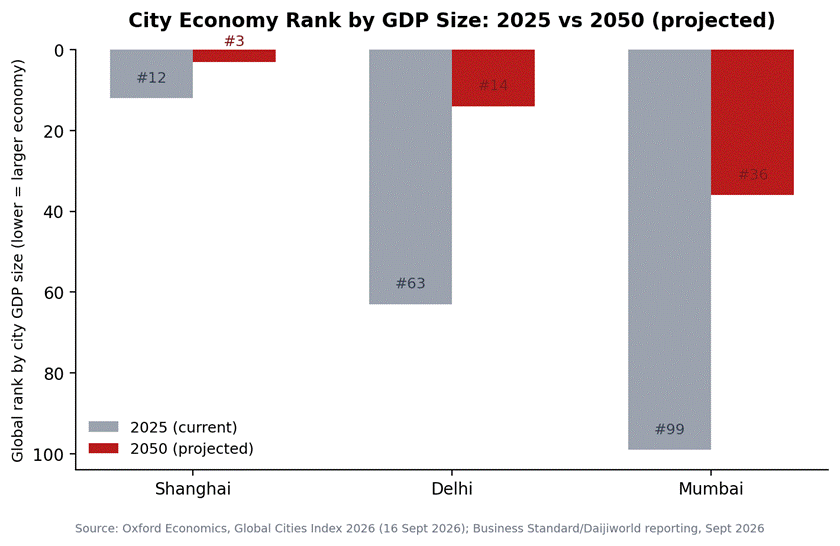
City Economy Rank by GDP Size: 2025 vs 2050 (projected)
Counter-evidence: the gap the growth numbers don't close
The same index is explicit that GDP momentum has not converted into overall competitiveness. Quality of Life is the weakest-performing category for Indian cities as a group — Bengaluru itself ranks 775th out of 1,000 on this measure despite its Economics-category strength — with the median Indian city ranking 850th out of 1,000, and Delhi recording the second-worst air quality score in the entire index. Among the 21 cities classified as "Global Leaders," none is Indian, and no Indian city appears on the index's Sustainable Cities, Legacy Cities, or Cultural Capitals lists. Oxford Economics attributes this directly to structural factors — air quality, income inequality, and educational attainment are named as what separates India's cities from their Asian peers, according to the report's lead economist for Asia-Pacific.
Beyond China: how India's cities sit against other emerging-market megacities
Coverage of this index has focused heavily on the China comparison, but Oxford Economics' own report explicitly widens the comparison set, naming fast-rising cities across Southeast Asia, Latin America, the Middle East, and Central Asia in the same "Cities to Watch" section as Bengaluru. A same-metric comparison across regions gives a fuller picture than a China-only frame.
On the overall composite index, several emerging-market peers already sit ahead of all three Indian cities: Kuala Lumpur (65th) is described by the report as "knocking on the door of the world's top 50," Shenzhen (93rd) is mainland China's top-ranked city, Lima (196th) leads Oxford Economics' Latin America picks, and Ho Chi Minh City (205th) has emerged as Vietnam's business and financial engine. Delhi (268th), Bengaluru (311th), and Mumbai (330th) sit behind all four, roughly in the same band as Monterrey, Mexico's industrial powerhouse (314th), and ahead of Tashkent, Central Asia's fastest-growing city economy (343rd).
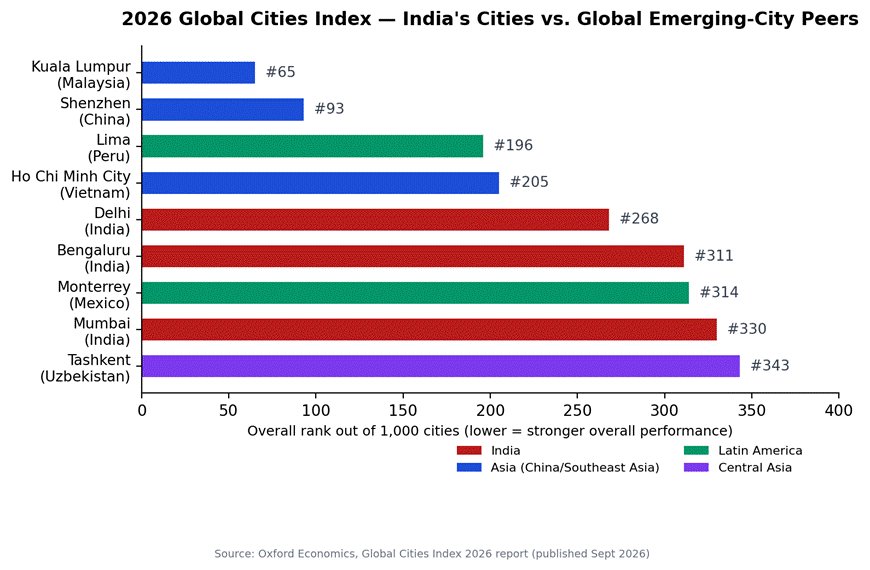
2026 Global Cities Index — India's Cities vs. Global Emerging-City Peers
The same pattern holds on raw economic size. Bengaluru's US$314 billion 2025 GDP is larger than Kuala Lumpur's (US$184bn), Lima's (US$152bn), Monterrey's (US$131bn), and Ho Chi Minh City's (US$128bn) — but well behind Shenzhen's US$572 billion, the city Oxford Economics explicitly names as Bengaluru's closest comparator on tech-led growth.
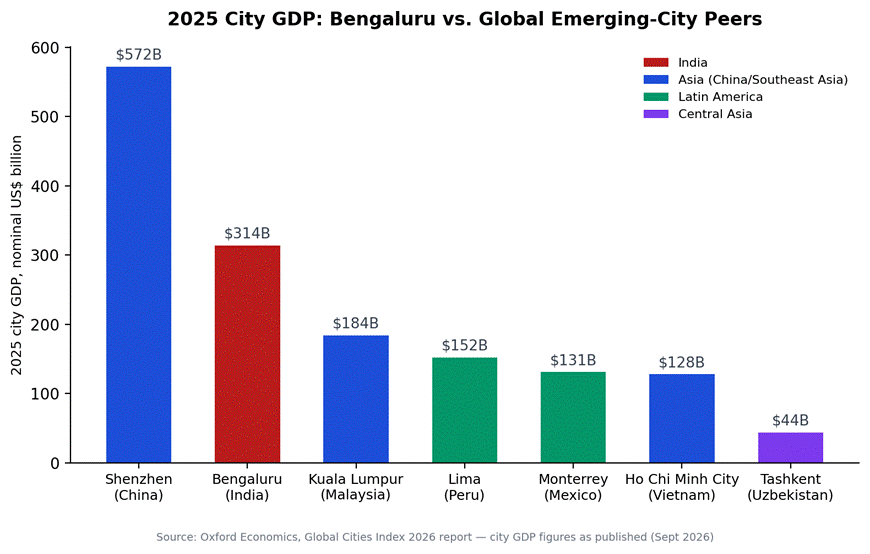
2025 City GDP: Bengaluru vs. Global Emerging-City Peers
What distinguishes the comparison is not scale but trajectory and sector mix. Kuala Lumpur has built a financial-services and data-centre economy over three decades and is now challenging Singapore regionally. Ho Chi Minh City's growth is trade- and manufacturing-led, benefiting directly from "China+1" supply-chain diversification, with exports growing more than 20% in recent years. Lima and Monterrey are growing on deep skills bases and nearshoring integration with, respectively, Peru's academic institutions and US manufacturing supply chains. Bengaluru's case for catching up rests specifically on IT services, R&D, and — per Oxford Economics — a forecast shift into "more advanced technology services such as R&D, Deep Tech, as well as AI," backed by a new state-planned AI city outside Bengaluru's urban area and Karnataka's 2025–30 IT policy.
The China comparison: what compressed catch-up actually looks like
China remains the sharpest illustration of how fast GDP-rank compression can happen, and Shanghai is the clearest single data point. In 2025, Shanghai ranked 12th globally by nominal city GDP at roughly US$780 billion — a quarter the size of San Francisco's economy as recently as 2000. By Oxford Economics' 2050 projection, Shanghai's GDP is set to more than quadruple to roughly US$3.26 trillion, moving it to 3rd place globally, just behind Los Angeles and narrowly ahead of Tokyo, with its GDP overtaking San Francisco's as early as 2027. By 2050, three Chinese cities — Shanghai, Beijing, and Shenzhen — are projected to sit inside the global top 10 by city GDP, compared with none today.
Set against that, Delhi's projected climb — 63rd to 14th by 2050 — and Mumbai's — 99th to 36th — describe real but slower compression than Shanghai's realised and projected trajectory, and neither reaches the absolute top tier Shanghai is set to occupy. Oxford Economics does draw one direct city-to-city comparison between an Indian and a Chinese peer: it names Bengaluru alongside Shenzhen specifically as a city positioned to capture rapid growth if it can convert its position in frontier technology into economic output — a comparison on tech-sector potential, not on current scale, given Shenzhen's GDP is currently nearly double Bengaluru's.
The larger picture
Strip away the percentages and projection years, and four things hold up.
One, the gap to the global top tier is still wide, and it isn't only a China gap. Kuala Lumpur, Shenzhen, Lima, and Ho Chi Minh City — cities from four different regions and income levels — all currently outrank Mumbai, Delhi, and Bengaluru on Oxford Economics' composite index. The comparison set that matters for India's cities is broader than the China narrative that dominates business-press coverage.
Two, the growth numbers are real and unusually broad-based for a single country. Fifty-five Indian cities in the global top 100 for GDP growth, and 23 in the global top 50, is not a statistic that shows up for most large economies. But growth rate alone hasn't been sufficient for peer cities either — Ho Chi Minh City and Tashkent both post strong growth yet remain well outside the top 100 overall, held back by the same Quality of Life and Governance weaknesses dragging on Indian cities.
Three, sector mix, not just growth rate, is what separates the cities already inside the top 100 from those still climbing. Kuala Lumpur built three decades of financial-services depth; Shenzhen built manufacturing-to-tech value-chain progression; Ho Chi Minh City is riding trade diversification. Bengaluru's bet — IT services moving into R&D, Deep Tech, and AI — is a comparable, plausible thesis, but it is a thesis, not yet a result reflected in the rankings.
Four, Shanghai remains the cautionary comparison as much as the inspiring one. Its climb from a quarter of San Francisco's size to overtaking it took a generation, arriving alongside sustained, centrally coordinated investment in infrastructure and export manufacturing — conditions that do not map neatly onto how Mumbai, Delhi, or Bengaluru have grown, or onto how Kuala Lumpur, Lima, or Ho Chi Minh City are growing either.
What the evidence supports, then, is a bounded claim: India's three largest cities are gaining ground faster than most global peers, on a ranking system that currently places them behind not just Chinese megacities but comparable emerging-market cities across three other regions, using projections that extend to 2050 — three decades in which India's own official city-GDP statistics, still being built by MoSPI, do not yet exist to check the private estimates against. Read the growth story with that qualification attached, not without it.
Sourcing note (digital): All figures above are drawn from Oxford Economics' Global Cities Index 2026 (published 16 September 2026) or MoSPI's April 2026 draft District Domestic Product framework, both timestamped in-text since city-GDP figures of this kind date quickly. Tier-3 aggregator figures for Indian city GDP were deliberately excluded from this draft. Hyperlinks to each cited source should be added before publish per the digital citation standard.