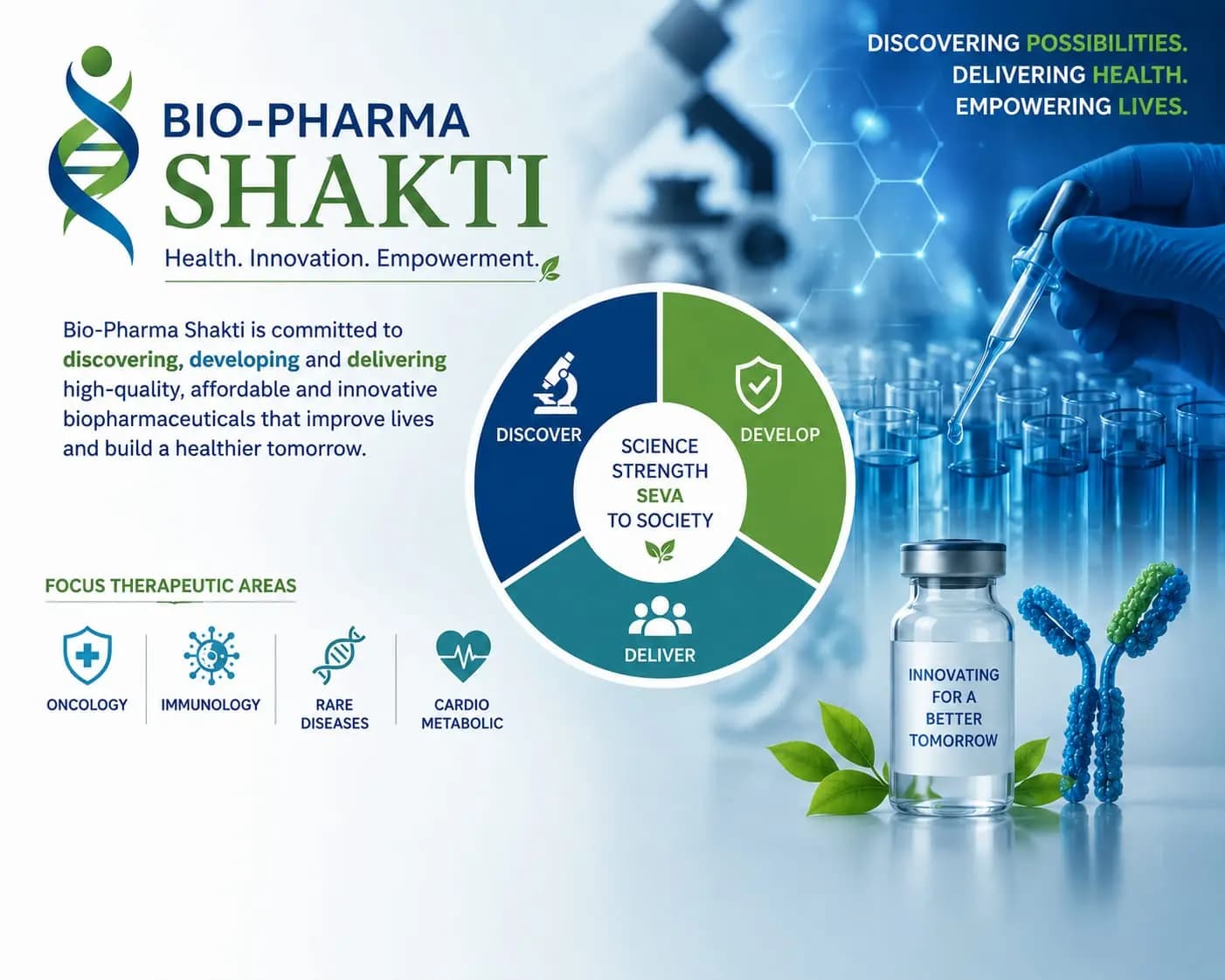
For decades India has worn the title of “pharmacy of the world” with quiet pride, built almost entirely on volume — cheap generics shipped to over a hundred countries. Indian pharmaceuticals rank third globally by volume, supported by more than three thousand companies and over ten thousand five hundred manufacturing units. But volume was never going to be the final chapter. The Union Budget 2026–27 signalled that shift decisively with the launch of Biopharma SHAKTI (Strategy for Healthcare Advancement through Knowledge, Technology, and Innovation), backed by ₹10,000 crore over five years, beginning FY 2026–27.
The logic behind the scheme is rooted in India's changing disease profile. As the country's burden shifts away from infectious disease toward non-communicable diseases such as diabetes, cancer, and autoimmune disorders, biologic medicines have become central to both longevity and quality of life. Unlike small-molecule drugs synthesised chemically, biologics are produced using living systems such as bacteria, yeast, or animal cells, and are structurally far larger and more complex than conventional medicines.
End-to-End Architecture & Pipeline
SHAKTI's architecture is deliberately end-to-end. It expands the country's specialised talent pipeline through three new National Institutes of Pharmaceutical Education and Research (NIPER) and the upgrade of seven existing ones, while simultaneously building a nationally accredited network of one thousand clinical trial sites under the Indian Council of Medical Research (ICMR). On the regulatory side, the Central Drugs Standard Control Organisation (CDSCO) is being reinforced through a dedicated Scientific Review Cadre to enable faster, globally credible approvals.
Industry Alignment and Market Scale
Industry leadership has responded with rare unanimity. Dr. Reddy's Laboratories chairman Satish Reddy called the scheme a key enabler for India's shift from volume-based generics leadership to value-driven global innovation in complex therapies, while Grant Thornton Bharat's Santosh Moses framed it as the moment India moves from being the world's “back-office pharmacy” to an innovation engine.
The ambition is measured against a steep climb. India's biopharmaceutical market is estimated at USD 8.95 billion in 2025, projected to reach USD 17.41 billion by 2033 at an 8.3 percent CAGR, even as the broader pharma sector aligns with the National Biopharma Mission's goal of a USD 100 billion biotech industry capturing five percent of the global pharmaceutical share.
Biopharma SHAKTI at a Glance
Parameter | Detail |
|---|---|
Outlay | ₹10,000 crore over 5 years (from FY 2026–27) |
New/Upgraded NIPERs | 3 new, 7 upgraded |
Clinical trial network | 1,000+ accredited ICMR sites |
India biopharma market (2025) | USD 8.95 billion |
Projected market (2033) | USD 17.41 billion |
Sector turnover, FY25 | ₹4.72 lakh crore |
Pharma exports (FY24–25) | USD 30.47 billion |
Global ranking (volume) | 3rd largest producer |
Call to Action
For investors, MSMEs, and institutions across the biopharma value chain, the window to engage with Biopharma SHAKTI's incubation, clinical research, and manufacturing pipelines is opening now. COSMINNOX invites stakeholders shaping India's biologics future to share their perspective for our continuing innovation series.
The Cosminnox • Data compiled from Press Information Bureau (PIB), ICMR registries, CDSCO operational outlines, NIPER development budgets, and corporate leadership briefs including disclosures from Dr. Reddy's Laboratories and industry advisories.