
The question: does JCR's upgrade to A- reflect a genuine return to the credit standing India held before 1991, or is it a narrower, one-agency signal that the market's three dominant raters have not matched?
WHAT JCR ACTUALLY SAID
On September 2, 2026, Japan Credit Rating Agency raised India's long-term foreign- and local-currency issuer ratings one notch, from BBB+ to A-, and lifted the country ceiling to A, while keeping the outlook Stable. The agency cited strong economic growth, resilient consumption, public investment and an improving financial system.
Indicator | Figure | Period |
Real GDP growth | 7.7% | FY2026 |
GDP growth forecast | >6% | FY2027 |
Nominal GDP | $3.9 trillion | FY2026 |
Gross NPL ratio (banks) | 1.8% | End-March 2026 |
Fiscal deficit (Centre) | 4.4% of GDP, down from 4.7% | FY2026 vs FY2025 |
Central government debt | 56.1% of GDP | End-FY2026 |
Table 1: Key macro indicators cited in JCR's ratings review [Source: JCR ratings statement, Sept. 2, 2026; Finance Ministry release]
JCR attributed the NPL improvement to the Insolvency and Bankruptcy Code, government capital injections and tighter RBI supervision, and expects the debt-to-GDP ratio to decline only gradually. The Finance Ministry's own framing stayed within JCR's language — solid growth, effective policy, an improved financial system — against what it called a challenging global backdrop.
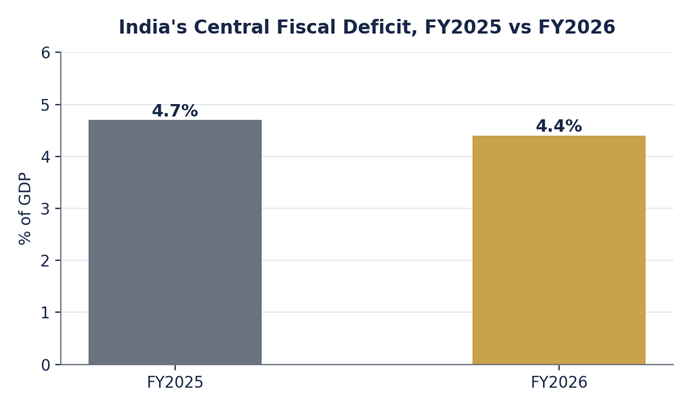
Chart 1: India's central fiscal deficit narrowed year-on-year, the trend JCR weighted most heavily. [Source: JCR ratings statement, Sept. 2, 2026]
WHEN INDIA LOST THE “A” GRADE — AND WHY
Moody's rated India A2 as recently as 1988. That rating was cut two notches to Baa1 in 1990. Political instability compounded the slide: Moody's placed India on a credit watch in mid-1990 amid unfolding turmoil, and the V.P. Singh government's fall that November was followed by a fragile minority government under Chandra Shekhar. By March 1991, with that government collapsing and elections pending, S&P cut India's long-term rating to BBB- from a 1990 peak of BBB. Weeks later, with reserves covering barely two weeks of imports, India sold 20 tonnes of gold with a repurchase option to raise emergency foreign exchange.
The structural cause was a widening trade deficit combined with a large fiscal deficit — a twin-deficit problem building since the mid-1980s — worsened by heavy foreign borrowing through the decade and the collapse of Eastern Bloc trade and rupee-settlement arrangements. The rupee was devalued in July 1991 under the IMF-backed stabilisation package that followed. India did not regain even the lowest investment grade with Moody's until roughly 2004, and only touched Baa2 — its best Moody's grade since 1988 — in 2017, before the pandemic-era downgrade pulled it back to Baa3 in 2020, where it still sits.
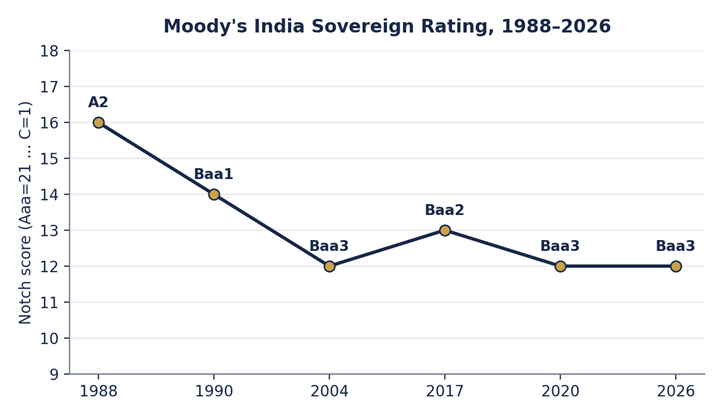
Chart 2: Moody's rating fell sharply after 1988 and has not fully recovered in 38 years. [Source: Moody's Investors Service actions, 1988–2026, as reported]
COUNTER-EVIDENCE: ONE AGENCY, NOT A CONSENSUS
JCR's A- is not shared by the market's larger raters. As of the most recent actions on record:
Agency | Current Rating | Outlook |
JCR | A- | Stable |
S&P | BBB | Stable |
Moody's | Baa3 | Stable |
Fitch | BBB- | Stable |
Table 2: Sovereign ratings across major agencies, September 2026. [Source: agency rating actions as reported]
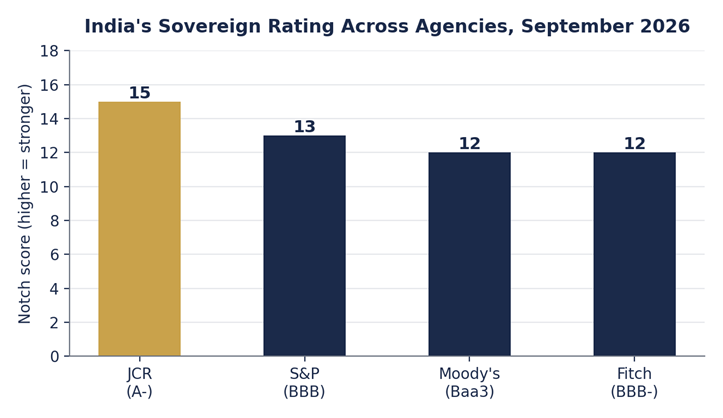
Chart 3: JCR's A- sits two to three notches above the other three major agencies. [Source: agency rating actions as reported]
JCR itself was at a comparatively cautious BBB+ as recently as its 2016 review, when it flagged productivity and export bottlenecks, deteriorating public-sector bank health, and unfinished fiscal consolidation — concerns it now treats as substantially addressed. The 56.1%-of-GDP debt figure JCR itself reports is a data point the larger agencies appear to weigh more heavily.
WHAT THE EVIDENCE SUPPORTS
JCR's upgrade is a genuine, sourced signal of improved fiscal and banking metrics relative to India's own recent past, and it does put one agency's assessment back in the band last occupied before the 1991 crisis. What it does not yet establish is a market-wide consensus: three of four major global raters still place India at or near the lowest investment-grade rung, two to three notches below JCR's new score. Whether JCR is ahead of the curve or an outlier will depend on whether S&P, Moody's and Fitch move in the same direction at their next review.
COSMINNOX · IDC Innovation Development Council, India