
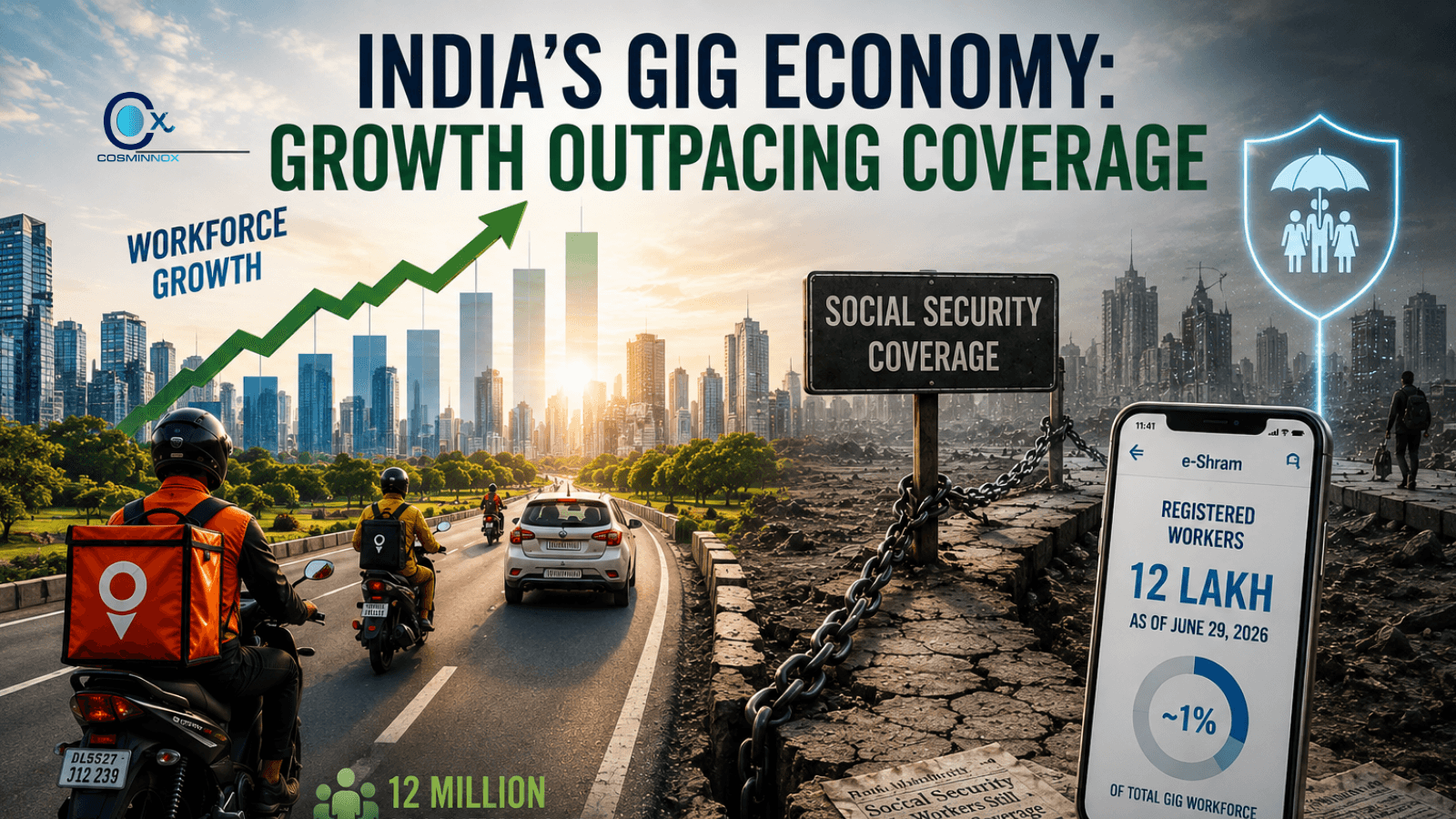
Has India's rapid gig-workforce expansion been matched by an equivalent build-out of social-security coverage, or has a formalisation gap opened between the two? Government data on workforce size and government data on scheme registration, read side by side, point to the latter: the workforce has grown steadily for five years, while the statutory registration mechanism meant to extend welfare benefits to it is less than two years into implementation and still covers a small share of that base.
The scale of the workforce
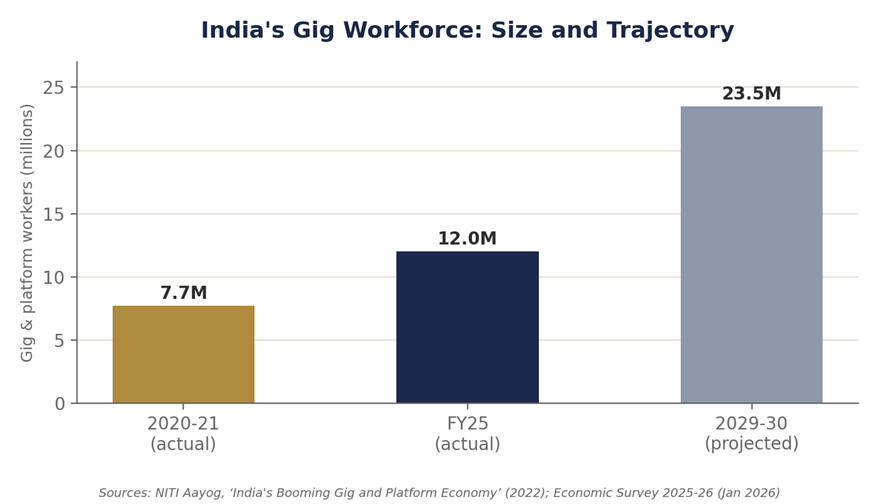
India's gig and platform workforce grew from 7.7 million workers in 2020-21 to 12 million in FY25, a rise of 55% over four years, now representing just over 2% of the total workforce [Economic Survey 2025-26, tabled January 29, 2026]. The Survey attributes the growth to smartphone penetration among over 800 million users and roughly 15 billion UPI transactions a month. Non-agricultural gig work is projected to reach 6.7% of the non-agricultural workforce by 2029-30, contributing an estimated ₹2.35 lakh crore to GDP [Economic Survey 2025-26]. NITI Aayog's 2022 baseline study projected the workforce would nearly triple from 7.7 million to 23.5 million by 2029-30, with the share of high-skilled gig workers reaching 27.5% and low-skilled workers 33.8% by 2030 [NITI Aayog, ‘India's Booming Gig and Platform Economy,’ June 2022, cited in Economic Survey 2025-26].
Metric | Value | Source |
Gig & platform workers, FY21 | 7.7 million | NITI Aayog, 2022 |
Gig & platform workers, FY25 | 12 million | Economic Survey 2025-26 |
Share of total workforce, FY25 | ~2% | Economic Survey 2025-26 |
Projected gig workforce, 2029-30 | 23.5 million | NITI Aayog, 2022 |
Projected share of non-agri workforce, 2029-30 | 6.7% | Economic Survey 2025-26 |
Projected GDP contribution, 2029-30 | ₹2.35 lakh crore | Economic Survey 2025-26 |
Projected high-skilled worker share, 2030 | 27.5% | NITI Aayog, cited in Economic Survey 2025-26 |
Projected low-skilled worker share, 2030 | 33.8% | NITI Aayog, cited in Economic Survey 2025-26 |
The social-security build-out
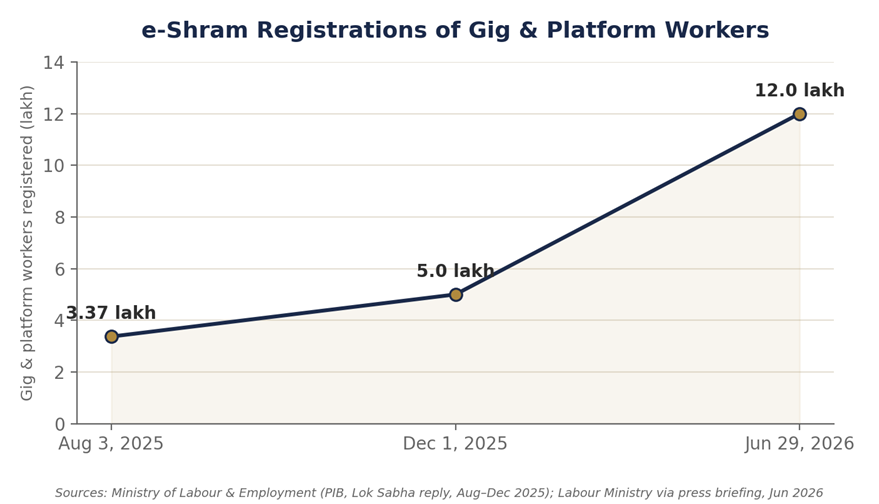
The Code on Social Security, 2020 was the first central law to define gig and platform workers and enable welfare schemes — life and disability cover, accident insurance, health and maternity benefits, and old-age protection — funded partly through aggregator contributions [Code on Social Security, 2020, Section 114]. The Code came into force on November 21, 2025, five years after enactment. Registration runs through the e-Shram portal, launched in August 2021, with a dedicated aggregator module added in December 2024. As of August 3, 2025, the Ministry of Labour and Employment reported 3.37 lakh gig and platform workers registered [Ministry of Labour and Employment, PIB, August 2025]. That figure rose to 5 lakh by December 1, 2025 [Lok Sabha written reply, December 1, 2025], and to 12 lakh workers with 20 aggregators onboarded by June 29, 2026 [Ministry of Labour and Employment, June 2026]. The Social Security Rules, 2026, notified on May 8, 2026, require aggregators to submit worker data via API within 45 days of the rules taking effect, and major aggregators — including Swiggy, Zomato, Uber, Ola, Rapido, Blinkit and Zepto — were set a June 21, 2026 deadline to complete registration [Ministry of Labour and Employment, via Times of India/Economic Times, June 2026].
Date | Milestone |
2020 | Code on Social Security, 2020 enacted — first central law to define “gig worker” and “platform worker” |
Aug 2021 | e-Shram portal launched for a National Database of Unorganised Workers |
Dec 12, 2024 | Aggregator module launched on e-Shram for platform-worker onboarding |
Nov 21, 2025 | Code on Social Security, 2020 formally brought into force |
May 8, 2026 | Social Security Rules, 2026 notified; aggregators required to submit worker data via API within 45 days |
Jun 21, 2026 | Deadline set for major aggregators (Swiggy, Zomato, Uber, Ola, Rapido, Blinkit, Zepto) to complete e-Shram registration |
Counter-evidence
Two factors complicate reading the registration numbers as a settled shortfall. First, the compliance architecture is new: the Social Security Rules were notified only in May 2026, and the aggregator registration deadline (June 21, 2026) had just passed at the time of the most recent count, so the 12-lakh figure reflects an early, not final, stage of rollout. Second, registration is only the enrolment step — the Ministry has stated that a National Social Security Board will separately recommend the specific benefit schemes, and a dedicated social security fund is planned, with full coverage targeted by 2029-30 [Ministry of Labour and Employment, cited in Tribune, 2026], the same horizon NITI Aayog uses for its 23.5-million workforce projection.
What the evidence supports
The data supports two separate, verifiable trends rather than a single narrative: gig workforce growth has been consistent and is well-documented across two government sources (NITI Aayog and the Economic Survey), while statutory social-security registration is a newer, fast-growing but still small base relative to the 12-million-worker estimate for FY25. Whether the gap closes by the 2029-30 horizon both processes are measured against is a question the current data does not yet answer — it depends on aggregator compliance and scheme notification still in progress as of this writing.
Policy recommendations
Researchers and regulators who have reviewed the same implementation gap have proposed specific fixes, though none carry the force of an adopted government decision. An April 2026 review of the four labour codes by NCAER researchers recommends that the Centre notify time-bound gig and platform worker schemes and aggregator contribution rates, arguing that the Code currently empowers government action without a fixed timeline and that the provisions therefore remain open to indefinite delay [Afridi et al., "Pathways to Jobs: A Review of India's Labour Reforms," NCAER Working Paper No. 189, April 2026]. The same review recommends periodic upward revision of the EPF and ESIC wage ceilings — unchanged since 2014 and 2017 respectively — to keep pace with earnings growth [NCAER Working Paper No. 189, April 2026].
On financing, the Pension Fund Regulatory and Development Authority has recommended that aggregators deduct a portion of gig-worker payouts and route it into the National Pension System, an approach officials there have compared to the United Kingdom's employer auto-enrolment pension model [PFRDA official S. Bandyopadhyay, reported by The Tribune]. Separately, an academic review of gig-worker social security gaps has recommended a portable benefits account tied to a worker's own identity rather than to any single aggregator, so entitlements accumulate across platforms and job changes [Dwivedi & Deepak, 'Social Security for Gig Workers in India: Challenges, Gaps and Policy Recommendations,' National Research Journal of Business Economics, 2024].
Some states have proposed a different funding design rather than waiting on the central scheme. Karnataka's platform-worker ordinance, moved as a Bill in August 2025, funds a state welfare board through a fee of 1% to 5% per transaction — a broader base than the Centre's 1% to 2% of aggregator turnover — and adds grievance-redressal provisions against arbitrary account deactivation; Telangana has circulated a draft bill on a similar model [Karnataka Platform-Based Gig Workers (Social Security and Welfare) Bill, August 2025]. Whether the central turnover-based levy or a state transaction-fee model would extend coverage faster is a design question the available data does not resolve; each has been proposed to address a different part of the funding gap documented above, and neither has yet been evaluated against outcomes at scale.
Sources: Economic Survey 2025-26 (Jan 2026); NITI Aayog, ‘India's Booming Gig and Platform Economy’ (Jun 2022); Code on Social Security, 2020, Section 114; Ministry of Labour and Employment / PIB (Aug 2025, Jun 2026); Lok Sabha written reply (Dec 1, 2025); Social Security Rules, 2026; Times of India / Economic Times (Jun 2026); Afridi, Chandna, Smruti, Talukder & Thakur, NCAER Working Paper No. 189 (Apr 2026); PFRDA remarks via The Tribune; Dwivedi & Deepak, National Research Journal of Business Economics (2024); Karnataka Platform-Based Gig Workers (Social Security and Welfare) Bill (Aug 2025).