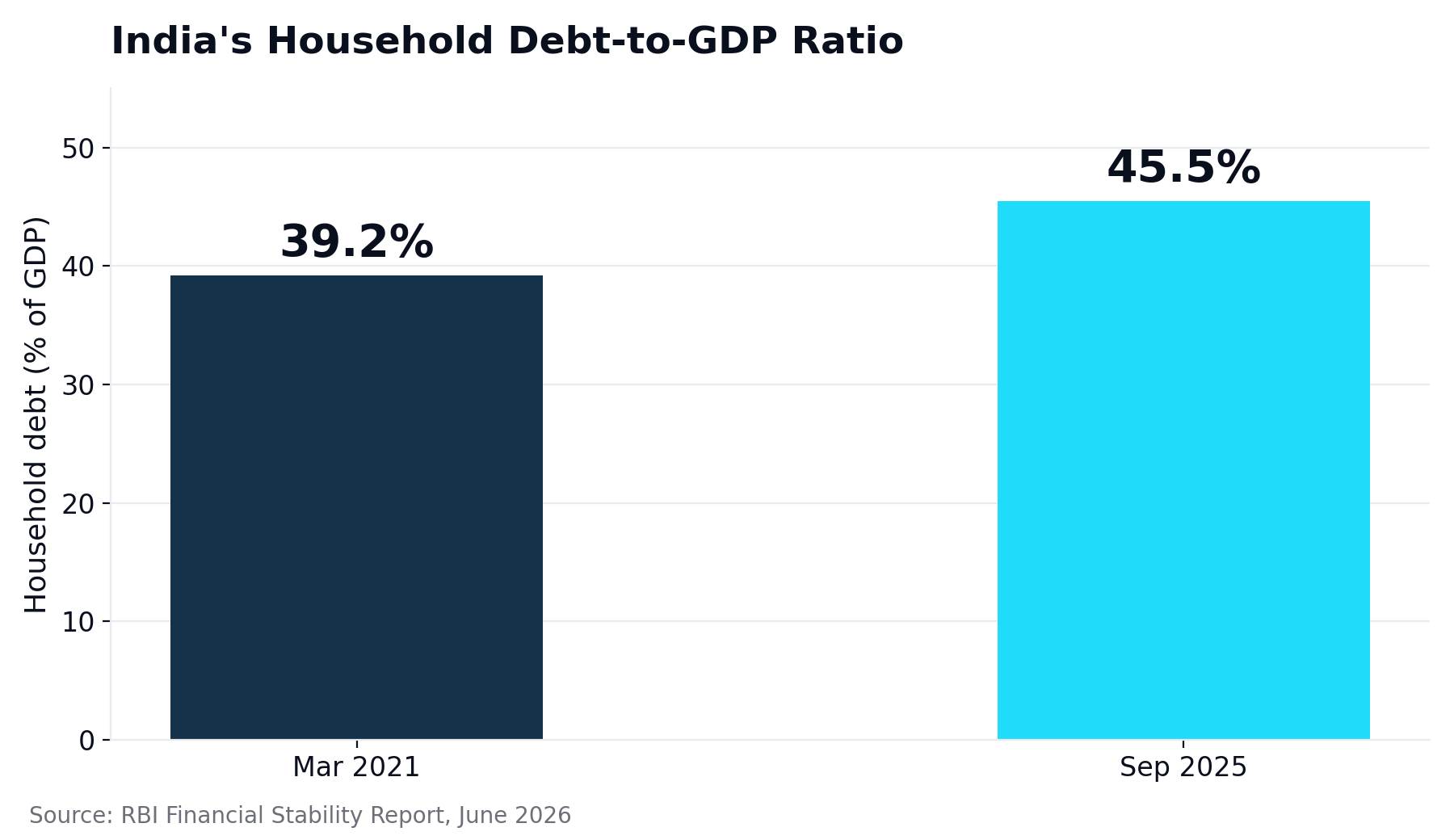
India's household debt-to-GDP ratio reached 45.5% as of September 2025, up from 39.2% in March 2021, according to the Reserve Bank of India's Financial Stability Report (FSR) released in June 2026 [RBI, Financial Stability Report, June 2026]. Debt-to-GDP ratios rising alongside financial inclusion is not inherently a warning sign — deeper credit markets are, on their own, a marker of a maturing financial system. The analytical question this piece examines is narrower: is the composition of that borrowing — what households are actually taking loans for — a more informative signal of risk than the headline ratio itself?
What Households Are Borrowing For
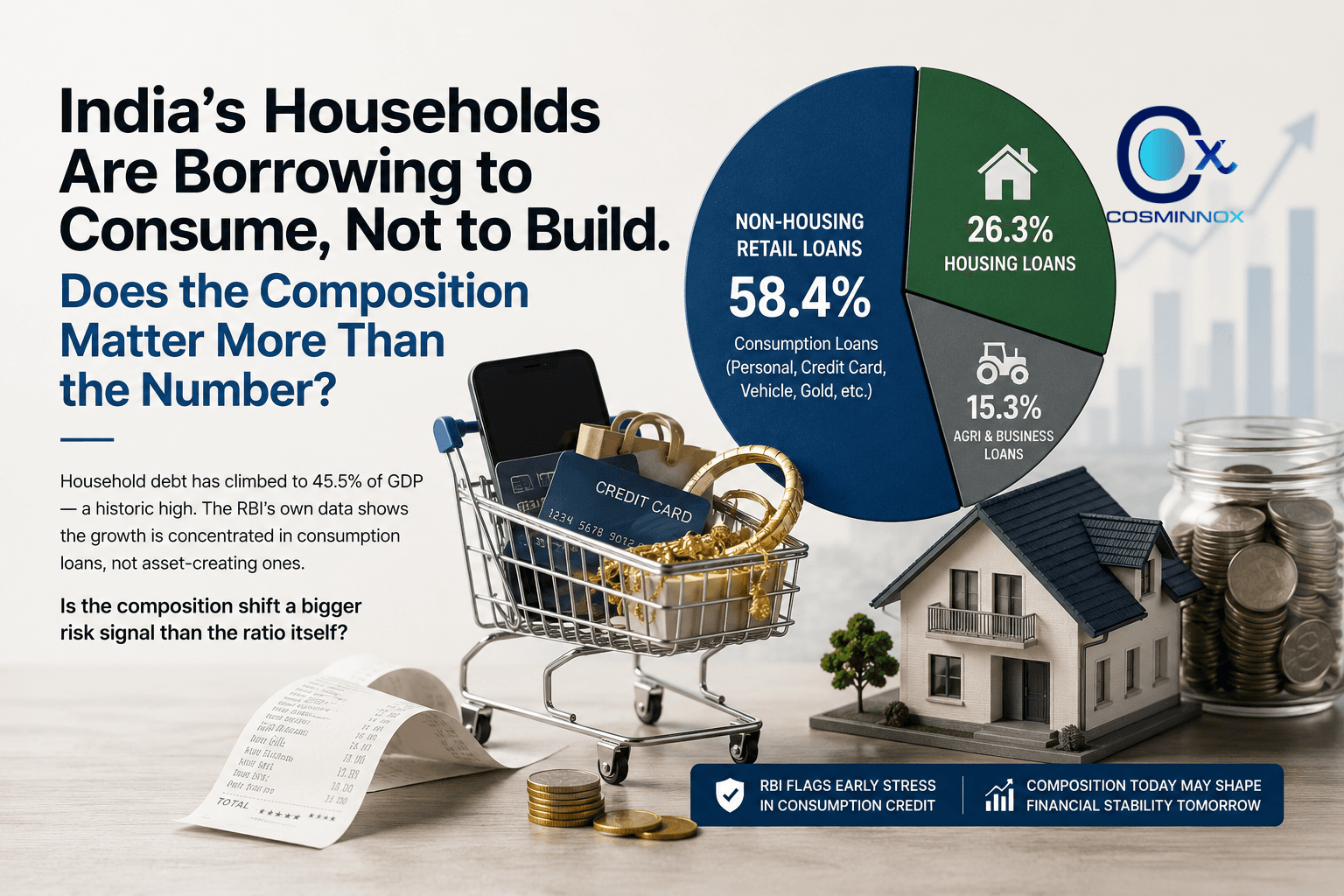
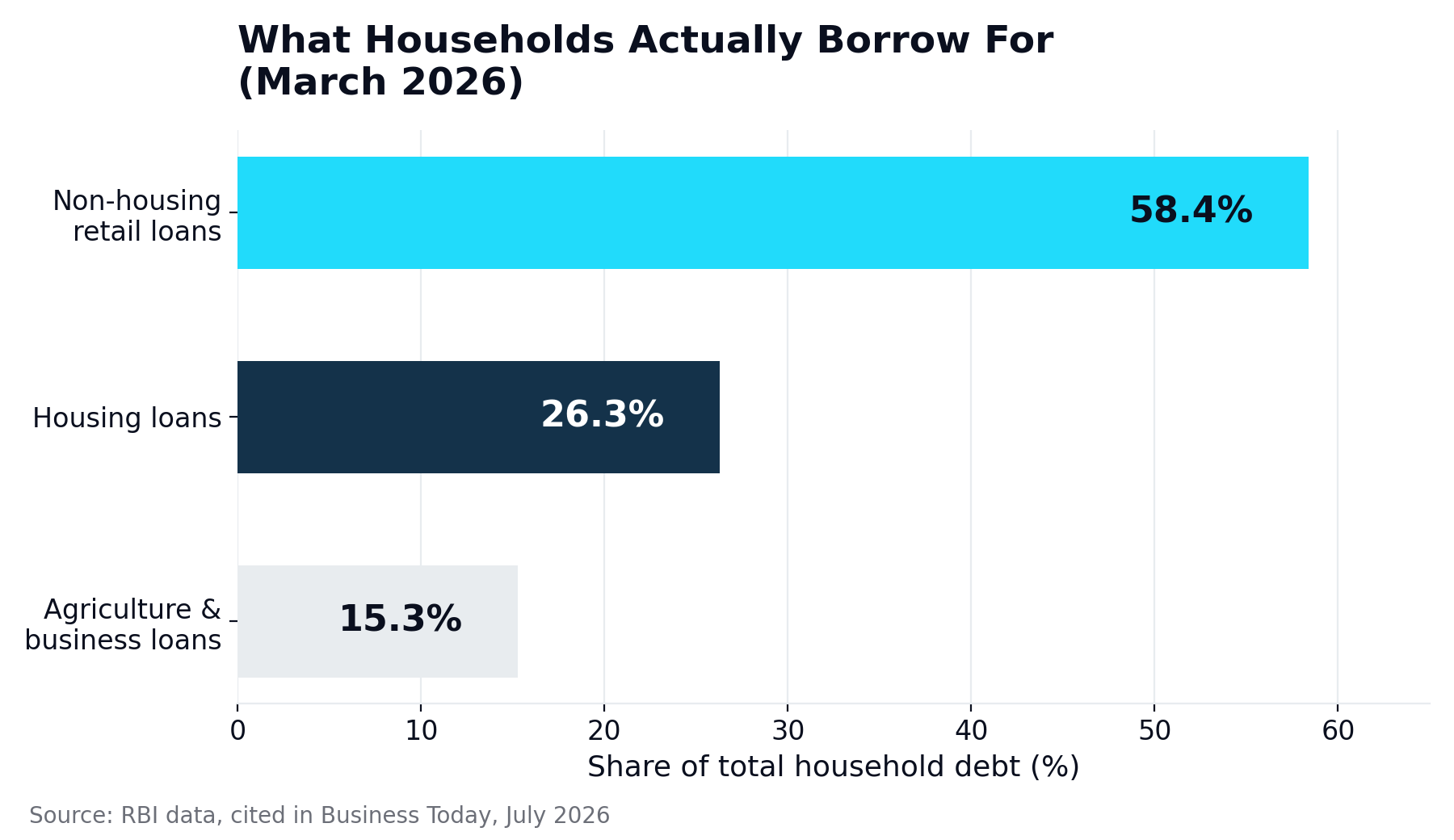
The RBI's own data answers this directly. Non-housing retail loans — personal loans, credit cards, vehicle loans, consumer durable loans, and gold-backed loans — accounted for 58.4% of total household debt as of March 2026, up from roughly 50% in 2019-20 [RBI data, cited in Business Today, July 2026]. A separate figure from the same reporting period shows non-housing retail loans rising from 54.9% in March 2025 to 58.4% in March 2026 within a single year [RBI data, cited in Indian Express current-affairs coverage, August 2026]. Housing loans, by contrast, account for 26.3% of household debt, with agriculture and business loans making up the remaining 15.3% [RBI data, cited in Business Today, July 2026].
The RBI's own report language is explicit on the interpretive point: "Consumption-related loans remained the primary driver of household borrowings, followed by loans for productive purposes, whereas borrowing for asset creation expanded at a relatively slower pace" [RBI, Financial Stability Report, June 2026, cited in The Core, August 2026]. This is the regulator's own framing of the composition shift, not an outside inference.
The Specific Categories Driving Growth
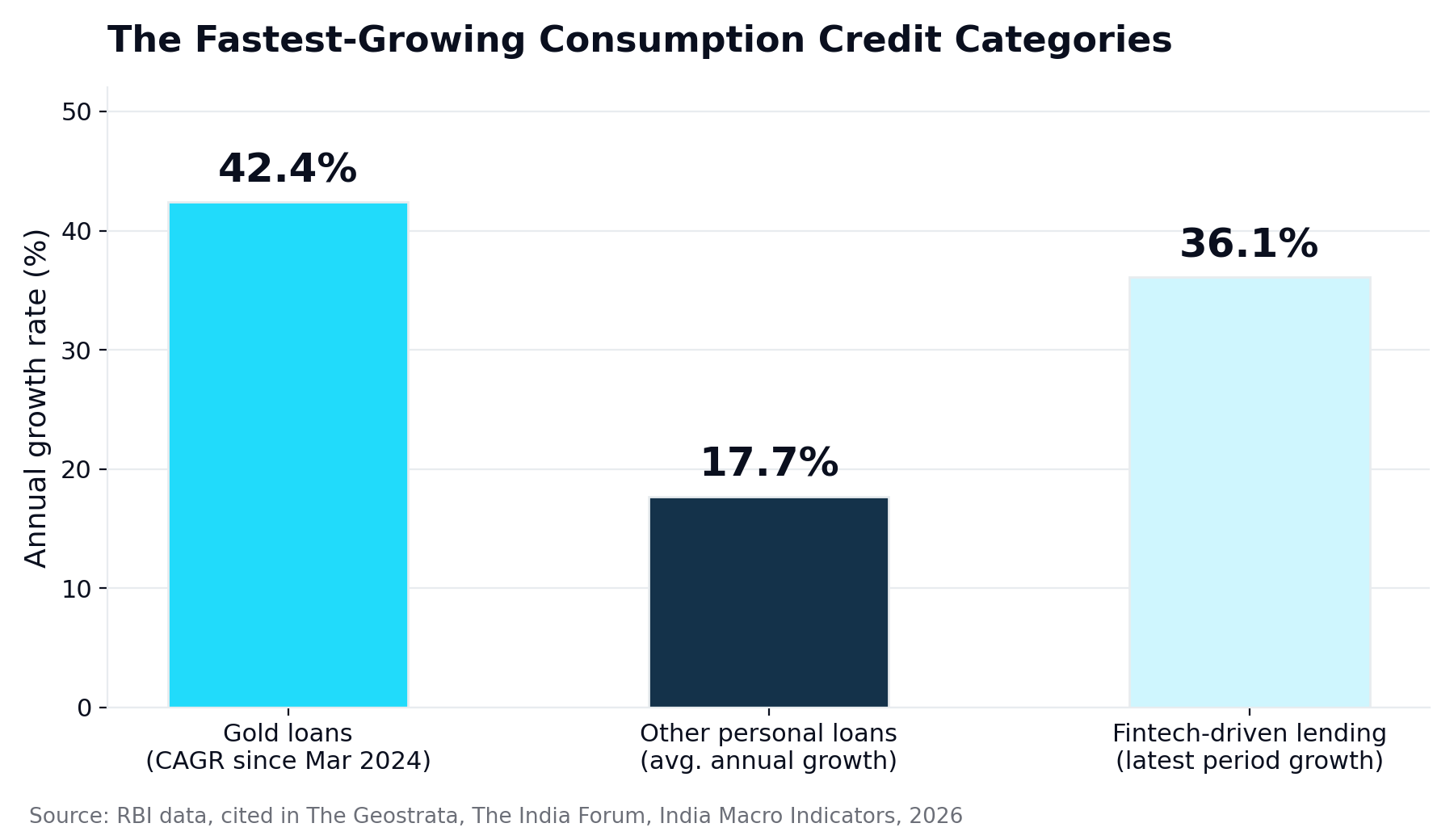
Gold loans are the fastest-growing segment. Outstanding loans against gold jewellery reached ₹4.61 lakh crore by March 2026 [RBI data, cited in Indian Express current-affairs coverage, August 2026], with a separate estimate placing outstanding gold loans at ₹5.14 trillion by May 2026 [RBI data, cited in India Macro Indicators, July 2026]. Growth has run at a 42.4% compound annual rate since March 2024 [RBI, Financial Stability Report, June 2026, cited in The Geostrata, August 2026]. The RBI has separately flagged that much of this growth reflects repeat borrowers leveraging rising gold prices to access larger loans against the same collateral — a credit-quality metric that depends on a commodity price holding up, not on independent underwriting improvement.
Other personal loans have scaled sharply. Outstanding "other personal loans" (a category distinct from gold loans and largely unsecured) reached ₹17.32 lakh crore by March 2026, having grown at an average annual rate of 17.7% [RBI data, cited in The India Forum, July 2026]. NBFC-originated personal loans, tracked less frequently by the RBI, stood at ₹5.45 lakh crore as of September 2025, up from ₹2.13 lakh crore in March 2019 — a 15.5% average annual growth rate over that period [RBI data, cited in The India Forum, July 2026].
Fintech-originated small-ticket lending is a distinct, faster-growing sub-segment. Fintech firms hold a 56.8% market share in small-ticket personal loans under ₹50,000, and 70.5% of fintech loan books are unsecured [RBI data, cited in Indian Express current-affairs coverage, August 2026]. Fintech-driven lending overall grew 36.1% in the most recent reporting period, and the RBI has flagged rising loan impairment specifically among borrowers who have taken unsecured loans from five or more lenders simultaneously [RBI, Financial Stability Report, June 2026, cited in India Macro Indicators, July 2026].
Where Stress Is Already Visible
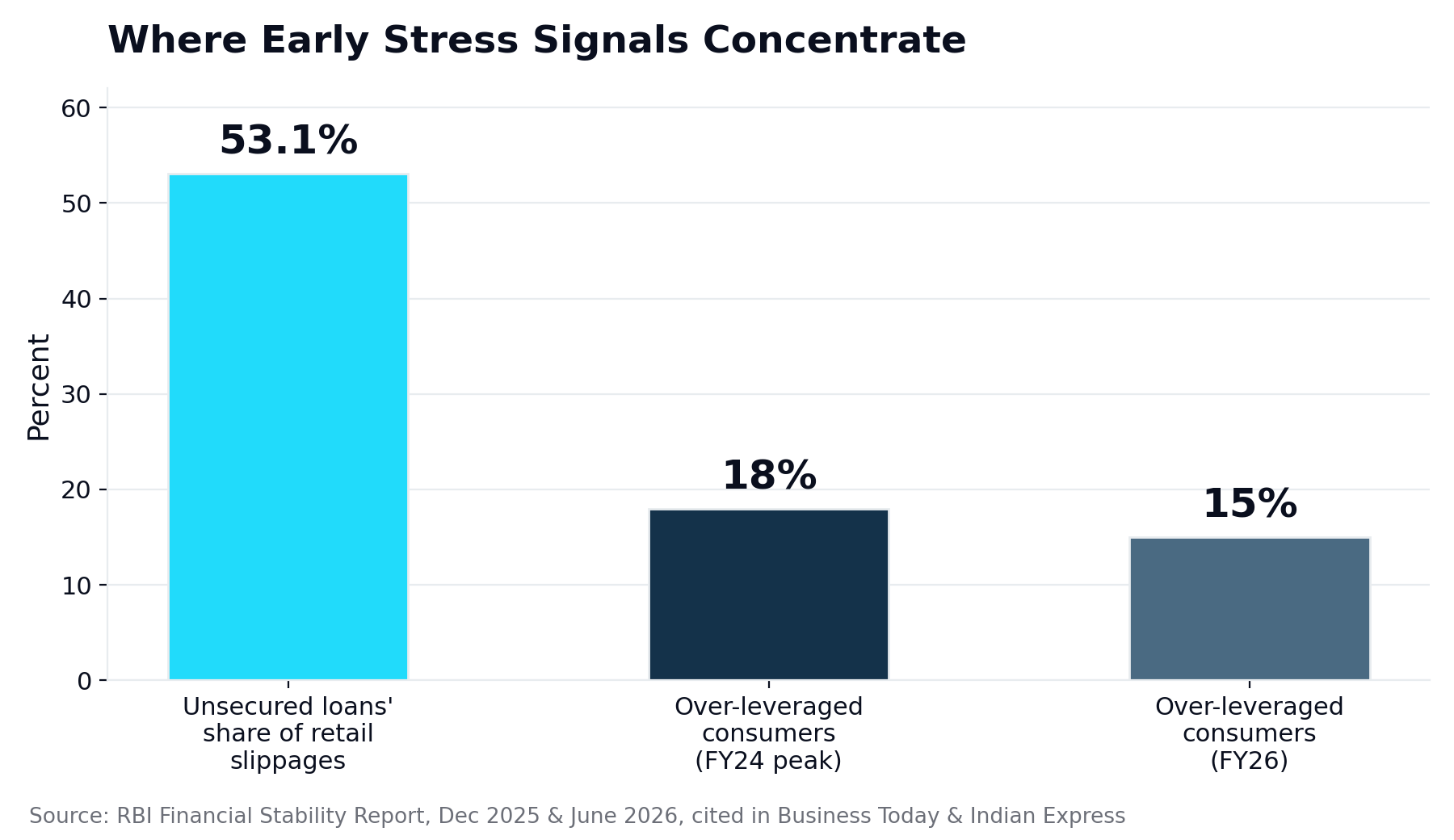
The RBI's December 2025 FSR reported that unsecured loans accounted for 53.1% of retail slippages — a disproportionate share relative to their share of the overall loan book [RBI, Financial Stability Report, December 2025, cited in Business Today, June 2026]. The share of over-leveraged consumers — the RBI's own metric for households carrying multiple concurrent unsecured obligations — rose from 5% in FY17 to a peak of 18% in FY24, before easing to 15% in FY26 [RBI data, cited in Indian Express current-affairs coverage, August 2026]. Average outstanding debt per borrower increased to ₹4.78 lakh by March-end 2025, up from ₹3.41 lakh in March-end 2018 [RBI data, cited in Indian Express current-affairs coverage, August 2026].
A separate RBI survey cited in its own December 2025 FSR found that 27% of personal loan borrowers in the first half of 2025 used loan proceeds for travel and vacation spending — a discretionary consumption use, up from a lower prior-period share [RBI, Financial Stability Report, December 2025, cited in Business Today, June 2026]. This is a specific, sourced data point on end-use, not an inference about borrower behaviour.
Counter-Evidence: The RBI's Own Contained-Risk Assessment
The RBI's own reporting does not characterize this as a crisis in progress. The central bank's FSR describes overall risks to the financial system from household lending as "contained," and notes that an easing monetary policy cycle is expected to reduce debt-service pressures on existing borrowers [RBI, Financial Stability Report, cited in HDFC-TRU primer, 2026]. Net household financial savings improved in Q4 FY25 even as the debt-to-GDP ratio rose over the same period [RBI data, cited in Business Standard, December 2025] — an indicator that is not consistent with a household sector in broad-based distress. Separately, the same June 2026 FSR that flags household debt concentration also reports the banking system's bank-level GNPA ratio at a multi-decadal low of 1.8%, with fresh retail slippages — while elevated in the unsecured category specifically — not yet translating into system-wide asset-quality deterioration [RBI, Financial Stability Report, June 2026, cited in India Macro Indicators, July 2026]. The RBI's November 2023 pre-emptive increase in risk weights on unsecured consumer credit, from 100% to 125%, is itself evidence of a regulator acting ahead of realized stress rather than responding to one already underway [RBI risk-weight notification, cited in Business Standard, 2023].
What the Evidence Does and Doesn't Establish
The data supports a specific, bounded claim: the composition of India's household borrowing has shifted materially toward consumption-oriented, non-housing retail credit — with gold loans and small-ticket unsecured fintech lending as the fastest-growing sub-segments — and this shift is a more informative signal than the aggregate debt-to-GDP ratio, because the RBI's own slippage and over-leverage data show early stress concentrated specifically within that consumption-loan category rather than spread evenly across all household debt. It does not establish that India faces an imminent household-debt crisis: the RBI's own assessment characterizes system-wide risk as contained, over-leverage metrics have eased from their FY24 peak, and net household savings improved even as debt rose. The bounded finding is that the growth in household debt is not uniform in risk profile, and a policymaker or lender reading only the debt-to-GDP headline would miss where the RBI's own data says the stress is actually concentrated.
As of: RBI Financial Stability Report, June 2026 (data points as of dates specified per figure; debt-to-GDP figure as of September 2025). Figures subject to revision in subsequent RBI publications.
Sources
Reserve Bank of India, Financial Stability Report, June 2026 (released June 30, 2026)
Reserve Bank of India, Financial Stability Report, December 2025
Business Today, "India's household debt rises to 45.5% of GDP; non-housing retail loans account for 58.4%," July 2026
Business Today, "Declining household savings pose risks to India's credit growth engine," June 2026
Indian Express (Superkalam current affairs), "Gen Z's buy-now, pay-later habit fuelling unsecured loans, worrying regulator," August 2026
The India Forum, "The Great Borrowing Boom: Why Indian Households are Taking on More Debt," July 2026
The Core, "India's Borrowing Boom Is Weakening The Household Safety Net," August 2026
India Macro Indicators, "India Household Debt at 45.5% of GDP: RBI FSR 2026," July 2026
The Geostrata, "Borrowing for Growth: The Rise of Household Debt in India," August 2026
HDFC-TRU, "India's Household Debt Landscape," primer, 2026
Business Standard, coverage of RBI risk-weight increase on unsecured consumer credit, November 2023