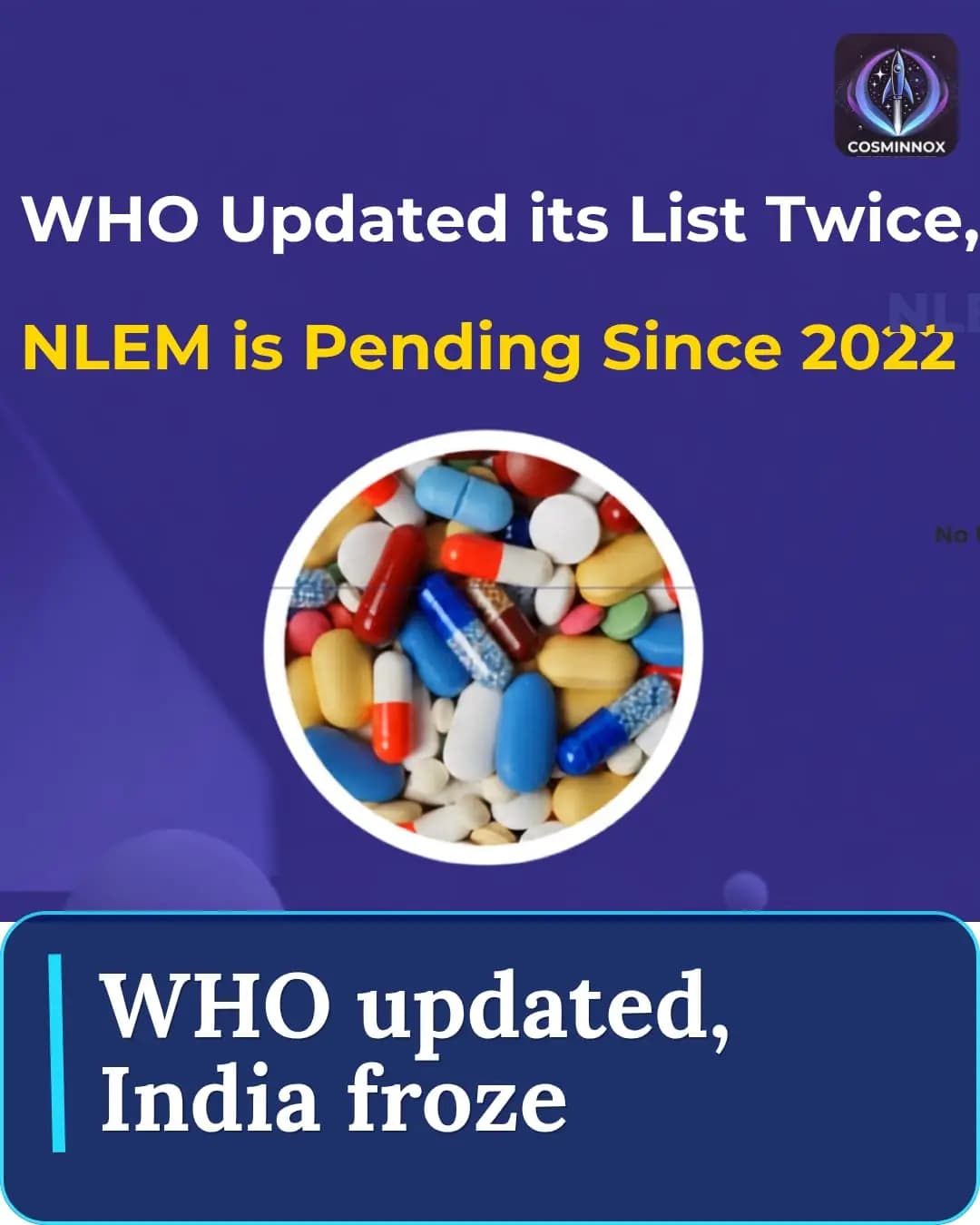
India's National List of Essential Medicines (NLEM) is a short document with an outsized job: it decides which drugs get dispensed free at public hospitals and which ones carry a government-fixed price ceiling. The list has not changed since September 13, 2022, when its fifth edition was notified with 384 medicines — up from 376 in 2015.
Two Revisions, Zero Movement
In the same four years, the WHO has updated its own Model List of Essential Medicines twice — the 23rd edition in July 2023, the 24th in September 2025 — expanding it to 523 medicines through a fixed, biennial cycle run by an independent expert committee. India's list, by contrast, has had only four editions in 26 years, on no fixed schedule at all.
That contrast has now become a formal grievance. The Working Group on Access to Medicines and Treatments — a civil society collective of patient advocates, academics, lawyers and journalists — has written to the Union government demanding an urgent revision, framing the delay as a matter of the constitutional Right to Life under Article 21.
“Transparent, time-bound, and conflict of interest-free”
— The Working Group on Access to Medicines and Treatments, on how the next NLEM revision should run
Where the Gap Bites Hardest
The Working Group's own analysis points to oncology as the sharpest edge of the problem. Seventeen active cancer-treating agents and four supportive cancer-care medicines on the WHO's current list are missing from the NLEM entirely. Monoclonal antibodies — targeted biologic drugs now central to modern cancer care — fare worse still: none of nine such drugs on the WHO list feature on India's at all.
The omission is not merely symbolic. Once a medicine enters the NLEM, the Department of Pharmaceuticals folds it into the Drug Price Control Order, 2013, and the National Pharmaceutical Pricing Authority sets a price ceiling for it. Medicines left off the list get no such protection — leaving newer cancer drugs, among others, exposed to market pricing with no ceiling in sight.
A Delay With Form
This is not the first time India's list has lagged. The Standing National Committee on Medicines, tasked with revising the 2015 edition, was constituted in July 2018 and took roughly four years — nearly two of them before the pandemic even began — to submit its report on September 10, 2022.
The Ministry of Health and Family Welfare has yet to issue a public response or a timeline for the next revision. For now, the Working Group's letter remains exactly that: a civil society demand, not a government commitment. Whether it becomes one may determine how many more cancer patients wait for a list to catch up with the medicine already treating them elsewhere in the world.
The Cosminnox • Reporting compiled from Press Information Bureau releases, Ministry of Health and Family Welfare notifications, World Health Organization publications, and current-affairs reporting on the Working Group on Access to Medicines and Treatments' July 2026 letter to the Union government.