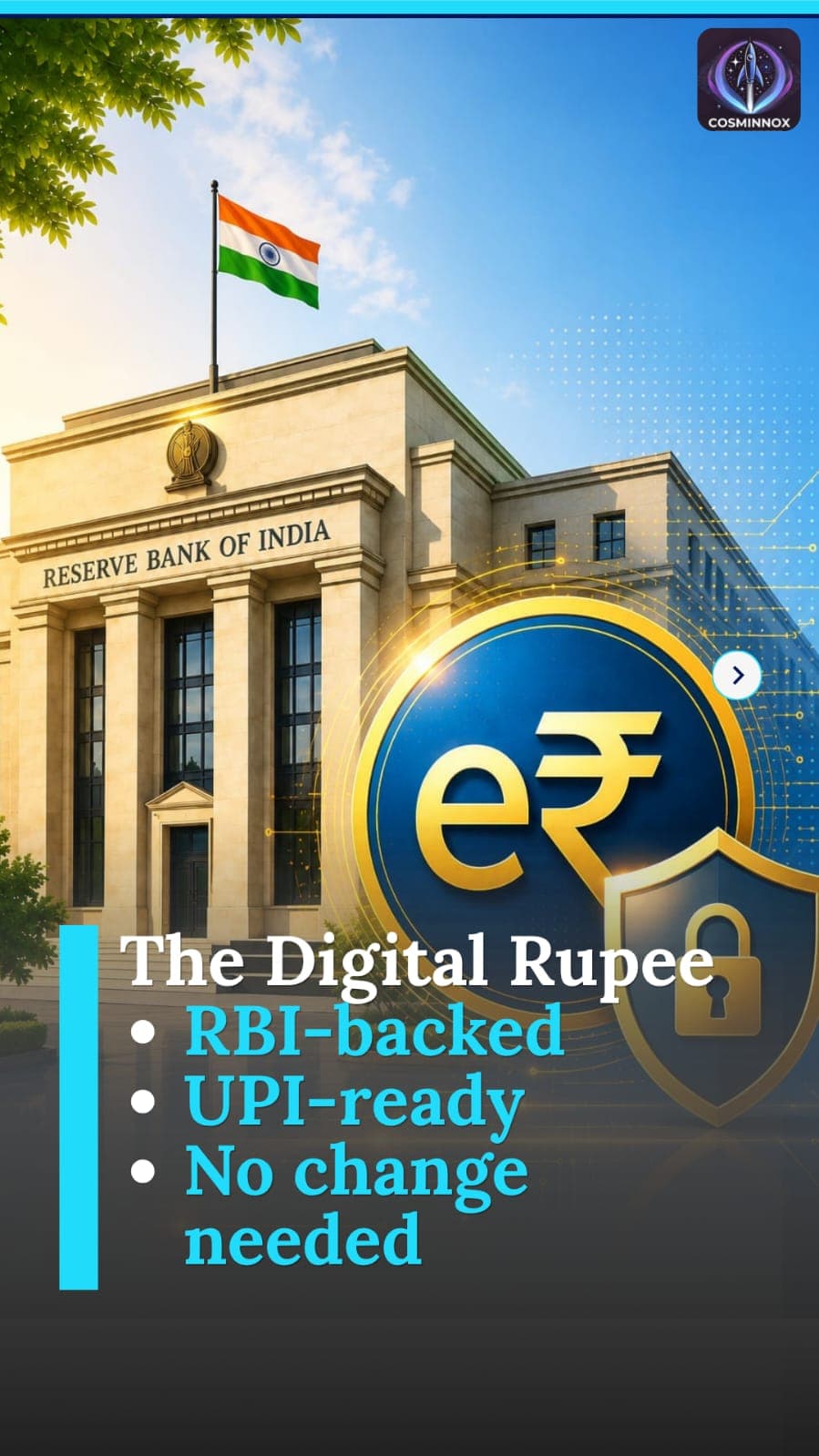
In villages across Gujarat, Puducherry and Chandigarh, food subsidies are now arriving not as cash or bank credit, but as lines of programmable code — digital tokens that can only be redeemed at designated ration shops. This is the Reserve Bank of India's Central Bank Digital Currency, the e-Rupee, quietly moving from concept to instrument of state.
A Currency Twice Removed From Paper
The digital rupee (e₹) was proposed in 2017 and launched on 1 December 2022, following amendments to the Reserve Bank of India Act, 1934. It exists in two forms: the Digital Rupee-Wholesale (e₹-W), used for interbank settlement of government securities, and the Digital Rupee-Retail (e₹-R), designed for everyday consumer and business transactions. Both are direct liabilities of the RBI — legally equivalent to holding a physical banknote, with no bank account required to hold or transact in them.
The Adoption Paradox
By 2026, the RBI's focus has shifted from expanding transaction volumes to testing specific functionalities. Retail e-rupee circulation actually fell to ₹771.7 crore as of 31 March 2026, down about 24 percent from ₹1,016.5 crore a year earlier, according to the central bank's Annual Report for 2025-26. Around 7 million retail users have engaged with the e-Rupee since its 2022 launch — a fraction of the more than 400 million users transacting over UPI. The contrast reflects a structural reality: India's existing digital payments ecosystem is already fast, free and familiar, leaving the CBDC to justify itself through capabilities UPI does not offer, rather than through raw adoption numbers.
Programmability as the Selling Point
That justification is emerging through programmability. Under Direct Benefit Transfer pilots run with state governments, welfare funds issued as e-Rupee tokens can be restricted to specific goods — agricultural inputs, healthcare services, or food items under the Public Distribution System — reducing the scope for diversion of public money. The RBI has also developed the Unified Markets Interface, a platform using wholesale CBDC to settle tokenised financial assets, with an initial pilot on tokenisation of certificates of deposit already underway.
Crossing Borders
Cross-border ambition is the other frontier. The RBI has signed a digital-assets pact with Singapore's monetary authority and is in discussions with Singapore and the United Arab Emirates on further pilots, alongside participation in multilateral CBDC initiatives led by the Bank for International Settlements. With India chairing BRICS in 2026 and hosting the bloc's summit later this year, the RBI has proposed placing the interlinking of BRICS members' digital currencies on the summit agenda — an approach aimed at connecting national currencies like India's e-Rupee and Brazil's Drex for faster trade and remittance settlement, rather than creating a single shared currency.
Building the Ecosystem
Infrastructure access has also been opened to non-bank fintech players, including CRED and MobiKwik, who are building smart-contract-enabled services, supply-chain tools and escrow mechanisms on the e₹ layer. Offline functionality, using near-field communication for areas with poor connectivity, remains under active trial, alongside a forthcoming CBDC and Asset Tokenisation Sandbox for testing third-party products on the currency's infrastructure.
Sovereign, Not Speculative
RBI officials have consistently distinguished the e-Rupee from private cryptocurrency and stablecoins on the basis of sovereign backing. Deputy Governor T. Rabi Sankar has noted that central bank digital currencies do not carry the same risks to monetary stability as stablecoins can. Analysts tracking the programme expect the near term — 2026 to 2028 — to bring expanded piloting, deeper wholesale settlement use, and continued government payment integration, with broader retail adoption and functioning cross-border corridors projected further out, from 2028 onward.
As India positions the e-Rupee at the intersection of welfare delivery, financial-market infrastructure and cross-border settlement, policymakers, financial institutions and fintech innovators alike are being invited into an evolving sandbox — one where the next chapter of India's monetary architecture is still being written.
SOURCES
Reserve Bank of India — Annual Report 2025-26 (digital rupee circulation and CBDC pilot data)
IDN Financials (Jan 20, 2026) — "RBI proposes linked BRICS digital currency to reduce USD dependence" — idnfinancials.com
Modern Diplomacy (Apr 21, 2026) — "RBI's Digital Currency Proposal for the BRICS 2026 Agenda" — moderndiplomacy.eu
Business Upturn (May 29, 2026) — "Digital rupee in circulation falls 24% to ₹771.7 crore, even as RBI expands CBDC pilots" — businessupturn.com
PingTV India (May 29, 2026) — "RBI to Expand CBDC Pilot for Welfare Schemes and Retail Sector" — pingtvindia.com
TechnoSports (Jun 10, 2026) — "Digital Rupee Pilot: 2026 Status and CBDC Progress in India" — technosports.co.in
Matribhumi Samachar English (Jun 13, 2026) — "Digital Rupee Growth: RBI Speeds Up CBDC Integration Across India" — matribhumisamachar.com
InsightfulPost (Jun 8, 2026) — "Digital Rupee (e₹) in 2026: RBI CBDC Features, Use Cases & Future in India" — insightfulpost.com
Wikipedia — "Digital rupee" (accessed July 2026) — en.wikipedia.org/wiki/Digital_rupee