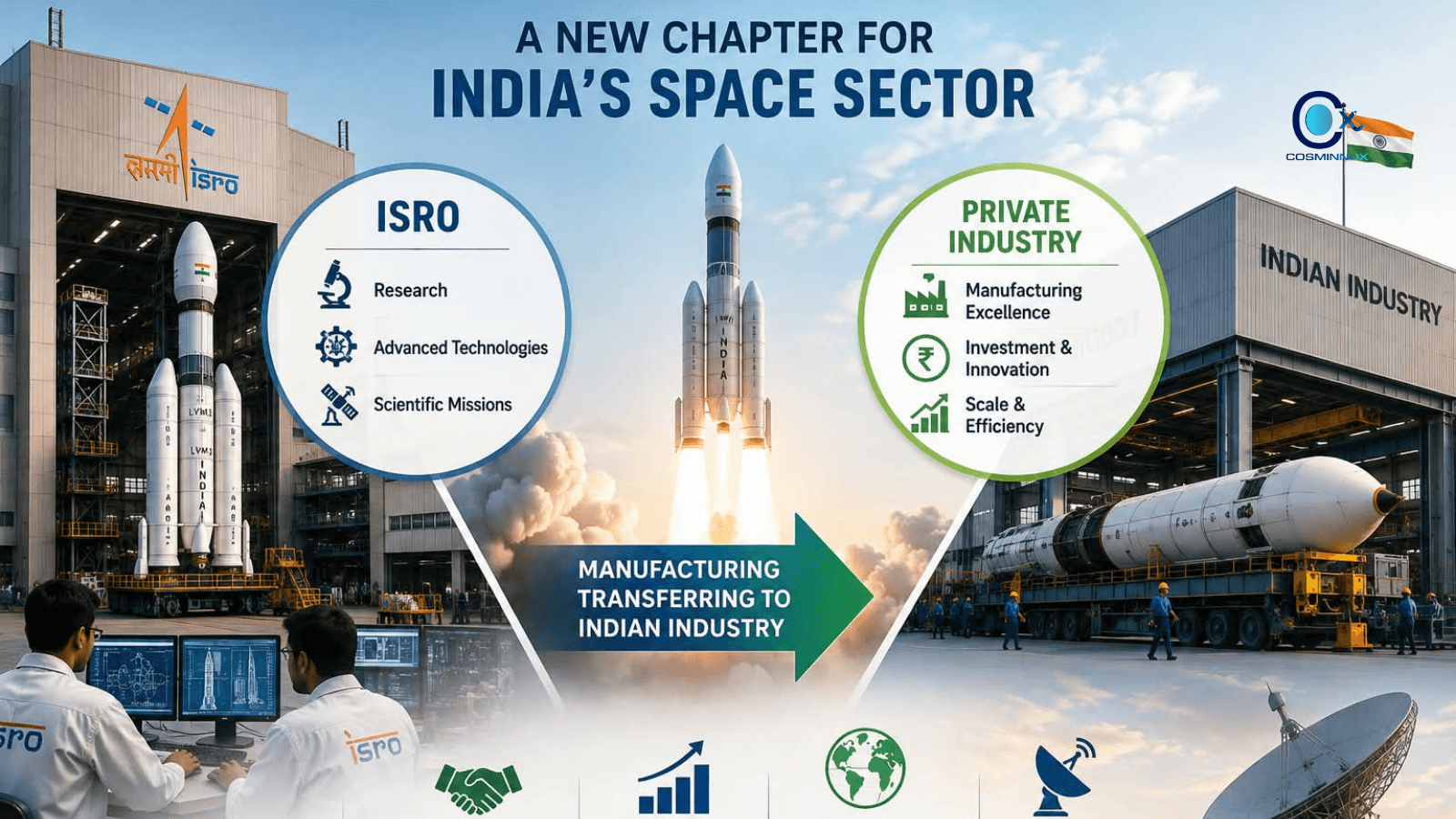
Speaking at Business Today's India @ 100 Economy Summit on August 21, 2026, IN-SPACe Chairman Dr Pawan Kumar Goenka said ISRO will "eventually" stop manufacturing launch vehicles altogether, with production handed to private firms or public sector undertakings, freeing the agency to concentrate on research, advanced technologies and scientific missions.
Source: Pawan Goenka, remarks at India @ 100 Economy Summit, August 21, 2026, reported by NewsGram, August 22, 2026.
The announcement, amplified around National Space Day on August 23, 2026, has been widely reported as a structural pivot in India's space policy.
Source: SatNews, "ISRO Transitions Rocket Manufacturing to Domestic Private Sector," August 23, 2026.
What Has Actually Moved So Far
The transfer is not hypothetical. Technology and production rights for the Small Satellite Launch Vehicle (SSLV) have already been handed to Hindustan Aeronautics Limited (HAL) following a competitive bid. Goenka indicated the Polar Satellite Launch Vehicle (PSLV) and the Launch Vehicle Mark-3 (LVM3) — India's heaviest operational rocket, used in the Chandrayaan-3 mission — are next, with this later phase restricted to private bidders rather than PSUs.
Source: India TV News, "ISRO to shift focus towards space research," August 24, 2026.
Separately, IN-SPACe has invited private operators to run ISRO's under-construction ₹1,000-crore Small Satellite Launch Complex at Kulasekarapattinam, Tamil Nadu.
Source: The News Minute, "ISRO to privatise launch vehicle production," August 2026.
Launch Vehicle | Status | Recipient / Route |
SSLV (Small Satellite Launch Vehicle) | Transferred — complete | Hindustan Aeronautics Ltd (HAL), via competitive bid |
PSLV (Polar Satellite Launch Vehicle) | Transfer announced, in progress | Private bidders (PSUs not eligible in this phase) |
LVM3 (Launch Vehicle Mark-3) | Transfer announced, in progress | Private bidders (PSUs not eligible in this phase) |
Table 1: Status of ISRO launch vehicle manufacturing transfers, as of August 2026. Source: India TV News, August 24, 2026; The News Minute, August 2026.
The Policy Scaffolding
This shift builds on the Indian Space Policy 2023, which assigned ISRO a research and mission-design role while giving NSIL commercial deployment functions and IN-SPACe regulatory authorisation duties. The government's April 2024 FDI liberalisation set out differentiated investment ceilings by segment of the space value chain.
Sources: Carnegie Endowment for International Peace, "A Review of India's 2023 Space Policy," June 2026; Business Standard, "Govt notifies liberalised FDI norms for space sector," April 17, 2024.
Segment | FDI Limit (Automatic Route) | Beyond Limit |
Satellite manufacturing & operations | Up to 74% | Government route required |
Launch vehicles & spaceports | Up to 49% | Government route required |
Satellite / ground-segment components | Up to 100% | No cap under automatic route |
Table 2: FDI limits by space-sector segment under the April 2024 policy amendment. Source: Business Standard, April 17, 2024; Department for Promotion of Industry and Internal Trade notification.
NSIL's revenue trajectory reflects the pace of commercialisation this framework was designed to enable.
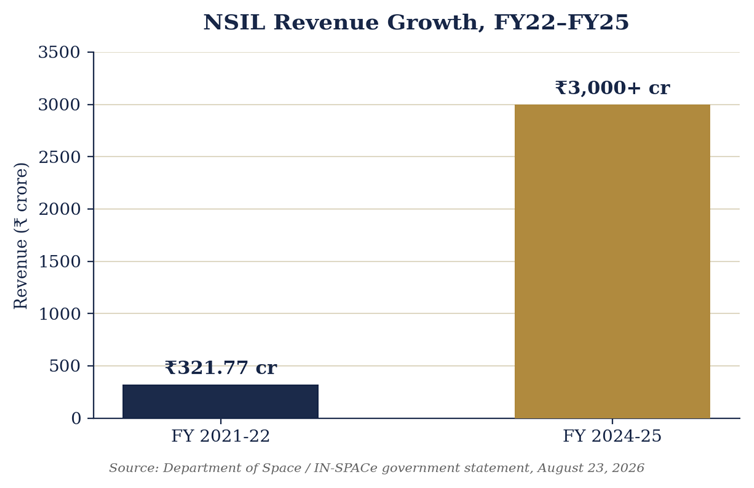
Chart 1: NSIL revenue rose from ₹321.77 crore (FY22) to over ₹3,000 crore (FY25). Source: Government statement via Indian Defence News / IANS, August 23, 2026.
Government projections for the wider space economy over the coming decade are considerably larger in scale, though — as with any decade-long projection — they should be read as directional rather than fixed.
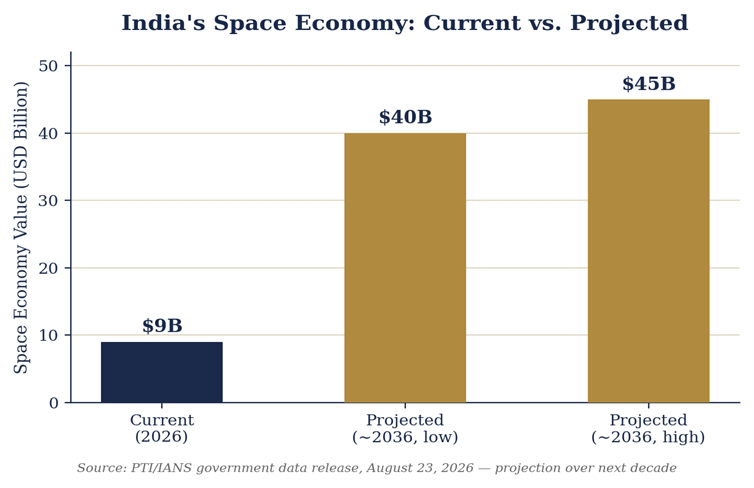
Chart 2: India's space economy, currently valued at $9 billion, is projected by government sources to reach $40–45 billion over the next decade. Source: PTI/IANS, August 23, 2026.
Counter-Evidence: Viability Concerns
Not every voice in the sector reads this transition as settled. Former ISRO chairman G. Madhavan Nair has publicly questioned whether private firms will make the scale of investment such an undertaking requires, estimating that replicating ISRO's establishment would cost roughly ₹50,000 crore against comparatively modest commercial returns.
Source: G. Madhavan Nair, quoted in The News Minute, August 2026.
Nair also pointed out that globally, only about 20% of space-sector revenue comes from hardware, with 80% derived from downstream applications such as communications and earth observation — suggesting launch vehicle manufacturing itself may be a lower-margin business than the headline transfer implies. His remarks do not dispute that the transfer is happening — multiple outlets confirm the SSLV handover is complete and PSLV/LVM3 negotiations are underway — but they flag an open question about whether private consortia can sustain full-scale rocket production independent of continued government demand.
Source: G. Madhavan Nair, quoted in The News Minute, August 2026.
What the Evidence Establishes
As of late August 2026, ISRO's transition away from launch vehicle manufacturing is confirmed in policy statements and partially executed through the SSLV-HAL transfer, with PSLV and LVM3 slated to follow. What remains unconfirmed by any Tier 1 source — government notification, cabinet order, or ISRO/NSIL filing — is a fixed timeline for full manufacturing handover, or independent verification of private industry's financial capacity to sustain production at ISRO's current cost and reliability benchmarks. The claim that ISRO will "focus on research" is well-sourced to official statements; the claim that private industry is ready to fully absorb rocket manufacturing remains, on current evidence, disputed rather than settled.
As of August 27, 2026. Figures reflect the most recent government and IN-SPACe disclosures available; timeline details for PSLV/LVM3 transfer should be checked against subsequent official announcements as the process is still in motion.