In India’s registered small-business sector, does women’s share of ownership translate into a comparable share of economic weight, and how do international benchmarks describe the conditions women entrepreneurs face?
The evidence supports a bounded answer. In Udyam Registration Portal data for January 2024, women owned about one in five registered MSMEs but accounted for about one-tenth of their turnover [1]. World Bank indicators place India ahead of South Asia but behind the world on women’s legal rights, and well behind on the share of formal firms with a woman among the owners [5]. A like-for-like business-environment benchmark for India, the World Bank’s B-READY report, is expected in November 2026 [11].
1. Ownership versus economic weight
As of 31 January 2024, women-owned enterprises were 46,67,278 of the 2,28,19,417 MSMEs registered on the Udyam Registration Portal since July 2020 [1].
Women-owned MSMEs on the Udyam Registration Portal
Measure (as of 31 Jan 2024) | Women-owned | All registered MSMEs | Women's share |
Enterprises | 46,67,278 | 2,28,19,417 | 20.5% |
Employment (persons) | 2,84,07,069 | 15,16,68,034 | 18.73% |
Investment (₹ crore) | 1,26,845 | 11,37,237 | 11.15% |
Turnover (₹ crore) | 17,14,993 | 1,67,84,358 | 10.22% |
Source: Ministry of MSME written reply to the Rajya Sabha, published by PIB on 5 February 2024 [1]. Shares as stated in the release; they match the table totals.
Dividing the PIB totals gives average turnover of about ₹36.7 lakh per women-owned registered MSME against about ₹73.6 lakh across all registered MSMEs, roughly half (COSMINNOX calculation from [1]). Average employment per enterprise is closer, about 6.1 persons against 6.6, and average reported investment is about ₹2.7 lakh against ₹5.0 lakh (same calculation).
Nearly all women-owned units on the portal are micro enterprises: 45,94,550 of 46,67,278, or 98.4% [1]. The release does not give the micro share for all MSMEs, so these figures cannot show whether women-owned units are more concentrated in the micro category than other units.
2. Why both "20%" and "40%" are in circulation
Two registries feed the numbers. The Udyam Registration Portal covers MSMEs. The Udyam Assist Platform, launched in January 2023, registers informal micro enterprises, including those without a PAN or GSTN [4]. On Udyam Assist, women owned 91,08,058 of 1,29,20,177 enterprises (70.49%) as of 31 January 2024 [1].
Adding the two registries for that date gives 1,37,75,336 women-owned enterprises out of 3,57,39,594, or 38.5% (COSMINNOX calculation from [1]). The government’s early-2026 statement that women-owned enterprises are approximately 40% of registered MSMEs [3] is consistent with a combined count in which informal micro enterprises weigh heavily.
The 2026 releases give totals: 3,07,42,621 women-led enterprises registered across both platforms as of 28 February 2026 [2], and over 3.11 crore in early 2026 [3]. They do not give the split between the two registries, nor a turnover share, so the 2024 turnover gap cannot be updated. The 2024 release says "women-owned" and the 2026 releases say "women-led"; the extracts reviewed do not define the difference.
Registration counts also include existing businesses that have registered since 2020. The rise in the combined count, from about 1.38 crore in January 2024 to 3.07 crore in February 2026 [1][2], should not be read as growth in new enterprises.
3. How India compares internationally
Selected World Bank gender indicators, India against regional and global comparators
Indicator (latest year shown) | India | South Asia | Lower-middle income | World |
Women's legal economic rights, WBL 2026 (score, 0–100) | 57.9 | 50.4 | 58.4 | 67.0 |
Firms with female participation in ownership, 2022 (%) | 3.88 | 16.5 | 29.8 | 34.0 |
Firms with a female top manager, 2022 (%) | 6.85 | 10.2 | 18.5 | 19.0 |
Female labour force participation, 2025 (%) | 32.4 | 33.0 | 40.6 | 48.9 |
Women with an account at a financial institution, 2024 (%) | 89.2 | 75.1 | 67.6 | 76.6 |
Source: World Bank, India Gender Data Landscape, 2026 edition (data as of 2 April 2026) [5]. Years differ by row. Female ownership and top-manager rows are Enterprise Survey results for formal firms with five or more employees.
Law and enforcement. India scores 57.9 on the World Bank’s Women, Business and the Law 2026 legal-frameworks measure, against 67.0 for the world, 50.4 for South Asia and 58.4 for lower-middle-income economies [5]. The same profile reports that only 55% of the mechanisms that support implementation of equal-opportunity laws are in place, and that experts rate enforcement of women’s legal rights at 43% of full potential. It also states that India enacted no reforms on the topics measured between 2 October 2023 and 1 October 2025 [5]. The 2026 edition revised the methodology and recalculated the 2024 data, so scores from earlier editions should not be set beside these [6].
Ownership of formal firms. In the World Bank Enterprise Survey for India in 2022, 3.9% of firms had female participation in ownership and 6.8% had a female top manager [7]. "Female participation in ownership" means at least one woman among the owners [8], not women-majority ownership. The survey covers formal, registered firms with at least five employees [7], so it excludes informal firms and those with fewer than five employees. Its figures cannot be compared directly with the Udyam shares in section 1. Read together, the two sources are consistent with women’s ownership being concentrated in smaller units, but neither tests that directly.
4. Access to credit
The IFC estimated in 2022 that India had about 15 million women-owned MSMEs and that about 90% of women entrepreneurs had not availed finance from formal financial institutions [9]. It also identified about 2.7 million women-owned very small enterprises, around 18% of women-owned micro enterprises, with estimated credit demand of ₹836 billion ($11.4 billion) [9]. That figure is IFC’s estimate of credit demand from this sub-segment. It is not an estimate of the total credit gap for women-owned businesses, although it is sometimes reported that way.
A 2025 SIDBI study estimated an addressable credit gap of about 35% for women-owned MSMEs, against about 20% for male-owned counterparts, and reported that women more often turned to informal credit to bridge it [10]. The same study reported that about 24% of women-led MSME respondents did not avail credit [10]. These are survey-based estimates drawn from primary interactions with MSMEs, so they describe the surveyed sample.
For context on assets, 66.2% of women aged 15 to 49 do not own land, against 40.7% of men (2021) [5]. The data do not measure whether land ownership affects the collateral that lenders ask of women entrepreneurs.
5. Counter-evidence: what supports women entrepreneurs
• Credit guarantees. Under the Credit Guarantee Scheme for Micro and Small Enterprises, loans to women-led enterprises receive 90% guarantee coverage against 75% generally, with a 10% concession in the guarantee fee, and no collateral or third-party guarantee is required [2].
• Public procurement. Central ministries, departments and public undertakings must procure at least 3% of annual purchases from women-owned micro and small enterprises, under a policy amended in 2018 [1].
• Subsidised self-employment. Women are 39% of beneficiaries under the Prime Minister’s Employment Generation Programme, with over 3.2 lakh women-owned enterprises supported in five years [3].
• Legal standing against the region. India’s legal-rights score of 57.9 is above the South Asian figure of 50.4 and close to the lower-middle-income figure of 58.4 [5].
• Account ownership. 89.2% of women had an account at a financial institution in 2024, against 88.8% of men and 76.6% of women worldwide [5]. On saving at a financial institution or via mobile money, the figures were 22.8% for women and 31.1% for men [5].
None of these sources measures whether the schemes have changed the scale of women-owned enterprises. The turnover gap in section 1 predates the 2026 releases, and no post-2024 turnover split was found.
6. Observations derived from the figures
The figures in sections 1 to 3 can be combined to give four observations. Each is arithmetic on published totals (COSMINNOX calculation), and none of them establishes a cause.
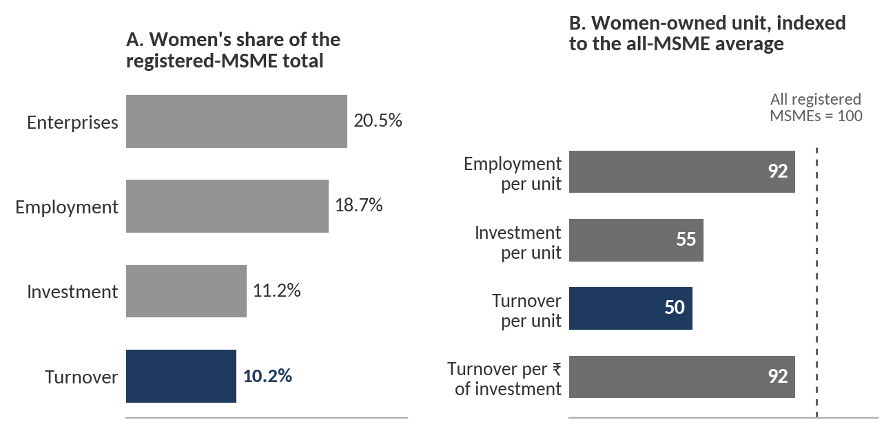
Women’s share falls at each step from enterprises to turnover. On the Udyam Registration Portal as of 31 January 2024, women-owned units were 20.5% of enterprises, 18.7% of employment, 11.2% of investment and 10.2% of turnover [1] (Figure 1, panel A).
Per-unit employment is close to the all-MSME average; per-unit investment and turnover are about half of it. Indexed to the all-MSME average of 100, a women-owned unit scores 92 on employment, 55 on investment and 50 on turnover (Figure 1, panel B). Turnover per person employed is about ₹6.0 lakh against ₹11.1 lakh. Turnover per rupee of reported investment is about ₹13.5 against ₹14.8, an index of 92. In these totals, the per-unit turnover gap is about the same size as the per-unit investment gap, while turnover per rupee invested differs by about 8%. The “all” benchmark includes women-owned units; against all other registered MSMEs the per-unit turnover is about ₹83.0 lakh, so the women-owned average is about 44% of it. These are relationships among reported totals. The data do not show whether lower investment leads to lower turnover, the reverse, or neither, and the extracts reviewed do not say how either was recorded.
Figure 1. Women-owned registered MSMEs: share of totals, and per-unit averages against all registered MSMEs
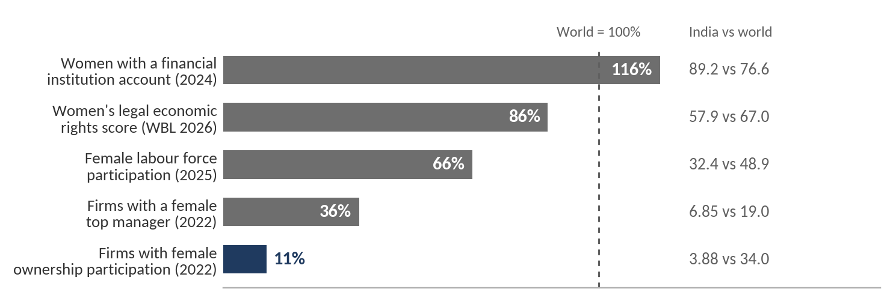
Source: World Bank, India Gender Data Landscape, 2026 edition [5]; COSMINNOX calculation (India figure divided by world figure). Years differ by row. Ownership and top-manager rows are Enterprise Survey results for formal firms with five or more employees; “female participation in ownership” means at least one woman among the owners.
Against the world figure, India is below on four of five World Bank indicators and above on one. India’s figure is 116% of the world figure for women’s account ownership, 86% for the legal-rights score, 66% for female labour force participation, 36% for firms with a female top manager and 11% for firms with female participation in ownership [5] (Figure 2). Against South Asia, India is above on the legal-rights score (57.9 against 50.4) and account ownership (89.2 against 75.1), and below on firm ownership (3.88 against 16.5), female top manager (6.85 against 10.2) and labour force participation (32.4 against 33.0). The five indicators differ in universe, year and scale. The percentages are ratios to the world figure, not a composite index, and should not be averaged.
Figure 2. India’s figure as a percentage of the world figure, five World Bank indicators
Two-thirds of women-owned enterprises in the combined count sit outside the turnover comparison. Of 1,37,75,336 women-owned enterprises across the two registries in January 2024, 91,08,058 (66%) were on Udyam Assist [1]. The turnover and investment shares in section 1 are reported for the Udyam Registration Portal, and the extracts reviewed report no turnover for Udyam Assist. The 10.2% turnover share is therefore a statement about registered MSMEs, not about every women-owned enterprise in the government’s combined count.
7. The report that is awaited
The World Bank discontinued its Doing Business ranking and replaced it with Business Ready, or B-READY. India is part of the third B-READY report. Firm-level survey data collection in India began in January 2025 and expert consultations in December 2025. The Department for Promotion of Industry and Internal Trade lists November 2026 as the estimated publication month for India’s report [11].
This report is awaited, and it may bring new findings. B-READY assesses ten topics, including financial services and market competition (which covers public procurement), and treats gender as one of three cross-cutting themes alongside digital adoption and environmental sustainability [11]. Those topics bear directly on the credit and procurement questions raised above. Expert data will be collected with a focus on Delhi, while firm-level surveys are conducted nationwide [11]. This article makes no prediction about what the report will show, and will be updated with a dated note once it is published.
8. What the evidence does and does not establish
Established
• On the Udyam Registration Portal as of January 2024, women owned 20.5% of registered MSMEs and held 10.22% of turnover. Average turnover per women-owned unit was about half the all-MSME average.
• Per-unit investment and per-unit turnover of women-owned units are each about half of the all-MSME average, while per-unit employment is about 92% of it (COSMINNOX calculation, January 2024).
• About two-thirds of women-owned enterprises in the combined 2024 count are on Udyam Assist, outside the turnover comparison.
• The early-2026 "approximately 40%" figure is consistent with a combined count of both registries, in which informal micro enterprises are a large part.
• On World Bank measures, India’s legal-rights score is above South Asia and below the world average, and the share of formal firms with a woman among the owners is well below regional and global comparators.
• Credit-guarantee, procurement and subsidy support for women entrepreneurs exists on paper, with specific coverage and quota parameters.
Notes on method
• Figures marked "COSMINNOX calculation" are simple divisions or sums of totals printed in the cited PIB release. The release itself should be consulted for the underlying numbers.
• Indian digit grouping (lakh, crore) is used for registry counts. One crore is ten million.
• Registry data are administrative registrations, not a census of businesses. The World Bank Enterprise Survey is a sample survey of formal firms. The two measure different universes.
Sources
1. PIB, Ministry of MSME, "Women Entrepreneurs in MSMEs", 5 February 2024. https://www.pib.gov.in/PressReleasePage.aspx?PRID=2002574®=48&lang=2 (Tier 1)
2. PIB, Ministry of MSME, "PM Vishwakarma and MSME Schemes Support Women Artisans and Entrepreneurs", 9 March 2026. https://www.pib.gov.in/PressReleasePage.aspx?PRID=2236871®=3&lang=1 (Tier 1)
3. PIB India, post on women-led enterprises in MSMEs, 20 April 2026. https://x.com/PIB_India/status/2046125290712416673 (Tier 1 channel)
4. The Pioneer, reproduction of the Minister of State for MSME’s PIB blog "Nari Shakti at the heart of new India’s MSME revolution". https://dailypioneer.com/news/nari-shakti-at-the-heart-of-new-indias-msme-revolution (Tier 2)
5. World Bank, "India Gender Data Landscape", 2026 edition. https://documents1.worldbank.org/curated/en/099116007012231127/pdf/IDU198b40b9e1f0b6143ec1b51d17c00e31478db.pdf (Tier 1)
6. World Bank, "Women, Business and the Law 2026: Benchmarking Laws for Jobs". https://openknowledge.worldbank.org/server/api/core/bitstreams/3c654cc7-b1ed-40c5-acc0-9ef770b36bff/content (Tier 1)
7. World Bank Enterprise Surveys, "India 2022 Country Profile". https://www.enterprisesurveys.org/content/dam/enterprisesurveys/documents/country/India-2022.pdf (Tier 1)
8. World Bank DataBank, metadata glossary, "Firms with female participation in ownership (% of firms)". https://databank.worldbank.org/metadataglossary/gender-statistics/series/IC.FRM.FEMO.ZS (Tier 1)
9. IFC, "Opportunities and Constraints of Women Owned Very Small Enterprises in India", 2022. https://www.ifc.org/en/insights-reports/2022/opportunities-and-constraints-of-wvses-in-india (Tier 1)
10. SIDBI, "Understanding Indian MSME Sector: Progress and Challenges", May 2025. https://www.sidbi.in/uploads/Understanding_Indian_MSME_sector_Progress_and_Challenges_13_05_25_Final.pdf (Tier 1)
11. DPIIT, Government of India, B-READY page (last updated April 2026). https://apps.dpiit.gov.in/b-ready/ (Tier 1)