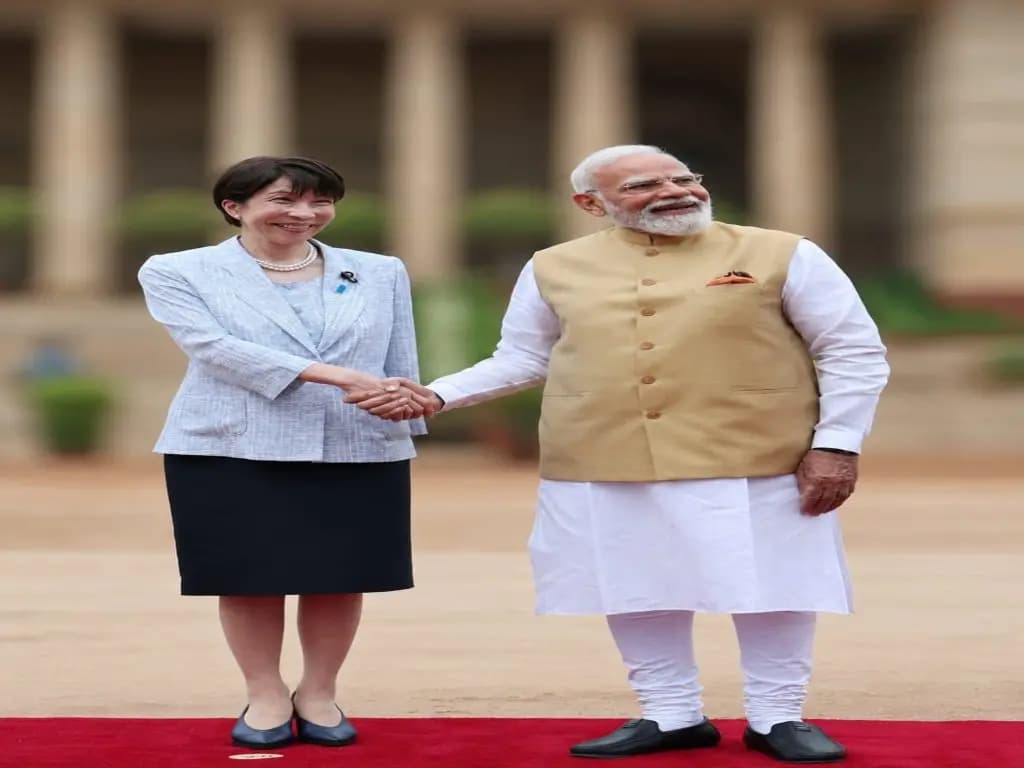
Japanese Prime Minister Sanae Takaichi arrived in New Delhi on July 1 for a three-day official visit, her first to India since taking office, to hold summit talks with Prime Minister Narendra Modi. Sanae Takaichi arrived at Palam Technical Airport in New Delhi on the evening of July 1, and was received by Minister of State (Science and Technology) Jitendra Singh.
Key Facts at a Glance
Visit dates: July 1–3, 2026, New Delhi; Takaichi's first official visit to India as prime minister, at Modi's invitation.
Summit agenda: economic security, resilient supply chains, emerging technologies, defence and maritime security, per the MEA.
Business delegation: 150+ representatives from Japan's business community, including Suzuki and Itochu, at the India-Japan Business Forum.
Prior milestone: follows Prime Minister Modi's August 2025 visit to Tokyo for the 15th India-Japan Annual Summit.
Ministry of External Affairs spokesperson Randhir Jaiswal said the visit marked a step in taking forward the India-Japan Special Strategic and Global Partnership. The visit, from July 1 to July 3, was made at the invitation of Prime Minister Modi and is Takaichi's first official visit to India since assuming office. It follows Modi's visit to Tokyo in August 2025 for the 15th India-Japan Annual Summit.
What the Two Governments Have Said
Ahead of her departure from Tokyo, Takaichi said: "Amid growing uncertainty in the international situation, the importance of collaboration with India, which shares fundamental values and strategic interests, is only increasing." She said her talks with Modi would focus on strengthening strategic cooperation, promoting economic security, and encouraging collaboration between businesses in both countries.
Welcoming her, Modi posted on X: "I look forward to exchanging views across a wide range of fields tomorrow to further deepen the Japan-India Special Strategic and Global Partnership."
Venue and Schedule
Guwahati, Assam, had been discussed as a possible venue; the original 2019 summit planned there was cancelled following protests against the Citizenship (Amendment) Act, and Assam Chief Minister Himanta Biswa Sarma had said a Guwahati summit remained possible. According to media reports, the visit was ultimately confined to New Delhi because of scheduling constraints tied to the ongoing session of Japan's parliament, the Diet.
Business and Sector Focus
More than 150 representatives from Japan's business community, including executives from companies such as Suzuki and Itochu, are taking part in the India-Japan Business Forum during the visit. According to the MEA, the summit agenda covers economic security, resilient supply chains, emerging technologies, defence and maritime security. Coverage of the visit has also referenced discussion of cooperation on semiconductors, drones and defence-related manufacturing, and a Japanese proposal to institutionalise a Quad Defence Ministers' Meeting to be hosted in India.
Wider Context Cited in Coverage
Reports on the visit have noted that Takaichi's government raised Japan's defence budget to a record level, close to 2 percent of GDP, and that Tokyo lifted its ban on lethal weapons exports in April 2026. Coverage has also noted her stated intention to pursue revision of Article 9 of Japan's constitution, the clause renouncing war, following her Liberal Democratic Party-led coalition's majority in the lower house in February 2026.
“India, like Japan, as a major democratic country in Asia, bears responsibility for achieving peace and stability in the Indo-Pacific region.”
— SANAE TAKAICHI, PRIME MINISTER OF JAPAN
What the Visit Establishes
Takaichi's Delhi visit confirms continuity, not a new direction, in the India-Japan Special Strategic and Global Partnership — the summit format, business forum, and agenda areas (economic security, supply chains, emerging technologies, defence and maritime cooperation) mirror the pattern set at the 15th summit in Tokyo.
What the visit adds is timing: it lands as Japan raises defence spending toward 2% of GDP, lifts its lethal arms export ban, and moves toward Article 9 revision — shifts that make Tokyo a materially different defence partner than it was at the last summit, independent of anything discussed in Delhi. The proposal to institutionalise a Quad Defence Ministers' Meeting hosted in India, if confirmed on July 3, would be the visit's most concrete structural outcome. Until the announcements land, the visit itself establishes intent and agenda-setting, not new commitments — the specifics of what was agreed, and whether India accepts the Quad defence-ministerial proposal as framed, remain to be confirmed in the official outcomes.
The COSMINNOX Diplomacy Desk • New Delhi, India • July 2026