THREE NATIONS, ONE ARC
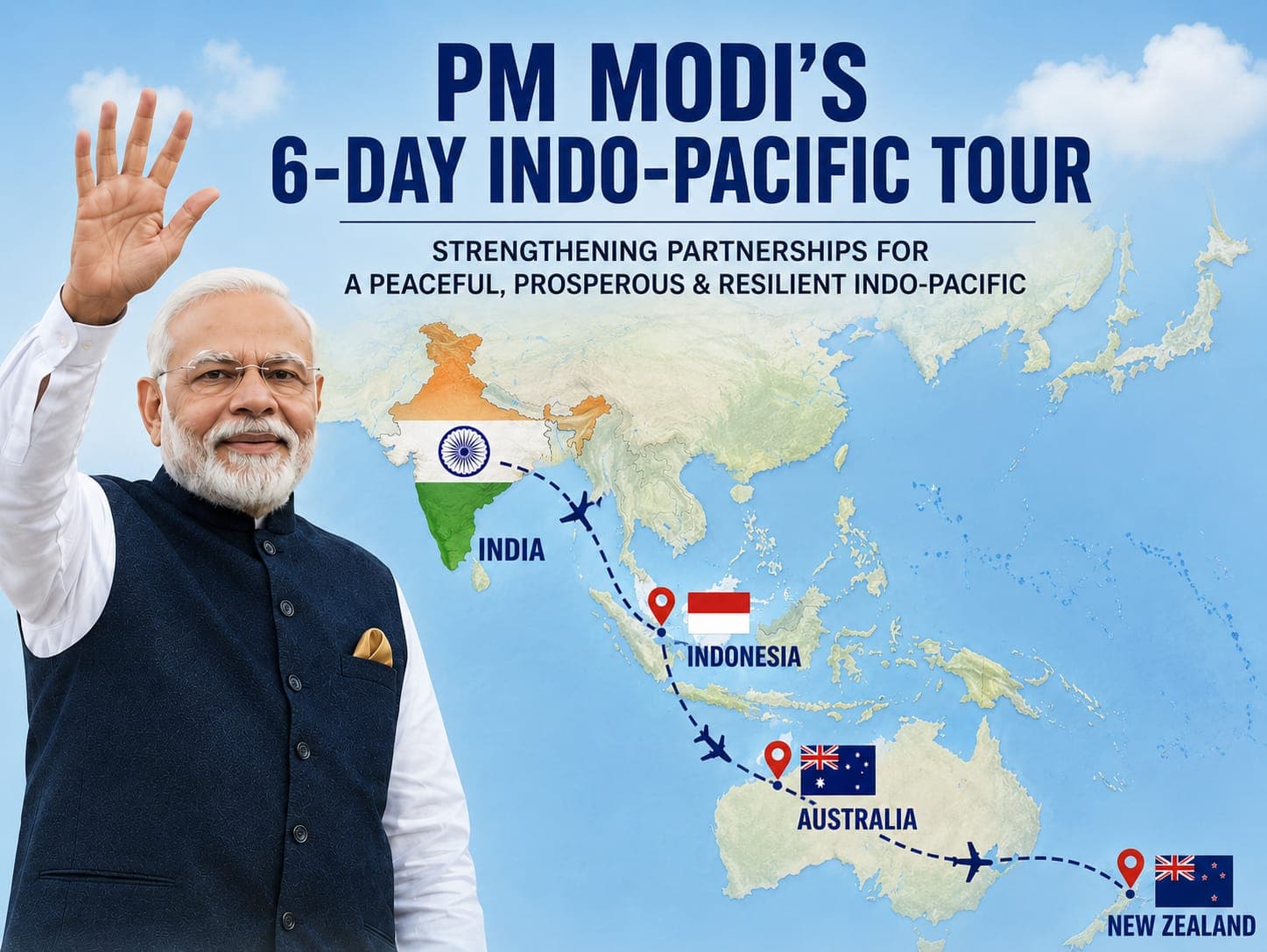
Modi's visit was structured as three legs across six days: Indonesia from July 6 to 8, Australia from July 8 to 10, and New Zealand from July 10 to 11. Framed by the government as an extension of India's Act East Policy and its MAHASAGAR vision, Mutual and Holistic Advancement for Security Across the Regions, the tour was the first State Visit to Indonesia by an Indian Prime Minister since 2018, the third to Australia, and the first to New Zealand in nearly four decades.
INDONESIA: MISSILES, MARITIME SECURITY, HERITAGE
In Jakarta, Modi and President Prabowo Subianto signed over a dozen agreements spanning defence, agriculture and maritime security. The centrepiece was a deal for Indonesia to acquire India's BrahMos supersonic cruise missiles, making it the third foreign buyer after the Philippines and Vietnam. The agreement was reached a day after China test-launched a long-range ballistic missile. The two sides also agreed to expand maritime security cooperation along shared shipping routes, and Modi visited the Prambanan temple complex in Yogyakarta, where India is expected to support a heritage restoration project.
AUSTRALIA: A URANIUM PACT AND A MINERALS CORRIDOR
In Melbourne, Modi and Prime Minister Anthony Albanese signed a civil nuclear agreement allowing Australia to export uranium to India under the 2015 bilateral nuclear cooperation pact, supporting India's target of 100 gigawatts of nuclear capacity by 2047. The two leaders also launched a Critical Minerals Corridor, given Australia's position as a major producer of lithium, cobalt and rare earths, and an India-Australia Defence Innovation Corridor. Additional agreements covered cyber security and supply chains under a new partnership called PACTS, a joint declaration on defence and security, a maritime security roadmap, and a plan for a temporary space-tracking terminal on Australia's Cocos Islands to support India's Gaganyaan human spaceflight programme. Both sides also agreed to fast-track talks on a Comprehensive Economic Cooperation Agreement.
NEW ZEALAND: A TRADE DEAL COMES FULL CIRCLE
The final leg brought Modi to Auckland, where he and Prime Minister Christopher Luxon formalised a series of agreements building on the India-New Zealand Free Trade Agreement concluded in April. Under its terms, tariffs are eliminated on 100 percent of India's exports to New Zealand, while duties are reduced on 95 percent of New Zealand's exports to India. The visit was the first by an Indian Prime Minister to New Zealand since Rajiv Gandhi in 1986.
WHY THESE DEALS, AND WHY NOW
Analysts covering the tour have linked its timing to two overlapping factors: China's expanding footprint across the Indo-Pacific, and uncertainty over the current pace of engagement within the Quad grouping of India, Australia, Japan and the United States, which has not held a leaders' summit in nearly two years. Australia's own National Defence Strategy 2026 has named India a "top-tier security partner."
The tour also followed a visit to India by Japanese Prime Minister Sanae Takaichi, positioning Modi's trip as part of a broader sequence of Indo-Pacific diplomacy rather than three isolated bilateral visits.
WHAT IT MEANS FOR INDIA'S FUTURE
Each leg of the tour maps onto a distinct strategic need. The Indonesia agreements extend India's defence-export base and reinforce its role as a security provider along key maritime chokepoints near the South China Sea. The Australia pact gives India a long-term uranium supply line for its civil nuclear programme and a framework to diversify critical-mineral sourcing away from China. The New Zealand agreement opens tariff-free access to a developed export market and mobility pathways for Indian professionals and students. Taken together, officials on both sides have described the outcomes as building blocks for India's expanding presence across the Indian and Pacific Oceans, with follow-through to be measured in the coming negotiations on the Australia CECA and the pace of implementation of the announced corridors and partnerships.
Sources: PMO India, Ministry of External Affairs, Al Jazeera, Outlook India, The Federal, ABC News, Business Standard, Bloomberg, ThePrint and Organiser (July 2026).