
COSMINNOX THINK TANK DESK
Does the Act deliver the fiscal certainty it promises the mining sector, or does it do so by legislating around a Supreme Court ruling the Centre lost eighteen months ago? The Act's mechanics answer the first half of that question clearly. Its constitutional footing answers the second far less clearly — and that gap is where this piece sits.
Timeline: How the Mining Law Reached This Point
Date | Development |
2015 | MMDR Amendment introduces competitive e-auctions as the mineral concession allocation mechanism. |
2021 | Further amendments expand private participation and auction scope in exploration. |
Jul 25, 2024 | Supreme Court (9-judge bench, 8–1) rules royalty is not a tax; states can tax mineral rights (Entry 50) and mineral-bearing land (Entry 49); Parliament cannot limit the Entry 49 power via a mineral-development law. |
2025 | MMDR amendment expands critical/deep-seated mineral framework; operationalised via 2026 rules. |
Aug 10, 2026 | MMDR Amendment Bill, 2026 introduced in Lok Sabha. |
Aug 12–13, 2026 | Passed by Lok Sabha (Aug 12) and Rajya Sabha (Aug 13); awaits presidential assent. |
Aug 25–31, 2026 | Left parties in Jharkhand hold statewide agitation against the Act. |
What the Act Actually Changes
The MMDR Act, 1957 already empowers the central government to control regulation of mines and development of minerals; the amendment adds that the central government will also regulate “mineral bearing lands,” defined as any land with mineral content meeting parameters the central government will prescribe. A new provision, Section 9D, prohibits state governments from imposing any tax, cess, or other levy on mineral rights or mineral-bearing lands — whether based on mineral quantity, value, royalty, or otherwise — except in accordance with conditions the central government prescribes under an amended Section 13. Unpaid or unrecovered state dues from before the Act's commencement are deemed invalid, though amounts already deposited or recovered will not be refunded.
Provision | Before the 2026 Act | After the 2026 Act |
Regulatory reach | Centre regulates mines and mineral development. | Centre also regulates “mineral-bearing lands” by prescribed parameters. |
State taxing power | States tax mineral rights (Entry 50) and mineral-bearing land (Entry 49), per the 2024 SC ruling. | States barred from new levies on either, except as the Centre's rules permit (Section 9D). |
Uncollected past dues | States could pursue dues retrospectively to April 2005 (per SC's phased schedule). | Uncollected dues before commencement are void; collected dues are not refunded. |
Rule-making | Centre fixes royalty rates only. | Centre also sets conditions/restrictions on any permitted state levy (amended Section 13). |
The Predictability Case, As Made
The Bill's Statement of Objects and Reasons frames the problem as uneven state-level taxation in the absence of reasonable limitations: a heavy tax burden on the mining sector, unpredictable introduction of new taxes after mining operations have already begun, multiple overlapping levies, non-uniform rates across states, and retrospective imposition of levies — all of which, the government argues, raise the cost of mining and can make operations commercially unviable.
The Ministry of Mines points to miners facing roughly fourteen separate state-level charges — royalty, dead rent, District Mineral Foundation contributions, and transit fees among them — layered unevenly and sometimes added after a project has already been sanctioned. India imported ₹10.12 lakh crore of minerals last year, and the Ministry's argument is that unpredictable state taxation pushes miners toward imports rather than domestic extraction.
Named beneficiaries are identifiable in the reporting: Coal India and its subsidiaries, along with Steel Authority of India, gain relief from retrospective demands that were building into tens of thousands of crores, and NMDC — India's largest iron ore miner — has welcomed the Bill on the grounds that it allows the company to plan mine economics on more stable assumptions rather than an open-ended tax overhang.
Metric | Figure |
Major mineral blocks auctioned (since 2015) | 723 blocks across 17 states |
Blocks auctioned, FY 2025-26 | 212 |
Blocks operationalised, FY 2025-26 | 36 |
Coal mines auctioned (cumulative) | 141 |
Coal mines operationalised (cumulative) | 23 |
Source: Ministry of Mines / Ministry of Coal auction data, as reported.
What States Say They Stand to Lose — and the 90% Dispute
Jharkhand Chief Minister Hemant Soren has written to the Prime Minister noting that mining accounted for 84.9% of the state's non-tax revenue in FY25, and that its two-year-old Mineral Bearing Land Cess was on track to raise ₹11,000 crore a year — a levy Section 9D voids going forward. Odisha's opposition BJD puts the state's annual loss at ₹12,000 crore, on top of more than ₹1 trillion in dues assessed but not yet collected since the 2024 Supreme Court verdict; Odisha holds 34 of the country's 101 auctioned mineral blocks currently in production, more than any other state.
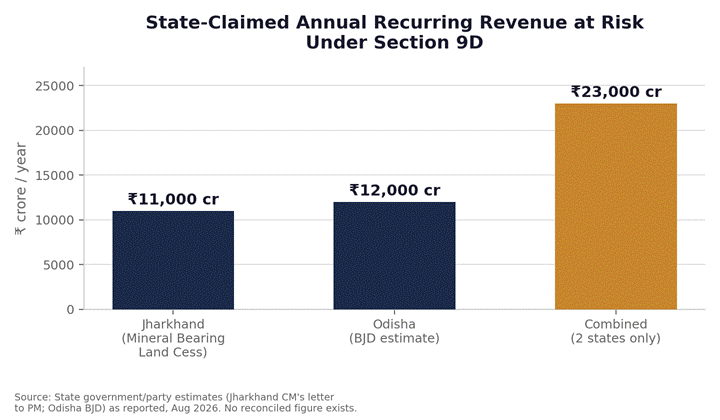
Fig. 1 — State-claimed annual recurring revenue exposure under Section 9D.
The Centre's response is a different set of numbers: the Ministry of Mines states that mining states already keep around 90% of total mining taxes and payments, and that this will not change, citing over ₹5 lakh crore collected by major mining states against roughly ₹82,000 crore for the Centre between FY16 and FY26, plus ₹96,000 crore in auction premiums between FY21 and FY26.
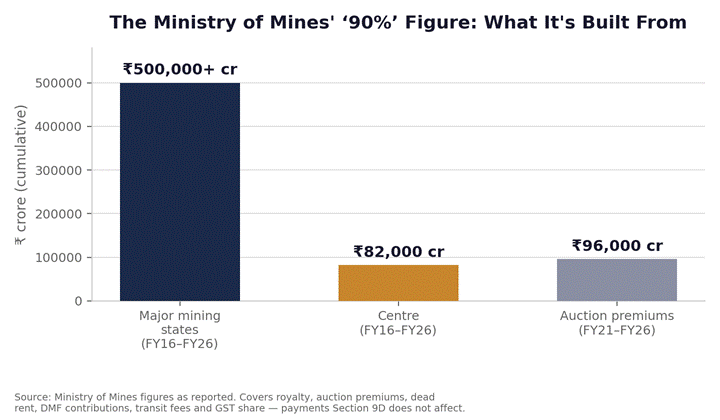
Fig. 2 — Cumulative collection figures underlying the Ministry's ‘90% of mining revenue’ claim.
Both figures are independently verifiable and both are true simultaneously, because they are measuring different things: the Ministry's 90% figure is built from roughly fourteen statutory payments — royalty, auction premiums, dead rent, DMF contributions, transit fees, and the states' GST share — that Section 9D does not touch, while the revenue category Section 9D actually extinguishes is the one payment stream states design and price under their own constitutional power, which appears nowhere in that calculation. No side has published a single reconciled number for what the Act's net fiscal effect on mineral-producing states will be.
Odisha's opposition leader Naveen Patnaik has called the Bill “a heavy blow to federalism and state revenue autonomy,” and Chhattisgarh, Rajasthan, and Andhra Pradesh carry comparable exposure given their reliance on mineral levies. Left parties in Jharkhand have announced a week-long statewide agitation from August 25 to 31, 2026.
The Open Constitutional Question
This is the section the Act's defenders and critics agree matters most, and it has not been resolved by any court. In July 2024, the Supreme Court held that royalty under the MMDR Act is not a tax but a contractual payment; that state legislatures have the power to tax mineral rights, though Parliament can limit that power by law under Entry 50 of the State List; and that states' power to tax land under Entry 49 extends to mineral-bearing land — a power the Court held Parliament cannot limit through a mineral-development law.
Issue | Core question |
Legislative competence over “mineral-bearing land” | Land is a state subject (Entry 18); the 2024 ruling placed mineral-bearing land within states' Entry 49 taxing power, which Parliament's Entry 54 mining authority was held not to limit. |
Retrospective invalidation of state dues | The SC's 2024 order allowed phased demands from April 2005; Parliament can alter a judgment's legal basis, but not simply legislate a ruling out of effect (per SC, 1993). |
Unequal treatment (Article 14) | Firms that paid dues get no refund; firms that delayed owe nothing — a distinction turning solely on payment timing. |
Excessive delegation | Section 13 delegates the substance of state-taxation limits to Central rules, with no guiding principle set in the Act itself. |
Source: PRS Legislative Research, bill note on the MMDR Amendment Bill, 2026.
Independent legal opinion, cited in reporting, splits on how serious a problem this is. Akash Lamba of SKV Law Offices has argued that redefining land as “mineral-bearing” by prescribed parameters does not create a Union power the Constitution never granted Parliament, while lawyers at Cyril Amarchand Mangaldas have gone further, arguing that capping states' Entry 49 powers is not achievable through an ordinary Act at all and would require amending the Seventh Schedule itself under Article 368, with state ratification. Khaitan & Co's Shivanshu Thapliyal has added that voiding dues Parliament itself once recognised as valid may exceed a limit even a constitutional amendment could lawfully cross. Against this, the Centre's defenders point to a genuine, pre-existing legal doctrine — the Supreme Court's 1955 ruling in State of Rajasthan v. G. Chawla, that a legislature's power over a subject carries with it power over matters ancillary to it — as grounds to argue mineral-bearing land is not a distinct subject but part of the same regulatory field as the minerals within it.
Opposition-ruled states under the INDIA bloc have stated their intent to challenge the Act in the Supreme Court, and Kerala's Chief Minister has said the state's formal objection will be conveyed to the Centre with legal action to follow. Jharkhand has separately written to the President requesting a GST Council-style consultation mechanism for future rule-making under the Act, while reserving its right to approach the Supreme Court.
What This Establishes — and What It Doesn't
The Act's mechanics are not in dispute: it centralises rule-making over state mineral levies, extends central jurisdiction to mineral-bearing land, and retrospectively voids uncollected state dues while leaving collected dues untouched. Nor is the predictability rationale unfounded on its own terms — a mining sector facing after-the-fact, non-uniform state levies across fourteen-odd charge categories is a documented feature of the pre-2026 regime, not a hypothetical one.
What the evidence does not establish is whether that predictability has been secured on stable legal ground. The Act answers a Supreme Court judgment that was decided eight-to-one by a nine-judge bench eighteen months earlier — the kind of majority that does not leave an obvious gap for an ordinary statute to legislate around unnoticed. Whether Parliament's Entry 54 mining-regulation power extends far enough to reach what the 2024 Court treated as a separate Entry 49 land-taxation power is, on the documentary record, a live and unresolved constitutional question rather than a settled one. Multiple opposition states have committed to litigating it. Until a court rules, the Act's core promise — a single, Centre-set, predictable fiscal regime for mining — and its central legal vulnerability are the same provision.
Source note: This analysis draws on PRS Legislative Research's bill note (based on the Act's text and the Supreme Court's July 2024 judgment in Mineral Area Development Authority v. Steel Authority of India), Lok Sabha/Rajya Sabha passage records, Ministry of Mines and Ministry of Coal auction data, and reporting on state and industry figures. Revenue-exposure figures are as stated by the respective state governments/parties and have not been independently reconciled against a government-published estimate; none exists in the Bill's Financial Memorandum. As of September 2026.