The Question
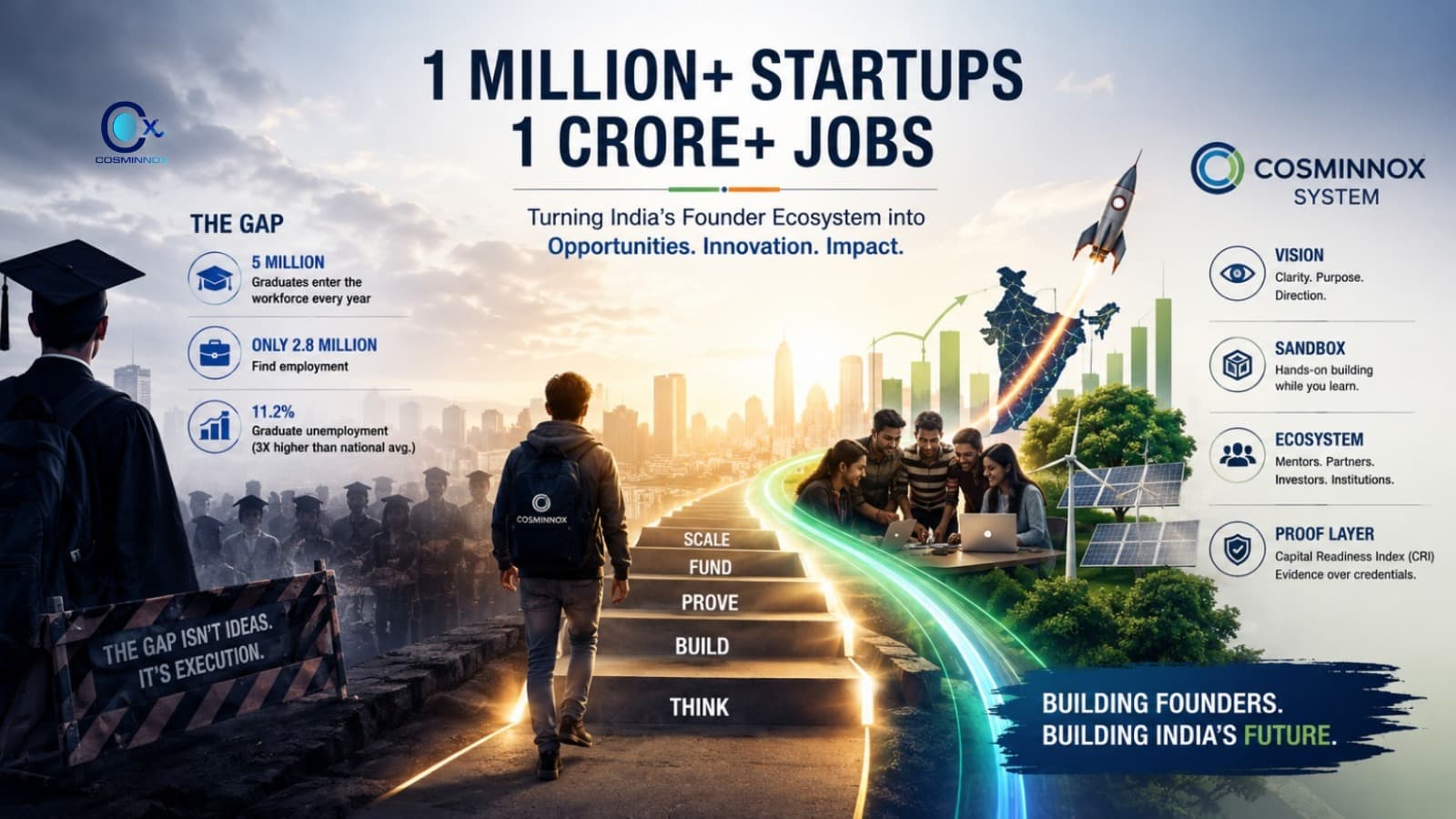
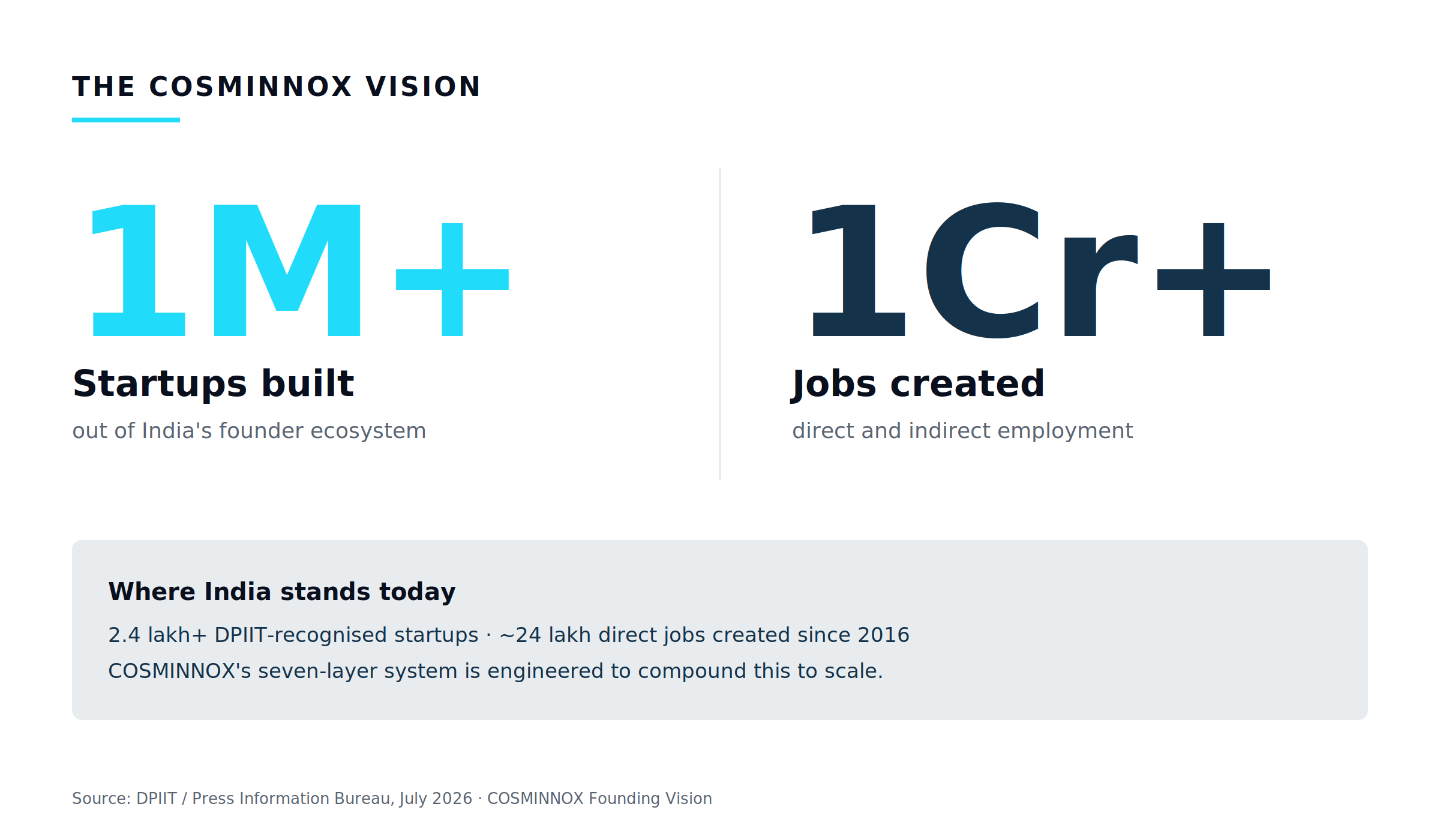
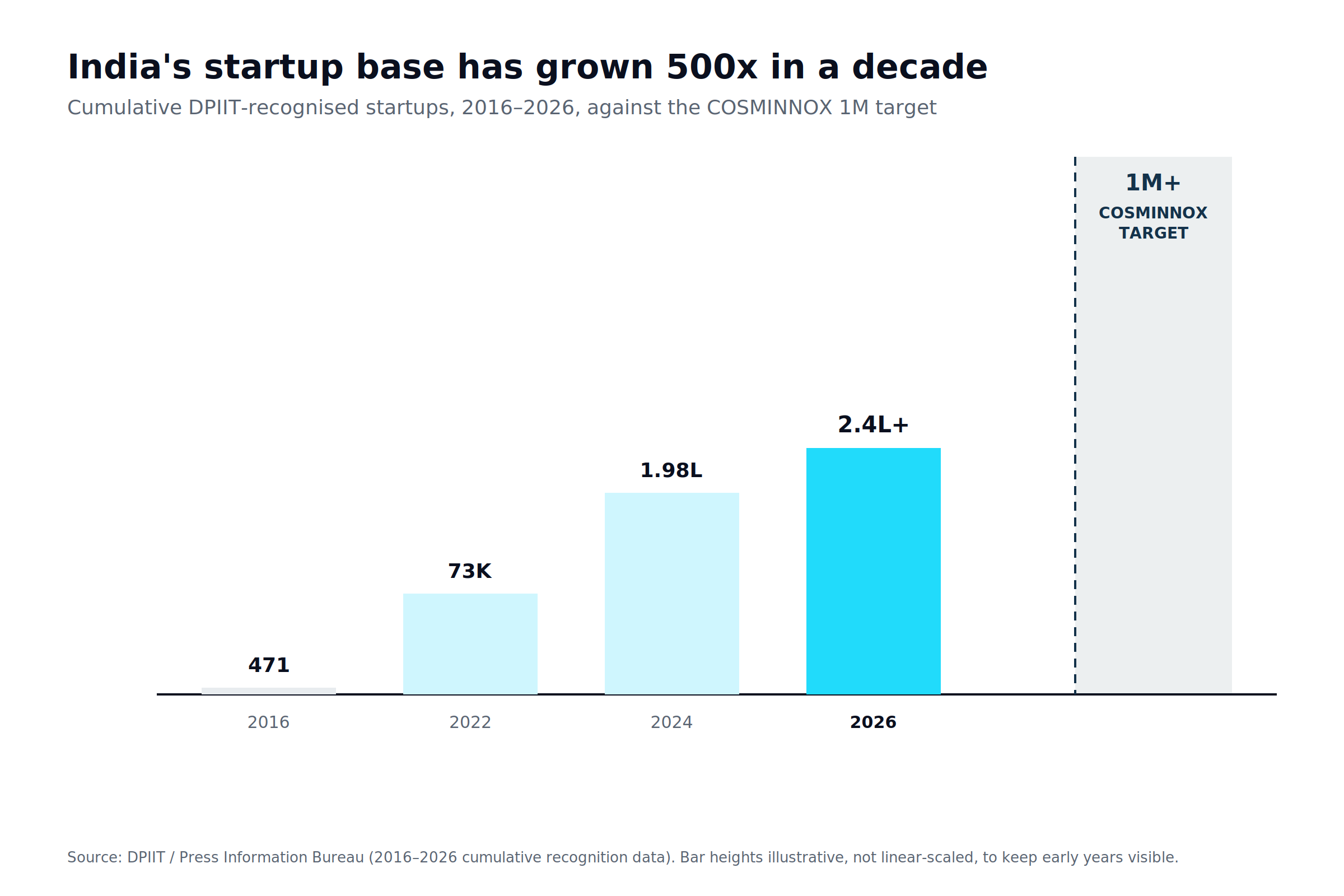
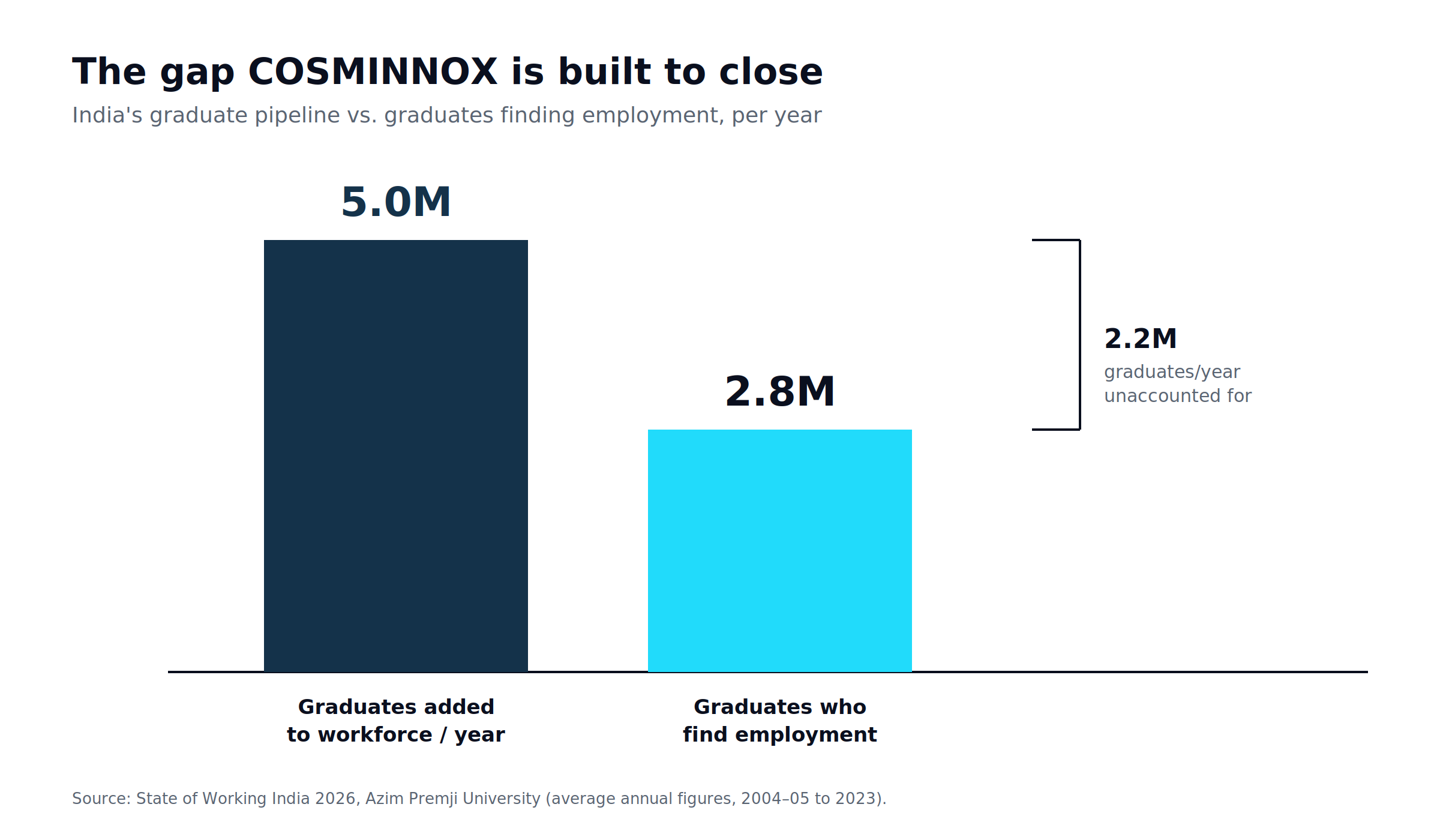
India adds roughly 5 million graduates to its workforce every year, but only about 2.8 million of them find any employment [State of Working India 2026, Azim Premji University]. Meanwhile, the Startup India initiative — ten years old as of January 2026 — has produced more than 2.4 lakh DPIIT-recognised startups and an estimated 24 lakh direct jobs since 2016 [DPIIT/PIB, July 2026]. That is real, measurable national progress. It is also, against COSMINNOX's own founding ambition, roughly a twentieth of the way there.
COSMINNOX's vision is stated in round numbers: 1 million-plus startups and 1 crore-plus jobs, direct and indirect, out of India's founder ecosystem. The analytical question worth asking is not whether that number is ambitious. It is what mechanism actually converts a graduate into a builder and a registered startup into a company that survives long enough to hire at scale — and why an operating system, rather than another isolated programme, is the structure that gets there.
This piece lays out the evidence for the gap COSMINNOX is built to close, and the mechanism engineered to close it.
The Gap, in Numbers
Three data points, read together, describe the scale of the opportunity.
First, the supply of graduates has outpaced the supply of jobs that match them. Between 2004–05 and 2023, India added roughly 5 million graduates a year to the workforce, of whom only about 2.8 million found employment of any kind. The share of degree-holders among India's unemployed 20–29 age group rose from 46% in 2017 to 67% in 2023, and less than half of all graduates were employed in any capacity, with only a small fraction holding permanent salaried positions [State of Working India 2026, Azim Premji University].
Second, this is specifically an educated-workforce gap, not a general jobs shortage. India's overall unemployment rate sits at 3.1% [PLFS Annual Report 2025, MoSPI], while graduate unemployment runs more than three times higher, at 11.2% [Forbes India, citing PLFS 2025]. Employability data tells the same story from a different angle: India Skills Report 2026 puts overall graduate employability at 56.35%, up from 46.2% in 2022 [India Skills Report 2026, ETS/CII/AICTE/AIU/Taggd] — meaning more than four in ten graduates are still not considered job-ready on the industry's own measure. A separate index (Mercer-Mettl's India Graduate Skill Index) points to non-technical skill gaps, not technical ones, as the primary driver.
Third, India's startup infrastructure has already proven it can scale fast. DPIIT recognised over 55,200 new startups in FY 2025–26 alone — the largest single-year figure since the programme launched a decade ago [SiliconIndia, June 2026] — taking the cumulative total past 2.4 lakh. Startup formation is not the constraint. What the national numbers show is a job-creation ratio that has not scaled at the same pace as registration — which is precisely the layer COSMINNOX is designed to sit on top of.
Put together: India is not short of graduates, and it is not short of registered startups. What multiplies the two into real employment is a system that reliably turns a graduate into a builder and a registered company into one that survives, executes, and hires. That is the specific layer COSMINNOX exists to build.
The COSMINNOX Mechanism
COSMINNOX treats the founder journey as infrastructure, not as an event. Its four-module structure — VISION, SANDBOX, ECOSYSTEM, and the Proof Layer — moves a founder through a continuous, staged pipeline (THINK → BUILD → PROVE → FUND → SCALE), rather than leaving execution to a single workshop, hackathon, or one-off incubation cohort. Three design principles anchor the system:
Execution over ideation. Inside the SANDBOX layer, students work on real startup problems while still enrolled, rather than encountering entrepreneurship for the first time after graduation. This is a direct response to the data: since the primary employability shortfall in India is execution and non-technical readiness rather than credentials, earlier and repeated exposure to real building is the more direct fix.
Evidence over credentials. The Capital Readiness Index (CRI) scores every founder from 0–100 across validation, execution, and traction — a milestone-gated, evidence-backed measure that replaces vanity signals like pitch-deck polish or follower counts with proof an investor or partner can actually verify. As a founder's CRI score rises, so does their visibility and readiness inside the ecosystem.
A connected system over disconnected relationships. India's founder-support landscape — university incubation cells, CSR-funded programmes, government schemes, angel networks — already exists, but it is fragmented, and founders spend as much energy finding the right door as they do building. COSMINNOX's Industry Relations and Investor Relations layers put a founder's CRI score, university cohort record, and market traction inside one system that partners, mentors, and capital allocators can read directly — collapsing the search cost that currently sits between a strong founder and the resources already available to them.
This is what distinguishes COSMINNOX from a single accelerator cohort or a university placement cell: it is not one intervention, but a seven-layer operating system — Execution Intelligence, Credential & Trust, Service Infrastructure, Tokenized Incentives, Founder Health Stack, Industry Relations, and Investor Relations — built to compound. A founder's proof of execution in SANDBOX becomes their credential in the Trust layer, which becomes their access in Industry and Investor Relations. Each layer makes the next one work harder.
Built to Compound at Scale
The arithmetic behind 1 million startups and 1 crore jobs is not a hope — it is a scaling logic. India already produces over 55,000 new startups a year and 5 million new graduates a year; the constraint has never been raw volume. It has been a system that reliably converts that volume into surviving, hiring companies. COSMINNOX's seven-layer structure is built precisely to close that conversion gap: every additional partner campus multiplies the SANDBOX pipeline, every additional CRI-scored founder strengthens the Proof Layer's credibility, and every additional Industry and Investor Relations connection compounds the ecosystem's pull for the next cohort.
This is the same structural bet every large-scale Indian public infrastructure programme has made — that a standardised, milestone-gated system scales faster and more reliably than a patchwork of one-off interventions. COSMINNOX applies that logic to founder-building. The GRASA Millets & Foods proof of concept, already operating inside the Founder Health Stack layer, is the first live demonstration that the system produces real, functioning companies — not just cohort participants.
The Bounded Claim
The evidence is unambiguous on the scale of the opportunity: India produces graduates and registered startups faster than it currently converts either into stable, hiring companies, and the shortfall is concentrated specifically in execution readiness. COSMINNOX's seven-layer operating system — Execution Intelligence through Investor Relations, run on the THINK → BUILD → PROVE → FUND → SCALE pipeline and measured by the Capital Readiness Index — is built directly against that gap, at the scale the gap demands.
1 million startups and 1 crore jobs is the target the system is engineered to reach. Every layer, every cohort, and every CRI score added to the platform is a compounding step toward it.
The Numbers at a Glance
Sources: Department for Promotion of Industry and Internal Trade (DPIIT), Press Information Bureau; Periodic Labour Force Survey (PLFS) Annual Report 2025, Ministry of Statistics and Programme Implementation; State of Working India 2026, Azim Premji University; India Skills Report 2026 (ETS/CII/AICTE/AIU/Taggd); Mercer-Mettl India Graduate Skill Index 2025. All figures as of the dates cited; DPIIT and PLFS figures are subject to periodic revision by the respective agencies.