The fund and its panel
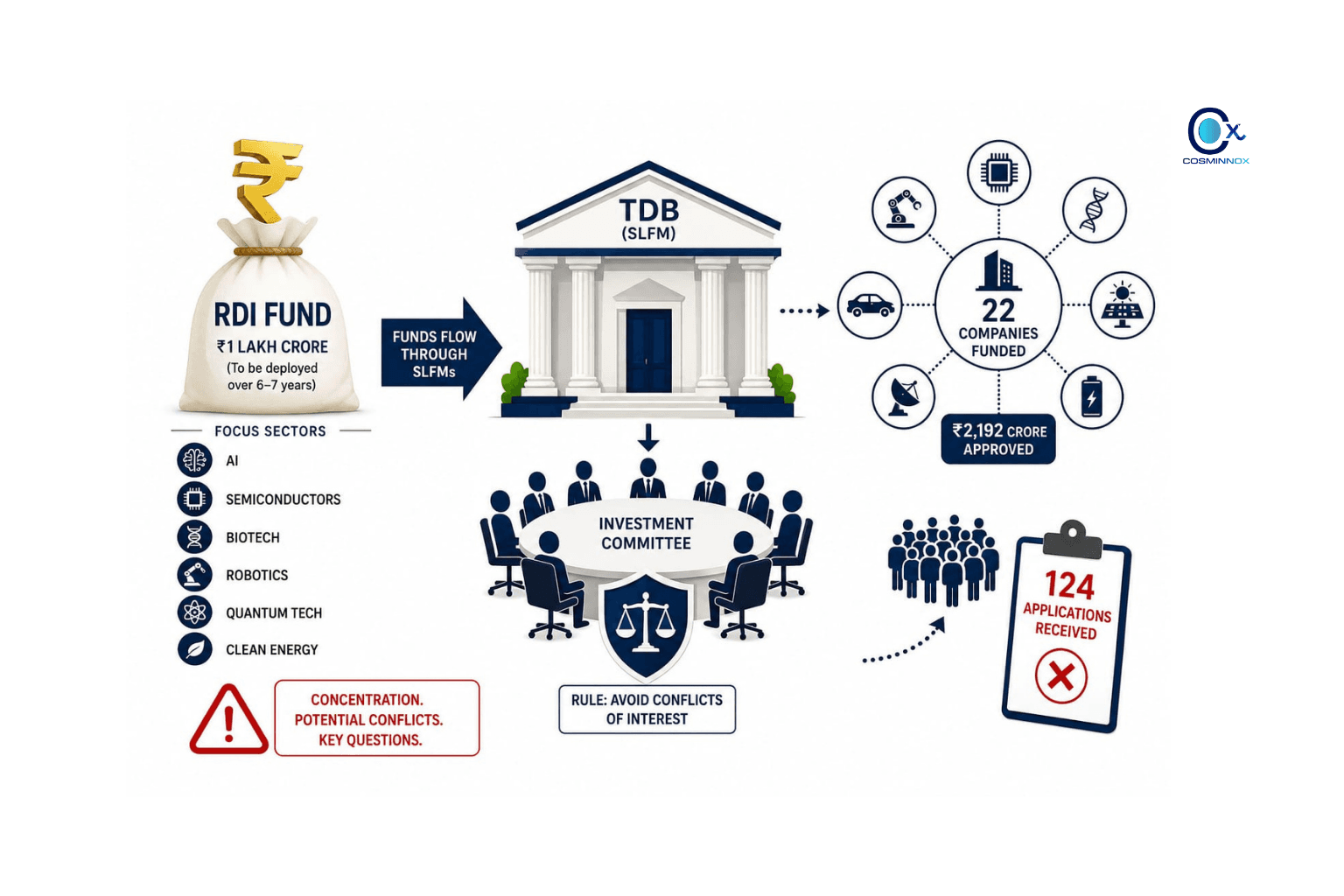
The Research, Development and Innovation (RDI) Fund was approved by the Union Cabinet in July 2025 and launched by Prime Minister Narendra Modi in November 2025 at Bharat Mandapam, New Delhi, as a ₹1-lakh-crore corpus meant to be deployed over six to seven years to advance private-sector R&D in sectors the market underfunds — artificial intelligence, semiconductors, quantum technology, biotechnology, robotics, and clean energy [The Tribune, Aug. 2026; The Wire, Jul. 31, 2026].
Under the fund's structure, money is routed through “Second-Level Fund Managers” (SLFMs) — statutory or public institutions such as the Technology Development Board (TDB), a body the government constituted in 1996 under the Technology Development Board Act, 1995. Each SLFM runs its own Investment Committee (IC), which vets and recommends specific projects; the SLFM's board then formally approves the disbursement. By RDI Fund rules, government officials cannot sit on an IC as voting members. The TDB's IC comprises 11 private-sector members, plus a TDB official serving as a non-voting Member Secretary — reported elsewhere as a “12-member” committee when the secretary is counted [RDI Fund FAQ, rdifund.anrf.gov.in; The Wire, Jul. 31, 2026; Inventiva, Aug. 8, 2026].
On what basis IC members are chosen: the RDI Fund's own guidelines state only that “the Investment Committee must be constituted in a way that avoids potential conflicts of interest,” and that the fund's oversight bodies — the RDIF Management Team, the Executive Council of the Anusandhan National Research Foundation (ANRF), and an Empowered Group of Secretaries — assess the “quality” of an SLFM's Investment Committee only as one input into evaluating the fund manager's overall competence, not by vetting individual members directly. Beyond that, the fund's rules explicitly decline to prescribe committee composition, leaving each SLFM — TDB in this case — to select its own panel [RDI Fund FAQ, rdifund.anrf.gov.in].
Table 1. The seven named committee members
Name | Primary role / background | Company reported as RDI-linked |
Saurabh Srivastava (Chairman) | Entrepreneur and investment professional; former chairman, NASSCOM; co-founder, Indian Angel Network; Padma Shri (2016) | Nine companies overall; personal equity stake of 0.75% in Noccarc Robotics, which received ₹11.41 crore in approved funding |
K.R.S. Jamwal | Executive Director, Tata Industries Ltd; oversees Tata Industries' incubation of and investment in new ventures | Not individually itemised in available reporting |
Gopal Srinivasan | Chairman, TVS Capital Funds | Agnikul Cosmos Pvt. Ltd. (space technology) — ₹200 crore approved |
Sudhir Mehta | Chairman, Pinnacle Industries (auto components) | Not individually itemised in available reporting |
Sanjay Nayak | Senior executive, Tejas Networks Ltd (Tata Group networking-equipment company) | Tejas Networks Ltd — ₹250 crore approved |
Anand Deshpande | Founder-Chairman, Persistent Systems (IT services) | Serigen Mediproducts Pvt. Ltd. (healthcare) |
Debashish Bhattacharjee | Former Vice President, Technology and R&D, Tata Steel | Neo Seekermetals Pvt. Ltd. (battery manufacturing) |
Source: The Wire, “Conflict of Interest Seen In Year-old Fund Set Up to Encourage Innovation: Parliament Reply,” Jul. 31, 2026 (based on a written Rajya Sabha reply from the Department of Science and Technology); TDB, “Board Members,” tdb.gov.in; Inventiva, “Public Money, Private Networks,” Aug. 8, 2026 (disbursement amounts and the Noccarc Robotics stake, drawn from the Indian Express investigation and Registrar of Companies filings); company biography pages for individual roles.
Each of the seven is a recognised figure in India's technology, industry, or investment ecosystem — which is broadly consistent with the fund's stated intent to staff ICs with sector expertise rather than bureaucrats. Whether that expertise-first design was, in this instance, adequately paired with independence safeguards is precisely what is contested (see below).
The numbers
In its first disbursement round, the TDB approved ₹2,192 crore in loans to 22 companies, out of 124 applications received [Inventiva, Aug. 8, 2026]. According to an August 7, 2026 investigation by The Indian Express, independently corroborated the following day by a separate Inventiva analysis drawing on the same investigation and on Registrar of Companies filings, 15 of those 22 companies, representing roughly ₹1,377 crore (about 62% of the round's value), have investment ties to seven of the IC's eleven members. Nine of the funded companies are linked to IC chairman Saurabh Srivastava; in one — Noccarc Robotics — he holds a direct 0.75% personal equity stake, against ₹11.41 crore in funding approved for that company [The Indian Express, Aug. 7, 2026; Inventiva, Aug. 8, 2026].
Table 2. Round 1 vs. Round 2 disbursements
Metric | Round 1 | Round 2 |
Companies approved | 22 | 13 |
Total disbursed | ₹2,192 crore | Not specified in available reporting |
Companies with IC-member investment ties | 15 | 1 |
Share of companies with ties | ~68% (15 of 22) | ~8% (1 of 13) |
Value tied to IC-linked companies | ₹1,377 crore (~62% of round value) | Not specified in available reporting |
Source: The Indian Express, Aug. 7, 2026; Inventiva, Aug. 8, 2026; government statements on Round 2 as reported in subsequent coverage.
Table 3. Committee-tie details (Round 1)
Detail | Figure |
IC members with investment ties to funded companies | 7 of 11 |
Companies linked to IC chairman (Saurabh Srivastava) | 9 |
Companies in which the chairman holds personal equity | 1 (Noccarc Robotics; 0.75% stake) |
Per-member breakdown of the remaining 6 linked companies | Not disclosed in available reporting |
Source: The Indian Express, Aug. 7, 2026; Inventiva, Aug. 8, 2026.
Table 4. Selected Round 1 companies with reported committee-member ties
Company | Reported disbursement | Linked committee member |
Tejas Networks Ltd | ₹250 crore | Sanjay Nayak (see Table 1) |
Ather Energy | ₹211.89 crore | Not individually attributed in available reporting |
Agnikul Cosmos Pvt. Ltd. | ₹200 crore | Gopal Srinivasan (see Table 1) |
Manastu Space | ₹116 crore | Not individually attributed in available reporting |
Dhruva Space | ₹105 crore | Not individually attributed in available reporting |
Noccarc Robotics | ₹11.41 crore | Saurabh Srivastava (personal 0.75% equity stake) |
Source: Inventiva, Aug. 8, 2026, drawing on the Indian Express investigation and Registrar of Companies filings. These six are the companies individually named in available secondary reporting; the remaining companies among the 15 linked firms are not individually identified in sourcing accessible to us at the time of writing.
Mission fit: does the capital reach market-underfunded technology?
The committee-conflict story is about who chose the winners. A separate, largely unasked question is whether the winners fit what the fund was built to do: back research “the market alone will not adequately fund” [RDI Fund FAQ, rdifund.anrf.gov.in]. The available reporting on committee ties does not resolve this on its own — a company can be free of any panel-member conflict and still be well short of a market-underfunded frontier bet, or vice versa.
The fund's own eligibility design bears on the question. TDB support is available only for projects at Technology Readiness Level (TRL) 4 or above, and is capped at 50% of a project's assessed cost — the remainder must be mobilised by the applicant from other, typically private, sources [TDB, “RDIF – TDB as Second Level Fund Manager,” tdb.gov.in]. Round 1's numbers are consistent with that cap: ₹2,192 crore in RDIF support against ₹4,744 crore in total project cost, or roughly 46% [Medical Buyer, Aug. 2026]. By this design, an applicant with no private-sector backing at all is structurally unlikely to qualify — which is close to the government's own defence of the companies' investor histories (see below).
Table 5. Funding and market-access status of identified Round 1 recipients
Company | RDIF disbursement | Funding / market-access status at time of approval |
ideaForge Technology Ltd | ₹151 crore | Listed on NSE/BSE since Jul. 2023; ~50% share of India's UAS market; public-market equity access |
Ather Energy Ltd | ₹211.89 crore | Listed on NSE/BSE since May 2025 (₹2,981 crore IPO); 40% held by Hero MotoCorp, with GIC and NIIF also shareholders |
Tejas Networks Ltd | ₹250 crore | Listed on NSE/BSE; Tata Group networking-equipment company (see Table 1) |
The ePlane Company | ₹285 crore | Unlisted; VC-backed (Series B, 2024); pre-certification eVTOL developer with no commercial revenue from its core aircraft |
GalaxEye | Not specified in available reporting | Unlisted; early-stage VC-backed (Series A, extended 2026); pre-revenue satellite manufacturer |
Agnikul Cosmos Pvt. Ltd. | ₹200 crore | Unlisted; privately VC/family-office funded (~$500M valuation, Nov. 2025); no commercial launches to date |
Source: Business Standard, “TDB-RDI selects 22 deeptech startups,” Jul. 2026 (disbursement figures for the five largest beneficiaries); NSE/BSE listing records and IPO reporting (ideaForge, Ather Energy, Tejas Networks); Business Standard and BusinessToday funding coverage (Agnikul Cosmos, Nov. 2025); Inc42 and BW Disrupt (The ePlane Company, GalaxEye). Funding/market-access status for the remaining 16 of the 22 Round 1 companies is not independently verified in this pass and is not asserted here.
On the numbers available, at least ₹612.89 crore of the ₹2,192 crore round — roughly 28% — went to three companies that already had either public stock-market listings or a listed corporate parent with a large equity stake at the time of approval: ideaForge and Ather Energy are themselves listed on the NSE and BSE, and Tejas Networks is a Tata Group listed entity. Against that, at least three other named recipients — the ePlane Company, GalaxEye, and Agnikul Cosmos — are unlisted, privately funded businesses with no commercial revenue yet from their core hardware, closer to the profile of the market-underfunded frontier research the fund describes itself as targeting, notwithstanding Agnikul's roughly $500 million private valuation.
The government's position, offered in response to the broader conflict-of-interest coverage, addresses this indirectly: officials have said that RDI Fund support is attached to specific research and technology-development projects, not to companies as entities, that TDB releases assistance only after a beneficiary brings in matching investment from other non-government sources, and that investments made before a proposal's submission do not influence the funding decision [The Tribune, Aug. 2026]. On this framing, a company being listed or well-capitalised elsewhere on its balance sheet does not by itself disqualify a specific R&D unit within it from needing patient, concessional project capital that ordinary lenders won't extend against early-TRL risk.
What the available numbers do and don't show: they don't establish misallocation — a listed company can still run a genuinely underfunded high-risk research programme, and the fund is explicit that it finances projects rather than balance sheets. But they do show that Round 1's portfolio, at minimum, was not confined to companies without market access to capital; a meaningful share of the money reached firms that could, in principle, have financed a comparable project through commercial channels — including Tejas Networks, one of the three listed companies in Table 5 and also one of the fifteen individually linked to a committee member's disclosed interest (Sanjay Nayak; see Table 1). Whether that reflects the fund correctly underwriting hard technical risk inside capable firms, or concessional capital being diluted toward recipients least in need of it, isn't settled by anything TDB has published: no project-level TRL-risk assessment or cost-benefit rationale for individual approvals is in the public domain. That is a second, separate open question from the conflict-of-interest one this piece opened with — and, like that one, one the fund's own disclosure practice going forward is best placed to resolve.
What the committee and the government have said
The Department of Science and Technology confirmed the underlying figures in a written Rajya Sabha reply to MP Praveen Chakravarty on July 30, 2026, stating plainly that “the Technology Development Board (TDB) has a conflict-of-interest policy for members of the Investment Committee,” without elaborating further in that reply [The Wire, Jul. 31, 2026].
The following day, the Ministry of Science and Technology went further, issuing a formal statement that described contemporary media coverage of the disclosure as “misleading, incorrect, and lack proper context” [Ministry of Science and Technology statement, Jul. 31, 2026, carried by IANS and reported in The Hans India and other outlets]. The ministry said TDB's conflict-of-interest policy had been followed consistently with no prior complaint, grievance, or irregularity on record. It said that, prior to the IC's first meeting, TDB had framed detailed Pre-Investment Guidelines and Standard Operating Procedures setting out the conditions under which a conflict arises and mandating full disclosure and complete recusal of a conflicted member from discussions and decisions involving that entity. The ministry additionally pointed out that 15 of the 22 Round 1 projects had separately been vetted by expert panels convened by the Ministry of Education before representing India at the Bharat Innovate event in Nice, France, and cited that as independent validation that the selected companies were chosen on technical merit.
TDB Secretary Rajesh Pathak, responding around the time the Indian Express story broke, described conflict of interest as “unavoidable” in expert panels of this kind and said it is managed through disclosure and recusal rather than eliminated [Inventiva, Aug. 8, 2026].
The government has also pointed to Round 2 as a counter-data point — of 13 companies approved, only one had a link to a committee member — framing Round 1's concentration as a function of networked firms applying earlier, not preferential treatment [Inventiva, Aug. 8, 2026]. Committee chairman Saurabh Srivastava has said, in comments reported alongside the government's response, that conflicts of this kind are an expected feature of panels staffed by active industry figures and that recusals are recorded when they occur. Other committee members have, per available reporting, uniformly maintained that they followed the disclosure and recusal rules; no member has, on the public record, disputed the underlying figures on their own portfolio's overlap with funded companies.
Counter-evidence: what the reporting does not establish
A rebuttal published on OpIndia argues the Indian Express investigation, while documenting the overlap between committee members' portfolios and funded companies, does not present evidence that a conflicted member actually participated in evaluating or voting on the proposal from a company they were invested in — the recusal question at the center of the government's defence [OpIndia, Aug. 2026]. On the available public record, no minutes, voting records, or recusal logs from IC deliberations have been published by either side to confirm or refute this. The dispute, as it stands, is over what the disclosed portfolio-overlap data can support — pattern versus proof of influence — not over the underlying figures themselves, which both the government and its critics accept.
Table 6. Where the two sides agree and disagree
Point | Government / TDB position | Critics' / counter-evidence position |
Portfolio overlap figures (15/22 companies, 7/11 members) | Not disputed | Not disputed |
Whether conflicted members evaluated their own linked proposals | Say “zero involvement”; managed via disclosure and recusal | Say this is asserted, not documented — no public recusal log |
Characterisation of the media coverage | Called “misleading, incorrect, and lack proper context” | Dispute the characterisation, not the numbers — say the rebuttal addresses process, not the substance of the overlap |
Explanation for Round 1 concentration | Early-mover advantage among networked, well-informed applicants | Structural risk in a committee design with no independent government vote |
Whether listed/well-capitalised recipients fit the fund's underfunded-technology mandate | Fund supports specific projects, not company balance sheets; matching investment still required | Not directly addressed by critics in available reporting; raised independently in this piece (see “Mission fit” above) |
Whether public minutes/voting records exist to settle the question | Not published | Not published |
Source: Ministry of Science and Technology statement, Jul. 31, 2026 (via IANS); The Wire, Jul. 31, 2026; Inventiva, Aug. 8, 2026; The Tribune, Aug. 2026; OpIndia rebuttal as reported, Aug. 2026.
What the evidence does and doesn't establish
The documented facts are not contested: a majority of Round 1's committee members hold investment ties to a majority of Round 1's funded companies, concentrated heavily around the committee's own chairman. The committee itself is composed of seven publicly identifiable figures in Indian technology, industry, and finance, selected under a framework that requires only that the panel be “constituted to avoid conflicts of interest” — with the specific criteria and nomination process for each member not disclosed in available reporting. What remains unestablished, on current public evidence, is whether the investment ties translated into actual influence over specific funding decisions — a question that depends on records (attendance, recusal, voting) that have not been made public. Round 2's more distributed pattern is a genuine data point but a single one, insufficient by itself to settle whether Round 1 reflected structural risk in the committee's design or a one-time timing effect. Given the fund's scale — a corpus intended to scale several-fold through leveraged co-investment [The Ken, Jun. 2026] — how the TDB documents and discloses recusal in future rounds is likely to be the evidence that actually resolves this question, one way or the other.
As of August 10, 2026. The core disbursement figures in this piece (15/22 companies, ₹1,377 crore, the chairman's nine linked companies) originate in the Indian Express investigation of Aug. 7, 2026, whose full text remains paywalled and inaccessible to us at the time of writing. Those figures are independently corroborated here through Inventiva's Aug. 8, 2026 analysis, which drew separately on the same investigation, on Registrar of Companies filings, and on company websites, and are consistent with the government's own written Rajya Sabha reply of Jul. 30, 2026, which does not dispute the portfolio-overlap numbers. The funding and market-access figures in the “Mission fit” section are drawn from company-specific IPO, exchange-listing, and funding-round reporting cited at each table and cover 6 of the 22 Round 1 recipients; the remaining 16 are not independently verified here. Any revision to these figures will be noted here with a dated correction.