01 THE QUESTION
Does India's current account deficit nearly doubling in dollar terms — from $3.4 billion to $4.2 billion — signal a genuine deterioration in the external accounts, or is it a modest, largely commodity-driven blip inside a still-comfortable range? The RBI's own data supports the second reading more than the first: the CAD stayed under 1% of GDP even as its internal composition shifted in ways worth tracking closely, particularly on the capital-account side.
02 THE NUMBER THAT MOVED
India's current-account deficit widened to $4.2 billion, or 0.5% of GDP, in Q1FY27 (April–June 2026), from a revised $3.4 billion, or 0.4% of GDP, in Q1FY26, per Reserve Bank of India data released September 1, 2026. The widening was driven by a higher merchandise trade deficit, which rose to $86.1 billion from $68.9 billion a year earlier. That was partly offset by stronger net services receipts — up to an estimated $51.6 billion from $47.9 billion, led by computer services, business services and transportation.
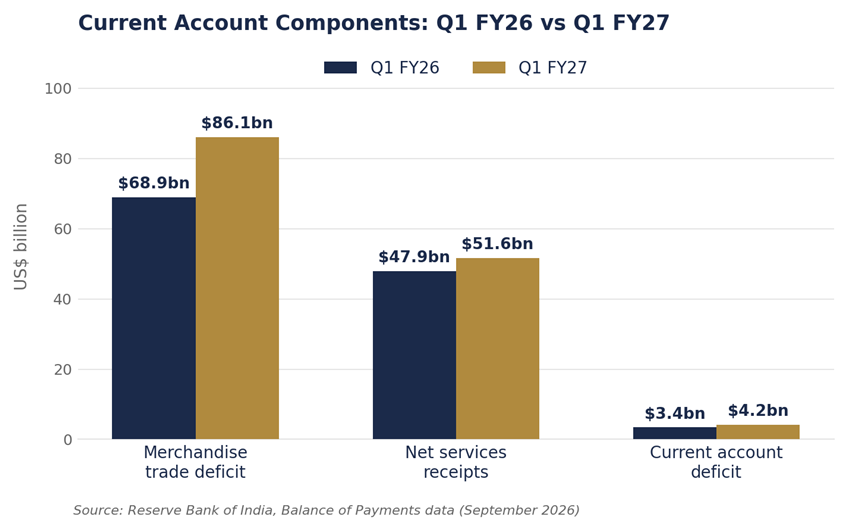
Current account snapshot: Q1 FY26 vs Q1 FY27
Metric | Q1 FY26 | Q1 FY27 | Change |
Current account deficit | $3.4bn (0.4% GDP) | $4.2bn (0.5% GDP) | Widened |
Merchandise trade deficit | $68.9bn | $86.1bn | Widened |
Net services receipts | $47.9bn | $51.6bn | Improved |
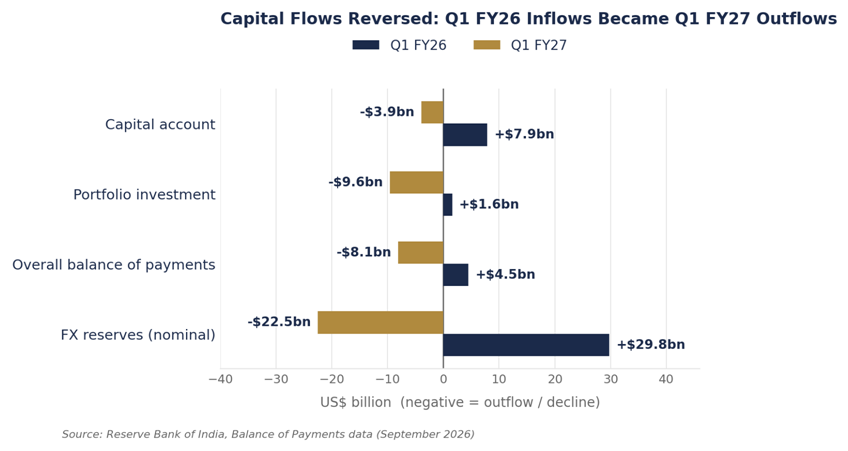
Capital account | +$7.9bn | −$3.9bn | Reversed |
Portfolio investment | +$1.6bn | −$9.6bn | Reversed |
FDI (net) | $5.2bn | $6.1bn | Improved |
External commercial borrowing | $5.5bn | $1.0bn | Declined |
Overall balance of payments | +$4.5bn | −$8.1bn | Reversed |
FX reserves (nominal change) | +$29.8bn | −$22.5bn | Reversed |
03 BLAME THE BARREL, NOT THE BALANCE SHEET
ICRA chief economist Aditi Nayar attributed the CAD widening to a surge in commodity prices, noting it was still contained at 0.5% of GDP "in spite of the ongoing challenges posed by the crisis in West Asia" — a reference to the regional conflict pushing up oil and commodity costs during the quarter. Despite that pressure, India's GDP growth accelerated to 7.8% in Q1FY27, suggesting the trade-deficit widening has not yet visibly dented headline growth.
04 FOLLOW THE MONEY LEAVING THE ROOM
The current account gap itself remained modest by historical standards. What changed more sharply was the capital account, which swung from a $7.9 billion inflow to a $3.9 billion outflow — driven almost entirely by portfolio investment, which reversed from a $1.6 billion inflow to a $9.6 billion outflow. FDI and banking capital inflows partly cushioned this, but were not enough to offset it. Because the capital-account outflow exceeded the current account deficit, the overall balance of payments swung to an $8.1 billion deficit from a $4.5 billion surplus, and foreign exchange reserves fell by $22.5 billion in nominal terms, alongside a $14.4 billion valuation loss tied to gold prices and dollar appreciation.
05 ZOOM OUT: STILL COMFORTABLE TERRITORY
A CAD of 0.5% of GDP remains well inside the range the RBI and most economists treat as sustainable — historically, CADs above 2–2.5% of GDP have drawn concern, and India's own FY18 Q1 figure once hit 2.4%. Nayar's ICRA outlook projects the full-year CAD widening further to around 0.9% of GDP in FY27, up from 0.7% in FY26 — a rise, but still within the comfortable band. FDI and services exports both improved year-on-year, and the trade-deficit widening tracks a global commodity-price shock rather than a structural loss of export competitiveness.
06 THE BOUNDED CLAIM
The data confirms a real, RBI-verified widening in both the trade deficit and the current account gap, driven substantially by external commodity-price pressure rather than domestic demand overheating. It does not establish an incipient balance-of-payments crisis: the CAD/GDP ratio remains low by historical standards, and FDI continued to strengthen. What the data does flag is a genuine shift in capital-flow composition — sustained portfolio outflows for a third consecutive quarter — that drove the reserve drawdown more than the current account itself did. Whether that portfolio exodus persists or reverses in Q2 and Q3 FY27 will determine whether this remains a commodity-driven blip or becomes a more durable external-financing concern.
As of September 3, 2026. Sources: Reserve Bank of India (Balance of Payments data), Business Standard (September 2026). Figures and quotes sourced from named outlets above; hyperlinks lead to the original reporting cited.